Benefits of an Integrated Design-Build Firm for Property Development
27 September 2026What if the greatest advantage of an integrated design-build firm isn’t simply faster delivery, but clearer accountability as decisions move from concept to construction? The benefits of an integrated design-build firm can include closer alignment between design intent and construction requirements, helping teams identify coordination issues before they lead to delays or rework.
It’s reasonable to question whether one firm should carry responsibility across multiple project stages. Separate appointments can give each party a distinct role, but they may also leave owners coordinating decisions across contracts and tracing responsibility when requirements change. Integration can streamline that coordination, though it doesn’t guarantee better outcomes or suit every development.
This article explains how integrated delivery can affect project decisions, accountability and coordination. It compares the model with separate design and construction appointments using consistent criteria, then offers practical questions to ask a prospective partner. These include how responsibilities are defined, how changes are managed and whether the model fits your project’s complexity and governance needs. The aim is to help you assess the delivery approach on its merits, not assume integration is automatically the right choice.
Key Takeaways
- Assess the benefits of an integrated design-build firm in context: project scope, contract structure, decision rights and partner capability all matter.
- Consider how coordination between design requirements, buildability input and construction planning can support better-informed decisions.
- Compare integrated delivery with separate appointments across accountability, coordination, oversight preferences and design independence.
- Use a focused assessment of project complexity, governance, scope and stakeholder priorities to judge which delivery model fits.
- Understand Federal Holdings’ role as an integrated design-and-build developer, with project scope described from architectural design through final construction.
What benefits can an integrated design-build firm deliver?
Integrated design-build is a project delivery structure in which one appointed entity coordinates design and construction responsibilities, rather than the owner appointing designers and builders separately under distinct contracts. This structure can connect decisions across project stages, but it doesn’t guarantee a particular cost, schedule or quality outcome. Its practical benefits depend on the project scope, contract terms, decision rights and the partner’s capability.
The main opportunity is to bring construction considerations into design discussions earlier. If a proposed layout affects structural requirements, material choices or construction sequencing, an integrated team can assess those connections while options are still under consideration. The owner may also have a clearer route for questions and decisions, provided the contract specifies who is responsible for each matter. A useful overview of the Design-build project delivery system explains how this structure differs from traditional design-bid-build.
These are potential advantages, not automatic results. An unclear scope or poorly defined authority can leave gaps even within an integrated appointment. The benefits of an integrated design-build firm are strongest when responsibilities, approval pathways and project priorities are aligned from the outset.
How does an integrated design-build firm work?
Design development and construction planning inform one another as a project progresses. The team can review design choices alongside buildability, sequencing and construction requirements, then incorporate relevant input into the developing plans. The precise division of work depends on the contract and project structure. An integrated developer coordinates delivery across design and construction. A designer-only or contractor-only appointment covers a narrower role and doesn’t, by itself, establish responsibility across both stages.
Which project challenges can integration address?
Integration can help address coordination gaps that emerge when design information passes between separately appointed parties. For example, construction input may flag that a design choice needs further coordination with installation planning before it is finalised. Raising the issue earlier gives the project team an opportunity to review options, although it doesn’t remove the need for owner decisions or technical review. Clear contractual responsibilities can also reduce ambiguity at handoffs by establishing who leads, contributes and approves each decision.
For a property owner, the value is a more connected decision process: design intent can be considered alongside construction needs, and accountability can be traced against agreed responsibilities. Whether that structure is preferable depends on the project’s governance and how much oversight or design independence the owner wants to retain.
How integration improves coordination from design through construction
Coordination works best when project requirements remain visible as plans develop and move toward construction. Teams can review design choices against buildability, material selection and sequencing, while construction planning can flag where information or decisions are needed. The Federal Highway Administration’s overview of design-build outlines how design-builder and owner responsibilities fit within this delivery method. On a property project, the practical value comes from connecting these discussions to agreed decision rights and a clear record of approvals.
Early coordination matters because requirements, design assumptions, construction methods and site constraints can affect one another. Reviewing those dependencies while options remain open gives the project team a basis for identifying conflicts and considering responses before decisions carry into later stages. It doesn’t remove uncertainty, but it can help owners understand relevant delivery implications when making decisions.
Why early construction input can strengthen design decisions
Sequencing, material choices and site constraints can shape whether a design is practical to deliver as planned. Hypothetical example: A proposed façade detail may require a particular installation sequence. If the construction team reviews it during design development, the team can compare workable approaches before the detail is finalised. This doesn’t guarantee a better outcome; it creates an earlier opportunity to surface competing requirements and document the owner’s preferred direction.
How one accountable structure supports project continuity
Agreed responsibilities can help preserve context as work moves between design development and construction planning. A decision log can record the issue, options considered, approver and resulting direction. An escalation route clarifies where unresolved questions go. These tools don’t replace the contract, but they help teams track how decisions were made. For further lifecycle context, see The Efficiency of the Integrated Design and Build Developer in 2026.
Change management needs the same discipline. Define who may propose, review and approve a change, how its implications are assessed, and where the approved direction is recorded before updated information is relied on. This clarifies ownership and helps relevant parties work from the same decision record, although the contract determines formal authority and procedures.
The benefits of an integrated design-build firm depend in part on how effectively the project turns coordination into documented decisions and controlled change. To understand how The Federal Group approaches integrated development, explore its design-and-build development work.
Integrated design-build versus separate appointments: what changes?
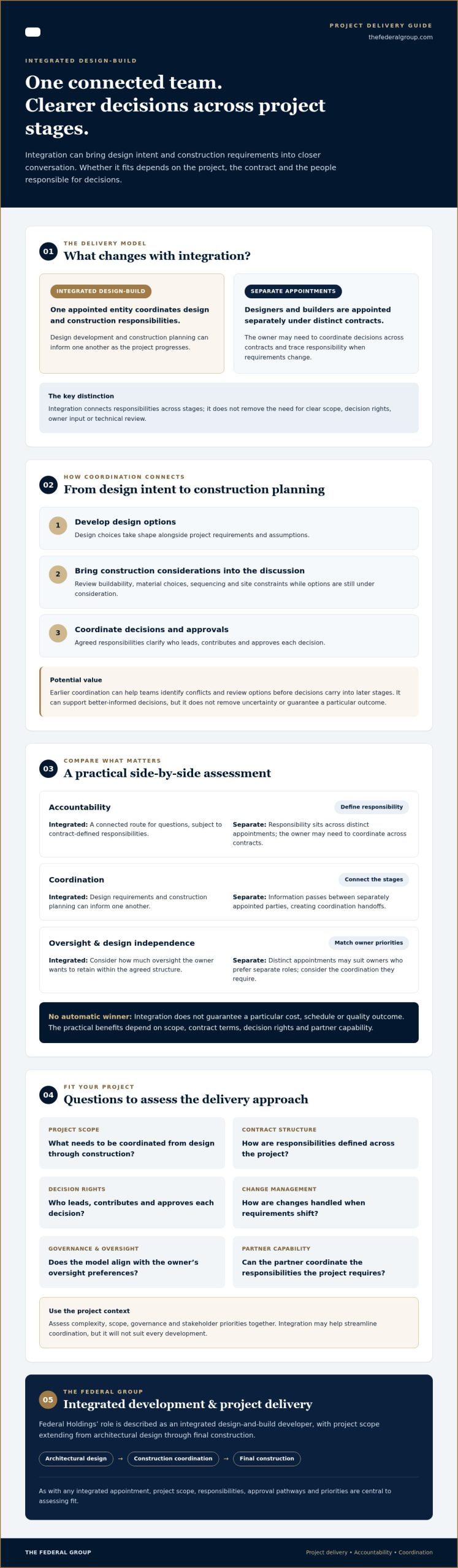
The key difference is how responsibility and communication are organised. In an integrated design-build arrangement, the owner engages one delivery structure to coordinate design and construction. With separate appointments, designers and builders hold distinct contracts, and the owner or its appointed project manager coordinates the interfaces between them. Neither model removes the need for oversight. Each assigns it differently.
- Accountability: Integration can give the owner a more consolidated route for design-and-construction matters. Separate appointments make each party’s contractual scope distinct, while coordination across those scopes remains essential.
- Coordination: An integrated team can align design and construction input within one delivery structure. Separate teams can still collaborate, but information exchange and handoffs need active management.
- Decision pathways: Integration may reduce the number of interfaces for some decisions, subject to the contract. Separate appointments can provide direct relationships with each specialist, but may require the owner to reconcile different recommendations.
The benefits of an integrated design-build firm depend on contract terms, governance, team capability and project conditions. Compare the models against your desired level of control, procurement requirements and the importance of independent design oversight, rather than assuming one structure is inherently superior.
Where integrated design-build may have an advantage
Integration may suit a project where design choices and construction planning are closely interdependent, or where the owner wants a unified responsibility structure to coordinate those functions. This can simplify stakeholder interfaces by giving the owner a clearer point of coordination. The contract still needs to define authority, approvals, scope and reporting. Integration alone doesn’t make procurement faster, less costly or lower-risk.
When separate design and construction appointments may fit
Separate appointments may be appropriate when the owner prioritises independent design oversight or must follow a particular procurement structure. They can also preserve direct engagement with design and construction parties. Effective project management can coordinate these appointments through defined communication protocols, responsibilities and decision routes. For related risk considerations, see De-risking Large-Scale Projects Through Integrated Design.
Practical takeaway: Consider integration when joined-up design and construction decisions and consolidated accountability match your governance needs. Separate appointments may fit better when independent design oversight, procurement requirements or direct control of each appointment carry greater weight. In either case, assess the proposed contract, decision rights and team capability before selecting a delivery model.
How to assess whether an integrated design-build firm fits your project
Start with the development’s requirements, not the delivery model’s label. The benefits of an integrated design-build firm depend on whether its structure matches your project’s complexity, governance and stakeholder priorities. Use this assessment to frame the decision:
- Project complexity: How closely do design decisions, construction planning and site conditions depend on one another? The more connected these decisions are, the more important it may be to assess how the proposed team coordinates them.
- Governance: Who needs approval authority, reporting access or independent oversight? Confirm whether the delivery structure can accommodate those expectations.
- Scope: What stages and responsibilities will the firm actually assume? Identify boundaries, exclusions and work that remains with the owner or other parties.
- Stakeholder priorities: Do owners, investors and other stakeholders prioritise consolidated accountability, distinct design oversight or a particular procurement structure?
Then assess demonstrated capability. Ask for relevant examples involving comparable project requirements, and establish what the firm was responsible for in each case. Treat broad claims about integration as a starting point, not proof of capability. Verify performance claims independently, and don’t assume results from another project will transfer to yours.
What should developers ask a prospective firm?
Ask specific questions to understand how the proposed team works in practice: Who controls design decisions, and how does construction input enter the process? Who reviews and approves changes? What reporting will owners receive? How are unresolved issues escalated, and where are decisions recorded? Request examples showing how responsibilities were handled, then verify any stated outcomes independently.
What contract and governance details need clarity?
Before appointment, clarify scope boundaries, responsibility by project stage, decision authority and information-sharing arrangements. Confirm how independent review and stakeholder requirements will be accommodated, and how proposed changes move through review and approval. The contract should make clear who acts, who advises and who decides. If capital planning is relevant, consult The Definitive Guide to International Property Development Finance (2026) alongside the delivery assessment. This reference is not linked here.
Federal Holdings is an example of an integrated design-and-build developer whose described project scope runs from architectural design through final construction. That context can inform your evaluation, but the key questions remain the same: what responsibility is included, how is capability evidenced, and does the structure fit your project’s governance?
Review The Federal Group’s design-and-build development as you assess whether its development approach aligns with your project requirements.
How The Federal Group connects integrated development and project delivery
After assessing which delivery structure fits your project, examine the actual remit and capabilities of a prospective partner. Federal Holdings is The Federal Group division that operates as an integrated design-and-build developer. Its described property project scope runs from architectural design through final construction, bringing design and construction within a development role rather than presenting the business as a standalone architectural consultancy.
What The Federal Group’s integrated development role includes
Connecting design and construction within the development lifecycle can help keep project requirements and delivery considerations in view across stages. The precise responsibilities for any potential project should still be established through its proposed scope and contract. For developers assessing the benefits of an integrated design-build firm, that distinction matters: an integrated model describes how responsibilities are structured, while the appointment defines what a specific partner will undertake.
The Federal Group also provides development finance and private equity alongside its development activity. These capabilities may be relevant when considering project delivery and capital planning together, but they should be assessed separately. Their availability within the group doesn’t mean financing or investment is automatically part of a design-and-build engagement.
What to prepare before discussing a potential project
A focused initial discussion is more useful when project context and expectations are clear. Prepare an outline covering:
- Location and stage: Where the development is and whether it is at concept, design development or another stage.
- Scope and requirements: The intended project scope, key constraints and priorities that will shape delivery.
- Stakeholders and governance: Who is involved, who approves decisions and what reporting or oversight they expect.
- Decision arrangements: Where you want design authority to sit, how construction input should be considered and how changes should be reviewed.
Use this information to clarify what responsibilities you expect a partner to take on, what remains with the owner or other parties, and how the proposed arrangement would address stakeholder requirements. These questions help you compare the firm’s stated role with your project needs without assuming one delivery model is right for every development.
Qualified stakeholders with a defined development requirement can Discuss your development project with The Federal Group.
Choose a Delivery Structure That Fits Your Development
The benefits of an integrated design-build firm can include closer coordination between design and construction, clearer accountability across project stages, and decisions informed by delivery requirements. Those advantages depend on the project, the agreement and the partner’s demonstrated capability. Separate appointments may better suit developments that require distinct design oversight, specific procurement arrangements or direct owner control of each appointment.
Before deciding, compare the models against your project’s complexity, governance and stakeholder priorities. Confirm who holds decision authority, how responsibilities are defined, how changes are approved and what oversight remains independent. A clear scope matters as much as an integrated structure.
Federal Holdings operates as an integrated design-and-build developer. The Federal Group also provides development finance and private equity, but these capabilities aren’t automatically part of a design-and-build engagement. Discuss your project requirements and the scope you have in mind through Discuss your development project.
With the right questions and a clearly defined remit, you can move forward with greater confidence in the delivery approach your development needs.
Frequently Asked Questions
What are the main benefits of an integrated design-build firm?
The main potential benefits are coordinated design and construction responsibilities, earlier construction input, and a clearer accountability structure. The benefits of an integrated design-build firm depend on how the contract assigns scope, authority and approvals, as well as the project’s governance and the team’s capability. For example, construction input during design development may help the team consider buildability before decisions are finalised. These advantages are not guaranteed outcomes.
Is design-build better than hiring an architect and contractor separately?
No delivery model is better for every project. Design-build may suit developments where coordination between design choices and construction requirements is a priority. Separate appointments may be preferable when an owner wants independent design oversight, direct relationships with each party or a particular procurement structure. Compare responsibility, decision rights, oversight needs and contract terms. The right approach is the one that fits the development’s requirements and governance.
How does an integrated design-build firm improve project coordination?
An integrated firm can coordinate design and construction considerations within the same delivery process. Teams may discuss buildability, sequencing and project requirements as design develops, rather than relying only on later handoffs. Clear role definitions, documented approvals and a process for escalating unresolved issues help preserve decision context. Coordination still relies on capable people, effective communication and a contract that defines responsibilities and authority. Integration by itself doesn’t ensure smooth delivery.
Can an integrated design-build firm reduce project risk?
Integration may help clarify responsibility for coordinating design and construction and bring some delivery considerations into view earlier. It doesn’t remove development, design, construction, market or contract risks. Assess how the proposed firm handles reporting, change control, decision-making and independent review. Ask for relevant experience and verify performance claims. Then consider how the specific contract and governance arrangements address the risks that matter to your project.
What should I look for when choosing an integrated design-build firm?
Look for relevant development experience, a clearly defined scope and transparent responsibility for design-and-construction coordination. Ask who controls design decisions, how construction input is considered, who approves changes and how progress or unresolved issues are reported. Request examples of comparable work, clarify what the firm was responsible for, and independently check any claimed outcomes. The proposed delivery structure should match your project’s complexity, stakeholder priorities and oversight requirements.
Does an integrated design-build firm also provide project financing?
Design-build does not automatically include project financing, so confirm which entity provides each service and what the proposed engagement covers. The Federal Group provides development finance and private equity alongside its development activity through Federal Holdings, an integrated design-and-build developer. These are distinct capabilities, not a guarantee of funding for a particular project. Discuss project-specific scope and any potential capital arrangements directly with the relevant entity.