Exit strategies for property developers and when to plan
22 October 2026A property development can incur substantial holding costs each week while still being projected to yield millions in two years. That is why exit strategies for property developers should be considered at the outset and tested during appraisal, not chosen only when construction is complete. Planning early aligns project assumptions with potential sale or rental routes. Reassess the plan as approvals, market conditions and project progress change.
It is natural to focus first on securing the site, funding the build and delivering the scheme. But deciding how and when to exit is part of those early investment decisions: it can shape feasibility, funding needs and exposure to holding costs. Reviewing exit strategies as the project evolves helps keep those choices grounded in current evidence.
This article explains what an exit strategy means in property development and when to review it across the development cycle. It compares options such as selling with approvals, disposing of units in bulk, arranging forward sales or holding completed property for rental income. It also explains how appraisal, net proceeds, timing and funding affect the choice, so you can plan for more than one outcome and adapt as the project evolves.
Key Takeaways
- Set out more than one potential route at appraisal, then revisit the plan as approvals, construction progress and market conditions change.
- Compare selling with approvals, selling during construction, disposing of completed units or retaining property for rental income against your project goals.
- Build decision points into the development cycle, including feasibility, approvals, construction and lease-up, so emerging risks can inform the next move.
- Assess forward sales and bulk disposals by weighing certainty and holding-cost savings against the potential effect on sale proceeds.
- Include tax implications in exit analysis: according to the Internal Revenue Service, depreciation claimed may be recaptured when a property is sold and taxed at rates up to 25%.
1. Why should property developers plan their exit strategy early?
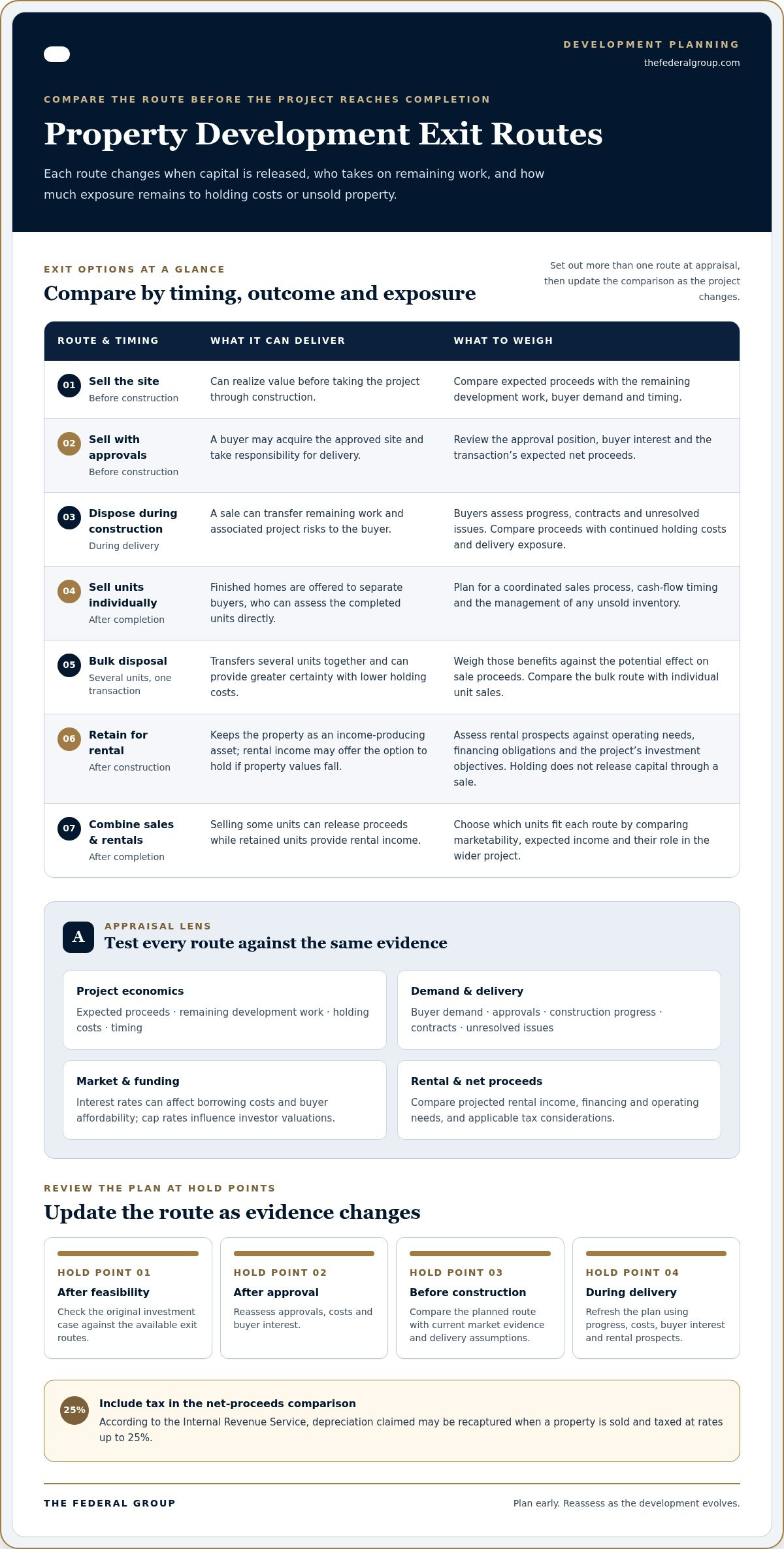
The main exit strategies include selling the site before construction, selling with approvals, disposing of a project during construction or selling completed units. Developers can also retain completed property for rental income or combine sales and rentals. Set out these options during appraisal, then review them as the project develops.
Early planning connects the intended exit with the investment case. For each route, estimate expected proceeds, remaining development work, holding costs, buyer demand and timing. A site sale may suit a developer looking to realize value before construction. A completed sale may make sense when construction and marketing support a stronger disposal case.
Each stage brings different opportunities and risks. Before construction, a buyer may acquire the site with approvals and take responsibility for delivery. During construction, a sale can transfer remaining work and risks, but the buyer will assess progress, contracts and unresolved issues. After completion, the asset is ready for individual sales, a bulk disposal or rental.
Compare selling the property as a whole with selling units individually. Individual sales reach separate buyers, while a bulk disposal transfers several units in one transaction. The choice affects the sales process, cash-flow timing and exposure to unsold inventory. Model both routes at appraisal, then update the comparison as construction milestones or market conditions change.
Rental offers another route after construction. Retaining units can generate ongoing income, while selling releases capital for other uses. If property values fall, rental income may give a developer the option to hold the asset rather than sell immediately at a loss. Assess expected rental income against operating needs, financing obligations and the project’s wider investment objectives.
A mixed strategy can spread exposure across different outcomes. For example, a developer might sell some completed units and retain others as rentals. This can provide sale proceeds while keeping part of the development as an income-producing asset. Choose which units fit each route by comparing marketability, expected income and their role in the overall project.
Tax treatment belongs in the early appraisal, not only at disposal. According to the Internal Revenue Service, the IRS can recapture depreciation claimed when a property is sold and tax it at rates up to 25%. Include applicable tax considerations when comparing a sale with continued ownership, and examine how the transaction structure affects net proceeds.
Revisit the exit at defined project milestones: after feasibility, after development approval, before construction and during delivery. At each point, compare the original plan with current costs, approvals, buyer interest and rental prospects. If the evidence changes, revise the route while there is still time to act, rather than waiting until completion limits your options.
2. So, what is a “real estate exit strategy” anyway?
A real estate exit strategy is the planned route for turning a development into sale proceeds or an income-producing asset. It links the intended transaction to project goals, buyer demand and delivery progress. For a residential scheme, individual unit sales may suit a sell-down objective. For commercial property, a sale to an investor or a lease to an occupier may better support the business plan. Multifamily developments can be sold as one asset or held for rental income.
Match the route to the return the project needs to deliver. A developer looking to release capital can compare a whole-project sale with individual sales. An owner prioritizing recurring income can assess rental demand, operating requirements and likely investor appetite. For mixed objectives, consider selling some units while retaining others as rentals. Record the assumptions behind each route, including expected proceeds, selling time and remaining obligations.
Market conditions can shift before completion, so review assumptions at appraisal and key delivery milestones. Interest rates affect borrowing costs and buyer affordability, while cap rates influence how investors value income-producing property. If financing becomes more expensive or investor yield expectations rise, a commercial asset’s indicated value may fall. Compare updated buyer evidence and projected rental income with the original investment case before committing to a sale.
In a softening sales market, developers may seek more time before reducing asking prices. They can reassess marketing, buyer terms, the release sequence or a temporary hold. Open-market sales of completed units let buyers assess finished homes directly, but require a coordinated sales process and management of unsold inventory. Alternatively, listing through auction specialists such as Auction Property Ltd can secure unconditional sales and fixed completion timelines for residential or commercial lots. Compare projected net proceeds and timing with a bulk transaction, where a discount may be offset by lower holding costs.
Commercial marketing needs a clear investment case. Present the asset’s use, leasing position, operating profile and relevant transaction information in a consistent data room. For a vacant property, explain the target occupier and how the space meets that use. For an income-producing asset, organize lease and income records so prospective buyers can assess cash flow and operational risks efficiently.
Permitting gaps, title issues, construction delays and seasonal constraints can all delay an exit. They may extend buyer diligence, postpone completion or reduce proceeds if they require additional work or weaken confidence. Identify risks before launching a sale, assign responsibility for resolving each issue and document the path to completion. Revisit the exit strategy when new approvals, construction evidence or market feedback materially change the project’s prospects.
3. Exit-planning hold points across the development cycle
Before acquiring a site, write an exit plan alongside the initial feasibility assessment. Compare the intended use, potential buyers, approval pathway and likely route to disposal. A residential site may support a build-to-sell scheme, while another buyer may value the land for a different permitted use. Prioritize feasibility work that remains relevant across likely uses and buyer types. This frames the acquisition decision around both development potential and a credible alternative exit.
At the feasibility hold point, test whether the project still works if the preferred exit changes. Record assumptions about expected demand, sale timing, financing and holding costs. Identify findings that could change the decision to acquire, such as unresolved site constraints or a limited buyer pool. Set a decision rule before committing further capital: proceed, revise the proposed scheme or sell the site if the evidence no longer supports construction. This structured approach to exit strategies for property developers connects early due diligence with practical choices.
After development approval, reassess the project before moving into construction. Approval does not guarantee that every entitlement or permit will follow smoothly, even when outside consultants are involved. Map remaining approvals, conditions and work required to satisfy them. Then compare construction with selling the approved project. A buyer will assess the approval position and outstanding obligations, so organize the documents and identify gaps before beginning a sale process.
Before construction starts, turn the chosen exit into a delivery and funding plan. Budget for delays and keep contingency options, including short-term financing if timing disrupts the expected sale or refinancing route. Track soft costs separately, such as design work, permitting, legal preparation and other pre-construction expenses. These costs can continue during a delay, even when construction has not begun. Review the budget if a key approval or procurement milestone slips.
During construction, use each major contract award, progress review and change order as an exit hold point. Compare the current completion forecast with the sale schedule and financing terms. If delays threaten the planned transaction, assess whether revised delivery sequencing, additional financing or a sale during construction would better protect the project’s position. Keep cost-to-complete information, contracts and approval records organized, since buyers need evidence of progress and outstanding work.
At completion, review lease-up and disposal together rather than treating them as separate decisions. Compare buyer demand for completed units with tenant demand and the costs of holding vacant space. Slower lease-up can affect projected income and investor interest; delayed unit sales can extend carrying costs. Update the exit plan using actual leasing, sales and operating information, then decide whether to sell, refinance or retain the asset.
Full-cycle development can move through entitlement, permitting, construction and lease-up, with a decision point at each transition. Keep an exit register showing the preferred route, alternatives, unresolved risks, responsible person and next review trigger. Review exit strategies for property developers when approvals change, construction delays emerge or buyer demand shifts. This makes exit planning part of project control, not a document prepared once and ignored.
4. Forward sales and forward funding
A forward sale agrees to sell a development before completion, often to an investor or end user. Forward funding goes further: the purchaser funds agreed development costs as work progresses, under negotiated milestones and controls. For a residential scheme, these routes can secure a prospective buyer earlier and influence the developer’s capital requirements. The agreement must define delivery obligations, payment triggers, conditions and remedies if the programme changes.
Before committing, prepare a buyer-ready information package. Include the development programme, cost plan, construction contracts, approvals, sales or leasing evidence and a clear account of outstanding risks. Buyers need to understand how the scheme will reach completion and what could alter delivery. Keep forecast costs, programme updates and sales data consistent, so a purchaser can assess the project’s position without avoidable discrepancies emerging during diligence.
Choose the transaction structure deliberately. In an asset sale, the purchaser acquires specified property and assets. In a share sale, the purchaser acquires the company, including its assets, liabilities, contracts and regulatory history. Tax treatment can differ between an asset sale, a share sale and other structures. Compare the legal, tax and commercial consequences, including which obligations transfer and how the purchase agreement allocates risk. Working with commercial and property law specialists like Aquarius Lawyers can help developers navigate these contractual complexities and protect project value.
Taxes and closing costs on a U.S. project sale depend on the property, transaction structure and applicable jurisdiction. Model the relevant tax treatment and transaction expenses before comparing offers, since a higher gross price may not produce higher net proceeds. Developer profit margins and returns also vary by project costs, financing, timing, sale terms and retained risk. Compare expected net proceeds, not a generic margin by exit type.
A bulk sale can trade a lower unit price for speed and reduced holding costs. One example compares £9 million received quickly from a bulk disposal with £10 million received in smaller tranches over an extended sales period. Bulk sales to investors may be discounted around 10 to 20 percent from aggregate retail value. Test whether savings in interest and holding costs offset that discount for this project.
Wholetail sales offer another route for residential property: make limited improvements, then sell rather than undertake a full redevelopment. Due diligence should establish title, approvals, contracts, cost-to-complete, programme, liabilities and sale conditions. Organize these records before marketing, disclose known issues and respond to buyer questions with current documentation. For forward funding, also define progress reporting, drawdown evidence and approval processes in the agreement.
Compare each route using the same assumptions: net proceeds, payment timing, remaining capital needs, buyer conditions and delivery exposure. A forward transaction may improve certainty, but it also commits the developer to specified terms and performance. A bulk disposal may accelerate capital recovery, while individual sales may preserve pricing flexibility. Base the comparison on actual project evidence and explain how each transaction changes risk, cash flow and control.
5. Choosing an exit strategy during appraisal
Appraisal is where an exit strategy becomes a testable investment decision. Compare the site’s current value, development costs, funding requirements and projected proceeds under each route. For every option, calculate net proceeds and timing, not just gross development value. A higher projected sale price may produce a weaker result if it requires more capital, extends delivery or increases holding costs.
Build a side-by-side appraisal for selling the site, selling an approved scheme, completing and disposing of the asset, or retaining it for income. Include the work still required, likely buyer profile, evidence of demand and conditions needed to complete each transaction. A rental strategy, for example, depends on tenant demand, operating assumptions and the time needed to establish income. A sale depends on buyer appetite and credible evidence for the proposed value.
Then test the hold option. Assess the cost of holding the development for a further 6-12 months, including financing, operating expenses and delayed capital recovery. Compare that cost with the additional proceeds expected from waiting. If a slower sales period reduces near-term receipts, a longer hold may preserve value, but only if projected income and the project’s funding position support it.
Set a clear evidence threshold for each exit. A lender assesses whether the proposed exit is evidenced, rather than merely asserted. Support a sale plan with current comparable transactions, buyer interest, approvals and a realistic completion programme. Support a rental plan with tenant demand, lease assumptions and operating information. If the evidence does not support the base case, revise the structure or assess an alternative before committing further capital.
Include transaction structure and tax considerations in the appraisal. In the United States, Section 1031 of the Internal Revenue Code allows proceeds from selling one commercial property to be reinvested in another, typically deferring immediate capital-gains tax liability. This route may affect how a commercial asset sale is evaluated, but the appraisal should still compare net proceeds, timing and reinvestment requirements.
For a landowner entering a development joint venture, model when contributed capital becomes available again. It may remain tied up until the developer refinances or sells the project. Record the distribution mechanics, decision rights and exit triggers in the proposed structure. For a development nearing repayment of its build loan, a development exit bridge can provide a sales window of 6 to 18 months after repayment.
Finish the appraisal with a preferred route, a viable alternative and specific review triggers. Revisit the decision when approval status, construction costs, buyer evidence or rental prospects change. If you’re assessing how funding fits your development’s exit plan, explore development finance options as part of that appraisal.
The Federal Group: Development Finance
The Federal Group provides Development Finance for property projects where funding needs and exit planning must be assessed together. Consider this financing when appraisal identifies a capital requirement and you are evaluating how delivery, funding and the intended disposal fit into the project plan. The Group also provides Private Equity and Design & Build Development, which may be relevant when the project’s capital structure or delivery approach is part of the decision.
Bring the project’s current appraisal, development programme and preferred exit route into the discussion. These inputs help frame how financing relates to milestones, potential sale timing and the project’s remaining requirements. For development projects where funding is a central consideration, explore Development Finance with The Federal Group.
To discuss your project, contact The Federal Group or visit its website.
Set the next decision in motion
The next step is to turn appraisal assumptions into a clear decision framework. Define the evidence that would support each route, the project changes that should trigger a review and how much flexibility you need to preserve. A disciplined approach to exit strategies for property developers makes these choices part of active project governance, rather than decisions deferred until delivery is near.
The Federal Group’s Development Finance, Private Equity and Design & Build Development relate to the capital and delivery considerations that shape a development plan. If you’re assessing how these considerations fit your project, contact The Federal Group to discuss your next steps.
With a clear decision framework, you can move forward with focus and keep the project’s objectives in view.
Frequently Asked Questions
Why should property developers plan their exit strategy early?
Early planning lets developers align site selection, project design and funding with the intended way of realizing value. For example, a scheme intended for rental may need different unit layouts and operating assumptions than one designed for individual sales. Define what evidence would change the preferred route, such as weaker buyer interest or revised construction costs. This gives the project team practical decision points before later commitments reduce flexibility.
So, what is a “real estate exit strategy” anyway?
It is the planned way a developer converts a project into sale proceeds, ongoing income or capital for another investment. The plan should identify the likely buyer or tenant, transaction structure, timing assumptions and evidence needed to proceed. For example, a developer may plan to sell completed units but retain the option of selling the whole asset if individual demand weakens. That makes the strategy a working decision framework, not just an end-stage sale.
How does selling the SPV work as an exit?
Selling the SPV generally means selling shares in the company that owns the development, rather than transferring the property asset directly. The purchaser acquires the company along with its assets, liabilities, contracts and regulatory history. Due diligence therefore extends beyond the building to the company’s accounts, agreements, approvals and obligations. The sale structure can affect tax treatment and risk allocation, so compare it with an asset sale before negotiating transaction terms.
When does a bulk sale to an investor make more sense than selling units individually?
A bulk sale may suit a developer who values faster disposal and reduced holding exposure over achieving each unit’s individual retail price. Investor offers may be discounted around 10 to 20 percent from aggregate retail value, so compare that discount with the interest and holding costs avoided. For example, a completed residential scheme with slow individual reservations may benefit from one transaction if the net proceeds and timing are stronger overall.
Which exit strategy do lenders prefer?
Lenders look for an exit supported by evidence, not just a stated intention. A contracted sale, documented buyer interest, current comparable transactions or a supported rental plan can help show how repayment is expected to occur. The relevant evidence depends on the project’s stage and structure. A lender also weighs remaining work, delivery timing and the relationship between expected proceeds and the outstanding loan balance.
How do property developers decide when to sell a project?
Compare the net proceeds available now with the projected outcome of holding the project longer. Include financing, operating expenses, remaining work, buyer demand and the timing of capital recovery. One useful appraisal test is the cost of holding for a further 6-12 months against the additional proceeds expected. Set review triggers, such as a change in construction forecasts or buyer evidence, then update the decision when those conditions occur.
What are the pros and cons of selling a development project before completion?
Selling before completion can release capital and transfer some remaining delivery responsibilities to the purchaser. It may also reduce the developer’s exposure to construction delays and later sales activity. The trade-off is that buyers factor outstanding work, delivery uncertainty and unresolved approvals into their offer. Prepare current cost-to-complete information, contracts and approval records so purchasers can assess the remaining obligations and distinguish manageable risks from material gaps.
How does refinancing or holding a completed property generate returns for developers?
Holding a completed property can generate rental income while the asset remains under ownership. Refinancing may release capital for another project while the developer retains the asset and its future income potential. The decision depends on rental performance, operating costs, debt obligations and available refinancing terms. Compare the capital released with the income and control retained, and account for repayment obligations created by new borrowing.