Residential Development Finance: A 2026 Guide to Funding Projects
20 October 2026A strong residential development finance plan isn’t built around a single loan. It aligns capital with the project’s stage, risk profile and intended exit, so funding can support the scheme from acquisition through construction and completion.
It’s understandable to focus first on how much you can borrow. But a credible funding case must also show how the project can remain viable as costs, timelines and risks change. Acquisition finance, construction funding and repayment each have different demands. A mismatch can put pressure on the whole plan.
This guide explains the main sources and layers of residential development finance, and how funding considerations shift at each stage. You’ll learn what capital partners assess when reviewing feasibility, leverage, delivery risks and exit plans, then how to present those elements as a clear capital plan. Federal Finance, The Federal Group’s specialist financier, offers development finance and other capital solutions for property projects. The aim is to help you approach funding decisions with greater clarity and confidence.
Key Takeaways
- Distinguish project funding from a personal home mortgage by focusing on the development’s costs, delivery plan and exit.
- Understand how senior debt, bridging finance, construction loans and equity can play different roles in a capital stack.
- Compare residential development finance structures by stage, timeline, risk allocation and exit assumptions, not headline rate alone.
- Build a stronger funding case by setting out the project, funding requirement, key assumptions and repayment rationale in a coherent financial model.
- Understand how Federal Finance’s financing services differ from Federal Holdings’ design-and-build development capabilities.
What Residential Development Finance Covers, and Where It Fits
Residential development finance is capital arranged to create, expand or complete a residential property project. It supports a defined development plan, rather than an individual buying a home to live in. The funding need can evolve as the project moves from securing a site to building, completing and realising value through sale or another planned exit.
That changing requirement is central to capital planning. A site may need to be acquired before construction funding is drawn. Later, funds must support the build programme and completion costs. Repayment depends on the chosen exit and its timing. Mapping each phase helps developers identify when capital is needed, what it will fund and how the project is expected to repay it.
Which residential projects may need development finance?
New-build schemes, property conversions and developments delivered in phases can all involve project-level funding needs. The nature of real estate development helps explain why: a project moves through connected stages, each with its own costs, risks and milestones. These are common contexts for development funding, not automatic eligibility criteria.
Scale matters, but it is only one factor. Planning status can affect the route and timing to delivery; construction complexity can shape the funding profile; and a phased scheme may need capital aligned with separate work packages or completion points. The exit strategy matters too. A plan based on selling completed homes differs from one based on retaining the asset, so funding assumptions should reflect the intended route and timing.
How project finance differs from a personal residential mortgage
A personal residential mortgage assesses borrowing in relation to an individual purchasing a home. Development finance instead centres on the project: its feasibility, site, costs, delivery plan, risks and expected repayment or exit. The analysis considers whether the proposed capital structure can support the scheme through its stages, rather than simply whether a person can meet home-loan repayments.
Federal Finance is a specialist financier offering development finance, construction loans, bridging finance, private equity, preferred equity and commercial mortgages. These capital solutions are designed for project and commercial financing needs, keeping the funding conversation focused on the development’s requirements and capital plan.
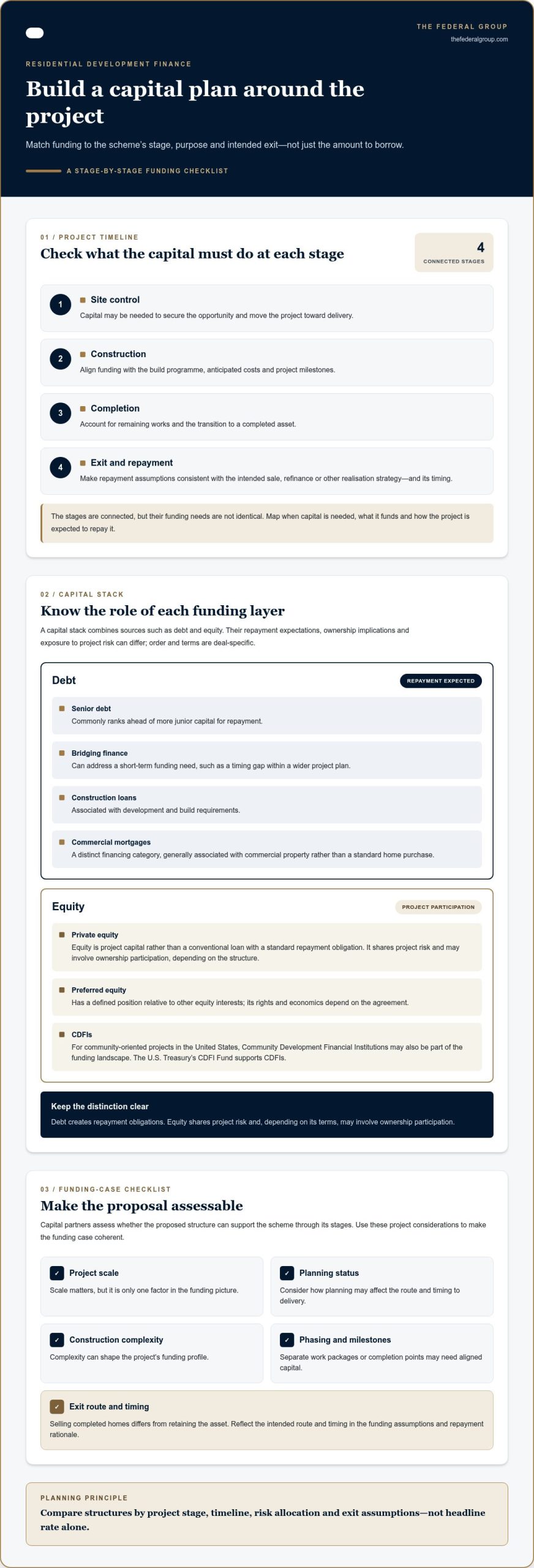
In practice, funding needs can shift at four broad points:
- Site control: Capital may be required to secure the opportunity and progress the project toward delivery.
- Construction: Funding must align with the build programme, anticipated costs and project milestones.
- Completion: The plan needs to account for remaining works and the transition to a completed asset.
- Exit: Repayment assumptions should match the intended sale, refinance or other realisation strategy and its timing.
These stages are connected, but they don’t carry identical funding needs. A credible project plan makes those differences visible from the outset, giving capital partners a clearer basis to assess the proposal.
How Residential Development Finance Fits into the Capital Stack
A capital stack shows how a project’s funding is assembled and how different sources relate to one another. In residential development finance, it may combine debt and equity rather than rely on one facility. The layers can differ in repayment expectations, ownership implications and exposure to project risk. Their order and terms are deal-specific, not universal.
Debt options for acquisition and construction stages
Debt is generally advanced with an expectation of repayment under agreed terms. Senior debt commonly ranks ahead of more junior capital for repayment, while bridging finance can address a short-term funding need, such as a timing gap within a wider project plan. For real estate investors managing fast-paced property purchases, specialist lenders such as Jet Lending, LLC provide short-term transactional funding to bridge critical acquisition windows. A construction loan is associated with development and build requirements. Commercial mortgages are a distinct financing category, generally associated with commercial property rather than a standard home purchase.
Federal Finance offers Bridging Finance, Construction Loans and Commercial Mortgages. The role of each depends on the project’s stage, funding purpose and repayment plan. A bridge may address a time-limited need, while construction funding is structured around the development requirement. The product name alone doesn’t explain the full terms or suitability.
Equity and preferred equity in residential projects
Equity is capital participation in a project, rather than a conventional loan with a standard repayment obligation. Depending on the structure, equity may involve an ownership interest and exposure to the project’s results. Preferred equity is a form of equity with a defined position relative to other equity interests, but its rights and economics depend on the agreement. It shouldn’t be treated as identical to senior debt or assumed to carry one standard set of terms.
Federal Finance offers Private Equity and Preferred Equity. For community-oriented projects in the United States, Community Development Financial Institutions may also be part of the funding landscape. The U.S. Treasury’s Community Development Financial Institutions Fund (CDFI Fund) supports CDFIs, a distinct source to understand alongside private capital.
Debt creates repayment obligations; equity shares project risk and, depending on its terms, may involve ownership participation. A capital stack needs to make those differences clear, not just add up available funding.
| Capital layer | Typical role in a project | Repayment and risk considerations |
|---|---|---|
| Senior debt | Higher-ranking debt within the stack | Repayment is generally prioritized over junior layers, subject to the agreed terms. |
| Bridging finance | Short-term funding for a defined project need | Plan around its repayment timing and the event expected to repay it. |
| Construction loan | Funding associated with development and build requirements | Consider how the facility aligns with project delivery and repayment assumptions. |
| Preferred equity | Equity with a specified position relative to other equity | Rights and risk allocation depend on the transaction documents. |
| Private equity | Capital participation in the project | May involve ownership participation and exposure to project outcomes. |
These layers may complement one another, but adding more sources also means coordinating their repayment expectations and risk positions. For an overview of Federal Finance’s property funding services, explore its property finance capabilities.
How to Compare Residential Development Finance Structures
Compare funding structures against the project’s requirements, not in isolation. Ask when capital is needed, how much is required, how long it must remain in place, who carries which risks and how repayment is expected to occur. The lowest headline rate may be less suitable if its repayment timing conflicts with construction milestones or the intended exit. Compare the full structure, including timing and obligations, rather than relying on one price indicator.
Separate general evaluation factors from transaction-specific terms. Lenders and investors assess projects individually, so a metric or structure used in one deal doesn’t establish a universal threshold or template for another. Use this framework to organise your analysis before assessing specific proposals.
Assess feasibility, leverage, and delivery risk
Start with a development budget that sets out acquisition, construction and other project costs. Compare it with projected value and the assumptions behind that estimate. Include a contingency that reflects identifiable uncertainties. Loan-to-value (LTV) compares the loan amount with the value of the property or asset used in the calculation. It is one possible leverage measure, not a standalone verdict on feasibility or a universal borrowing limit.
Planning status, construction complexity and delivery capacity also shape risk. A clear programme should show how the work can progress, what could disrupt it and how the plan responds. These factors matter alongside the numbers because delays or delivery constraints can affect both the amount and timing of capital required.
Use the comparison below as a starting point. Actual terms and risk allocation depend on the transaction.
| Structure | Questions to compare | Key fit consideration |
|---|---|---|
| Debt | What are the repayment obligations and timing? | Match planned repayments to available project cash flow or the exit. |
| Bridging finance | What short-term need does it address, and what event repays it? | Check that the expected funding period aligns with the project milestone. |
| Construction finance | How does funding relate to the build programme and costs? | Assess whether the drawdown and repayment profile suits delivery. |
| Equity | How are participation, ownership and project risk allocated? | Consider the implications for control and the distribution of project outcomes. |
Test the exit strategy before selecting a structure
A sale, refinance or decision to retain completed residential assets can each produce a different repayment route. The expected exit date should inform the financing period and repayment plan. For a US project, distinguish developer capital planning from programs aimed at households. USA.gov’s housing assistance programs provide information for people seeking housing help, not a substitute for project-level financing analysis.
Then test the plan under less favourable conditions. Model a construction delay, higher costs or slower-than-planned sales, and observe how each changes the funding gap, completion date and exit proceeds. If a structure depends on everything happening on schedule, examine that sensitivity closely. A robust comparison makes those dependencies visible before you choose a financing structure.
How Developers Can Prepare a Residential Finance Case
A clear finance case turns a development proposal into an assessable plan. It should explain what is being built, how delivery will be managed, what capital is needed and how the project is expected to repay or realise that capital. For residential development finance, consistency matters: the budget, programme and exit rationale should support the same project assumptions.
Build a transparent project and funding summary
Start with a concise overview of the site, proposed residential use, current project stage and intended outcome. Then set out the budget, funding requirement and exit rationale, distinguishing confirmed facts from estimates and assumptions. A schedule of uses and sources shows where project capital is expected to go and how each part is intended to be funded.
- Define the project. Describe the site, proposed scheme, current status and key milestones, including relevant planning progress.
- Set out the costs. Present the budget by major category, explain the basis of estimates and state the contingency assumptions.
- Map sources and uses. Show the total capital requirement, the funding already committed or contributed, and any remaining gap.
- Build the timeline. Connect expected funding needs to acquisition, delivery milestones and completion, making timing assumptions visible.
- Explain the exit. Set out whether the plan relies on sale, refinance or retaining completed assets, and how that route is expected to support repayment.
A coherent financial model brings these pieces together. It should make cash requirements over time visible, rather than presenting only a project total. Test how changes to cost estimates, timing or sales assumptions affect the funding gap and projected outcome. State uncertainty plainly: a forecast is an informed model, not a guaranteed result.
For projects spanning different jurisdictions, the international property development finance guide offers broader context on funding across markets.
Present delivery capacity and project risks clearly
Identify who is responsible for development oversight, design, construction and project management, and explain how those responsibilities fit together. A finance case is stronger when roles are specific and the delivery programme reflects the team’s actual plan, rather than relying on broad statements about experience or capability.
- Planning or approval risk: State the current position, outstanding steps and how the programme accounts for them.
- Cost or schedule pressure: Explain how costs and milestones will be monitored, and how material changes will be reflected in the model.
- Delivery complexity: Identify relevant dependencies and show who is accountable for tracking them.
- Exit uncertainty: Describe how changes to sale timing or the chosen exit would affect repayment assumptions.
Connect each risk to a practical mitigation, such as a monitoring process, contingency assumption or alternative timing scenario. This doesn’t remove uncertainty; it shows that the project team has considered how risks could affect funding and delivery. To discuss a project funding plan with a specialist financier, explore Federal Finance.
How Federal Finance Supports Residential Development Projects
Residential development finance requires a clear view of both the project and the capital behind it. Federal Finance, The Federal Group’s specialist financier, provides financing for individuals, companies and organizations. Its finance services cover several capital needs, helping developers consider funding in relation to project stage, purpose and planned exit.
Federal Finance’s stated capital solutions
Federal Finance offers the following finance services:
- Private Equity
- Construction Loans
- Bridging Finance
- Commercial Mortgages
- Preferred Equity
These are distinct forms of financing, not interchangeable labels. A project’s requirements, timing and capital plan inform which type of funding is relevant. Use the preparation framework in this guide to describe the proposed scheme, its funding requirement and expected exit, creating a structured basis for a financing discussion. Terms depend on the transaction and its structure.
The Federal Group’s experience across finance and development
The Federal Group brings together separate finance and development capabilities. Federal Finance provides financing, while Federal Holdings is a fully integrated design-and-build developer. Federal Holdings has its own General Contractor licence and in-house design capabilities, and has developed 1,000+ residential units as well as commercial space across the US and UK. These delivery credentials belong to Federal Holdings, not Federal Finance.
At group level, The Federal Group reports $3 billion+ in completed transactions, a $600 million+ total portfolio value across the US and UK combined, and 15+ years of industry experience. These figures provide context on the group’s experience, while the distinction between its business divisions remains important: Federal Finance brings financing expertise; Federal Holdings brings design-and-build delivery capability.
For additional perspective on how financing expertise can be applied to a development scenario, explore the development finance lender case study. The integrated design-and-build developer guide provides a separate view of Federal Holdings’ delivery model. Together, they offer useful context for considering how project funding and development execution relate while remaining distinct functions.
If you’re preparing a residential project funding case, explore Federal Finance’s development finance as part of your capital planning.
Make Your Next Funding Decision with Clarity
Turn your funding analysis into a decision-ready plan. Set out what the project needs at each stage, how the proposed capital structure supports delivery, and what assumptions underpin the exit. A plan that makes timing, dependencies and potential pressure points visible gives you a stronger foundation for financing discussions.
Keep the structure responsive as the project develops. Changes to planning, costs or delivery can alter the amount and timing of capital required, so revisit your model when key assumptions shift. This disciplined approach helps ensure residential development finance remains aligned with the project’s direction, rather than relying on a funding plan that no longer reflects reality.
For a project-specific perspective on capital requirements, explore Federal Finance’s specialist property finance solutions. Build your funding plan around the project’s needs, then speak with Federal Finance about development finance for your project.
Frequently Asked Questions
What is residential development finance?
Residential development finance is project funding for creating or completing housing, rather than borrowing to purchase a home for personal occupation. A developer might use it for a new-build scheme, a conversion or a phased project. The funding plan should reflect what has already been completed and what remains, since a site at acquisition stage presents different requirements from one nearing practical completion or sale.
How does residential development finance work?
Residential development finance starts with a defined project and a clear account of the capital it requires. The developer sets out the proposed works, costs, programme and expected exit, then considers how debt, equity or a combination can support the plan. For example, a funding model should distinguish committed capital from a projected sale receipt. Before proceeding, understand the obligations, timing, ownership implications and risk allocation in the proposed structure.
What types of finance are used for residential development?
Common categories include bridging finance, construction loans, commercial mortgages, private equity and preferred equity. Their roles differ: a short-term bridge may address a funding gap, while construction finance relates to development works and equity represents capital participation. A developer comparing options should map each source against the specific use of funds and repayment route. Labels alone don’t establish the transaction’s terms, which depend on the project and agreement.
Can residential development finance cover land acquisition?
Land acquisition may be included in a development funding plan, depending on the project and its assessment. For a site with a time-sensitive purchase, a developer could consider whether short-term bridging finance fits the wider capital plan and how it would be repaid. The case should explain the site’s status, intended residential use, next milestones and expected exit. The acquisition plan should be assessed alongside the project’s overall funding structure.
How much deposit or equity is needed for a residential development?
There’s no universal deposit or equity figure for a residential scheme. The capital contribution depends on project costs, asset characteristics, proposed financing and the transaction’s risk assessment. Rather than relying on a generic percentage, prepare a sources-and-uses schedule: show total project funding needs, capital already available and any remaining shortfall. Make clear which figures are estimates and explain the assumptions behind them, including contingency and projected value.
Is residential development finance the same as a buy-to-let mortgage?
No. Development finance supports a project to create, convert or complete homes, while a buy-to-let mortgage is associated with financing a property held for rental under its own lending criteria. The purpose, repayment assumptions and timing can therefore differ. For instance, completing a conversion and then selling the units is a different funding scenario from acquiring an already completed rental property. Federal Finance’s specialist financing focuses on project and commercial funding needs.
What documents are needed to apply for residential development finance?
Document requirements vary by transaction, but a useful initial pack can include a project summary, site details, cost plan, financial model, delivery schedule, team responsibilities and exit rationale. Keep the documents aligned: if the programme assumes completion before the budget’s forecast sales period, explain the difference. Mark estimates and unresolved assumptions clearly. A concise, consistent pack helps capital partners understand the proposal and identify where further detail may be needed.
What happens if a residential development project is delayed?
A delay can extend the period before sales, refinancing or another planned exit, while affecting costs and the project’s funding needs. Model a delayed completion scenario and show how it changes cash requirements and repayment timing. Track milestones against the working programme and record material changes as they arise. The consequences for financing depend on the relevant agreement and circumstances; an extension or other adjustment shouldn’t be assumed to happen automatically.