Risk Management in Real Estate Development: Control Costs
21 October 2026A development’s greatest exposure is often the risk its model treats as manageable. Effective risk management in real estate development assesses potential threats by likelihood and impact, then plans, identifies, analyzes, responds to, and monitors them throughout the project. The aim isn’t to eliminate uncertainty, but to understand how it could affect costs, timing, asset value, and returns, and prepare a proportionate response.
This discipline matters because delays can increase financing costs and defer revenue, while market shifts can weaken demand or portfolio performance. A structured approach connects these risks rather than assessing each in isolation.
This article explains how developers can address construction delays, protect real estate assets through insurance planning, and manage portfolio risk and leverage. It also covers how analytics and scenario planning can reveal a project’s or portfolio’s main exposures, helping decision-makers compare outcomes and make informed choices as conditions change.
Key Takeaways
- Assess market, operational, legal, environmental, and financial exposures by considering both their likelihood and potential impact.
- Build realistic schedules, contingency time, and clear contract responsibilities into development plans to help contain delay-related costs.
- Review coverage, deductibles, exclusions, and insurance documentation as part of protecting assets and supporting claims.
- Use tenant and asset diversification, regular valuation, and stress testing to understand portfolio concentration and leverage risks.
- Apply analytics and scenario planning to test changing market conditions and guide decisions as project risks evolve.
What Is Risk Management in Real Estate?
Risk management in real estate development identifies potential threats, assesses their likelihood and impact, and plans responses. This process helps owners connect site, market, financing, and operational decisions before risks affect delivery or asset value.
Financial and Non-Financial Risk Categories
Financial risks include market fluctuations, interest-rate changes, and credit exposure. Non-financial risks include legal, environmental, tenant, operational, and property issues. Each can affect ownership and asset-level financial security: weak tenant demand can reduce income, while structural or infrastructure problems can increase operating demands. A thorough assessment links each risk to its likely effects, helping owners make informed decisions about the project and its reserves.
Property Type and U.S. Location
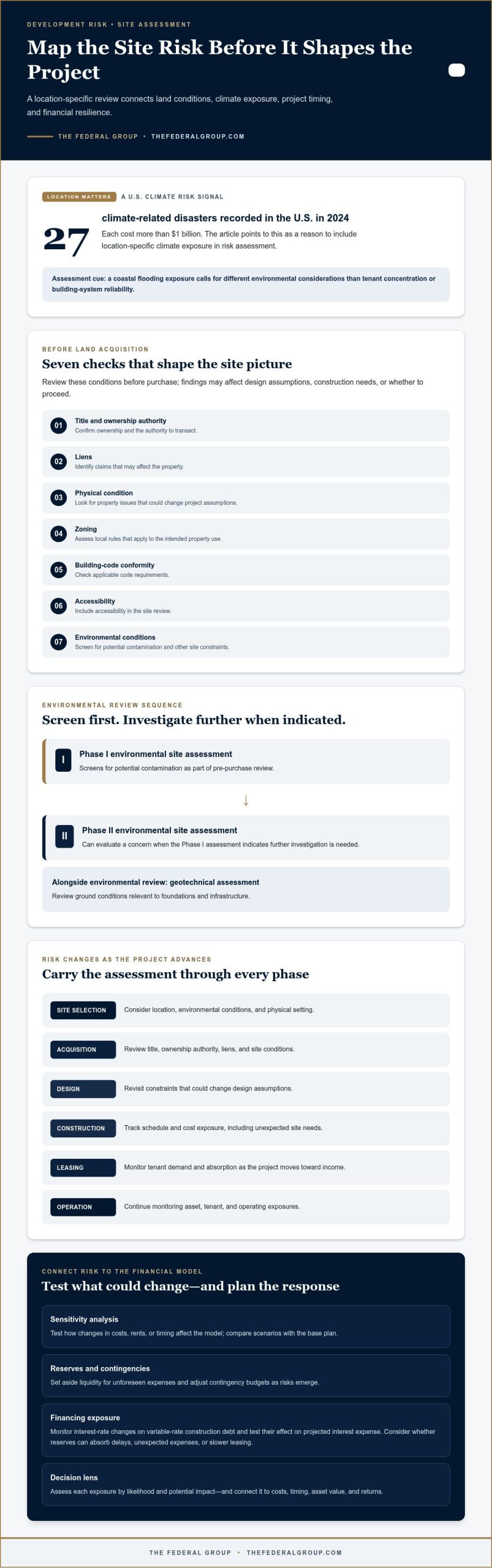
Development risks vary with the asset’s use, tenant profile, local market, and physical setting. Developers should assess occupancy, rental trends, and absorption in the specific submarket, while considering how local laws apply to the property. A project exposed to coastal flooding faces different environmental considerations from one whose primary exposure is tenant concentration or building-system reliability. In 2024, the U.S. recorded 27 climate-related disasters costing more than $1 billion each, underscoring why location-specific climate exposure belongs in assessment.
Reserve Planning and Project Stages
Project risk changes as a development moves from site selection and acquisition through design, construction, leasing, and operation. Acquisition raises questions about title, ownership authority, liens, and site conditions; construction brings schedule and cost exposure; leasing brings tenant-demand and absorption risks. Reserve planning sets aside liquidity for unforeseen expenses, while sensitivity analysis tests how changes in costs, rents, or timing affect the model. Developers can compare scenarios with the base plan and adjust contingency budgets as risks emerge.
Site and Environmental Risk Evaluation
Before buying land, developers examine title, liens, physical condition, zoning, building-code conformity, accessibility, and environmental conditions. A Phase I environmental site assessment can screen for potential contamination. If it indicates a need for further investigation, a Phase II assessment can evaluate the concern. Geotechnical review examines ground conditions relevant to foundations and infrastructure. Together, these steps help identify site constraints that could change design assumptions, construction needs, or the decision to proceed.
Financing Terms and Debt Risk
Interest rates and financing terms shape a development’s carrying costs and flexibility. Variable-rate construction debt exposes a project to rate changes, so developers can monitor fluctuations and test their effect on projected interest expense. Conservative financing and reasonable loan-to-value ratios can preserve options if demand weakens or market conditions deteriorate. Contingency planning should also test whether reserves can absorb delays, unexpected expenses, or slower leasing without undermining the project’s financial position.
Construction delays and contracts
A schedule slip can affect an investment well beyond the construction site. Clear contracts, realistic timelines, and active communication help development teams manage delays and clarify responsibilities.
Construction Delay Risks
Construction delay risk is the possibility that work finishes later than planned, postponing occupancy and revenue. A late handover can extend financing costs and push back leasing or operations, changing the project’s financial assumptions.
Map schedule dependencies, such as site preparation before foundations and inspections before occupancy. If one task slips, identify the later milestones it affects, who is responsible for responding, and whether the timeline includes contingency time. This turns a general scheduling concern into a specific mitigation plan.
Contract Review and Communication
Contract review clarifies who must deliver each part of the project, by when, and how unresolved issues will be handled. Before work begins, legal and risk management teams can review party selection, alignment of interests, deadlines, responsibility for open matters, and dispute resolution.
Specificity matters. A construction contract should describe fixtures, fittings, and finishes so the parties share an understanding of what the base price includes. For example, a written finish schedule can distinguish agreed flooring and fittings from later changes, reducing scope disputes that disrupt procurement or work.
Communication keeps commitments visible as the project changes. Record decisions, schedule updates, and open issues in a shared project record, then assign each item to a responsible party and a due date. This gives owners a clearer view of emerging delays and potential liability.
Risk Mitigation and Controls
Risk mitigation combines preventive planning with controls that reveal schedule pressure early. Build a realistic construction schedule with contingency time, then compare actual progress against milestones. If a critical delivery falls behind, assess its effect on dependent work and document the agreed response.
Fixed-price construction contracts can protect developers from material and labor cost increases during construction. They don’t remove every delivery or scope risk, so review contract terms alongside project documentation. Clear specifications, change procedures, and responsibility for unresolved issues help teams distinguish agreed work from proposed changes.
For a project where funding and delivery planning intersect, development finance can form part of the wider investment structure. Keep contract reviews and schedule controls connected, so a change in scope, timing, or responsibility is reflected in the project’s current plan.
Clear accountability helps parties resolve outstanding matters, while transparent communication keeps expectations aligned throughout development and supports timely decisions when plans change.
Insurance coverage for real estate assets
Commercial property, liability, workers’ compensation, and errors and omissions coverage address different exposures. Contract terms can assign responsibilities, require insurance documentation, and clarify how incidents are recorded and reported.
Match Coverage to Asset Exposures
Insurance strategies should reflect the property, its operations, and its environmental exposures. A development with complex building systems, for example, needs a different coverage review from a site where flood or storm exposure is the main concern. Identify the asset, relevant hazards, parties involved, and potential financial effects before reviewing policy terms. Working with specialists such as AllCover Insurance Brokers can help teams structure comprehensive business packages that align coverage directly with their operational exposures.
In 2024, more than 60% of commercial property insurers raised deductibles or exclusions. That shift makes it important to read exclusions, deductibles, insured values, and covered events together. A policy may respond differently to direct building damage than to resulting business interruption. Align the coverage review with the project’s construction, leasing, and operating phases, then record any material gaps for action.
Certificates, Records, and Contract Controls
Insurance oversight continues after a policy is placed. Track certificates for the property, tenants, and vendors, and monitor renewal dates so expired documentation doesn’t go unnoticed. Contracts can specify which party must maintain coverage, provide evidence, and notify others when coverage changes.
After an incident, create a clear record promptly. Include dated photographs, a description of what happened, the affected location, and steps taken to limit further damage. For example, documenting a water leak and the immediate response can help establish the sequence of events during a claim review. Keep maintenance records and relevant correspondence with the incident file.
Contract review also supports insurance risk control. Define responsibility for reporting incidents, preserving evidence, and coordinating repairs. Review these terms alongside certificates and policy requirements so owners can identify inconsistencies before an event tests them.
Employee and Professional Exposures
Workers’ compensation insurance can protect employees in real estate businesses. Include it in the coverage review when employees perform site visits, supervise work, or handle property operations. Document how incidents are reported and retain relevant records so the response follows a consistent process.
Errors and omissions insurance addresses professional liability exposures tied to alleged errors or omissions in professional services. It differs from coverage focused on physical damage to a building. Review its scope alongside the work being performed and related contract responsibilities. A clear record of advice, decisions, and project changes can help explain how a matter developed.
These strategies work best as ongoing controls, not a one-time policy exercise. Revisit coverage when a property changes use, a tenant or vendor changes, or project operations introduce new challenges. Regular certificate tracking, contract review, and incident documentation connect insurance decisions to the asset’s current risk profile.
Portfolio diversification and leverage
Portfolio diversification spreads exposure across assets, locations, and tenant sectors rather than concentrating value in one source of income. For example, a portfolio dependent on one commercial property type may face correlated pressure if demand for that use weakens. Assess each asset’s income drivers, market conditions, financing structure, and contribution to overall returns. This helps decision-makers prioritize opportunities and allocate capital according to their risk appetite.
Tenant mix matters because businesses in different industries can respond differently to economic changes. If a development relies heavily on tenants from one sector, a downturn affecting that sector could weaken rental income across the property. Reviewing lease expirations, tenant concentration, and represented industries helps reveal this exposure. Diversifying tenants across industries can reduce the chance that one sector’s downturn undermines an entire development, though it doesn’t remove property-level or market-wide risks.
Asset and geographic diversification can also reduce concentration. Compare properties by type, location, operating profile, and exposure to local market conditions. Two assets in separate areas may still face similar risks if they depend on the same tenant sector or demand driver. Conversely, properties with different uses may respond differently to a market shift. The key question is whether portfolio income and asset values rely on overlapping conditions, not simply how many properties the portfolio holds.
Leverage adds another layer of risk. Debt can increase exposure to changes in an asset’s value, income, and borrowing costs. A variable interest rate, for instance, can raise financing costs while weaker tenant demand reduces cash flow available to meet obligations. Conservative financing and reasonable loan-to-value ratios can give owners more flexibility if market conditions deteriorate. Assess each project’s debt alongside projected income, refinancing exposure, and the effects of slower leasing or lower valuations.
Portfolio management should connect these exposures through regular valuation, rebalancing, and stress testing. Revaluation can show whether asset weights have shifted; rebalancing can bring allocations back in line with the intended risk profile. Stress tests can model scenarios such as weaker demand in one sector, rising interest rates, or falling property values, then show how those changes affect income and debt capacity. Use the results to identify concentration, review investment priorities, and adjust practices as market conditions and portfolio objectives evolve.
Integrated risk management helps real estate professionals prioritize investment opportunities, allocate resources, and optimize risk-adjusted returns across a portfolio. It brings asset, tenant, and financing exposures into a shared decision process, so each opportunity is considered in relation to its contribution to portfolio risk rather than in isolation.
Real estate portfolio management can use regular rebalancing, asset valuation, and stress testing to align a portfolio with risk appetite and market conditions. These practices provide a basis for checking whether changing values or modeled pressures call for adjustments in allocation or financing. The aim isn’t to eliminate uncertainty, but to keep portfolio choices consistent with the risks owners are prepared to accept.
Automation, analytics, and scenario analysis
Developers forecast demand, rents, sales prices, and returns by combining submarket evidence with project assumptions. Compare occupancy, rental trends, absorption, and competing supply, then test how changes affect projected income and value.
Start with the market structure around the proposed asset. Assess a residential project against local rental demand and comparable supply; a commercial development needs evidence relevant to its intended tenants. Track new development permit filings during the project timeline to identify potential future competition. Pair these indicators with current submarket data, since broad market averages can conceal local shifts.
Analytics make assumptions visible and comparable. A project model can connect leasing pace, rents, construction timing, operating costs, and financing terms to expected returns. Change one assumption, such as slower absorption, and examine how the effect flows through income, cash flow, and valuation. The value lies in identifying which inputs drive the result, not treating a forecast as fixed.
Scenario analysis gives this assessment a useful structure. Build a base case, then test alternatives such as weaker tenant demand, lower rents, delayed completion, or higher borrowing costs. For each scenario, record the assumptions and compare effects on revenue, project timing, debt capacity, and net present value. This reveals where pressures could compound, helping decision-makers prioritize responses rather than focus on one variable alone.
Automated workflows can support consistent monitoring by bringing project updates, documentation, and risk indicators into a shared process. Risk tools can also track regulatory changes, flag possible non-compliance, and alert teams to required audits. Predictive analytics can help identify patterns across market and project data, while human review keeps assumptions and decisions accountable. For example, an increase in permits near a planned retail site may prompt a reassessment of competing supply and leasing assumptions.
Scenario planning should also cover safety, operational continuity, and reputation. Map plausible events, such as an infrastructure disruption or a cyber incident affecting property systems, then document the response and responsible decision-makers. If artificial intelligence informs tenant screening or property valuation, audit outputs for bias that could create legal or reputational exposure. Refresh assumptions as actual leasing, construction, and market trends diverge from the model.
When scenario results inform a project’s capital plan, explore development finance for property projects as one part of evaluating funding needs against timing, risk, and projected returns.
The Federal Group: Development Finance
The Federal Group supports property projects through Development Finance, Private Equity, and Design & Build Development. These offerings are relevant when a project’s capital structure, investment requirements, or delivery approach needs to be considered alongside its risk profile.
For developers assessing funding needs, Development Finance can be a relevant next step. Private Equity can suit investment requirements, while Design & Build Development brings project delivery into the development process. The appropriate offering depends on the role needed in the project, not simply on a risk assessment in isolation.
Property teams ready to discuss how The Federal Group’s offerings fit their development can contact The Federal Group.
Turn Risk Insight Into Your Next Decision
Risk management in real estate development is most useful when it shapes decisions before capital, timelines, and responsibilities become difficult to change. Translate your assessment into a clear project direction: identify which exposures require action now, which need ongoing monitoring, and how your funding and delivery approach supports the development’s objectives.
The Federal Group offers Development Finance and Private Equity for property investment, alongside Design & Build Development. These offerings provide pathways to consider when evaluating a project’s capital requirements or delivery structure. A focused discussion can help you explore how these capabilities relate to your development plans and priorities.
Contact The Federal Group to discuss your project and its next stage. Thoughtful decisions today can position your development to move forward with greater clarity and purpose.
Frequently Asked Questions
Which use cases show the value of AI in CRE risk management?
AI can help teams identify patterns in property, tenant, and market data, but its outputs need oversight. Predictive analytics, for example, can flag changing demand signals, while automated workflows can organize compliance records or surface upcoming audit requirements. Scenario analysis can compare potential investment outcomes under changing assumptions. Tenant-screening and valuation tools need bias audits, since flawed outputs can create legal and reputational exposure.
What are the main risks in real estate development?
The main risks include market, financial, legal, environmental, tenant, operational, and property exposures. Their effects can overlap: weaker demand may reduce leasing, while borrowing costs continue during a longer holding period. Site conditions or building-system failures can create additional operational pressure. Consider how each risk affects income, schedule, asset condition, and financing together, rather than treating exposures in isolation.
How do developers assess and mitigate real estate development risks?
Developers assess risks by identifying them, analyzing their likelihood and impact, assigning responses, and monitoring changes throughout the project. A practical review might connect a lease-up shortfall to cash flow, financing, and planned operating decisions. Teams can record each exposure, its owner, and the response, then revisit the assessment as conditions change. This creates a clear basis for prioritizing action and reporting project status.
How do zoning, land-use regulations, and permits affect development risk in the United States?
In the United States, zoning and land-use rules can limit a parcel’s permitted use, while required approvals determine whether planned work can proceed. Local requirements may differ between jurisdictions, so a site suitable for one project concept may not support another. Before acquisition, align the intended use with applicable zoning, land-use conditions, and permit requirements. Changes or approval delays can affect project design, timing, and financial assumptions.
How do construction cost overruns and delays affect real estate development projects?
Cost overruns increase the capital needed to complete a project, while delays can raise loan interest expense and postpone revenue. Together, they can weaken projected returns and strain available reserves. For example, late completion may postpone leasing income while financing costs continue. Developers can model combined cost and schedule changes, identify which assumptions have the greatest effect, and use that analysis to guide decisions about scope and contingency planning.