Private Equity Portfolio Development: 2026 Guide
19 October 2026Portfolio value depends on matching capital and development execution to each asset’s needs. For a development services private equity investment portfolio, that means deciding which opportunities need financing, which suit equity investment, and which require an integrated development partner to progress from plan to delivery.
These roles are distinct. A capital strategy can support an opportunity, while project execution determines how the asset is developed. Investors assessing a portfolio can start by identifying each property’s stage, its outstanding capital requirements and the work needed to move it forward.
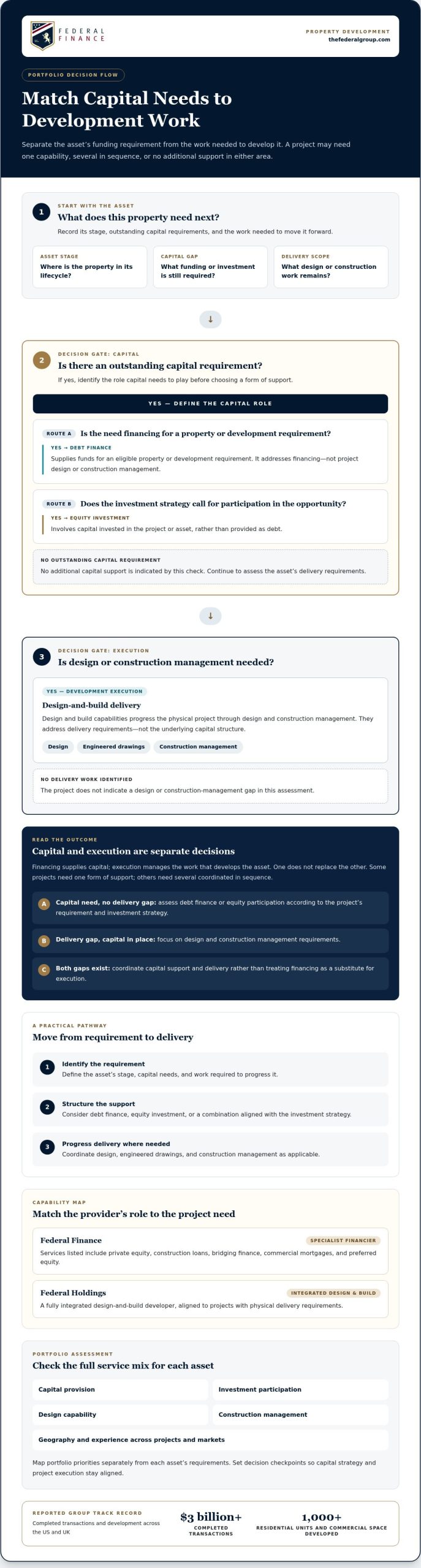
This guide sets out a practical framework for matching development finance, private equity and design-and-build delivery to portfolio needs. It also explains how to assess a specialist partner’s capabilities across projects and markets. Federal Finance operates as a specialist financier, while Federal Holdings is a fully integrated design & build developer. The group’s record includes $3 billion+ in completed transactions and 1,000+ residential units and commercial space developed across the US and UK. The sections ahead show how distinct capabilities can support a property opportunity from capital strategy through execution.
Key Takeaways
- Separate debt finance, equity participation and development delivery so each property opportunity gets the support its requirements call for.
- Use a clear project pathway: identify capital requirements, structure financing or investment, then progress design and construction where needed.
- Compare development services private equity investment portfolio needs across capital, investment participation, design, construction management and geography.
- Map portfolio priorities separately from each asset’s requirements, then set decision checkpoints to keep capital strategy and project execution aligned.
- Distinguish Federal Finance’s financing and investment services from Federal Holdings’ design-and-build role when assessing support for a property opportunity.
What development services can support a private equity investment portfolio?
Development services are capabilities that fund, structure or deliver property development opportunities within an investment portfolio. For a development services private equity investment portfolio, distinguish capital provision, investment participation and project execution. Each addresses a different requirement and may be relevant at a different stage of an asset’s lifecycle.
Private equity describes a broad investment approach, while property development services address the needs of a particular asset or project. For a foundational overview of private equity strategies and their role in investment portfolios, see What is Private Equity? For a property opportunity, focus on practical questions: What capital is required? Does the strategy call for an equity partner? Who will manage the work needed to progress the development?
- Capital provision: Debt finance supplies funds for an eligible property or development requirement. It addresses financing, rather than project design or construction management.
- Equity partnership: Equity investment involves investment participation in an opportunity. Unlike lending, the capital is invested in the project or asset rather than provided as debt.
- Development execution: Design and build capabilities progress the physical project through design and construction management. They address delivery requirements, not the underlying capital structure.
These capabilities can work together, but they are not interchangeable. An asset might need financing for an acquisition, equity participation to support its investment plan, or delivery expertise when construction is required. Some projects call for one form of support; others need several in sequence.
How development services differ from general private equity support
General private equity support can address fund or portfolio-company priorities. Property development services work at the asset level, focusing on a project’s capital needs and delivery requirements. A property requiring construction may need a different combination of capabilities from a stabilized asset or a company seeking broader operational support. Match the service mix to the project rather than applying a standard template.
Which portfolio situations create a development-service need?
A development-service need can arise when an investment plan includes a new property development or when an existing asset requires construction. Start by defining the gap. If the project is ready to proceed but needs capital, assess its financing or equity requirements. If capital is in place but the project needs design or construction management, focus on execution. If both gaps exist, coordinate the support rather than treating financing as a substitute for delivery.
For example, an investor acquiring a site for development may need to assess the funding structure before delivery begins. An asset already under construction may instead need attention to design coordination and construction management. These are separate requirements, even when they relate to the same property.
The right combination depends on the project and investment strategy. For each asset, record its stage, capital requirement and delivery scope before selecting support. This asset-level view helps investors distinguish what needs funding, where investment participation fits and what work is required to advance the property.
How financing, private equity and development execution fit together
A property project is better positioned to progress when its capital structure and delivery plan reflect the same investment objective. In a development services private equity investment portfolio, equity can provide investment participation, debt can address a defined project funding need, and development execution can turn an approved plan into physical work. These roles can be coordinated, but not every project requires all three.
Financing supplies capital; execution manages the work that develops the asset. One does not replace the other. A project may have its delivery team in place but still need funding, or have capital arranged while requiring design and construction management.
A practical project pathway is to:
- Identify the requirement. Define the asset’s stage, capital needs and the work required to progress it.
- Structure the support. Consider whether the opportunity calls for debt finance, equity investment or a combination aligned with the investment strategy.
- Progress delivery where needed. Once the project’s execution requirements are clear, coordinate design, engineered drawings and construction management as applicable.
Where private equity and specialist finance fit
Equity is investment participation in an opportunity. Finance is capital structured around a project requirement. Federal Finance operates as a specialist financier and offers private equity, construction loans, bridging finance, commercial mortgages and preferred equity. These are distinct forms of support. The appropriate route depends on the asset and the role capital needs to play in the investment plan.
For example, a property opportunity with a construction requirement may call for consideration of a construction loan, while an asset with a different financing need may call for another facility. Private equity and preferred equity are investment options, not the same thing as a loan. Assess the project’s structure and strategy rather than assuming that one form of support fits every asset.
Where integrated design and build fits
Capital does not manage construction. Federal Holdings is a fully integrated design & build developer, with in-house design, engineered drawings and construction management. Its own General Contractor licence relates to its development delivery role. These capabilities connect planning and technical design with construction management, keeping the focus on progressing the property work itself.
This distinction helps investors identify the right sequence. A project may need a capital decision before moving into design and delivery; another may already have financing arranged and need execution capability. Federal Finance’s financing and investment services remain distinct from Federal Holdings’ design-and-build role, even when a project calls for coordinated support across both.
For a property opportunity that needs capital and delivery capabilities considered together, explore how The Federal Group supports property development.
How to compare development services for a private equity portfolio
Compare capabilities against the property’s requirements, not just a broad service label. A partner may provide capital, take an investment position, manage development delivery or bring together selected capabilities. The right fit depends on the asset’s stage, intended outcome and outstanding work. Support can be coordinated without requiring one partner to perform every role.
A useful comparison separates capital expertise from project-delivery responsibility. Use a consistent framework to identify what each capability addresses and where it applies.
| Capability | What to assess | Portfolio question |
|---|---|---|
| Capital | Relevant financing capabilities and alignment with the project’s funding requirement. | Does the asset need debt finance for a defined purpose? |
| Investment participation | Private equity or preferred equity experience and how investment participation fits the opportunity. | Does the strategy call for an equity partner? |
| Design | In-house design and the ability to produce engineered drawings, where relevant. | Does the project need design capability to progress? |
| Construction management | Responsibility for coordinating the development work and managing construction. | Who is accountable for delivery? |
| Geography | Evidence of completed work and active projects in relevant markets. | Does the experience relate to the locations under consideration? |
Assess capability against the project, not the service label
Start with the gap the investment needs to close. If the main requirement is capital, assess financing. If the strategy calls for investment participation, consider the equity capability. If the asset needs design or construction management, focus on development delivery. A project can require a combination, but listing every service does not establish fit. Compare the capabilities with the property’s stage, asset type and intended outcome.
This approach avoids ranking services in the abstract. Financing may be central to one opportunity and irrelevant to another. Delivery expertise matters most when there is development work to manage. For a development services private equity investment portfolio, compare how each capability serves a defined asset-level objective.
Evaluate delivery experience and geographic relevance
Look for evidence related to the work, such as completed development, active projects and experience in the markets under consideration. The Federal Group reports 1,000+ residential units and commercial space developed across the US and UK, alongside 10+ active projects. These figures describe its development activity and do not imply identical experience in every location or promise future results.
Keep evidence distinct from assumptions. Match documented activity to the project’s geography and delivery scope, then decide which capabilities are relevant. The Federal Group’s property development capabilities bring specialist financing and integrated development into view as distinct areas to assess against an opportunity.
A practical framework for mapping services across your portfolio
A portfolio-level strategy sets priorities, but each property has its own stage, capital requirements and delivery scope. A structured map helps investment teams see where those needs align, where they differ and which decisions need attention. A portfolio service map is an asset-by-asset view of development needs and the capabilities required to address them.
Use this four-step sequence to turn portfolio priorities into project-level decisions:
- Map the assets. Record each property’s location, current stage and planned development activity. Distinguish assets targeted for construction from those with no immediate development scope.
- Define project needs. For each asset, identify whether the requirement concerns capital, investment participation, design, construction management or a combination. Separate defined requirements from assumptions that still need assessment.
- Match capabilities. Connect each defined need to the relevant capability. Keep financing and investment considerations distinct from development execution, even when a project may need both.
- Set decision checkpoints. Establish when the investment team will review the capital structure, development progress and delivery responsibilities. Track progress against agreed portfolio objectives without treating projected outcomes as assured.
Map asset stages and development requirements
Start with a consistent record for each relevant property: its current stage, intended activity, immediate requirement and open questions. This makes it easier to distinguish portfolio priorities, such as allocating attention to planned developments, from an individual asset’s specific funding or delivery needs. For international projects, international property development finance offers further context for considering financing across markets.
Be precise about what is known. A planned construction project may have an identified delivery scope but unresolved capital needs; another property may have a financing plan while its execution requirements are still being developed. Keeping these details separate reduces the risk of treating an assumption as a decision.
Set decision checkpoints for the investment team
Assign clear ownership for reviewing capital structure, design development and delivery responsibilities. Set checkpoints around meaningful project decisions, such as confirming the support required before moving into the next stage. An integrated delivery model can bring related responsibilities together; learn more about integrated design and build development when assessing execution approaches.
Use each review to compare actual project status with the investment plan, record changes in requirements and decide whether the capability mix still fits. This keeps oversight tied to evidence rather than assumed performance. For a property opportunity, explore development support with The Federal Group as you map the capital and execution needs.
How The Federal Group supports property development investment portfolios
The Federal Group is a specialist financier and international property development group. For a development services private equity investment portfolio, it brings together distinct capabilities for different project requirements: Federal Finance provides financing and investment services, while Federal Holdings delivers design-and-build development. Keeping these roles clear helps investors assess support at asset level without treating capital provision and project execution as the same function.
Federal Finance: specialist financing and private equity
Federal Finance serves individuals, companies and organizations globally as a specialist financier. Its offerings include private equity, construction loans, bridging finance, commercial mortgages and preferred equity. These provide different routes for addressing investment participation or project financing needs. Their appropriate role depends on the opportunity and its capital structure. Investors assessing how equity participation relates to a property opportunity can explore this real estate private equity partnership context.
Federal Holdings: integrated design and build development
Federal Holdings is a fully integrated design & build developer. Its delivery capabilities include in-house design, engineered drawings and construction management, supported by its own General Contractor licence. This is a separate role from Federal Finance’s financing and investment activity. For an asset requiring development execution, these capabilities provide a basis for assessing how design and construction management fit the project’s requirements and investment plan.
The group’s experience provides relevant context for investors assessing a development opportunity. Its record includes:
- $3 billion+ in completed transactions
- $600 million+ total portfolio value across the US and UK combined
- 1,000+ residential units and commercial space developed across the US and UK
- 10+ active projects
- 15+ years of industry experience
These figures describe the group’s activity and track record; they do not guarantee future project or investment outcomes. The development record relates to the US and UK and does not imply identical experience in every market. Investors can use this evidence alongside their asset-level assessment, considering where financing is required, whether equity participation fits the strategy and what development work the property needs.
For a portfolio with projects at different stages, the group’s distinct finance and development capabilities offer a framework for assessing each opportunity on its own requirements. Share the outline of a relevant property opportunity with The Federal Group to discuss how financing or development execution may fit its needs.
Put your next property opportunity into focus
Turn a promising asset into a clear, decision-ready opportunity by setting out its current stage, intended development, outstanding capital requirements and delivery needs. This gives your investment team a practical basis for deciding what support to consider and which questions require further assessment.
A disciplined approach to a development services private equity investment portfolio connects each opportunity to the wider strategy while preserving the detail that makes every asset distinct. It also creates a clear starting point for discussions about structure, execution and the decisions that will shape the project’s next phase.
Bring your plans and priorities into the discussion. Discuss a property development opportunity with The Federal Group and take a considered next step toward progressing your project.
Frequently Asked Questions
What is the difference between a property development service and a property investment service?
A property development service helps progress a project, while a property investment service concerns capital participation in an asset or opportunity. For example, a property may need construction planning and delivery support, while an investor separately evaluates whether to invest equity in it. The roles can sit within one broader strategy, but they answer different questions. Identify whether the immediate need is project capital, investment participation or delivery expertise.
Can a private equity portfolio include development-stage property assets?
Yes. A private equity portfolio can include property assets at different stages, including those with planned development activity. For a development services private equity investment portfolio, consider an asset acquired for future construction alongside a completed property held for another purpose. Their requirements may differ. Assess each opportunity against its investment strategy, project scope and current stage rather than applying one financing structure or development approach across the entire portfolio.
How should investors assess development risk across multiple property assets?
Review each asset on its own terms, then compare the findings across the portfolio. A practical project record can track development stage, capital requirements, delivery responsibilities, open decisions and relevant market context. For example, flag whether a project’s funding plan or construction responsibilities remain unresolved. Use decision checkpoints to revisit those items as the project progresses. This creates a clearer view of differences between assets without assuming a particular outcome.
What does an integrated design and build developer do?
An integrated design and build developer combines defined development capabilities, including design, engineered drawings and construction management. This helps investors understand how design and delivery responsibilities relate within a project. At The Federal Group, Federal Holdings is the fully integrated design & build developer and has its own General Contractor licence. Federal Finance’s role remains distinct, focused on financing and investment services rather than design or construction management.
Why might a property investor consider both debt finance and equity?
Debt finance and equity offer different ways to structure capital around an opportunity. An investor might evaluate debt for a defined project funding need and equity when investment participation aligns with the strategy. The decision depends on the asset, its requirements and the investment plan; neither option is universally appropriate. Compare the intended role of each form of capital and its relationship to project delivery, without assuming specific terms, rates or results.
Does an international property portfolio require the same development approach in every market?
No. A consistent review framework can help an investment team compare assets, but each project still needs assessment in its own market context. For example, an investor might apply the same portfolio-level checkpoints to properties in the US, UK, Canada and EU while recording each asset’s distinct capital and delivery needs. The Federal Group’s active markets include these regions. Avoid assuming that one project plan or capability mix transfers unchanged across markets.