Bridge Investment Group vs The Federal Group: Which Partner Fits Your Project?
12 October 2026The bigger investment platform isn’t automatically the better partner for your project. In a Bridge Investment Group vs The Federal Group comparison, the key question is how each firm deploys capital and where it fits in a property strategy. The distinction matters even more now that Apollo completed its acquisition of Bridge in September 2025, making Bridge part of Apollo’s asset management business.
One firm operates within a large asset management platform, while The Federal Group combines property finance with an integrated development arm. The right fit depends on your project’s requirements, not just a firm’s profile or scale.
This article compares each firm’s stated business model, capital approach, and potential project fit. It also clarifies which “Federal Group” the comparison refers to: the property finance and development group at thefederalgroup.com. Use the practical criteria here, including project stage, asset type, geography, capital needs, and the partner’s intended role, to prepare for a focused discussion.
Key Takeaways
- Use Bridge Investment Group vs The Federal Group to compare operating models and project fit, rather than assuming the firms perform interchangeable roles.
- Separate debt financing, equity participation, and development delivery when assessing what kind of partner your project requires.
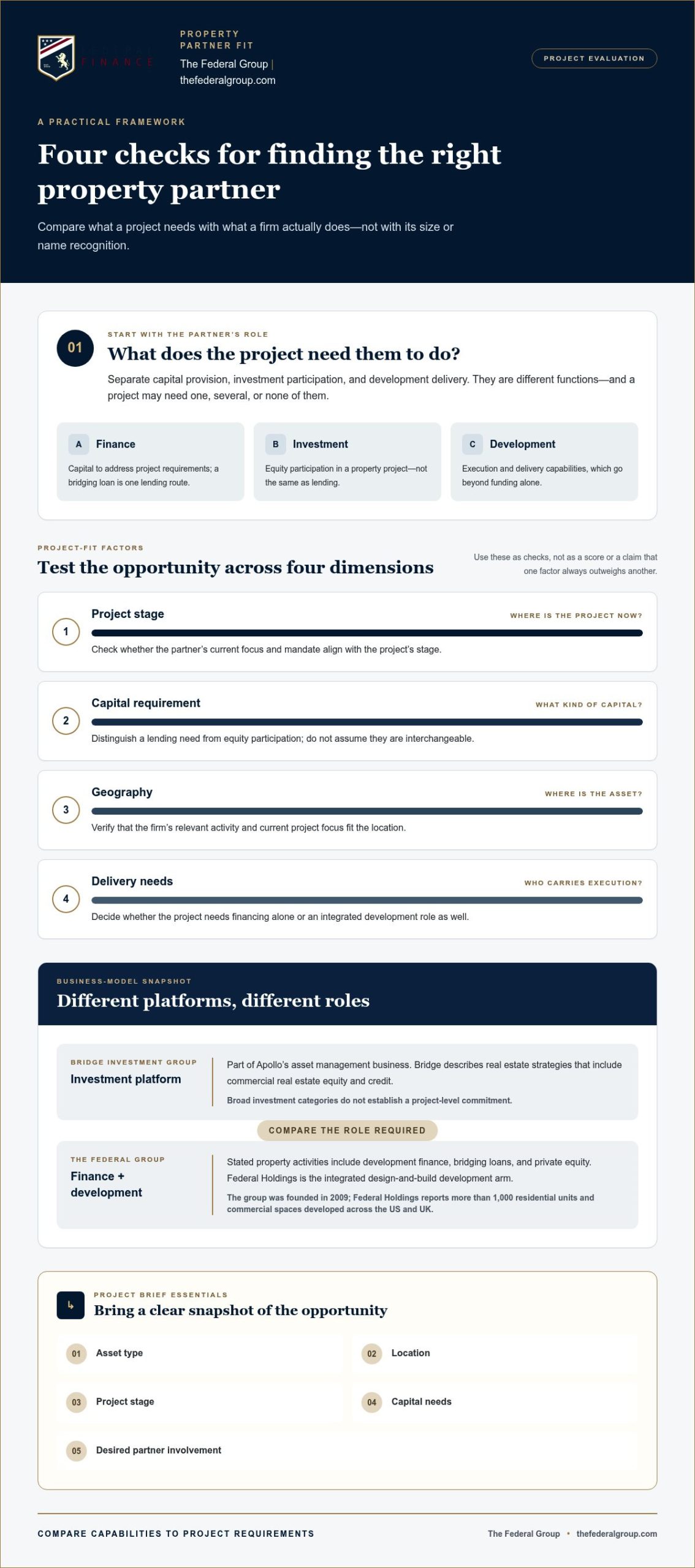
- Evaluate fit against four practical factors: project stage, capital requirement, geography, and delivery needs.
- Understand how The Federal Group’s financing capabilities and Federal Holdings’ integrated development role relate to different project requirements.
- Prepare a concise project brief covering your asset, location, stage, capital needs, and desired partner involvement.
Bridge Investment Group vs The Federal Group: Why the Business Models Matter
The comparison between Bridge Investment Group and The Federal Group is useful when it starts with what each firm does. They may not be direct substitutes: a real estate investment platform, a property financier, and an integrated developer can play different roles in the same project. Comparing names alone can obscure those differences.
Assess four dimensions: property finance, investment activity, development execution, and fit with your project’s stage and requirements. The practical question isn’t which firm sounds larger or more familiar. It’s which role your project needs a partner to play.
Business model is more useful than name recognition: it shows whether a firm’s capital and capabilities align with the work your project requires.
What the comparison can and cannot establish
A sound assessment distinguishes documented facts from interpretation. Company materials and regulatory filings can establish ownership, organizational structure, and stated business lines, but they don’t prove that two firms offer identical mandates or terms. The Bridge Investment Group Wikipedia page provides background on Bridge’s history and investment areas; current company materials are the better reference for present-day details.
Here, the focus is relevance to property projects, not investment performance. Assets under management, transaction history, or completed development work can provide context, but none alone determines whether a firm fits a specific project.
A quick profile of The Federal Group
Founded in 2009, The Federal Group’s property activities include development finance, bridging loans, and private equity. Federal Holdings is its integrated design and build development arm. These are distinct capabilities: financing can address a project’s capital needs, private equity involves investment participation, and development execution concerns delivery. The group’s separate Sports Division invests in professional football clubs globally; that activity is distinct from property finance.
| Item | Documented fact and source date | Current verification point |
|---|---|---|
| Bridge ownership | Apollo completed its acquisition of Bridge in September 2025; Bridge operates within Apollo’s asset management business. Bridge, September 2, 2025. | Confirm current structure and business lines in company materials and filings. |
| The Federal Group | Founded in 2009; its stated activities include property finance, bridging loans, private equity, and integrated development. Company website, accessed October 2026. | Review current project focus and relevant mandate details. |
| Development record | Federal Holdings has developed over 1,000 residential units and commercial spaces across the US and UK. Company website, accessed October 2026. | Check the latest company-reported portfolio information. |
Use this evidence as a starting point, not a verdict. In Bridge Investment Group vs The Federal Group, ownership and stated activities help define the landscape. Project stage, capital structure, geography, and delivery requirements determine whether either firm is relevant to the opportunity.
How Bridge Investment Group and The Federal Group Operate
To understand how these firms might relate to a property project, separate three activities that can sound similar but serve different purposes. Development finance supplies capital for a project. Private equity involves investment participation. Integrated development brings execution capabilities into the project process. A firm may focus on one role or combine several, but not every project needs all three.
Capital can help fund a project; development delivery concerns how the project is carried forward. This distinction helps define a partner’s role, responsibilities, and fit with your project team.
Bridge Investment Group’s verified business profile
Bridge Investment Group is now part of Apollo Global Management. Apollo completed its acquisition in September 2025, and Bridge operates as a platform within Apollo’s asset management business, according to Bridge’s announcement dated September 2, 2025. Bridge’s official materials describe real estate strategies that include commercial real estate equity and credit. For current descriptions of its activities, consult the Bridge Investment Group official website alongside dated company announcements and filings.
That evidence establishes an ownership change and broad investment categories, not a project-level commitment. Fund terms, target assets, geographies, and availability can change. Treat these details as time-sensitive when assessing a particular opportunity.
The Federal Group’s finance and development roles
The Federal Group provides development finance, bridging loans, and private equity for property projects. Each addresses a different potential need: finance supports project capital requirements, bridging loans provide a lending route, and private equity represents investment participation. These are distinct activity categories, not a claim that every project combines them or uses the same structure.
Federal Holdings operates as the group’s integrated design and build development arm. Development activity can therefore involve more than funding alone, bringing a delivery role into the comparison. The group was founded in 2009 and provides capital solutions for property projects. Its separate Sports Division invests in professional football clubs globally, an activity distinct from property finance and development.
For a project team, the practical distinction is whether the need is primarily capital, investment participation, development execution, or a defined combination. A project seeking an investment platform shouldn’t be assessed on the same criteria as one seeking an integrated development partner. In a Bridge Investment Group vs The Federal Group review, compare each firm’s stated role with the project’s stage, structure, and delivery requirements.
For a closer view of The Federal Group’s property activities, explore its international property finance and development information.
Comparing Capital, Investment, and Development Involvement
A useful comparison separates the source of capital from the way a project is delivered. Debt is borrowed capital that must be repaid under agreed terms. Bridging finance is short-term lending commonly used to address a funding need between project stages or transactions. Private equity is different: an investor contributes capital in exchange for an ownership interest or other investment participation, rather than making a loan.
These categories describe distinct roles, not interchangeable services. The exact structure depends on the project and the parties’ agreement. The comparison below reflects publicly stated business activities, not specific terms, rates, minimum project sizes, or a commitment to fund a particular opportunity.
| Activity | Verified firm information | Relevance to project needs |
|---|---|---|
| Debt and bridging finance | The Federal Group provides property development finance and bridging loans. Bridge’s official materials describe real estate strategies that include credit; that category alone doesn’t establish a specific loan product or project mandate. | Relevant when the project needs borrowed capital. Define the required structure, timing, and repayment approach for the specific project. |
| Equity investment | The Federal Group lists private equity among its activities. Bridge describes real estate equity strategies in its official materials. | Relevant when investment participation, rather than a loan alone, may form part of the capital plan. Participation and terms depend on the transaction. |
| Development execution | Federal Holdings operates as The Federal Group’s integrated design and build development arm. Bridge’s stated investment activities do not, by themselves, establish a project delivery role. | Relevant when the project requires a development partner involved in execution as well as capital planning. |
Debt, bridging finance, and equity are different roles
For a project team, the key distinction is how capital relates to the asset and the business plan. Debt creates a borrowing relationship; bridging finance is a lending category; equity brings investment participation. Bridge’s current real estate strategies include equity and credit, according to its official materials, while The Federal Group provides development finance, bridging loans, and private equity. Don’t infer identical products or mandates from shared category labels.
When development execution changes the comparison
Development execution can change the project relationship because design and build activity connects planning and delivery within a development arm. Federal Holdings has this integrated role. It may be relevant when a project needs to coordinate capital decisions with development activity, but integration alone doesn’t guarantee faster delivery, lower costs, or a better result. The project’s scope and agreed responsibilities remain central.
Bridge’s acquisition by Apollo was completed in September 2025, according to Bridge’s announcement dated September 2, 2025. Its current structure and strategy should be understood through dated company materials, particularly when assessing capital activity. In Bridge Investment Group vs The Federal Group, compare the project need with each firm’s documented role: financing, equity participation, development execution, or a defined combination. That distinction creates a more useful basis for evaluation.
Which Firm May Fit a Property Project? A Practical Evaluation Framework
A useful partner assessment starts with the project brief, not a league table. A firm may be relevant for one requirement and not another: a capital provider, an equity investor, and a development delivery partner each address a different part of the plan. Map your requirements to documented capabilities, then identify what needs to be established for the specific opportunity.
Four questions that define project fit
Work through these questions in order. The answers create a concise basis for comparing firms without assuming their roles or terms are identical.
- What stage is the project at? Define whether you’re acquiring land or an asset, planning a development, bridging a funding gap, or progressing toward delivery. State the immediate decision or milestone that requires partner input.
- What capital role do you need? Distinguish development finance or bridging finance from private equity. Describe the purpose of the capital and how it fits the wider project plan, without assuming a particular structure or commitment.
- Where is the project located? Record the country and relevant market. Compare this with each firm’s documented geographic scope rather than assuming that an international profile means every location is within mandate.
- What delivery involvement is required? Decide whether you need a capital relationship alone or a partner with a development role. The Federal Group identifies Federal Holdings as its integrated design and build arm; compare that role with the specific execution responsibilities your project needs.
How to interpret differences without forcing a winner
The answer may not be a single winner. One firm could be more relevant to an investment strategy, while another may align with a project seeking property finance or development involvement. In Bridge Investment Group vs The Federal Group, compare role against requirement: don’t treat a firm’s scale, public profile, or investment activity as proof of suitability for a particular asset.
Use a simple evidence record for each firm: note the capability, its source and date, and how it relates to your project. Separate confirmed statements from open questions. For example, a stated credit or equity strategy indicates an investment category, not that a particular financing structure, location, or transaction is available. Likewise, an integrated development role doesn’t guarantee a delivery outcome or replace a project-specific scope.
If land acquisition is the immediate need, include bridging finance for land acquisition as a distinct requirement in your comparison, rather than treating it as a general development funding need. Prepare a brief with project stage, asset and location, capital purpose, delivery expectations, and key milestones. This makes discussions more precise and shows whether the firms’ stated roles map to the work involved.
Explore The Federal Group’s property finance approach to understand how its finance capabilities may relate to your project requirements.
The Federal Group’s Role in International Property Finance and Development
The comparison points to a practical conclusion: choose a partner by the role your project needs, not by name recognition alone. Bridge Investment Group operates within Apollo’s asset management business, while The Federal Group provides property finance, private equity, and development through Federal Holdings. Those profiles offer context, but they don’t establish which firm is suitable for a specific opportunity or guarantee a particular result.
Assess the project’s capital requirement and delivery needs first. A project seeking finance may need a different relationship from one seeking equity participation or development execution. A combination may also be relevant, depending on the project’s structure and requirements.
Where The Federal Group’s integrated approach is relevant
The Federal Group’s development finance and bridging loans address property capital needs, while its private equity activity represents a distinct investment role. Federal Holdings adds an integrated design and build development capability. That role may be pertinent when a project’s needs extend beyond capital to development delivery, though integration alone doesn’t establish an advantage or a specific outcome.
The group works internationally. For a project with cross-border considerations, location is one factor to include in the assessment, alongside asset, stage, capital purpose, and the delivery role required. An international profile should not be treated as proof that every market or project fits a particular mandate. The international real estate finance partner guide can help frame the finance dimension of that assessment.
Prepare for a project-focused conversation
A focused project overview makes the discussion more specific. Set out the project stage, location, asset type, capital purpose, and development plan. Note whether the requirement concerns development finance, bridging finance, private equity, design and build development, or a combination. Include the anticipated partner role and the key decisions or milestones ahead.
This information supports a clearer assessment of fit; it doesn’t imply a particular approval process, financing structure, or outcome. Keep confirmed project facts separate from assumptions, and explain what the capital is intended to support. That gives both sides a practical starting point for discussing the project’s requirements.
Ultimately, Bridge Investment Group vs The Federal Group is not a universal contest with one winner. It’s a question of alignment: does the documented role match the project’s capital and delivery needs? Explore The Federal Group’s property finance capabilities as you shape your project brief and assess potential fit.
Turn Your Project Brief Into a Clearer Next Step
The strongest partner decision starts with a clear definition of the project. Set out what needs to happen next, what role you expect a partner to play, and how that involvement fits your wider delivery plan. This shifts the discussion from comparing firm profiles in the abstract to testing alignment against real project priorities.
That’s the practical value of Bridge Investment Group vs The Federal Group: not naming a universal winner, but identifying which documented capabilities deserve closer consideration for your specific strategy. Use your brief to frame a focused conversation about the property, capital purpose, and development requirements.
For a project where international property finance and development capabilities are relevant, take the next step and explore The Federal Group’s international property finance capabilities. A well-defined brief gives the conversation a strong foundation and helps you move forward with greater clarity.
Frequently Asked Questions
Are Bridge Investment Group and The Federal Group the same company?
No. They’re separate organizations with different ownership and operating structures. Apollo Global Management completed its acquisition of Bridge Investment Group in September 2025, and Bridge now operates within Apollo’s asset management business. The Federal Group is a separate private property finance and development group. Because “Federal Group” is a name used by unrelated businesses, identify the property firm by its official website, thefederalgroup.com, when researching the comparison.
Is Bridge Investment Group publicly traded in 2026?
No, Bridge’s common stock is no longer publicly traded. Following Apollo’s acquisition, Bridge common stock ceased trading on the New York Stock Exchange in September 2025. Apollo Global Management, by contrast, is publicly traded under the ticker APO. For a current ownership or listing check, use Apollo’s investor materials and Bridge’s dated acquisition announcement rather than older articles that may describe Bridge as an independent public company.
What types of real estate investments does Bridge Investment Group focus on?
Bridge describes its real estate strategies broadly as including equity and credit investments. One example is Bridge Logistics Properties’ value-add fund, which raised nearly $1.4 billion by June 2, 2026, according to Bridge. That example indicates logistics investment activity, but it isn’t a complete account of Bridge’s current strategies. Fund focus can differ, so use current, dated company materials to assess a particular investment area.
Does Bridge Investment Group provide development finance directly?
Bridge’s stated real estate equity and credit strategies don’t, by themselves, establish whether it provides a particular borrower-facing development finance facility. Credit investment can take different forms and shouldn’t automatically be equated with a direct loan to a developer. For a project-level comparison, distinguish Bridge’s documented investment activities from a specific financing mandate, using current official disclosures to describe any facility or lending structure.
Can The Federal Group support international property development projects?
Yes. The Federal Group provides international property development finance, bridging loans, and private equity, and develops projects through Federal Holdings. For a project with cross-border elements, explain where the asset is located and what kind of partner involvement you’re seeking. Clarify whether the immediate need is capital for development, bridging finance, equity participation, or a development role. The project’s details will shape the relevance of each capability.
What information should a developer prepare before discussing a finance opportunity?
Prepare a concise project overview that explains the asset, location, current stage, and intended use of capital. Include a development plan, indicative timeline, current ownership or site-control position, and a summary of known project costs and funding sources. If available, add planning information, feasibility work, and the proposed delivery team. These materials help frame the opportunity and the partner’s potential role; they don’t imply approval or a financing outcome.