How to Secure Funding for a Large Construction Project in 2026
18 October 2026A large construction project isn’t funded by its headline budget alone. A financier needs to understand the full capital requirement, how the project will be delivered, and how the financing is intended to be repaid or realized. If you’re weighing how to secure funding for a large construction project, a compelling vision is only the starting point.
Structuring the request can be challenging. Costs can change, delivery risks can affect the funding case, and the right mix of debt and equity depends on the project’s stage, assets and repayment plan. An incomplete or poorly sequenced application can also create avoidable questions during review.
This guide explains how to build an evidence-led funding case and compare structures such as construction loans, bridging finance and private equity. You’ll learn which project documents and assumptions to prepare, how development readiness and delivery planning shape funding discussions, and why a clear exit strategy matters from the outset. Federal Finance is The Federal Group’s specialist financier, offering financing solutions for property projects.
Key Takeaways
- Learn how to secure funding for a large construction project by connecting the capital request to a credible delivery plan and repayment or exit strategy.
- Compare construction loans, bridging finance, commercial mortgages, private equity and preferred equity against your project’s stage and funding needs.
- Assess financeability by checking that your budget, schedule, development status, sponsor capability and proposed capital structure work together.
- Organize application evidence by project, sponsor, costs, schedule, funding request and repayment or exit plan to make the case easier to assess.
- Understand how Federal Finance’s property and construction financing offerings relate to the funding structures discussed in this guide.
How to secure funding for a large construction project: start with the funding case
A funding case answers three connected questions: how much capital the project needs, how it will be delivered, and how the finance may be repaid or realized. A lender-ready construction funding case is a dated, evidence-led model that reconciles project costs, funding sources, delivery milestones and a credible repayment or exit plan. It should show the total capital requirement and the assumptions behind it, rather than relying on a headline valuation or broad project vision.
Scale alone doesn’t make a project financeable. A substantial asset value cannot make up for an incomplete budget, an unclear development stage, an unrealistic schedule or a mismatch between when funds are needed and when they may be generated. Show the project’s readiness and execution plan alongside its proposed capital structure and cash flow. This is especially relevant to megaprojects, where economics, funding and delivery challenges are closely connected, as outlined in Megaproject funding and economics.
Be precise about the funding requirement. Whole-project development finance supports a property project’s capital needs across its development plan. A contractor’s short-term working-capital requirement, by contrast, addresses near-term business cash flow, such as the timing of mobilization or supplier payments. These needs are related to construction but are not interchangeable. Define the borrower, purpose, amount and timing before presenting the request.
Build a complete picture of the project’s capital requirement
Break the working model into acquisition, design, construction, professional fees, financing costs and contingency. Show total project cost, sponsor contribution and requested finance as separate figures. For each material assumption, record its source and date, and flag estimates that still need validation. A single undifferentiated budget makes it harder to understand what drives the request and where uncertainty remains.
Map anticipated expenditure against delivery milestones. This makes it easier to see when capital is required and whether the requested amount and timing fit the project sequence. Keep contingency visible as a separate assumption. Explain what it is intended to cover and how it was estimated rather than burying it in another cost line.
Explain the project’s commercial logic and intended exit
Summarize the asset, its intended use, the market rationale and the project’s current development stage. Support relevant claims with project documents or market analysis, and label assumptions that remain sensitive or unverified. This helps a reviewer distinguish established project facts from the sponsor’s expectations.
Set out the anticipated repayment or realization route, such as a sale, refinancing or income from an operating asset, where relevant. Explain how that route connects to the project’s timing and delivery plan. Avoid presenting projected values, demand or cash flow as guaranteed outcomes. A coherent case makes the path from capital need through completion to potential repayment easy to follow.
Compare construction project funding structures before choosing a route
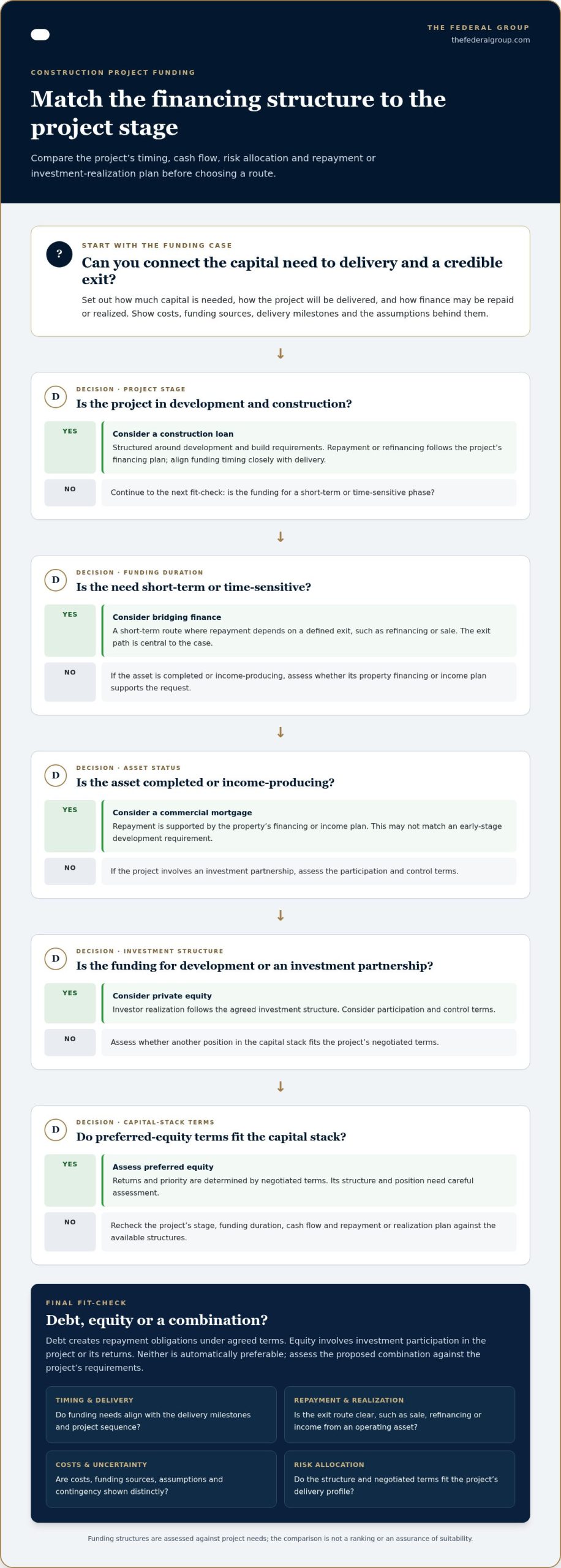
The right capital structure depends on what the project needs at each stage, how long funds are required, and how repayment or investment realization is expected to work. Debt creates repayment obligations under agreed terms. Equity involves an investment participation in the project or its returns. Neither is automatically preferable. When considering how to secure funding for a large construction project, compare structures against the project’s timeline, cash flow and risk allocation, then assess whether the proposed combination can support the project’s requirements. Working with a specialist commercial finance brokerage such as TMS Finance can help businesses evaluate these options and secure tailored funding solutions.
Large infrastructure projects also show how funding approaches can vary with asset type and scale. The European Investment Bank transport project financing overview offers an international perspective on financing transport infrastructure. It illustrates why the capital source should fit the project’s purpose and delivery profile.
| Capital source | Project stage | Repayment or realization logic | Key trade-offs |
|---|---|---|---|
| Construction loan | Development and construction | Repayment or refinancing follows the project’s financing plan | Debt obligations; timing and delivery need close alignment |
| Bridging finance | Short-term or time-sensitive phase | Repayment from a defined exit, such as refinancing or sale | Short duration makes the exit path central to the case |
| Commercial mortgage | Completed or income-producing asset | Repayment supported by the property’s financing or income plan | May not match an early-stage development requirement |
| Private equity | Development or investment partnership | Investor realization follows the agreed investment structure | Participation and control terms must be considered |
| Preferred equity | Capital stack where its terms fit | Returns and priority are determined by negotiated terms | Structure and position need careful assessment |
When construction loans or bridging finance may fit
A construction loan is structured around a project’s development and build requirements. The funding request should therefore reflect when capital is needed as work progresses. Bridging finance may suit a temporary capital gap, such as a time-sensitive phase before longer-term financing or another planned exit. For real estate investors seeking asset-backed commercial or bridge financing, private money brokerages such as jglcapital.com offer solutions designed to close short-term funding gaps quickly. Before seeking short-term capital, map the repayment or refinancing route to realistic milestones. Treat a projected exit as an assumption to support with evidence, not a guaranteed outcome.
When equity or preferred equity may be considered
Private equity can support a project through an investment partnership, with participation and realization governed by agreed terms. Preferred equity is a distinct structure within the capital stack, not a universal substitute for debt or ordinary equity. Assess its role alongside the project’s cash flow, sponsor contribution and decision-making arrangements. Broader context on International Property Development Finance and the role of a Real Estate Private Equity Partner can help frame those comparisons.
A blended structure may align different capital sources with different project phases, depending on the assessment and terms each source requires. The aim is not to assemble the largest number of funding sources. It is to create a coherent structure with clear uses, obligations and repayment or realization logic. For a project-specific perspective on development finance and private equity, explore The Federal Group’s specialist finance capabilities.
What makes a large construction project financeable?
A substantial projected asset value can strengthen a project’s rationale, but it doesn’t establish that the project can be delivered or that financing can be repaid. Financeability depends on whether the evidence tells a coherent story: costs align with the schedule, the development is sufficiently advanced for its next phase, the sponsor and delivery team can execute, and the capital structure fits the project’s cash flow. A gap in any one area can weaken confidence, affect decision timing or influence proposed financing terms.
Assess the project as a connected plan, not as a collection of attractive headline figures. If the schedule depends on a key milestone being reached by a certain date, show what supports that assumption, who is responsible and what happens if it takes longer. This helps distinguish a managed risk from an unexplained gap. Planning, security and legal requirements vary by jurisdiction and transaction, so a general checklist is not a universal rule.
Evidence that supports project and sponsor credibility
Present project status and delivery evidence together. Site control, design information, cost planning and the construction schedule should reflect the project’s actual stage. Make responsibilities clear across the sponsor, management team and relevant delivery partners. A strong presentation doesn’t hide uncertainty. It identifies it and explains how it will be managed.
- Development status: Summarize site control, design progress and material dependencies.
- Cost and schedule: Align the current cost plan with milestones and explain key assumptions.
- Sponsor capability: Present relevant experience, governance and financial capacity accurately.
- Risk ownership: Record significant risks, mitigation steps and the person responsible for each action.
For example, if construction cannot proceed until the design is complete, make that sequence visible in the schedule. Show what has been completed, what remains outstanding and how the delivery plan addresses the dependency. The aim is not to imply that every risk can be removed, but to demonstrate that material risks have owners and practical responses.
Cash flow, drawdowns, and repayment logic
Translate the delivery schedule into a funding timeline. Map anticipated construction expenditure to milestones and identify when capital is required. Where the agreed terms provide for staged drawdowns, align them with documented progress and project needs rather than treating funding as a single undifferentiated event. The model should show how each funding period relates to planned work and available capital sources.
Then connect projected cash flow to a credible repayment or realization strategy, such as refinancing, sale or longer-term ownership. Explain the assumptions behind the chosen route and how timing, project progress or market conditions could affect it. A financeable project is not one without uncertainty. It is one where the evidence, execution plan and cash-flow logic are sufficiently aligned for a financier to assess the opportunity and its risks.
How to prepare and submit a construction funding application
A disciplined application helps a financier assess the project, its sponsor and the funding request without having to reconcile conflicting versions of the plan. Start discussions early enough to identify evidence gaps before they become time-critical. Requirements vary by project, financing structure and jurisdiction, so use the process below as a framework rather than a universal checklist.
A coherent construction funding application connects the capital requested with supporting evidence and delivery milestones that show how the funds will be used. Keep one controlled set of current documents, record revisions and check that key figures agree across the funding brief, budget and schedule. Consistency makes it easier to maintain a clear case as assessment and diligence progress.
Assemble the project information pack
Build a concise funding brief, then organize the supporting material so each claim can be traced to its source. Group documents by project, sponsor, costs, schedule, funding request and repayment or exit evidence. Include design, engineering, construction, market and financial materials relevant to the project’s stage. Clearly label verified information, estimates and assumptions that still need validation.
- Prepare the funding brief. Summarize the project, asset, intended use, development status, proposed structure, funding amount, timing and intended repayment or exit.
- File evidence by category. Place site and development information under project; sponsor background and governance under sponsor; cost plans and supporting estimates under costs; and milestone plans under schedule.
- Reconcile the model. Check that the funding request, sponsor contribution, budget and drawdown timing agree across documents. Date material inputs and explain any differences.
- Review for completeness. Note outstanding information, its expected source and its relevance to assessment. Document requirements may vary with the project and jurisdiction.
Small discrepancies can create avoidable clarification rounds. For example, if the schedule assumes a different completion date from the cash-flow model, identify which version is current and update the other document before submission.
Run a disciplined funding discussion and diligence process
Present the proposed structure alongside the required timing, drawdown profile and repayment or exit logic. Be ready to explain dependencies, material risks, mitigations and sensitive assumptions consistently. During diligence, log each request, its owner, the response and any resulting change to the model or project plan. This creates a clear record and reduces the chance that later answers contradict the original case.
- Submit the brief and core evidence. Set out the project’s current position and identify supporting materials.
- Work through assessment questions. Respond with evidence and update relevant documents when an assumption changes.
- Review diligence and proposed terms. Compare the proposed structure, conditions, timing and obligations with the project plan before progressing.
- Coordinate completion. Track remaining documentation and transaction steps against the agreed process and applicable requirements.
For sponsors considering how to secure funding for a large construction project, early preparation is practical risk management. It gives the funding discussion a reliable basis while leaving room to address project-specific diligence. Learn more about property financing through Federal Finance.
Secure project funding with The Federal Group’s specialist capabilities
Choosing a capital structure is only part of the work. A productive funding discussion also depends on presenting the project’s stage, capital requirement, timing and delivery plan together. Federal Finance is The Federal Group’s specialist financier for property and construction funding. Its financing offerings include Construction Loans, Bridging Finance, Commercial Mortgages, Private Equity and Preferred Equity.
For sponsors considering how to secure funding for a large construction project, connect the project’s needs to the right financing discussion. Outline the asset and development stage, the capital required, when funds are needed, the preferred structure and the intended repayment or exit. This gives the discussion a project-specific foundation without treating any structure or outcome as assured.
Match the discussion to the project’s funding requirement
Bring a concise project summary, current funding model and delivery timeline. Identify which assumptions are supported by evidence, which remain subject to validation and how the requested capital relates to upcoming milestones. Federal Finance’s specialist finance expertise can help frame a discussion around those requirements. The Federal Group’s 15+ years of industry experience provides context for that expertise, not a promise of funding or a particular decision.
At group level, The Federal Group has completed $3 billion+ in transactions and has a total portfolio value of $600 million+ across the US and UK. These figures describe the group’s completed transactions and portfolio, respectively. They provide context on the group’s scale, while each funding case remains tied to its own evidence, structure and assessment.
Keep financing and delivery capabilities clearly distinguished
Federal Finance is the group’s financing vertical. Federal Holdings is a separate, fully integrated design-and-build developer with its own General Contractor licence, in-house design, engineered drawings and construction management. Keeping these capabilities distinct makes clear which vertical provides financing and which undertakes development activity. Where delivery integration is relevant to a project plan, the guide to an Integrated Design and Build Developer can provide further context.
For a funding discussion, organize the key information before presenting the opportunity:
- Project: asset, intended use and current development stage.
- Capital: total requirement, proposed structure and sponsor contribution.
- Timing: expected funding periods and relevant delivery milestones.
- Repayment or exit: intended route and evidence supporting its assumptions.
A focused brief keeps the conversation grounded in the project’s actual requirements. Discuss your construction project with Federal Finance.
Turn your funding case into a clear next step
Put the project’s current position into a concise brief and identify the decisions that could shape its financing: what capital is needed, when it must be available, and how the project is intended to reach repayment or realization. Keep unresolved assumptions visible. A clear account of what’s established and what still needs work can make the next funding discussion more focused.
Understanding how to secure funding for a large construction project is not about forcing every opportunity into one structure. It’s about presenting a credible plan and exploring a financing approach that fits the project’s requirements. Federal Finance brings specialist property finance expertise to that discussion, backed by The Federal Group’s track record of $3 billion+ in completed transactions and a $600 million+ total portfolio value across the US and UK, with 15+ years of industry experience.
Discuss your construction project with Federal Finance to take a considered next step toward financing. A well-prepared funding case gives your project a stronger foundation for the conversations ahead.
Frequently Asked Questions
How early should I seek funding for a large construction project?
Start exploring funding before a capital gap becomes urgent, ideally while the project’s scope and development path are taking shape. Early discussion can help identify information gaps and whether the proposed structure fits the project’s stage. When considering how to secure funding for a large construction project, distinguish an initial discussion based on current information from a formal application supported by a more developed evidence pack.
What documents are usually needed to apply for construction project funding?
Requirements vary, but a useful starting pack may include sponsor and project entity details, evidence of site control, available design and engineering materials, a detailed cost plan, a delivery schedule and a cash-flow model. Add relevant sponsor financial information and documents supporting the intended repayment or exit. Date and clearly name source files so updated plans or estimates can be distinguished from superseded versions.
Can a construction project use more than one type of funding?
Yes, a project may combine capital sources if their roles, timing and terms work together. For example, a sponsor might consider equity for part of the capital stack and debt for another requirement, subject to assessment. Map each source to its intended use and repayment or realization logic. Account for how the sources interact, including priority or control terms that could affect project decisions.
How are funds typically released during a construction project?
Funds may be released in stages under the agreed financing terms, with each request tied to the project’s funding needs and any required evidence of progress. A draw request could relate to a planned construction milestone or eligible project expenditure. Build the expected release schedule into cash-flow planning, and allow time to assemble supporting records. The process depends on the financing arrangement and project requirements.
Does a project need final planning approval before funding discussions begin?
Not necessarily for an initial discussion. A project can be presented at its current development stage, provided its status and outstanding planning matters are described accurately. Identify approvals or decisions that could affect timing, design or delivery, and explain how they relate to the proposed funding request. Requirements differ by jurisdiction and project, so assess planning status in its local context.
How does the repayment or exit plan affect a construction funding request?
The repayment or exit plan shows how the financing is intended to be repaid or realized and whether that route fits the project’s delivery and cash-flow profile. Support the plan with relevant evidence and state the assumptions it depends on. If repayment relies on refinancing, sale or future operating income, explain the timing and conditions that could affect it. A forecast is a planning case, not a guaranteed result.
Can an international property project apply for specialist construction finance?
Federal Finance serves property projects across global markets. Prepare a clear account of the asset’s location, borrower structure, funding need, project stage and intended exit. Cross-border transactions can involve jurisdiction-specific planning, security and legal considerations, so assess those details in the context of the project and relevant markets. An initial discussion does not itself determine financing terms or approval.