Challenges of Owning a Football Club, From Startup Costs to Fair Competition
30 October 2026Owning a football club is a capital-intensive, long-term undertaking, and the challenges of owning a football club reach well beyond building a squad. Owners must define the club’s identity, fund its operations, manage cash flow and weigh how control affects players, supporters and competition. By early 2025, nearly 400 football clubs worldwide were controlled by multi-club owners or ownership groups, adding further complexity to questions of influence and fairness.
It’s natural to focus first on the team and the ambition to compete. But a club’s long-term direction also depends on sound financial planning, a clear mission and governance that can withstand competing interests. This article explores the challenges of owning a football club, from launching a team to managing the risks of concentrated ownership. You’ll learn what drives startup costs, why cash flow can come under pressure, and how owners can balance strategic influence with the integrity of the game.
Key Takeaways
- Set a clear club mission early so sporting ambition, community identity and long-term priorities guide decisions.
- Build a realistic startup budget around facilities, staffing and ongoing cash flow, not just the initial launch.
- Assess how shared ownership can shape club autonomy, decision-making and the movement of players across teams.
- Put transparent governance and conflict-of-interest safeguards at the center of ownership to support fair competition.
1. Defining the club’s identity and mission
A club’s mission should define who it represents, how it aims to compete and what it will protect during setbacks. A community-rooted club, for example, might prioritize local player development and affordable access, while a professional side may focus on sustained performance and academy progression. These priorities shape recruitment, spending and communication with supporters.
Owners can make the mission operational by setting a clear sequence: identify the club’s community and sporting context, establish priorities, then align coaching, recruitment and investment with them. In the UK, more than 10,000 clubs are affiliated with the County FA system, while more than 7,000 compete at Step 7 of the grassroots football pyramid. A club’s identity must fit its actual level and ambitions.
For a new or changing club, identity also takes shape through visible decisions: its name, colors, home ground and relationships with local teams. Matching these commitments to the club’s stated purpose and operating model helps make its identity credible.
Building a competitive roster means balancing immediate results with a coherent squad plan. Owners must identify recruitment priorities, decide how coaching will develop existing players and consider what may encourage players to stay, including a clear role and credible sporting direction.
A fan base grows through consistent engagement, not match results alone. Owners can establish regular channels for supporter feedback, explain major decisions and build local partnerships, such as programs with schools or community clubs, that give residents a reason to identify with the team.
Youth academies require sustained attention to coaching, player progression and safeguarding. In clubs with players under 18, coaches must have an up-to-date enhanced DBS check, and a Club Welfare Officer is a mandatory role. Owners must also align academy pathways with first-team needs without treating young players as guaranteed future assets.
When mission, roster strategy and community relationships pull in different directions, owners face difficult trade-offs. A written set of priorities gives the board a consistent basis for decisions, from signing a player to allocating pitch time or supporting an academy pathway.
2. Startup costs, budgets, and cash-flow risks
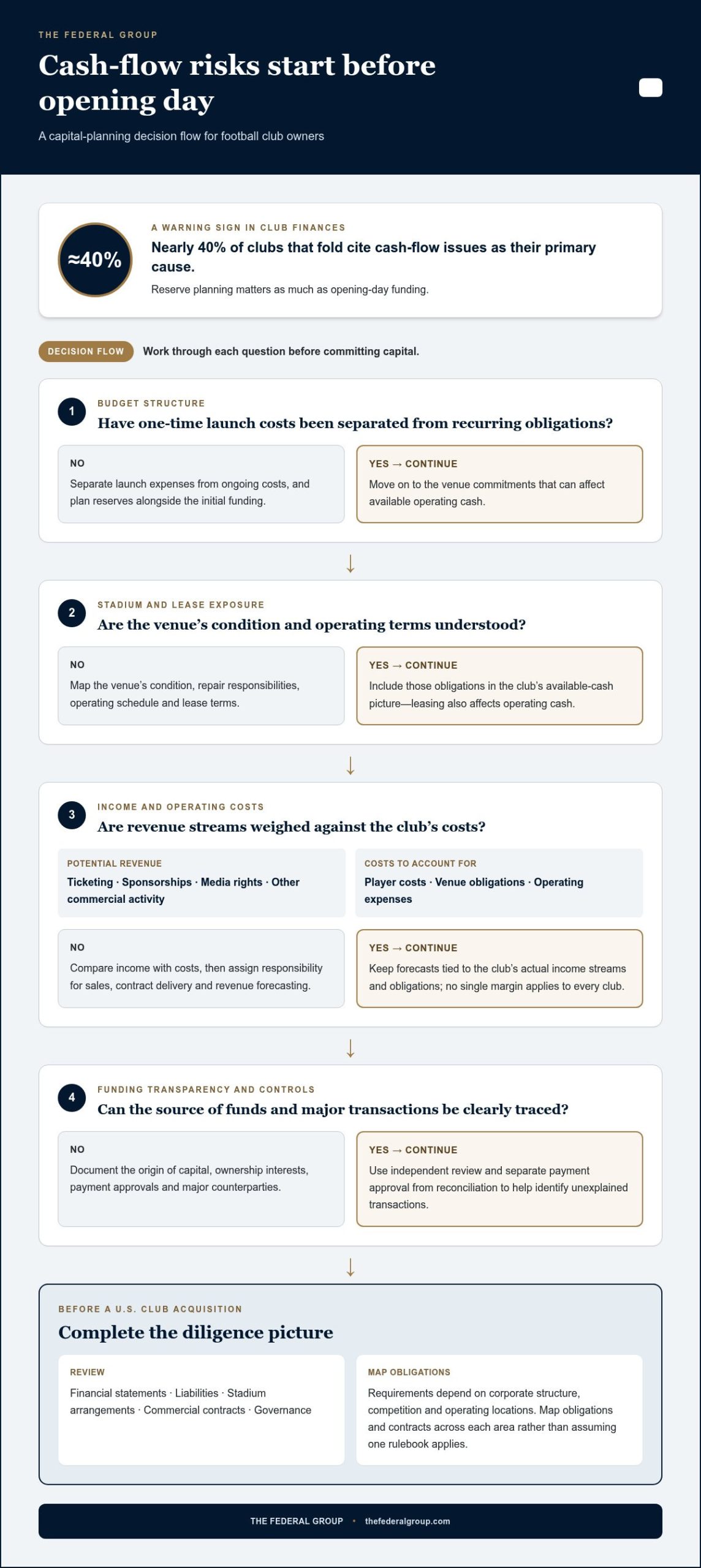
Separate one-time launch expenses from recurring obligations before committing capital. Nearly 40% of clubs that fold cite cash-flow issues as their primary cause. Reserve planning matters as much as opening-day funding.
In the United States, requirements for a professional club depend on its corporate structure, competition and operating locations. Before an acquisition, map the relevant obligations and contracts across each area rather than assuming one rulebook applies to every club.
Stadium ownership, leases and maintenance create different cash-flow demands. Owners need to account for the venue’s condition, repair responsibilities, operating schedule and lease terms. Leasing may avoid the need to own the asset, but the obligations still affect the club’s available operating cash.
Clubs can earn revenue from ticketing, sponsorships, media rights and other commercial activity. Profitability depends on how those income streams compare with player costs, venue obligations and operating expenses; there is no single margin that applies to every club. Assign clear responsibility for sales, contract delivery and revenue forecasting.
Financial crime and money-laundering risks make transparent funding and transaction records essential. Document the origin of capital, ownership interests, payment approvals and major counterparties. Independent review, along with separating payment approval from reconciliation, can help identify unexplained transactions.
Before buying a U.S. club, review its financial statements, liabilities, stadium arrangements, commercial contracts and governance. A structured capital plan can clarify the investment required; explore club development finance as part of that planning.
3. Concentration of ownership and influence
Multi-club ownership can extend one investor’s influence across several football teams. In 2021, 156 clubs worldwide belonged to multi-club ownership groups, and football had 60 such groups. By early 2025, nearly 400 clubs were controlled by 147 different multi-club owners or ownership groups. The challenges of owning a football club can therefore include balancing group strategy with each club’s independent sporting priorities.
City Football Group owns Manchester City and several other clubs, demonstrating how ownership can span teams. Shared structures may coordinate investment or create player pathways, but they can also complicate decisions at individual clubs. Owners should define which decisions belong to each club and which involve the wider group, then document how those responsibilities work in practice.
The effects reach players as well as boardrooms. By early 2025, thousands of players worldwide were affected by multi-club ownership groups. Movement between connected teams can create development opportunities, while raising questions about player choice and whose interests guide decisions. Play the Game began tracking ownership and governance problems in 2021, then published coverage of player protections on 2 May 2024.
A key challenge of owning a football club within a group is establishing clear accountability. Map ownership links, identify who approves transfers and investment, and document how potential conflicts are reviewed. Transparent reporting lines help boards, players and supporters understand who has influence and how decisions are made.
Play the Game published articles on governance challenges on 27 October 2021 and changing ownership on 14 April 2025. These discussions point to a practical need: each club should have defined decision rights, oversight and a clear account of how shared resources support its objectives. Such governance gives owners a stronger basis for assessing influence across the group.
4. Conflicts of interest and fair competition
A club owner must protect fair competition while balancing sporting, commercial and investment priorities. Practical governance starts with clear decision-making authority, documented financial approvals and a process for declaring conflicts. Requirements vary by jurisdiction and competition, so owners need to understand the rules that apply to each club and keep decisions traceable.
Conflicts can arise when connected clubs compete for the same players, share commercial relationships or make decisions affecting a common owner. For example, a transfer between related clubs should have a documented rationale and transparent approval process. Independent review can help boards distinguish each club’s sporting interests from wider group objectives.
League structures shape an owner’s risk and planning horizon. In a promotion-and-relegation system, sporting performance can change a club’s competitive level and revenue outlook. A franchise structure may instead center on membership and league participation rules. Before setting investment plans, owners should map the competition format, entry conditions and financial consequences.
Compliance is an ongoing governance responsibility, not a task to complete only during acquisition. Assign responsibility for financial reporting, contract records, conflict disclosures and competition-related decisions. A board can maintain a decision log recording who approved each transaction, the rationale and any related-party interests. These steps support accountability while allowing for differences in jurisdiction.
Integrity concerns also extend to financial crime. Play the Game published an article about crime risks associated with multi-club ownership on 22 April 2025. Clear ownership records, documented funding sources and review of unusual transactions help strengthen oversight. Play the Game also published an article about a buying spree threatening football integrity on 10 March 2023, underscoring why ownership decisions warrant scrutiny.
For owners assessing how investment and club structures interact, explore strategic football ownership as part of a disciplined governance approach.
The Federal Group: Development Finance
The Federal Group supports football investment through Development Finance and Private Equity, and its Federal Holdings division operates as a fully integrated design-and-build developer for projects involving club facilities. Its Sports Division invests in and manages professional football clubs globally through a multi-club ownership model. These capabilities can be relevant when ownership plans involve capital, property development or connected clubs.
The right starting point depends on the project: financing, facility development or a multi-club investment strategy. The Federal Group brings together property finance, development and sports investment for plans that combine these needs.
To discuss your football club plans, contact The Federal Group or visit thefederalgroup.com.
Build the Club You Intend to Lead
The next step is to turn ambition into an ownership plan that can guide decisions under pressure. Define what success means for your club, establish who is accountable for key choices and connect investment priorities to a long-term sporting direction. This framework helps owners respond consistently as opportunities and risks change.
The challenges of owning a football club are easier to address when finance, development and governance decisions work together. The Federal Group offers Development Finance, Private Equity and Design & Build Development for projects where these capabilities support a club’s investment and development requirements. Contact the team to discuss how your plans align with these services.
Contact The Federal Group to discuss your project and take a considered next step toward building a sustainable future for your club.
Frequently Asked Questions
What does it cost to buy and operate a professional football club in the United States?
There’s no single purchase price or operating figure for every professional football club in the United States. Valuation and ongoing requirements depend on the competition, the club’s assets and liabilities, its contracts and its stadium arrangements. Before agreeing to a purchase, build a forecast that separates acquisition costs from recurring obligations, then test whether projected income can support the club under different sporting and attendance scenarios.
What are the biggest financial risks of owning a football club?
The main financial risks include income falling short of committed expenses, unexpected asset or facility needs, and reliance on a small number of commercial partners. A sponsor’s departure or lower-than-planned ticket sales, for example, can reduce available cash while existing contracts remain payable. Owners can strengthen oversight by stress-testing budgets, tracking contract renewal dates and setting approval controls for major commitments and related-party transactions.
How do football clubs generate revenue, and what are typical profit margins?
Clubs can earn revenue from ticketing, sponsorships, media rights and other commercial activity. Profit margins vary according to how those income streams compare with player costs, venue obligations and operating expenses; no single margin applies across clubs.