Loan to Cost for Construction: How Project Costs Shape Borrowing
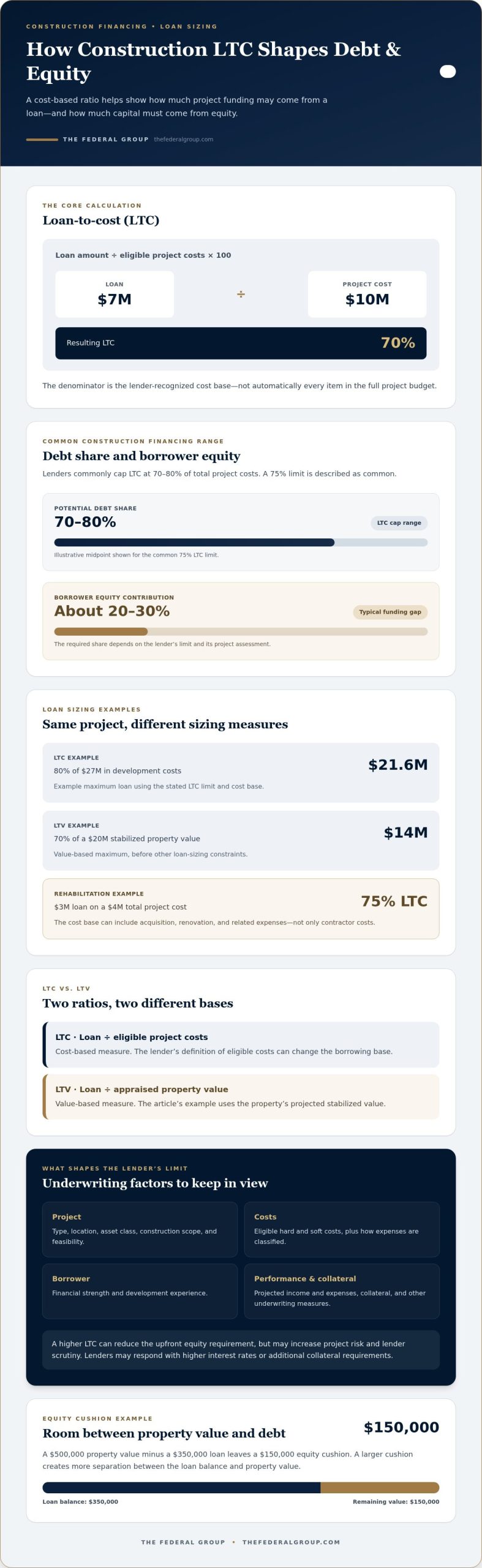
26 October 2026The borrowing limit is shaped by the costs a lender is willing to finance, not just by the value of the finished property. Understanding loan-to-cost for construction starts with a simple calculation: divide the loan amount by eligible project costs. For example, a $7 million loan against a $10 million project cost equals a 70% loan-to-cost ratio.
That ratio helps clarify how much capital may come from debt and how much the developer needs to contribute as equity. Construction lenders commonly cap loan-to-cost at 70-80% of total project costs, with 75% described as common, though the applicable limit depends on the project and borrower.
This guide explains which costs may count toward understanding loan-to-cost for construction, how LTC differs from loan-to-value, and how the ratio affects borrowing capacity, equity needs, and project risk. You’ll also learn how a lender’s treatment of eligible costs can change the construction loan amount, even when the total budget stays the same.
Key Takeaways
- Separate total development costs from the construction budget: land and soft costs can affect the borrowing base, while lenders may exclude some expenses.
- Compare loan-to-cost with loan-to-value to see how project spending and projected completed value can produce different borrowing limits.
- Assess the equity contribution alongside the ratio: a higher debt share can reduce upfront equity needs but increase financing risk and scrutiny.
- Look beyond the headline loan limit. Project type, eligible costs, borrower strength, and the lender’s underwriting criteria all shape the amount available.
What is Loan to Cost Ratio?
Lenders set a construction loan’s maximum LTC by weighing project type, location, borrower strength, projected income and expenses, and collateral asset class. Developer experience and financial strength can also influence the ratio.
LTC Definition and Calculation
Loan-to-cost measures the loan as a share of total project costs: divide the loan amount by those costs, then multiply by 100. A $7 million loan for a $10 million project produces a 70% cost ratio. One practical use of understanding loan-to-cost for construction is estimating the debt share before finalizing a capital plan.
Commercial real estate lenders commonly use LTC for ground-up construction and substantial rehabilitation. Eligible costs matter because a lender may exclude some budget items, changing the cost base used in the calculation.
Maximum Loan and Required Equity
The maximum loan calculation applies the lender’s LTC limit to the costs it recognizes. At an 80% LTC ratio on $27 million of development costs, the example maximum loan is $21.6 million. This calculation helps developers assess the funding gap alongside the planned capital structure.
Loan-to-value (LTV) compares debt with the property’s appraised value. Divide the loan by that value and multiply by 100. A project valued at $20 million when stabilized supports a maximum $14 million loan at 70% LTV, before other loan-sizing constraints. Understanding loan-to-cost for construction also requires distinguishing this cost-based measure from value-based limits.
Factors That Set Maximum LTC
Lenders assess location, asset class, project feasibility, projected income and expenses, and the borrower’s financial strength. The construction scope and assessment of eligible costs also shape the ratio. A developer’s experience and financial strength may support a higher LTC.
These factors help lenders assess whether the requested debt fits the budget and the project’s expected performance. They may also consider debt service coverage, debt yield, and LTV based on the future stabilized value. As a result, the same project cost can support different loan amounts under different underwriting assessments.
Land, soft costs, and hard costs in project costs
Project costs can include more than construction work. Which categories count toward LTC affects the financing base and the resulting loan calculation.
Costs Included in LTC
LTC may include land acquisition, construction or rehabilitation, and related development expenses. Depending on the project scope, soft costs may include architectural plans, impact fees, interest, and other financing fees. For custom residential projects, teams like Galloway Realty help coordinate both lot purchase and building plans so development budgets are clear from the outset. Lenders may assess only eligible costs, rather than accept the full budget, so excluding certain expenses can change the ratio.
Construction and Rehabilitation Costs
Hard costs cover the physical work needed to build or improve a property. Soft costs support planning and project delivery. Together, they form the project-cost base used to calculate LTC, so construction costs are only one part of total development costs.
For rehabilitation, the project budget can combine the acquisition price with renovation work and related expenses. A commercial rehabilitation project with a $4 million total cost and a $3 million loan has a 75% LTC ratio. This shows why the denominator should reflect the full development plan, not just contractor costs.
Lenders may treat expenses differently. For example, a construction budget may exclude financing costs, including the upfront loan origination fee, from total development costs. In other cases, interest and other financing fees may be included, depending on the project scope. Separate included and excluded expenses, and hard and soft costs, to clarify the eligible-cost base.
For a project involving land acquisition and delivery, project financing considerations can help frame how costs relate to the overall development plan.
How LTC relates to investor equity and risk
A higher LTC means borrowers contribute less equity and take on greater project risk. Lenders may respond with higher interest rates, additional collateral requirements, or closer scrutiny of project feasibility. Borrowers can lower LTC by contributing more equity or reducing the loan request. Financial strength, development experience, and a feasible project may also support better terms.
Borrower Equity Contributions
Borrower equity is the capital contributed to cover the portion of total project cost not financed through debt. It matters because the lender’s maximum LTC determines the minimum funding gap the borrower must fill. Construction borrowers commonly need to cover about 20-30% of project costs with equity when lenders cap LTC at 70-80%. The required share depends on the lender’s loan limit and its assessment of the project.
Equity Cushion and Risk
An equity cushion is the value remaining after subtracting debt from an asset’s value. It matters because a larger cushion provides more separation between the loan balance and the property value. For example, a property valued at $500,000 with a $350,000 loan has a $150,000 equity cushion. A higher LTC reduces the borrower’s upfront equity contribution, but leaves less capital between project costs and debt.
Lowering LTC for Better Terms
Lowering LTC means reducing the loan relative to eligible project costs, which can reduce lender exposure. Borrowers can contribute additional equity, request less debt, or ensure the budget accurately identifies eligible costs. Financial strength and relevant development experience may also support the lender’s assessment. Together, these factors help determine whether the proposed financing fits the project’s feasibility and risk profile.
Equity planning also affects the capital available for contingencies and project delivery. Consider the full budget, lender-recognized costs, and required contribution together. A lower debt share can reduce financing exposure, but retaining adequate capital for delivery remains central to managing development risk—often supported by tailored risk management from firms like Paterson Insurance Brokers to safeguard project capital.
Construction loan amounts and down payments
In the United States, construction lenders commonly cap loan-to-cost at 70-80% of total project costs, with 75% described as common. The ratio influences the maximum loan and required down payment; higher LTC may also bring higher rates, added collateral, or closer feasibility review.
Typical Construction Loan LTC
A construction loan’s LTC limit sets the maximum debt as a share of recognized project costs, helping borrowers estimate their funding gap. The actual limit varies by project type, lender, and borrower credit profile.
Some lenders may offer financing at ratios as high as 90%, while 80% is described as a typical maximum offered by banks. These figures are reference points, not a universal borrowing standard. Loan sizing may also be constrained by the property’s projected value and other underwriting measures, so the LTC calculation alone doesn’t establish the final loan amount.
LTC Effects on Loan Terms
Higher LTC means less borrower equity and greater lender exposure, which can lead to higher interest rates, additional collateral requirements, or more rigorous feasibility review. On a $1 million project, an 80% LTC loan is $800,000, leaving a $200,000 down payment. A lower loan share increases the borrower’s required contribution.
LTC alone does not determine fees. Financing costs, including an origination fee, may be excluded from total development costs, while other project scopes may treat financing fees differently. Account for these costs separately from the down payment when assessing the full capital requirement. At closing, the loan amount and borrower contribution should match the lender-approved cost base and loan limit.
For a project where short-term financing needs to align with construction timing, explore bridging loan options as part of the wider funding plan.
The Federal Group: Development Finance
The Federal Group provides Development Finance and Private Equity for property projects where funding structure and equity planning are central to delivery. If your LTC calculation reveals a funding gap, these capital solutions may help address the project’s financing needs. Through Federal Holdings, The Federal Group also delivers fully integrated design & build development, connecting project delivery with the development process.
Consider The Federal Group when assessing a development opportunity, structuring project capital, or aligning funding with construction plans. A clear breakdown of total costs, eligible expenses, borrower equity, and projected outcomes helps frame the financing approach. The right structure depends on the project’s requirements and capital needs.
To discuss a development opportunity, contact The Federal Group or visit thefederalgroup.com.
Turn Your Funding Strategy Into a Project Plan
Use understanding loan-to-cost for construction to test how funding decisions affect project delivery. Before committing to a development, align the financing structure with the delivery plan and capital strategy, while considering how the project may respond to budget or schedule changes. A clear financing discussion can identify which assumptions need attention and how funding should support the project’s next stage.
The Federal Group provides Development Finance and Private Equity, alongside fully integrated design & build development through Federal Holdings. These capabilities are relevant when a property project needs financing, investment capital, or an integrated development approach. They connect capital and delivery considerations to the opportunity at hand.
For a discussion about your project’s construction financing, contact The Federal Group about construction financing. Bring your development priorities and funding objectives to the conversation, and take the next step with a clearer strategic direction.
Frequently Asked Questions
What is LTC in Real Estate?
LTC in real estate describes the loan as a percentage of a project’s total cost. For example, a $700,000 loan on a $1 million project equals 70% LTC. Investors use the ratio to understand how much project capital comes from borrowing rather than equity. It applies to development costs, not the property’s appraised value after completion.
Which Matters More: LTC or LTV?
Neither ratio always matters more. Their importance depends on the financing stage and the lender’s loan-sizing tests. LTC compares the loan with project costs, making it useful during development. LTV compares the loan with appraised property value, helping assess collateral. A lender may review both alongside income measures, so the tighter applicable limit can shape the available debt.
Which one influences the max loan amount?
Both LTC and LTV can influence the maximum loan amount, along with measures such as debt service coverage and debt yield. The lender assesses each limit against the project and property, then determines how they interact. For a development with substantial construction costs, LTC directly relates debt to the cost basis, while the projected completed value can also affect loan sizing through LTV.
What does loan-to-cost (LTC) mean in construction financing?
In construction financing, LTC shows how much of a project’s recognized cost the loan funds. It lets borrowers compare requested debt with the budget for acquisition, construction, or substantial rehabilitation. For a ground-up project, this cost-based view focuses on the capital needed to deliver the asset, while a value-based measure considers the completed property.
How is the loan-to-cost ratio calculated for a construction loan?
Divide the construction loan amount by the lender-recognized total project cost, then multiply by 100. For example, a $3 million loan divided by a $4 million rehabilitation budget produces a 75% LTC ratio. The denominator matters: if some budget items are ineligible, calculate using the recognized cost base to understand the ratio applied to the loan request.
What costs are included in a construction loan’s total project cost?
Total project costs may include land acquisition, hard construction or rehabilitation costs, and soft costs such as architectural plans or impact fees. Interest and other financing fees may also count, depending on the project scope and the lender’s cost treatment. List each item separately in the budget: financing charges, for example, may be excluded from development costs even when other soft costs are included.