Financial due diligence for football club acquisition costs and obligations
29 October 2026A club’s most consequential liabilities can be sporting as well as financial. Financial due diligence for a football club acquisition assesses obligations, financial performance and the sporting conditions that may affect future value. Squad spending limits can shape a club’s financial planning, including costs related to players, coaches, transfers and agents.
A balance sheet alone cannot show how squad needs, player commitments, or promotion and relegation exposure may shape an investment. This article explains how to assess club obligations, compare wages, revenue and transfer spending, and turn financial and sporting findings into investment recommendations. It also shows how due diligence can inform the ownership plan after completion.
Key Takeaways
- Map player, management and transfer commitments to understand which obligations may carry through to new ownership.
- Use investment reports to distinguish material risks from issues that can be managed after completion.
- Compare wages, revenue and transfer spending to test whether the club’s financial model can support its sporting plans.
- Assess squad strength, promotion and relegation exposure, and other sporting factors alongside the financial position.
Player, management and transfer-fee obligations
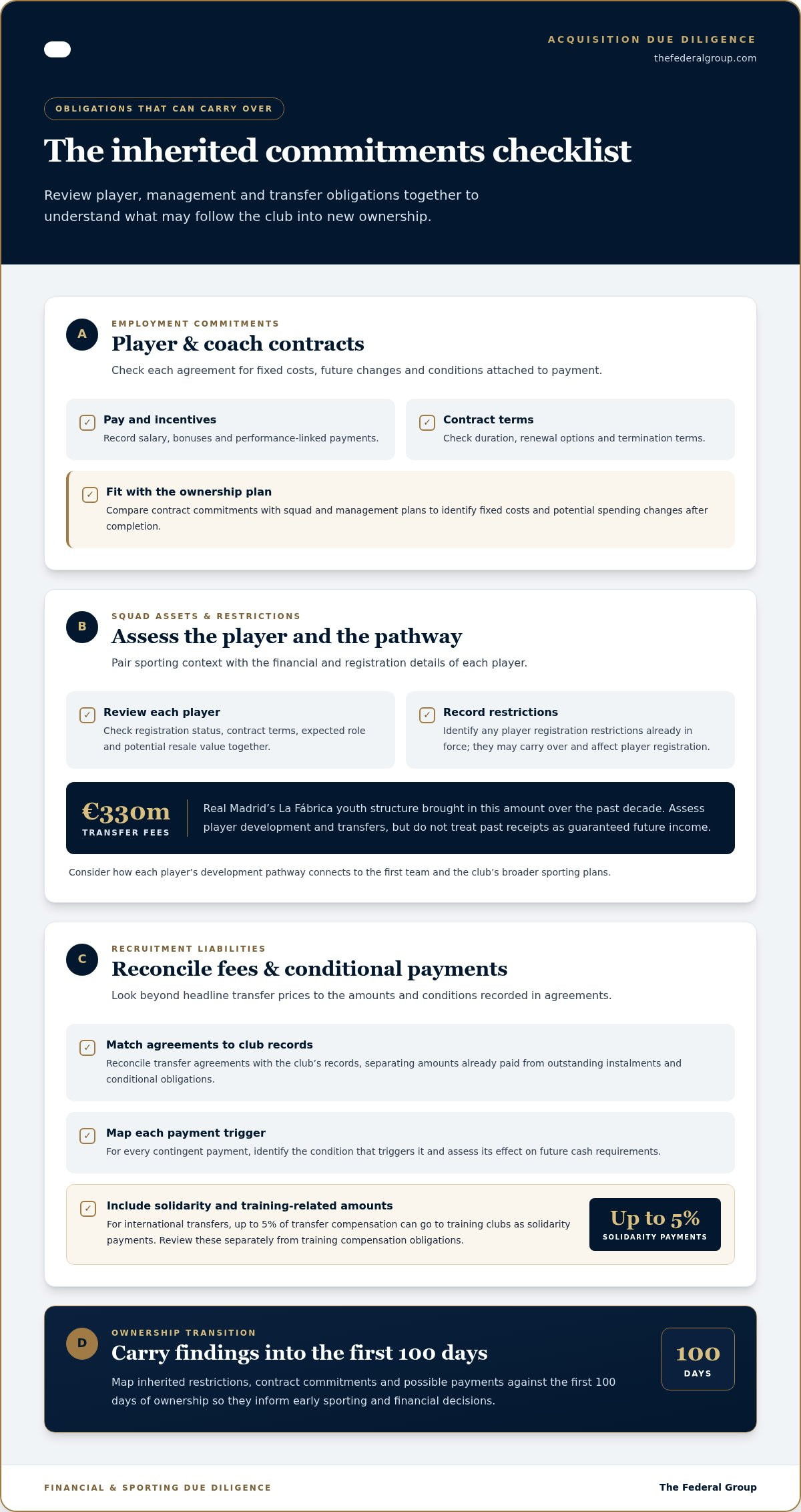
Assess transfer fees, player and coach contracts, and contingent payments together to establish the obligations that carry over into the transaction. Reconcile agreed amounts with payment schedules and conditions, then model how future sporting events could trigger additional payments.
Player and Coach Contract Obligations
Player and coach contracts set employment terms and financial commitments that can continue after a change of ownership. Review each agreement for salary, bonuses, duration, renewal options, termination terms, and performance-linked payments. Compare these commitments with the club’s plans for its squad and management to identify fixed costs and potential changes in spending after completion.
Academies can also represent a source of player-trading revenue and future sporting value. Real Madrid’s La Fábrica youth structure brought in €330 million in transfer fees over the past decade. Assess the academy’s contribution by examining player development and transfers, rather than treating past receipts as guaranteed future income. Consider how each player’s development pathway connects to the first team and the club’s broader sporting plans.
Assess each player as both a sporting asset and a financial commitment. Review registration status, contract terms, expected role, and potential resale value together. Check whether any player registration restrictions are already in force, as these may carry over at completion and affect the club’s ability to register players. Record each restriction alongside the relevant player and contract in the transaction review.
Transfer Fees and Contingent Payments
Assess transfer fees by accounting for agreed payments and any additional sums triggered by specified conditions. Reconcile transfer agreements with the club’s records, separating amounts paid from outstanding instalments and conditional obligations. For each contingent payment, identify its trigger and assess its effect on future cash requirements. This gives the buyer a clearer picture of liabilities from previous recruitment.
On international transfers, up to 5% of transfer compensation can go to training clubs as solidarity payments, separate from training compensation obligations. Include both categories when reviewing transfer documentation and forecasting the cost of recruitment. Map findings against the first 100 days of ownership, so inherited restrictions, contract commitments and possible payments inform early sporting and financial decisions.
Investment reports and recommendations
Investment reports turn financial findings into decisions: proceed, renegotiate, or decline. For investors, the report should distinguish verified performance from forecast assumptions, identify material risks, and set out actions required after completion.
Review audited financial statements, management accounts, cash-flow forecasts, debt schedules, budgets, and revenue records. Reconcile key figures across documents, then flag gaps, unusual movements, and obligations that affect available cash. Corporate finance firms such as Pinnacle Global Advisory commonly assist buyers with buy-side diligence and prepare separate reports setting out findings and concerns. A concise red-flag report helps decision-makers focus on material issues.
Build the investment thesis around the club’s earnings drivers, cost base, assets, and strategic objectives. Test each assumption against documentary evidence, including whether forecast income is supported by contracts. If management is co-investing, define decision rights, funding responsibilities, and reporting expectations before completion. Clear governance links the investment plan to accountable execution.
Investment screening also considers ownership eligibility, governance, and the rules relevant to the club’s jurisdiction. In the UK, the National Security and Investment Act can apply to transactions with a UK nexus, even when the target isn’t obviously sensitive. The EU FDI Screening Regulation establishes a cooperation mechanism among EU Member States and the Commission to review investments from outside the EU. These considerations can affect transaction structure and timing.
How should a football club be valued using due diligence findings? Adjust the valuation analysis for sustainable earnings, debt, cash requirements, asset condition, and the evidence behind forecasts. Separate recurring operating performance from exceptional items, then test how proposed investment plans affect future cash flows. State which assumptions drive the recommendation.
Common red flags include unreconciled accounts, unexplained liabilities, weak cash-flow support, and forecasts based on uncontracted income. Treat each as a specific finding: quantify its financial effect where records allow, identify the supporting evidence, and explain the impact on the investment case.
A disciplined report helps co-investors compare risks, agree priorities, and track post-completion actions. Investors considering capital deployment alongside club development can explore football investment opportunities as a related next step.
Performance benchmarking against wages, revenue, and transfer spend
Compare the target’s wage commitments, income, transfer activity, and cash position over consistent reporting periods. This helps buyers distinguish sustainable performance from results that depend on exceptional revenue or rising liabilities.
Transfer Liabilities and Compensation Payments
Transfer liabilities include unpaid instalments and compensation obligations arising from player movements. Reconcile transfer agreements with creditor schedules, payment records, and cash-flow forecasts to identify amounts due after completion. Account for training compensation and solidarity payments separately from transfer fees. This helps buyers assess the full recruitment cost and avoid treating headline transfer prices as the entire financial commitment.
Projected Transfer Spending
Projected transfer spending estimates the recruitment investment needed to support the club’s sporting plan after acquisition. Model transfer needs for the first 18 to 24 months of ownership, including likely fees, wages, agent costs, and contingent obligations. Compare those projections with available cash and expected revenue. The analysis should show how different recruitment choices affect financial capacity, not assume that spending will automatically improve results.
Revenue Verification
Revenue verification matches reported income to contracts, receipts, and operating records. For broadcasting, reconcile distributions with league statements; for sponsorships, compare contract terms with invoices and payments. Match ticket income to sales and attendance records, then reconcile merchandise sales with point-of-sale reports and inventory. Chelsea’s Champions League broadcast fees were worth £70 million in 2021, illustrating why buyers should isolate competition-related income.
In the U.S., buyers should assess the applicable league’s ownership approval process and financial controls alongside the target’s obligations. In England, the Premier League and English Football League have separate financial controls, while the Independent Football Regulator can approve or block ownership changes under its owner suitability regime.
Analyze debt, cash flow, working capital, and liabilities by reconciling loan schedules, bank records, aged payables, and receivables. Map payment dates against projected cash receipts, then identify overdue balances and seasonal pressure points. Compare wage costs with football earnings: a Squad Cost Ratio approaching 90% is nearing the significant breach threshold described for the measure. This flags pressure before acquisition plans are finalized.
Sporting due diligence alongside financial analysis
Financial analysis shows a club’s resources; sporting due diligence tests whether its strategy can use them effectively. Assess the playing squad, manager’s approach, promotion and relegation exposure, brand, real estate, projected EBITDA, and valuation as connected parts of the investment case.
Start with squad composition and contract horizons, then assess whether available players suit the club’s intended style and competition level. A thin squad may increase recruitment needs, while a strong group without a clear development pathway may limit the value of existing talent. Compare the sporting plan with projected revenue and wage commitments, and identify assumptions that depend on results on the pitch.
Promotion and relegation scenarios can change revenue, costs, and investment priorities. Model each outcome against the club’s operating plan, including its effect on commercial opportunities and staffing. Review the manager’s objectives alongside squad depth and recruitment priorities, rather than treating a forecast league position as guaranteed income. This connects sustainability to practical decisions about spending, performance, and the club’s capacity to adapt.
The cost of due diligence depends on its scope, the target’s operational complexity, the records available, and the number of specialist workstreams required. Reviewing financial performance, sporting operations, real estate, and valuation takes more work than a narrower assessment. Key cost drivers include the depth of analysis, the volume and quality of information, and the coordination required across advisers.
For a clear investment recommendation, connect every sporting assumption to a financial consequence. For example, assess how a change in competition status would affect projected income, then test whether the wage structure and squad plan remain sustainable under that scenario. Separate evidence from assumptions, record the implications for valuation, and identify decisions that need attention after completion. This integrated view helps buyers judge whether the club’s sporting potential supports its financial case.
The Federal Group: Development Finance
The Federal Group can be a next step when due diligence identifies an acquisition or development opportunity requiring capital and a clear ownership strategy. Its Development Finance and Private Equity offerings support projects requiring structured funding or investment, while Sports Multi-Club Ownership supports strategies involving multiple football clubs.
Consider these offerings once your assessment has clarified the club’s obligations, investment priorities, and sporting objectives. A plan involving club facilities may align with Design & Build Development, while a multi-club strategy may align with Sports Multi-Club Ownership. The right fit depends on the transaction’s objectives and structure.
Contact The Federal Group to discuss how its investment and development capabilities can support your plans.
Turn the acquisition case into an ownership plan
Completion marks the shift from assessing an opportunity to executing an ownership strategy. Financial due diligence for a football club acquisition should inform that next phase, helping owners set priorities, align investment decisions with long-term objectives, and turn the transaction rationale into a clear plan. The aim is not simply to close a deal, but to establish a sound basis for what follows.
For investment and development requirements, The Federal Group offers Development Finance, Private Equity, and Design & Build Development. These capabilities can support ownership plans involving capital investment or a development project. Connect the acquisition’s objectives with the resources and structure needed to pursue them.
Discuss your plans with The Federal Group and take the next step toward shaping a considered ownership strategy.
Frequently Asked Questions
What does financial due diligence for a football club acquisition include?
Financial due diligence examines whether the club’s financial position and plans support the proposed investment. Alongside accounts and forecasts, assess how revenue depends on competition participation, commercial agreements, and match-day activity. For example, compare a sponsor’s contractual commitments with forecast income, then test how sporting performance could affect that revenue. The review should connect evidence, assumptions, and investment decisions.
What off-balance-sheet risks and contingent liabilities should be investigated?
Investigate obligations that could create future cash outflows without appearing as ordinary recorded debt. These may include conditional transfer payments, guarantees, commitments to related parties, unresolved disputes, and future facility or service commitments. Trace each item to its agreement, identify the event that could trigger payment, and assess its timing and potential impact. For example, a transfer bonus tied to appearances could become payable after completion.
What are the financial due diligence steps and typical timeline for acquiring a football club?
The process commonly takes 2-3 months. After heads of agreement are signed, sellers normally provide financial, operational, and legal records through a virtual data room. Buyers organize specialist reviews, reconcile records, investigate material issues, and use the findings to shape recommendations and transaction decisions. A buyer’s legal team ideally has 3 or 4 weeks for its review, so access and document organization can affect progress.