Equity Partners for Real Estate Development Projects
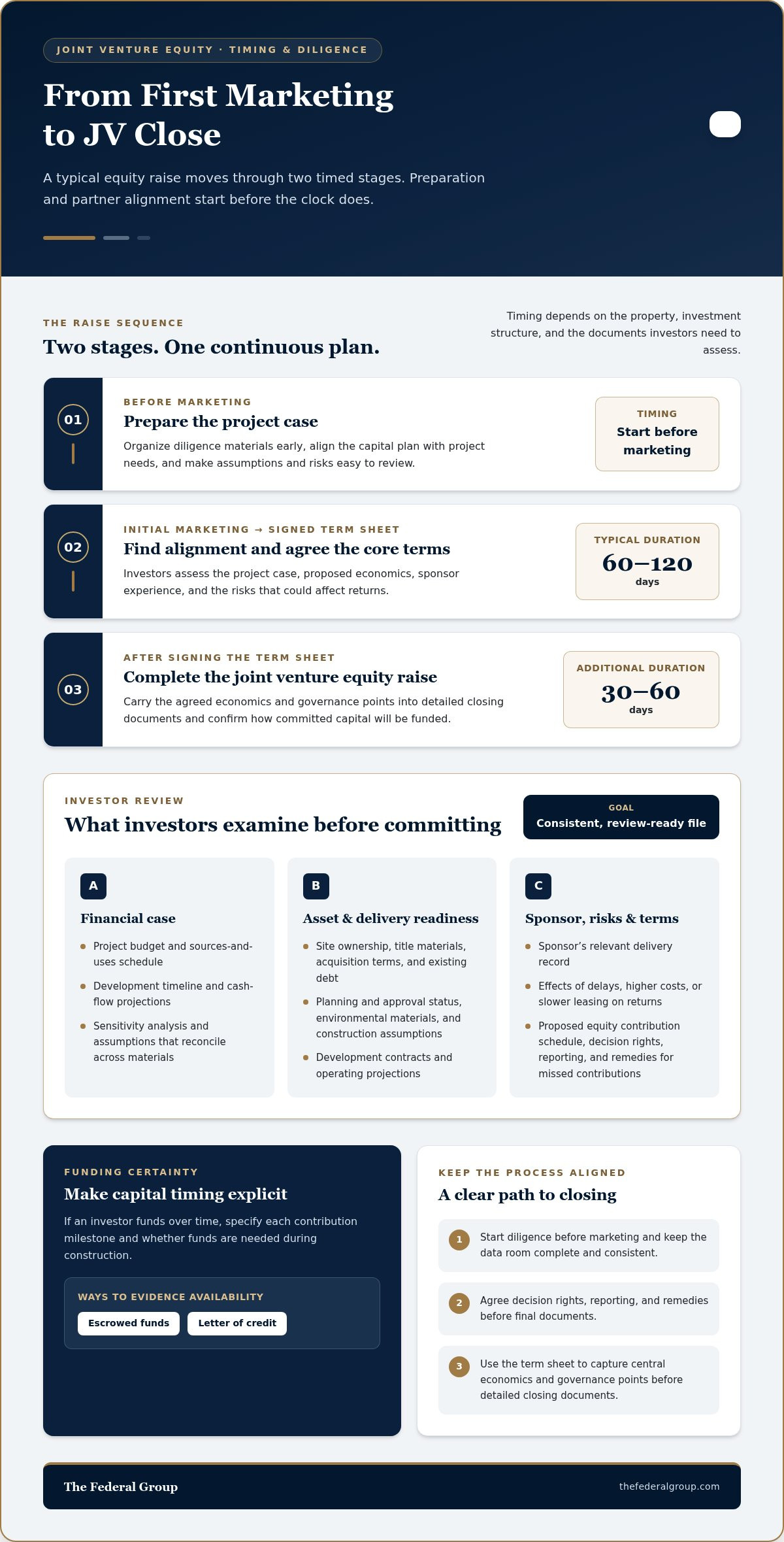
27 October 2026Finding an equity partner for my development project typically takes 60-120 days from initial marketing to a signed term sheet. Closing the joint venture equity raise typically takes an additional 30-60 days after that. The timeline makes preparation and partner alignment as important as the search itself.
It’s easy to focus on the capital target, but an equity partnership also shapes control, risk, and how returns are shared. A credible opportunity needs a clear business plan and a capital structure suited to the project’s stage and needs.
This guide explains how joint venture timelines relate to development phases and capital stacks, what investors assess during due diligence, and how preferred returns and promote structures affect the economics. You’ll also learn how to prepare for partner discussions and when private equity may suit a development project.
Key Takeaways
- Match each funding source to the project phase, balancing equity’s shared ownership and profits against debt’s repayment obligations.
- Prepare a credible project case and clarify when and how investor capital will be contributed before moving toward a joint venture.
- Compare preferred-return priorities and promote tiers to understand how cash flow and upside may be distributed between partners.
- Set expectations for control, responsibilities, and risk-sharing early so the partnership structure fits both the development plan and the investors.
Real estate development phases and capital stacks
A development’s capital stack changes as it moves from land acquisition through approvals, construction, and operations. Match each source of capital to the risks, cash needs, and repayment profile of the relevant phase.
Equity Capital Sources
Institutional investors, private equity firms, and individual investors can provide equity in exchange for an ownership interest and a share of project profits. Institutional investors in commercial real estate joint ventures may seek check sizes of $25 million or more, so align the project’s scale and investment case with the capital source. Review each investor’s decision process, expected role, and funding capacity.
Map funding needs by phase: acquisition debt and equity can fund site selection and land purchase; additional equity or mezzanine debt may support planning and approvals. Construction commonly uses equity alongside construction loans, while permanent financing and further equity can support operations. Separate working capital for ongoing project needs from transaction capital for acquisition and closing, then show the timing in your capital plan.
Comparing Equity, Loans, and Crowdfunding
Equity partnerships exchange ownership for capital and may involve sharing control and profits. Loans preserve ownership but require regular payments regardless of property performance; syndicated debt comes from a group of investors and is secured by the property. Crowdfunding can broaden access to potential investors, but equity and debt crowdfunding have different compliance requirements.
Securities rules and investor eligibility depend on the offering structure and jurisdiction. In the United States, the 2012 JOBS Act changed real estate crowdfunding by allowing developers to publicly advertise opportunities and solicit funding from accredited investors. According to United States Congress, crowdfunding proceeds may go to the issuer only after capital raised meets or exceeds the target offering amount, and investors must be allowed to cancel commitments.
Investor Readiness and Market Appeal
Prepare a concise investment case with a development budget, phase-by-phase capital plan, project schedule, and clear use of funds. Include relevant delivery experience, then explain how site selection, approvals, construction, and operations connect to projected cash flows. Investors can assess the opportunity more directly when assumptions and risks are visible.
Location affects investor interest through demand, comparable properties, access, and planning conditions. For example, explain how a proposed residential development fits local rental demand and nearby supply, rather than relying on broad market claims; looking at regional property specialists like kingestates.es can help developers ground their comparable sales data in real market activity. Show which local factors support the project and how changes in approvals or construction timing could affect its capital needs.
Due diligence and closing timelines
Commercial real estate equity raises typically take 60-120 days from initial marketing to a signed term sheet. Closing the joint venture equity raise typically takes an additional 30-60 days after signing. Build the schedule around the property, investment structure, and documents investors need to assess before committing.
Equity partners examine whether the project’s assumptions support its proposed ownership and profit-sharing terms. Prepare a project budget, sources-and-uses schedule, development timeline, cash-flow projections, and sensitivity analysis. Include the sponsor’s relevant delivery record and identify how delays, higher costs, or slower leasing could affect returns. Ensure the financial information reconciles across the model, budget, and investment materials.
Due diligence also tests whether the proposed asset and development plan are ready to proceed. Organize the project file so investors can review:
- Site ownership, title materials, acquisition terms, and any existing debt.
- Planning and approval status, environmental materials, and construction assumptions.
- Development contracts, operating projections, and the proposed equity contribution schedule.
For example, if an investor funds capital over time, specify each contribution milestone and whether funds are needed during construction. Escrowed funds or a letter of credit can help demonstrate that committed capital will be available. Agree on decision rights, reporting, and remedies for missed contributions before negotiating final documents. A term sheet should capture the central economics and governance points before detailed closing documents are prepared.
Start diligence before marketing, not after a prospective partner requests materials. A complete, consistent data room helps keep questions, revisions, and approvals on the same schedule. For a structured view of project funding and capital planning, explore development project finance.
Preferred returns and promote structures
A distribution waterfall defines how project cash flows move between investors and the sponsor. In a commercial real estate joint venture, limited partners commonly receive a preferred return of 8-12%. This priority sets the order for distributing available cash; it doesn’t make the return equivalent to guaranteed income.
Preferred equity investors rank ahead of common equity investors for claims on property cash flow and assets in a default. They may receive a fixed return but may not share fully in gains from property appreciation. Common equity sits lower in payment priority and may lose its entire investment if a project fails. Compare these risks with each investor’s role and expected upside.
A promote rewards the sponsor for delivering returns above agreed hurdles. Commercial real estate joint ventures commonly allocate sponsors 20-35% above hurdle rates of 15-20% IRR. The exact waterfall matters: the agreement should state how the preferred return accrues, when capital is returned, how hurdles are measured, and when promote distributions begin.
Model the structure against more than one outcome. For example, compare a slower sale with a stronger exit, then trace each scenario through the same distribution sequence:
- Pay operating expenses and debt obligations from available project cash.
- Distribute the preferred return according to the agreement.
- Return invested capital as specified in the waterfall.
- Allocate remaining profits between investors and sponsor, including any promote.
Ground-up commercial development joint ventures typically target 18-25% or more IRR, while value-add deals typically target 15-20% IRR. These target profiles help frame negotiations, not promise an outcome. Commercial joint venture equity multiples commonly range from 1.5x to 2.0x, depending on hold period and strategy.
Before signing, test how timing, additional capital needs, and sale proceeds change distributions. A clear model lets investors assess whether the preferred return, capital return, and promote align with the project’s risk and business plan.
Real estate joint ventures between developers and equity partners
A real estate joint venture combines a developer’s delivery role with an equity partner’s capital. Before acquisitions begin, define contributions, decision rights, responsibilities, and how project profits will be distributed.
Joint Venture Agreements
A joint venture agreement, often supported by the entity’s operating agreement, records the partnership’s economics and governance. It should identify each party’s contributions, ownership interests, capital-call process, approval rights, reporting duties, and exit procedures. Legal documents for a development equity partnership typically include the joint venture agreement and entity documents, with investment and subscription documents defining the investor’s commitment.
For example, state who can approve a budget change, refinance, sale, or new acquisition, and how disputes will be handled. Align the documents with the project’s funding schedule so obligations and decision authority remain clear through construction and sale.
Risks of Accepting an Equity Partner
Equity brings shared control and profits, so assess whether the partner’s investment objectives match the development plan. A commercial real estate sponsor may contribute 5-20% of the equity, while the equity partner supplies most of the capital. That split makes agreed governance and funding commitments especially important.
Consider delayed contributions, disagreement over a sale, and limited flexibility if the relationship breaks down. Replacing a development partner can be difficult if a new partner won’t assume the existing investment. A development partner investing in the project may also have an incentive to spend more if higher spending could increase its share of the company.
Before committing, document how additional capital needs are approved, what happens after a missed contribution, and whether either party can transfer its interest. Resolve philosophical, financial, and operational differences before acquiring the property. These terms help protect project continuity when construction costs, timing, or exit plans change.
For a considered development partnership, discuss your project with a real estate partner.
The Federal Group: Development Finance
The Federal Group supports developers assessing capital needs and partnership structures through Development Finance and Private Equity. These options can suit projects that need funding aligned with acquisition, planning, or construction, and investor participation that fits the project’s ownership and delivery plan.
When financing and delivery need coordinated consideration, Design & Build Development connects development planning with construction execution. The right route depends on the project’s stage, capital requirements, and the developer’s role in delivery.
To discuss your development project, contact The Federal Group or visit thefederalgroup.com.
Turn Your Development Plan Into a Clear Next Step
Partnership decisions are strongest when the project’s priorities are clear before discussions begin. Set out what success means for this development, which decisions you need to retain, and what role you expect an equity partner to play. That clarity gives potential partners a sharper basis for assessing strategic fit.
If you’re finding an equity partner for my development project, focus the next conversation on how capital and delivery needs align. The Federal Group offers Development Finance, Private Equity, and Design & Build Development, connecting funding considerations with development execution.
Bring your project priorities into a focused discussion and consider which form of support best fits your plans. Contact The Federal Group to discuss your development project. A well-defined next step can move your partnership strategy forward with purpose.
Frequently Asked Questions
How long does it take to raise JV equity?
Commercial JV equity raises commonly take 60-120 days from initial marketing to a signed term sheet, followed by another 30-60 days to close. Plan these as separate workstreams: align on key terms while assembling diligence materials, then coordinate entity, investment, and closing documents. A land contract deadline or unresolved approvals can affect the practical schedule, so connect financing milestones to acquisition planning.
How much co-investment do equity partners require from sponsors?
Commercial development sponsors commonly co-invest 10-20% of total equity. This differs from the operating sponsor’s share of equity in a joint venture, which typically falls within 5-20% while the equity partner contributes most of the capital. Model the required contribution against the project’s total equity need, and document the sponsor’s commitment clearly in the proposed structure.
In property development organizations, what is Equity?
Equity is capital invested in a property or development in exchange for an ownership interest and participation in its financial outcome. In a development organization, it can come from the sponsor or outside investors. Common equity ranks behind debt and preferred equity for payment priority, so its returns depend on available cash and asset value, and investors may lose their investment if the project fails.
What Is Joint Venture Equity?
Joint venture equity is capital contributed by partners to a shared real estate project, typically through an agreed ownership and governance structure. For example, a developer may oversee delivery while an investment partner supplies capital. The agreement sets each party’s rights, responsibilities, decision-making authority, and share of distributions, allowing the arrangement to be tailored to the project and partners.
What types of equity partners fund real estate development projects?
Developers asking, “What types of investors should I consider when finding an equity partner for my development project?” can explore institutional investors, private equity firms, individual investors, and investment companies. Crowdfunding can also connect developers with a broader pool of prospective investors. Compare each source’s capital capacity, decision process, investment strategy, and preferred role against the project’s scale and ownership structure.
Where can I find equity partners for a development project in the United States?
For someone asking, “Where can I begin finding an equity partner for my development project?” useful starting points include United States real estate events, industry meetups, online profiles and forums, and professional contacts. Build a focused list of six to 10 prospective investors, then tailor outreach to each project’s location, strategy, and capital needs. A concise investment case helps make introductions more productive.