Non-bank property development lending for developers
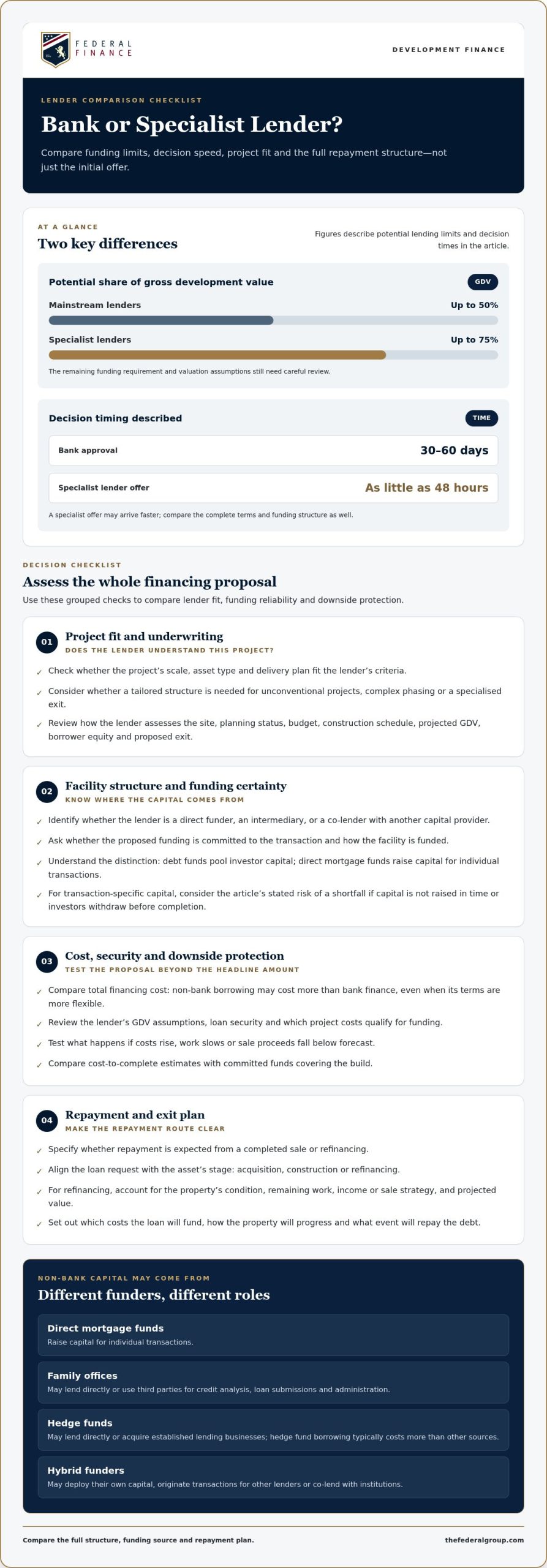
25 October 2026Developers can raise finance through banks or non-bank lenders for property development, with specialist lenders potentially financing up to 75% of a project’s gross development value, compared with up to 50% from mainstream lenders. Bank approval can take 30 to 60 days, while specialist lenders can sometimes issue an offer in as little as 48 hours. The right route depends on the project, its funding structure and the time available.
Banks are a familiar source of development finance, but their criteria and approval processes may not suit unconventional projects or tight schedules. Non-bank lenders for property development can offer more flexible structures, although that flexibility may come at a higher borrowing cost. Compare the full funding structure, not just how quickly an initial decision is made.
This guide explains how developers raise finance and what to assess before choosing a lender. It compares bank and non-bank lending, explains closing timelines and construction draws, and looks at floating and fixed rates. You’ll also see how project scale, repayment strategy and exit planning shape the decision, helping you assess which route fits your development’s requirements.
Key Takeaways
- Compare financing options by looking beyond the initial offer to underwriting criteria, project risk and downside protection.
- Assess whether a faster lending decision justifies potentially higher borrowing costs and more tailored terms.
- Plan for staged construction funding by aligning expected draw timing with completed and certified work.
- Understand how floating and fixed rates affect cost certainty and exposure to changing interest rates.
- Explore development finance when a project’s scale, structure or funding needs call for a specialist approach.
What Is Non-Bank Construction Lending?
Non-bank construction lending finances real estate development through lenders outside the traditional banking system. When comparing non-bank lenders for property development, assess funding structures for commercial projects, multifamily housing, acquisitions and refinancing. To prepare an application, assemble site and ownership information, planning documents, a project budget, delivery schedule, borrower details and a clear repayment plan.
Underwriting and Downside Protection
Underwriting assesses whether a project can repay its debt under realistic and adverse conditions. Lenders examine the site, planning status, development budget, construction schedule, projected gross development value (GDV), borrower equity and proposed exit. Specialist lenders may finance up to 75% of a development’s GDV, making the remaining funding requirement and valuation assumptions important to review.
Downside protection means testing what happens if costs rise, work slows or sale proceeds fall below forecast. Compare gross development value assumptions with cost-to-complete estimates, confirm how committed funds cover the build, and identify the security for the loan. Property development bridging loans require a feasible, well-structured exit plan for lender approval, such as repayment from a completed sale or refinancing.
Property Types and Lending Opportunities
Non-bank real estate lending can fund commercial property and multifamily development, including projects whose structure or delivery plan falls outside a bank’s standard approach. For example, a developer planning a multifamily conversion can present the existing asset, construction scope, leasing assumptions and repayment route as one financing proposal.
Commercial real estate (CRE) refinancing can be useful when an existing loan no longer fits the asset’s stage. A lender may assess whether refinancing can repay current debt while supporting redevelopment or repositioning. Key considerations include the property’s condition, remaining work, income or sale strategy, and projected value.
Match the financing request to the asset’s stage. Acquisition, construction and refinancing involve different costs, risks and repayment sources. Specify which costs the loan will fund, how the property will progress, and what event will repay the debt.
Differences from Bank Lending
Traditional banks often use established lending criteria and formal approval processes. Non-bank lenders can consider unconventional projects and tailored financing structures, which may suit complex phasing or a specialised exit. Even with non-bank lenders for property development, carefully review the underwriting: flexibility doesn’t remove assessment of the asset, borrower, budget or repayment plan.
Compare each proposal’s full structure, not just its initial loan amount. Review how the lender assesses gross development value, what security supports the mortgage, which project costs qualify, and how repayment aligns with completion or sale. Non-bank borrowing can cost more than bank finance, so weigh that cost against the project’s timing and funding needs.
Non-bank lenders compared with traditional banks
Developers compare lenders by capital access, approval criteria, project fit and total financing cost. A structure suited to a large corporate development may not work for a smaller or mid-tier project.
Types of Non-Bank Lenders
In the United States, non-bank development capital can come from direct mortgage funds, family offices, hedge funds and hybrid funders. These are lender categories, not a single national lender group; each funder’s operating footprint depends on its investment mandate and the property location. Direct mortgage funds raise capital for individual transactions, while family offices may lend directly or use third parties for credit analysis, loan submissions and administration.
Hedge funds may lend directly or acquire established lending businesses. Hybrid funders can deploy their own capital, originate transactions for other lenders, or co-lend with institutions. For a specific project, identify the lender’s capital source and role. A direct lender controls its own funding decision, while an intermediary may need to place part of the loan with another capital provider.
Private Loans, Bank Loans, and Debt Funds
Private development loans can offer more flexible structures than bank construction loans, but borrowing may cost more. Mainstream lenders typically lend up to 50% of a development’s gross development value; specialist lenders may sometimes provide offers in 48 hours, while high-street decisions can take six to eight weeks. Compare those terms with the project’s actual funding gap and delivery schedule.
Debt funds pool investor capital for lending, while direct mortgage funds raise capital for individual transactions rather than spreading it across multiple projects. This distinction affects funding certainty: direct funds may face a shortfall if capital isn’t raised in time or investors withdraw before completion. Ask how the proposed facility is funded and whether that funding is committed to the transaction.
Traditional banks often apply rigid criteria, longer approval processes and strict risk controls. Non-bank lenders can tailor terms to a project’s structure, but flexibility doesn’t mean lower cost. Hedge fund borrowing typically costs more than other sources. Investment-bank funding is generally more accessible to large-scale corporate developments than to smaller or mid-tier projects.
Use a consistent comparison process before choosing:
- Match the lender type to the development’s scale, asset and funding requirement.
- Compare leverage against gross development value, required borrower capital and the project’s remaining costs.
- Review the approval timetable alongside land, construction and sale milestones.
- Test the repayment plan against delays, weaker sales or a refinancing requirement.
Direct lending may suit a transaction needing dedicated capital, while a pooled debt fund can distribute exposure across loans. Neither structure removes the need to assess underwriting, funding certainty and exit risk. If development finance is relevant to your project, explore development finance as part of the funding mix.
Closing timelines
A development loan closes through coordinated review, documentation and funding. The timeline depends on how quickly the borrower, lender, legal teams and project stakeholders complete each step. An indicative offer isn’t the same as cleared funds: map every condition to the acquisition or construction deadline.
What Shapes the Closing Schedule
First, the lender needs a complete picture of the asset and proposed financing. A recent cost plan, development schedule, planning information, valuation assumptions, borrower structure and exit strategy help establish the transaction’s scope. Missing or changing details can lead to further questions, revised underwriting and additional legal work.
Second, the funding structure affects coordination. A lender with capital already available for a transaction may avoid delays associated with raising funds from investors. Pooled mortgage funds typically have capital available in advance, which can reduce delays in accessing development finance. Direct mortgage funds raise capital for individual transactions, so the timing of that process can affect completion.
Third, legal completion depends on resolving conditions and documenting the agreed security. Title review, loan documents, borrower approvals and coordination with other parties all need to align. For example, a land acquisition with a fixed completion date needs financing documents and funds ready by that date, not simply an offer issued beforehand.
Build a Practical Timeline
Work backwards from the transaction’s critical date, then assign responsibility for each requirement. Developers can use this sequence to manage the process:
- Set the acquisition or project funding date and identify any contractual milestones.
- Submit a consistent application pack, including the project budget, schedule, ownership details and repayment route.
- Respond to underwriting questions and keep cost, valuation and equity assumptions aligned.
- Coordinate legal review, security documents and any required borrower approvals.
- Confirm that loan conditions are satisfied and funds can be released for completion.
Keep a live conditions tracker for each transaction. Record the responsible party, required document, current status and any dependency. For example, if a valuation relies on a revised design, the design information must be ready before the valuation can support final underwriting. This makes the critical path visible and helps teams resolve bottlenecks early.
Distinguish Offer Speed from Closing
A specialist lender can sometimes provide a property development loan offer in as little as 48 hours, but an offer does not itself complete the loan. Underwriting, legal due diligence and satisfaction of conditions still shape the route to closing. Developers should therefore compare the full process, not just the first decision.
Flexibility can help structure a facility around an acquisition, construction phase or refinancing need, but it doesn’t replace a clear funding plan. Match the lender’s process to the project deadline, confirm when capital becomes available, and maintain enough equity and liquidity to cover costs outside the agreed facility.
Construction draw timing
Construction funding usually arrives in stages rather than as one advance. Property development lenders commonly release funds as work is completed and certified. The draw schedule links available credit to project progress, so keep the budget, contractor programme and evidence of completed work aligned.
How Staged Draws Work
A draw is a request to release an agreed portion of the facility for eligible project costs. The loan terms specify what evidence supports each request and how the lender assesses progress. For example, a developer may submit a draw after a defined construction stage, supported by invoices, site records and certification of completed work.
The lender connects the amount requested to the approved budget and work completed. If a request includes costs outside the agreed scope, the lender may need to review the change before including it. Separate acquisition costs, construction expenditure and contingency items in the cash-flow forecast.
Prepare Each Draw Request
Organise the draw process before construction begins. Map expected spending against the project’s work stages, then identify the evidence needed for each request. Keep a central record to reconcile amounts requested with invoices, certified progress and the remaining budget.
- Update the cost-to-complete forecast against the approved project budget.
- Collect invoices and records for work completed during the relevant stage.
- Match each cost to the correct budget category and funding purpose.
- Submit the draw request with the required progress evidence.
- Record the released amount and revise the remaining cash-flow forecast.
This process can expose a funding gap early. For example, if contractor invoices fall due before the next stage is complete and certified, the project may need working capital to bridge the timing mismatch. A draw plan should account for payment dates, certification and lender review, not just the construction programme.
Manage Changes and Timing Risks
Construction plans can change. A revised scope, delayed materials or unexpected site work may affect the schedule and eligible costs. If the specification changes after budget approval, reconcile the revised cost plan and programme before the next draw request. This keeps the lender’s credit assessment grounded in current project information.
Track three items throughout the build: work completed, funds already released and forecast cost to finish. If certified progress falls behind the contractor’s payment schedule, identify the shortfall and its cause promptly. Clear records show the remaining funding position and help coordinate acquisition commitments, construction obligations and draw requests.
Floating and fixed interest rates
A development loan’s interest structure affects cash flow during acquisition, construction and repayment. Fixed rates set the borrowing rate for an agreed period; floating rates move with a reference benchmark and the loan’s margin. Compare payment exposure, draw timing and the project’s expected exit, not just the opening rate.
How Floating Rates Affect a Project
A floating rate changes when its benchmark changes, so interest expense can rise or fall during the loan term. For a facility drawn in stages, the amount outstanding also changes as construction funding is released. Model interest against the expected draw schedule and repayment plan, then test how a benchmark increase affects cash available for project costs.
In the United States, SOFR is a reference benchmark used in lending markets. A loan’s quoted rate may combine a benchmark with a lender margin, so compare both elements and any adjustment terms. According to Värde, interest rates had changed over the preceding 18 months, driving up the cost of capital for real estate owners. That movement shows why a floating-rate forecast needs more than one rate scenario.
Fixed Rates and Rate Protection
A fixed rate can make interest payments more predictable during its fixed period, supporting a clearer project budget. It may also limit the benefit if market rates fall. Check the loan documents for the fixed period, how the rate applies to staged advances, and what happens when that period ends. These details show whether the rate structure aligns with construction and sale milestones.
A cap can limit exposure to increases in a floating benchmark, while adding a cost to the financing structure. Rate caps were at issue for three-year floating-rate debt originated in 2021. This example makes the distinction clear: a cap manages benchmark exposure; it doesn’t convert the full loan into fixed-rate debt. Compare the protection period with the facility’s expected duration.
Compare the Full Interest Structure
Build a side-by-side analysis before choosing a structure. Include the benchmark, lender margin, fixed period or cap, draw assumptions, payment schedule and repayment date. For example, a project with staged construction advances should model interest on the drawn balance at each stage, rather than treating the full facility as outstanding from day one.
- Use the same draw and repayment assumptions for each option.
- Stress-test floating rates against higher benchmark scenarios.
- Check whether fixed-rate protection covers the construction and exit timetable.
- Assess how interest payments affect contingency and remaining project capital.
Choose the structure that fits the project’s cash flow and risk tolerance, then align it with the facility terms. Discuss development finance in the context of your project’s funding structure.
The Federal Group: Development Finance
The Federal Group offers Development Finance for developers planning how to fund a property project. If your financing plan needs capital beyond a conventional bank facility, its Development Finance and Private Equity offerings are options to consider alongside the project budget, delivery plan and repayment strategy.
Through its Federal Holdings division, The Federal Group operates as a fully integrated Design & Build Development developer. This capability brings development and delivery together, making it relevant when both need to be considered as part of the project. The starting point depends on the project’s structure and funding requirements.
To discuss your project’s financing needs, contact The Federal Group or visit the website.
Set the Funding Strategy for Your Next Project
Turn the development plan into a financing brief. Define the capital requirement, project milestones, funding structure and intended exit, then use those priorities to assess which lending route fits. This creates a clear basis for discussions with non-bank lenders for property development and keeps financing decisions connected to delivery objectives.
The Federal Group offers Development Finance and Private Equity, alongside Design & Build Development. These offerings can help align project capital with delivery. Focus on identifying a structure that suits the development, rather than selecting finance in isolation.
Bring your project requirements into a focused discussion and consider the available next steps. Start a conversation with The Federal Group about your development plans. With a defined brief and clear priorities, you can move forward with greater direction.
Frequently Asked Questions
How Do Property Developers Raise Finance?
Property developers typically combine debt financing with equity from the developer, investors or partners. Start by defining the project’s funding gap, then match finance to its purpose: acquisition, construction or refinancing. For example, a developer might use equity for early costs and a loan for eligible project expenditure. A clear budget, delivery plan and repayment route help lenders assess the proposal and funding structure.
What Are the Different Types of Development Loans for Property Developers?
Common development finance structures include construction loans, bridging loans and refinancing facilities. Construction loans fund eligible building costs, while bridging finance can support a short-term acquisition or funding need. Refinancing replaces existing debt, often as a project enters a different phase. The best fit depends on the asset’s stage, funding purpose, planned repayment source and how project cash flow changes over time.
What Rates Can I Expect on a Real Estate Development Loan?
Rates depend on the loan structure, lender, project risk and whether interest is fixed or floating. A floating rate changes with its benchmark, while a fixed rate makes payments more predictable during its agreed period. Compare the benchmark and lender margin, and model interest against expected loan draws. Pricing for an individual facility depends on the case and is provided after a quote request.
Why do property developers use non-bank lenders instead of banks?
Developers use non-bank lenders when a project needs a funding structure or underwriting approach better suited to its circumstances. A complex redevelopment, unusual asset or time-sensitive acquisition may require flexibility in how the transaction is assessed. The trade-off is that tailored finance can cost more. Compare the full facility terms, funding conditions and repayment requirements with the project schedule and capital plan.
What are typical loan-to-cost and loan-to-value limits for development loans?
Loan-to-cost compares the loan with eligible project costs; loan-to-value compares it with the property’s assessed value. These measures aren’t interchangeable, and lenders may assess both alongside gross development value, borrower equity and the exit plan. For a project with construction and acquisition costs, clarify which costs enter the calculation and whether the valuation reflects the current asset or completed development.
What are current interest rates, origination fees, and other costs for non-bank development loans?
Rates and fees depend on the lender, project, loan structure and risk assessment. Total financing cost can include interest, origination charges and transaction expenses such as legal work or valuation. Compare the cost across the expected loan period, including how staged advances affect interest. Pricing depends on the case and is provided after a quote request, with the project’s scope and structure shaping the terms.
What borrower qualifications, experience, credit score, and equity do lenders require?
Lenders assess the borrower’s financial position, development experience, credit history, available equity and capacity to complete the project. They also consider the proposed budget, construction plan, security and repayment strategy. A first-time developer can strengthen an application with clear cost assumptions and experienced project partners. No single credit score or equity threshold applies across every lender and transaction.
What property types and development stages can non-bank lenders finance?
Non-bank lenders finance commercial real estate and multifamily projects, including developments with unconventional structures. Funding may support acquisition, construction or refinancing, depending on the asset and proposed repayment route. For example, a commercial property being repositioned can be assessed based on its current condition, planned work and intended exit. Present the development stage clearly so the funding request matches the project’s needs.