Commercial Property Development Finance and Loan Terms
24 October 2026The quoted term is only one part of a development loan. Commercial real estate loan terms may range from 5 to 25 years, while down payments may range from 10% to 30% or more. Commercial property development finance is also shaped by the project stage: construction funding commonly arrives in phases and may require interest-only payments during construction.
Those terms can seem straightforward until you compare land acquisition, site preparation and construction costs. The right funding structure depends on what the capital must cover, how the project will progress and how the lender assesses risk and repayment.
This guide explains common commercial loan terms, financing options for different development stages and the factors lenders consider during underwriting. It also covers typical application materials and how financing may transition after construction, helping you plan the project’s funding.
Key Takeaways
- Commercial real estate loan terms may range from 5 to 25 years, and down payments may range from 10% to 30% or more. Compare repayment structure as well as the headline term.
- Match funding to the project stage: acquisition and development loans can support land purchase and site preparation, while construction loans commonly release funds in phases.
- Prepare for underwriting by organizing business financial statements, tax returns, a detailed business plan, and owners’ personal financial statements.
- Strengthen a financing proposal with a viable project plan, a clear exit strategy, and a realistic assessment of land value, zoning, cash flow, and available collateral.
- For projects requiring capital or an integrated development approach, The Federal Group offers Development Finance, Private Equity, and Design & Build Development.
What are typical terms for commercial real estate loans?
Commercial real estate loan terms may range from 5 to 25 years, and down payments may range from 10% to 30% or more. For a development loan, the required equity depends on project costs, collateral, projected value, and the lender’s repayment assessment.
Loan Purpose and Structure
An acquisition and development loan can finance a land purchase and prepare the site for construction. Proceeds may cover subdivision, grading, roads and sewer-line installation. Because the property being purchased and developed secures the loan, review which costs the facility covers and whether its draw schedule matches the planned work.
Some development loans are assessed against the completed project’s projected gross development value. Others focus on land value, project costs and available collateral. If a lender also takes a mortgage on existing property, it usually contributes a lower percentage of project funding. Include a contingency reserve in your financing plan.
Debt Coverage and Loan-to-Value
Debt service coverage ratio compares income available for debt payments with the required debt service. Many commercial real estate lenders may look for a ratio above 1.0. A developer should test projected income against principal and interest payments, then examine whether the result remains workable if leasing or sales take longer.
Loan-to-value compares the loan amount with the property’s assessed value. A lower ratio means you contribute more equity relative to the collateral. Lenders also assess cash flow, balance sheet strength, the land’s quick-sale value, additional collateral and the exit plan. Keep these figures consistent across your project model and application.
Agreement Obligations and Lender Protections
A loan agreement sets out repayment dates, interest calculations, permitted uses and conditions for drawing funds. It may also require progress reports, insurance, property maintenance or lender approval before major changes. Compare each obligation with the project schedule, particularly when construction milestones trigger further advances.
Lender protections may include property security, limits on additional borrowing and conditions for repaying the loan before parcels can be sold free of a lien. For an acquisition and development loan, clarify any minimum payoff required to release parcels. Prepare business financial statements, tax returns, a detailed business plan and owners’ personal financial statements.
Rate Options and Developer Equity
A fixed interest rate stays unchanged for the agreed period, making interest costs easier to model. An adjustable rate can change according to the agreement, affecting payment projections. Compare the rate structure with the loan term, expected construction period and planned repayment or refinancing date.
Traditional bank loans for commercial property development typically offer competitive interest rates and steady terms, but banks generally apply strict approval criteria. Owner-occupied commercial real estate loans may have longer amortization periods, which can make monthly payments more manageable. For independent guidance when assessing whole-of-market borrowing, platforms such as leetonksmortgageguru.uk can help clarify relevant mortgage options. Model both your equity contribution and debt payments before choosing a structure.
The required down payment may range from 10% to 30% or more. The lender’s contribution can depend on collateral, project viability, developer cash flow, and projected completed value. A clear sources-and-uses schedule helps show how equity, loan proceeds, and contingency reserves support each stage.
Commercial property finance across acquisition, construction, and earnest money deposits
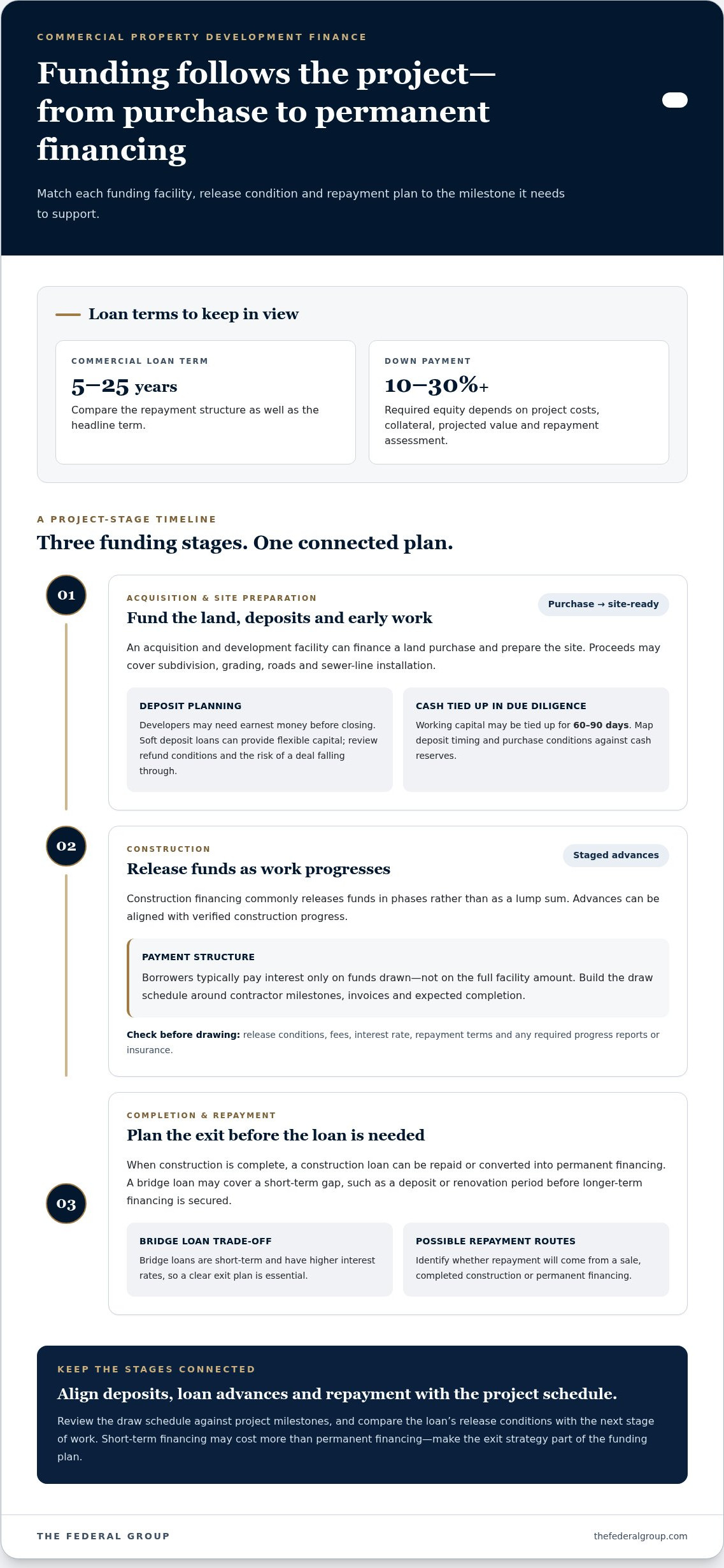
Commercial property funding needs change as a project moves from acquisition through construction to completion. Align each facility’s release conditions and repayment plan with the next project milestone.
Bridge and Permanent Financing
An acquisition facility can fund a property purchase and site preparation, while construction financing covers eligible building costs through staged advances. Developers may also need earnest money before the purchase closes.
A bridge loan can cover a short-term funding gap, such as a deposit or renovation period before longer-term financing is secured. Its short duration and higher interest rates make a clear exit plan essential: identify whether repayment will come from a sale, completed construction or permanent financing. A construction loan can be repaid or converted into permanent financing when the project is complete.
During due diligence, developers may tie up working capital for 60-90 days. Map deposit timing, purchase conditions, and expected loan advances against cash reserves. Soft deposit loans can provide flexible capital, but the deposit’s refund conditions and the risk of a deal falling through should shape the funding decision.
Construction-Period Payments
Construction loans commonly release funds in phases rather than as a lump sum. Borrowers typically pay interest only on funds drawn, not on the full facility amount. For example, when funds are advanced in line with verified construction progress, interest accrues on the amount drawn at each stage.
Staged funding can preserve cash during construction, but it does not remove repayment obligations. Build your draw schedule around contractor milestones, invoices and the expected completion date. Compare it with the loan’s interest rate, fees and repayment or conversion conditions. Short-term financing may cost more than permanent financing, so establish a clear exit strategy.
Financing by Property Sector
Commercial property loans may finance office buildings, retail spaces, warehouses and multifamily units. The property type affects construction costs, anticipated income and the financing plan. A warehouse development, for example, requires a different assessment of building specifications and leasing prospects than a retail or multifamily project.
For each property type, match the amount and timing of construction advances to the work being completed. Lenders assess the project plan, costs, collateral and expected repayment route. Show how acquisition, construction and permanent financing fit together instead of treating each facility as a separate transaction.
If your capital plan spans acquisition and construction, explore integrated project finance as a potential next step.
Credit approval and underwriting conditions
Underwriting assesses whether the developer, property and repayment plan support the requested capital. Approval criteria vary by lender and project type.
Developer Track Record and Creditworthiness
To qualify, developers need a credible project plan and financial profile. Lenders assess creditworthiness, development track record, cash flow and balance sheet strength. If you are a first-time developer, present relevant team experience, defined responsibilities and a realistic delivery plan to address limited personal project history.
Traditional commercial banks generally apply strict approval criteria and process applications more slowly than faster financing options. Organize evidence of completed projects, current obligations and repayment capacity so the lender can assess both the sponsor and the proposed property.
Credit, LTV, and DSCR Requirements
Lenders assess creditworthiness alongside loan-to-value (LTV), which compares the loan with property value, and debt service coverage ratio (DSCR), which compares income available for debt payments with required debt service. Many commercial real estate lenders may look for a DSCR above 1.0. There is no single credit score or LTV threshold stated for every development loan.
Present consistent figures for project costs, collateral, income and debt obligations. Stress-test repayment against slower leasing or sales, then explain how the project would meet its payments in that scenario.
Private Credit and Non-Bank Lenders
Developers can explore commercial banks, private credit funds, and other non-bank lenders in the United States. Deloitte’s 2026 outlook reports that private lenders accounted for 24% of U.S. commercial real estate lending volume, compared with a 14% average over the prior 10 years. Alternative lenders accounted for 34% of non-agency loan closings in Q2 2025.
For small businesses, U.S. Small Business Administration-backed 504 and 7(a) loans are financing options. Compare each program’s intended use and repayment structure with the project’s needs. Private property lenders may also tailor terms, including equity participation options.
Project Feasibility and Supporting Assessments
Lenders assess feasibility through the project plan, land value, budget, collateral, cash flow and exit strategy. Appraisals inform the collateral assessment, while budgets show how capital will be used. Pre-leasing can help demonstrate demand and projected income. For affordable housing, Low-Income Housing Tax Credits may form part of the proposed capital stack.
Federal, state and local rules can affect permitted use, approvals, timing and project costs. Identify which jurisdictions govern the site, map relevant requirements and show how approvals fit the development schedule. This helps lenders assess project assumptions alongside the financing plan.
Business and owner information required for applications
A commercial property loan application typically includes business financial statements, tax returns, a detailed business plan and owners’ personal financial statements. Together, these documents help lenders assess the investment, the company’s cash flow and the owners’ ability to support the project. Present them as one consistent financial picture, not separate files with conflicting assumptions.
Start with the business financial statements. They show the company’s financial position and cash flow, helping a lender understand existing commitments and capacity for new debt. Use the same business name and reporting periods throughout the application. If the company owns several properties, distinguish figures for the borrowing entity from those for other operations.
Tax returns provide another view of business performance and reported income. Gather the returns required for the application and reconcile key figures with the financial statements. If a multifamily project sits in a separate entity, explain how that entity relates to the applicant and where project income and expenses appear. Clear alignment makes the assessment easier to follow.
Your business plan should connect the proposed investment to its funding and repayment. Describe the property, intended use, project stages, expected costs, revenue assumptions and exit plan. For example, a multifamily development plan should distinguish construction spending from anticipated rental income. Keep assumptions consistent with the financial statements and loan request so the lender can see how capital supports each stage.
Owners’ personal financial statements complete the application. They help lenders assess the owners’ financial position alongside the company’s. Prepare each statement using consistent dates and clear details of assets, liabilities and other financial commitments. If several owners are involved, identify each person’s role and match their information to the ownership structure in the business plan.
Use a document index to make the application easier to review. A practical sequence is:
- Business financial statements, grouped by reporting period.
- Business tax returns, matched to the periods shown in those statements.
- The business plan, with project costs, revenue assumptions, and repayment strategy.
- Owners’ personal financial statements, clearly identified by owner.
Before submission, compare the business name, ownership details, income assumptions and project costs across all four document groups. For example, if the business plan relies on rental income for repayment, make sure its assumptions align with the financial information elsewhere in the application. Consulting with experienced specialists such as Engage Financial Solutions can help ensure documentation and reporting align cleanly. A complete, consistent file gives the lender a clearer basis for assessing the investment and your ability to meet the proposed obligations.
Lender assessment of land and developer
A lender evaluates both the site and the developer behind a real estate loan. The land’s location, zoning, local economic conditions, political climate, collateral and proposed exit plan can all shape the assessment. A clear application connects these factors to the project budget and financing structure.
Start with the site’s current status and intended use. Explain its location, existing zoning, proposed development and any zoning changes being pursued. Pursuing zoning changes before applying for an acquisition and development loan may strengthen the project plan. This shows how the intended development relates to the land’s permitted use and identifies a key step in the schedule.
Put the location in context. Describe the local economy and political climate, then explain how they affect the project assumptions. A site’s value and development prospects, for instance, may be assessed differently depending on its location and zoning. Lenders consider these factors when determining acquisition and development financing. Do not rely on projected value as the only measure of the site’s strength.
Land value matters under a downside scenario, too. Lenders may consider the land’s quick-sale value rather than relying only on its expected value after development. Explain how the land could support repayment if development or sale takes longer than planned. If the property secures the acquisition and development loan, describe its role as collateral and clearly identify any additional security.
Your financial position is another part of the assessment. Lenders may review cash flow, the balance sheet, additional collateral and the proposed exit plan. Show how available resources support the project and specify the exit route, such as repayment through completed asset sales or refinancing. If an existing property secures the loan through a mortgage, account for the typically lower contribution to project funding when this collateral is used.
Bring these details together in a concise land and sponsor summary. Link site facts to the development schedule and connect the budget to the expected repayment route. Include a contingency reserve in the acquisition and development plan, explaining how it relates to project risks. This gives lenders a structured view of the land, developer and financing request, rather than a set of disconnected assumptions.
For developers preparing a site-led funding strategy, discuss your development project as a next step.
Local zoning rules determine whether the proposed development fits the land’s permitted use, and any zoning changes being pursued can affect a lender’s assessment. Local economic conditions and the political climate also shape project assumptions and financing.
The Federal Group: Development Finance
The Federal Group provides Development Finance and Private Equity for property projects that need capital and a considered funding structure. For developers assessing land acquisition, construction or the transition between project stages, these offerings address the financing needs described above.
Through its Federal Holdings division, The Federal Group also operates as a fully integrated design and build developer. This can suit projects where development and delivery are planned together rather than as separate workstreams. To discuss an opportunity in context, outline the site, development plan, funding requirement and intended exit.
To discuss a development opportunity, contact The Federal Group or visit thefederalgroup.com.
Set the Next Stage of Your Project in Motion
Your next financing decision should support the project beyond its immediate capital needs. Consider how the land strategy, funding structure and delivery plan work together, then define the decision you need to make next. This helps keep commercial property development finance aligned with the project’s objectives as it advances.
The Federal Group’s Development Finance and Private Equity address capital needs, while its Design & Build Development capability connects financing considerations with project delivery. These options are relevant when shaping a development strategy and considering how funding and execution fit together.
Prepare a concise outline of the opportunity, including the site, intended development, funding priorities and planned route forward. A clear starting point makes the conversation more focused and useful.
Contact The Federal Group about financing to discuss your project’s next stage. A considered plan can turn a complex development decision into a clear path forward.
Frequently Asked Questions
What type of commercial property financing is available?
Options include commercial real estate loans, acquisition and development loans, construction loans, bridge loans, permanent financing and mezzanine financing. The right structure depends on the asset and project stage. For example, a bridge loan can cover a short-term gap before long-term financing, while mezzanine financing combines debt and equity. Owner-occupied financing serves businesses buying or refinancing premises they will use as their operating base.
How long does it take for loans to close?
Closing time depends on underwriting, property due diligence, valuation, documentation and lender processing. Traditional commercial bank loans generally have stricter approval criteria and slower processing than faster financing options. After closing, commercial real estate loan funding may take anywhere from a few days to a few weeks. To keep the process moving, organize business and owner financial documents alongside the project budget and property information.
What is an Acquisition and Development Loan?
An Acquisition and Development Loan finances a property purchase and the work needed to prepare land for construction. Eligible improvements may include subdivision, grading, road construction and sewer-line installation. The property being purchased and developed secures the loan. The agreement may also require a minimum payoff before the lender releases developed parcels from its lien, so account for these release terms in your parcel-sale plans.
Will I need to pay for a property appraisal?
An appraisal can help a lender assess property value and collateral, but the loan agreement determines who pays for it. Review the term sheet for appraisal responsibilities, timing and valuation conditions. For a development site, make sure the valuation reflects the land and proposed project appropriately. Align appraisal timing with underwriting and the transaction schedule to avoid delaying other due diligence.
What is commercial property development finance and how does it work?
Commercial property development finance is funding structured around a business property project, from land acquisition and preparation through construction and completion. Before setting terms, a lender assesses the borrower, site, budget, collateral and repayment route. Construction funding commonly arrives in stages, with advances linked to project progress. After completion, the construction loan can be repaid or converted into permanent financing, depending on the agreed structure.
What types of commercial real estate development loans are available in the United States?
U.S. developers may consider acquisition and development loans, construction loans, bridge financing, permanent loans, and mezzanine financing. Small businesses may also explore SBA-backed 504 and 7(a) loans. These options serve different purposes: acquisition and development funding prepares a site, construction financing funds building work, and permanent financing can support a completed property. Compare each option’s permitted use, repayment structure, and fit with the project’s timeline.
What are typical commercial development loan rates, fees, and terms in 2026?
Commercial real estate loan terms may range from 5 to 25 years. Commercial construction loan rates range from 6.8% to 13.8%, depending on borrower strength and project type. Construction loans may also carry multiple fees, but fee amounts depend on the financing structure and lender. Compare the rate type, draw schedule, repayment period, and any fees together, since the headline rate alone doesn’t show the full financing commitment.
What loan-to-cost and loan-to-value ratios do commercial development lenders require?
There isn’t one ratio that applies to every development loan. Requirements depend on the project, property valuation, borrower strength, collateral, and equity contribution. As a specific example, data center construction debt typically represents 65-80% of loan-to-cost. That figure is sector-specific, not a general benchmark for all developments. Ask how the lender calculates project costs and property value, then align the financing model with those definitions.