Compare Alternatives to Traditional Bank Construction Loans
23 November 2026A bank loan isn’t automatically the best fit for a construction project. Alternatives to traditional bank construction loans may suit projects with different financing needs, but compare costs, approval requirements, and access to funds before choosing.
It’s understandable to value a familiar lender and predictable financing. Yet traditional construction loan approvals can take 30 to 60 days, and the right option depends on the project, borrower and funding schedule.
This guide compares non-bank financing with bank loans, including differences in approval and construction draws. It also explains how owner-builder financing fits, why building experience can affect eligibility, and what to weigh before choosing a route. You’ll get a clearer view of which financing structure aligns with your project and when development finance may be relevant.
Key Takeaways
- Match funding to both land acquisition and staged construction costs so capital aligns with the project’s needs.
- Compare approval timelines and draw procedures separately; approval alone doesn’t show when funds will be available for project costs.
- Owner-builder financing can be a narrow fit: borrowers generally need building experience, and not all construction lenders offer these loans.
- According to the U.S. Small Business Administration, SBA 7(a) loans can be used to acquire, refinance, or improve real estate and buildings.
Non-Bank Construction Lending: Is it Right for You?
Non-bank financing can fund land, construction, and project cash flow. Before choosing, compare the total cost, eligible uses, draw process, and closing structure.
Private Construction Loans
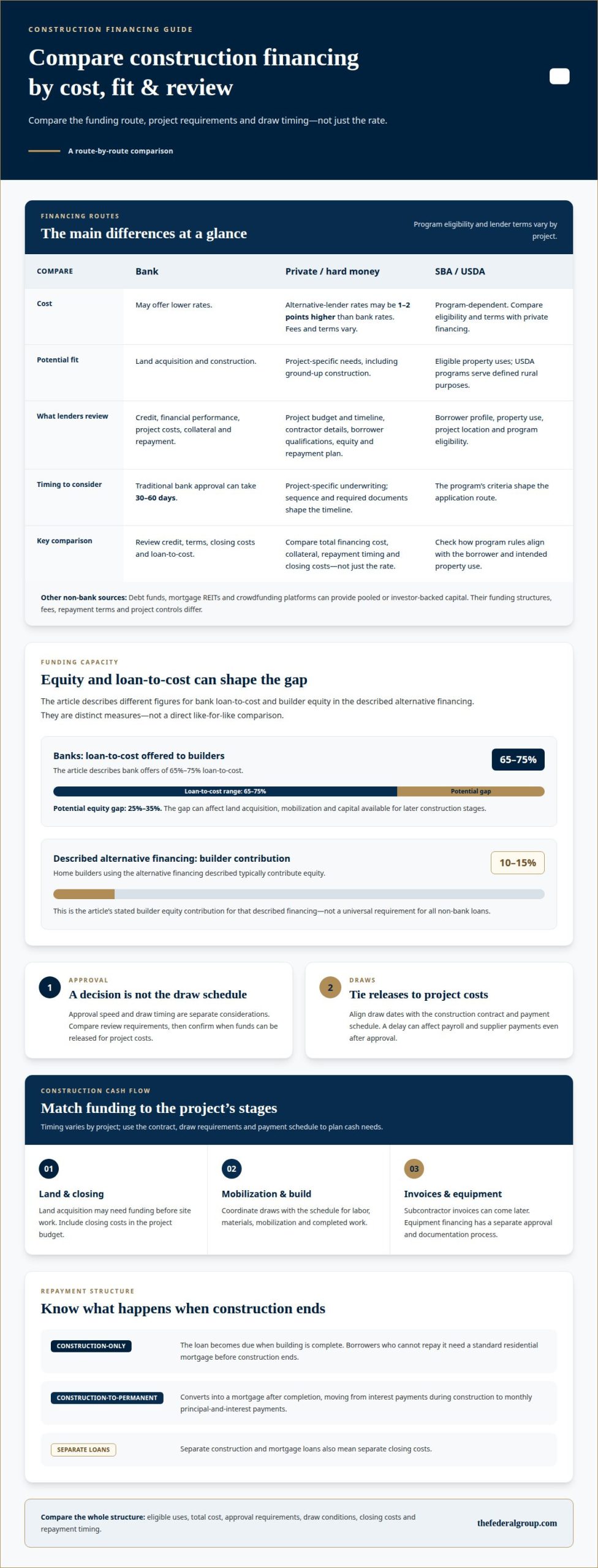
Private construction loans come from non-bank lenders and can be structured around project needs. Alternative-lender rates may be 1-2 points higher than bank rates, while fees and terms vary. Compare total financing cost, repayment timing, collateral, and closing costs, not just the rate. A financing provider can organize project details and help compare options and application requirements.
Hard Money Construction Loans
Hard money lenders may finance ground-up construction, assessing the property and project. Requirements can include a defined construction budget and timeline, contractor information, and a repayment plan. For example, a lender reviewing a ground-up project needs to assess land acquisition and construction costs alongside the proposed contract. Equipment financing has a separate approval process, so include machinery needs in the funding schedule.
SBA and USDA Construction Programs
SBA 7(a) loans can be used to acquire, refinance, or improve real estate and buildings, according to the U.S. Small Business Administration. This makes the program relevant to some business property projects, subject to program eligibility. USDA programs serve defined rural purposes; the project’s location, property use, and borrower profile shape fit. Compare those criteria with private financing before selecting an application route.
Debt funds, mortgage REITs, and crowdfunding platforms can provide capital through pooled or investor-backed structures. Review repayment terms, fees, and project controls. A financing provider can also compare state or local programs with the project’s location and intended use, then help with comparisons and applications.
For payroll, labor, materials, and mobilization, align each draw with the construction contract and payment schedule. Land acquisition may need funding before site work, while subcontractor invoices come later. Include closing costs in the project budget. These details distinguish construction financing from equipment financing, which has its own review and documentation process.
| Option | Cost comparison | Project fit | Key review |
|---|---|---|---|
| Bank | May offer lower rates | Land and construction | Credit, terms, closing |
| Private or hard money | May cost more | Ground-up projects | Budget, contract, repayment |
| SBA or USDA | Program-dependent | Eligible property uses | Borrower and location |
Choose financing that covers the project’s stages and aligns repayment with the contract and cash flow.
Speed of non-bank loan approvals and construction draws
Approval speed and draw timing affect whether a project can pay contractors as work advances. Traditional bank construction loan approval can take 30 to 60 days. Non-bank lenders may use project-specific underwriting, so the review sequence and required documents shape the timeline.
Bank underwriting typically examines credit, financial performance, project costs, collateral, and repayment. A traditional bank line of credit is typically sized using a construction company’s past 24 months of financial performance. Alternative construction lenders also assess borrower qualifications and project equity. Home builders using the described alternative financing typically contribute 10% to 15% equity.
Loan-to-cost limits shape how much the lender will fund against land and construction costs. Banks are described as offering builders 65% to 75% loan-to-cost, leaving a potential 25% to 35% equity gap. That gap can affect land acquisition, mobilization, and the capital available for later construction stages.
Draw speed depends on how the lender releases funds against project progress and supporting costs. A clear construction schedule can link each draw to labor, materials, or completed work, helping coordinate contractor payments with available capital. Include draw dates in the cash-flow plan: a delay can affect payroll and supplier payments even after approval.
Repayment structure also shapes the project’s final financing step. A construction-only loan becomes due when building is complete, so borrowers who cannot repay it need a standard residential mortgage before construction ends. A construction-to-permanent loan converts into a mortgage after completion, shifting from interest payments during construction to monthly principal-and-interest payments. Separate construction and mortgage loans also mean separate closing costs.
For projects where debt and equity need to work together, consider the broader project-financing picture alongside approval timing, draw milestones, and repayment.
Definition of non-bank construction lending
Non-bank construction lending is project financing from a lender outside the traditional banking system. Private lenders, debt funds, mortgage REITs, and crowdfunding platforms are examples, but their funding structures differ. Some lend capital directly; others pool investor funds or connect projects with investors.
The loan agreement defines how financing supports the project. It sets approved uses, interest rates, repayment terms, and conditions for releasing draws. For example, one structure may fund a project in stages, while another may advance funds against invoices after work is billed. The funding source and agreement determine which structure applies.
That distinction matters because construction lending isn’t a standardized product. A private lender may assess a project individually, while an investment platform may arrange capital from multiple investors. The borrower’s obligations are set out in the financing agreement, including interest, fees, draw conditions, and repayment schedule. Compare these terms together rather than relying on the lender category alone.
Construction funding can also differ from general business credit. A contractor’s bank line of credit is typically sized using the company’s past 24 months of financial performance. Invoice factoring, by contrast, provides cash after a contractor invoices a customer, not before work begins. Funds advanced against invoices should be reserved for related project costs, such as subcontractor, vendor, and supplier payments.
For a practical comparison, map each funding source to a project stage: land purchase, mobilization, construction draws, or billed work. Then compare the agreement’s interest rates, fees, term, and release conditions. An average interest rate alone won’t show whether funds arrive when needed. Focus on how each lending structure supports the planned work and repayment.
What are the best alternatives to traditional bank construction loans?
The right alternative depends on the property, borrower, and project purpose. Regional banks and credit unions offer another route to construction financing, while private lenders and government-backed programs serve different needs. Compare eligible uses, funding stages, repayment terms, and total borrowing costs before choosing.
Regional banks and credit unions can be useful when a project needs construction financing beyond a large bank’s standard approach. Alternative lenders offer another route, but may charge higher interest rates or fees to offset project risk. Evaluate the full terms, including draw conditions, repayment timing, and closing costs, instead of comparing interest rates alone.
SBA financing may fit business property projects. According to the U.S. Small Business Administration, SBA 7(a) loans can be used to acquire, refinance, or improve real estate and buildings. That stated use makes the program relevant to some commercial projects, but it doesn’t establish eligibility for every construction plan. Match the intended use and borrower profile to the program’s requirements.
FHA and VA One-Time Close Construction Programs serve a narrower residential purpose: they allow single-family dwellings with 1 unit, not multifamily dwellings. They may suit an eligible single-family build, but don’t fit a multi-unit development. Owner-builder financing is another specialized path; borrowers generally need building experience, and not all construction lenders offer these loans.
Start by identifying the project’s purpose, then compare program fit, equity needs, draw timing, and repayment structure. A commercial builder improving business premises faces a different decision from someone building one home. Assess options from banks and alternative lenders against the project’s scope and schedule. This helps clarify which programs fit and which don’t.
Credit unions and community banks may offer construction financing beyond a large national bank’s standard approach. Compare eligible uses, draw conditions, repayment timing, closing costs, and total borrowing costs.
The Federal Group: Bridging Loans
The Federal Group offers Development Finance, Bridging Loans, and Private Equity for property projects with different capital needs. Bridging Loans can connect funding between project stages, while Development Finance and Private Equity provide other routes for property development. The right structure depends on the project’s purpose, funding requirements, and planned progression.
For a development that also needs delivery capability, The Federal Group’s Design & Build Development service brings financing decisions into the context of the project itself. Its integrated approach helps developers assess how capital and execution fit together, rather than treating the loan as an isolated decision. Consider these options when bank terms, timing, or project structure don’t align with the development plan.
Contact The Federal Group to discuss your development financing needs.
Move Your Project Toward a Financing Decision
Turn your financing comparison into a clear project brief. Set out the property, intended use, construction stages, capital requirements, and expected repayment route. Separate fixed project commitments from assumptions that could change. This gives a financing discussion a practical starting point anchored to your development plan.
The best alternatives to traditional bank construction loans support the project’s full structure, not just its initial funding need. The Federal Group offers Development Finance, Private Equity, and Design & Build Development, bringing capital and project delivery together within its development business.
Contact The Federal Group about financing to discuss how your project’s requirements could shape its next financing decision. A well-defined plan is a strong foundation for moving forward.
Frequently Asked Questions
What are alternative lenders?
Alternative lenders provide financing outside conventional banks, including private lenders, debt funds, mortgage REITs, and crowdfunding platforms. Their structures differ: a private lender can provide capital directly, while a crowdfunding platform can connect a project with multiple investors. For construction, focus on who provides the funds, how draws are released, and which repayment obligations the agreement sets.
What are current interest rates and loan-to-cost limits for construction financing alternatives in the U.S.?
There isn’t one rate or loan-to-cost limit for every U.S. construction financing option. The described bank financing rate is around 9.5% to 10%, and alternative-lender rates may be 1-2 points higher than bank rates. Banks are described as offering home builders 65% to 75% loan-to-cost. Treat these as broad market comparisons, not a quote for a particular project or lender.
What are the risks and disadvantages of using private or nonbank construction financing?
Private or nonbank financing can carry higher interest rates or fees, raising the project’s total borrowing cost. Borrowers also need to manage draw conditions and repayment deadlines: a gap between a scheduled payment and a released draw can strain cash flow. If invoice factoring is involved, the general contractor may need to verify the invoice and confirm payment when due.
What construction financing programs are available in my state or local area?
Regional banks and credit unions may offer construction financing, and SBA or USDA programs may suit eligible projects. Compare state or local programs with your project’s location and intended use.