Design-build project examples that align scope, budget, and schedule
18 November 2026A project can stay aligned only when scope, budget, and schedule inform decisions from the outset. The most useful case studies of successful design-build projects show how teams set shared expectations, review cost and schedule implications as design develops, and manage changes before they disrupt delivery. They also make clear how collaboration and transparent decision-making support the result.
It’s reasonable to expect a project team to protect the brief while responding to practical constraints. The challenge is seeing how that balance works in real projects, not just in principle. These case studies of successful design-build projects show how teams coordinate stakeholders, explain design choices, and manage scope changes while keeping delivery priorities visible. Each example highlights the project’s goals, key decisions, and lessons for aligning scope, budget, and schedule.
Key Takeaways
- Set the project brief, budget parameters, and schedule expectations before final design decisions to give the team a shared baseline.
- Assess the cost and schedule impact of proposed changes as they arise, so stakeholders can make informed trade-offs.
- Use regular coordination and direct communication to keep project participants aligned from planning through construction.
- Explain design decisions by connecting each choice to the project’s requirements, constraints, and intended outcomes.
Avoiding delays and additional costs from late scope changes
Design-build success stories span transportation, healthcare, and education. The examples here include education and healthcare projects, where clear scope decisions matter to specialized facilities and the people who use them.
U.S. project delivery and procurement requirements vary by state and public owner. For a specific project, the applicable jurisdiction and procurement documents define the process. Teams should align proposals, approvals, and change tracking with those requirements.
Fenton, Missouri: controlling owner changes
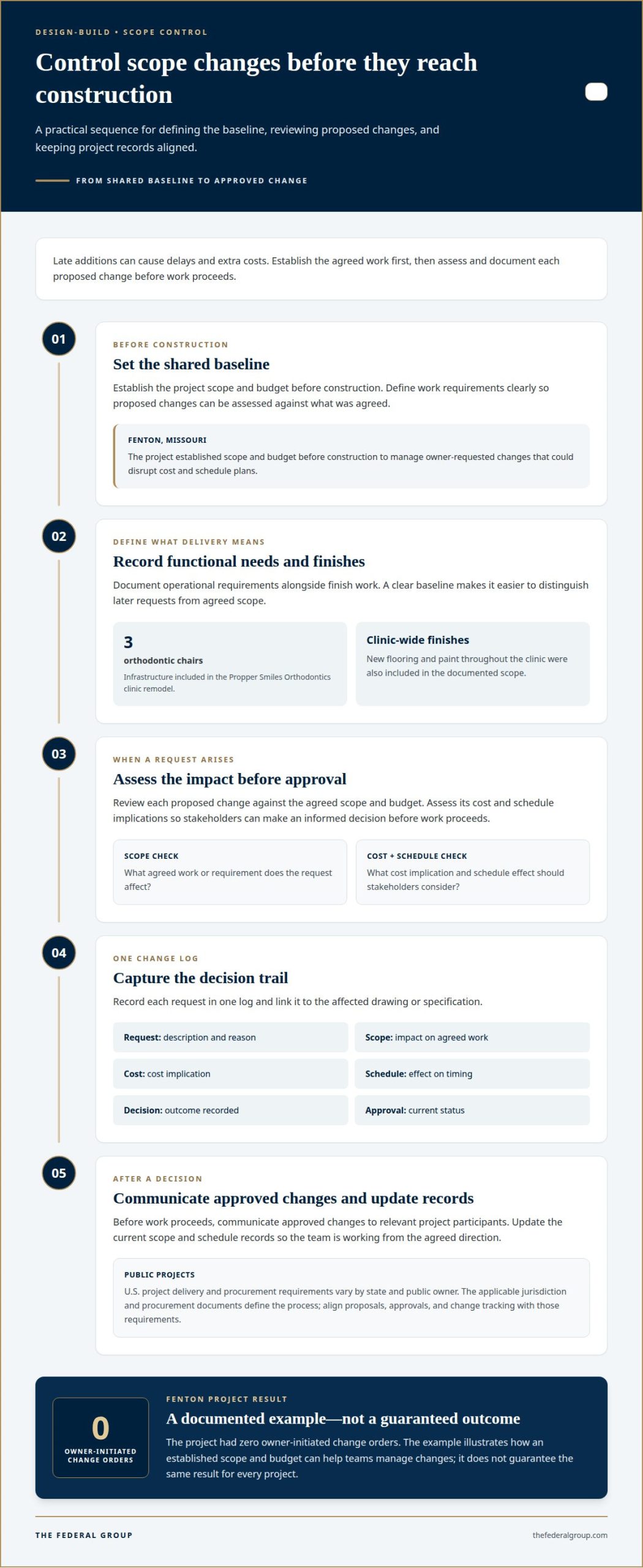
Situation: The Fenton project faced a common construction risk: owner-requested scope changes after work begins can disrupt cost and schedule plans. Action: Establish the scope and budget before construction, then assess each proposed change against both. Result: The project had zero owner-initiated change orders. This is a useful example, not a guarantee that every project will achieve the same result.
Propper Smiles Orthodontics: defining functional scope
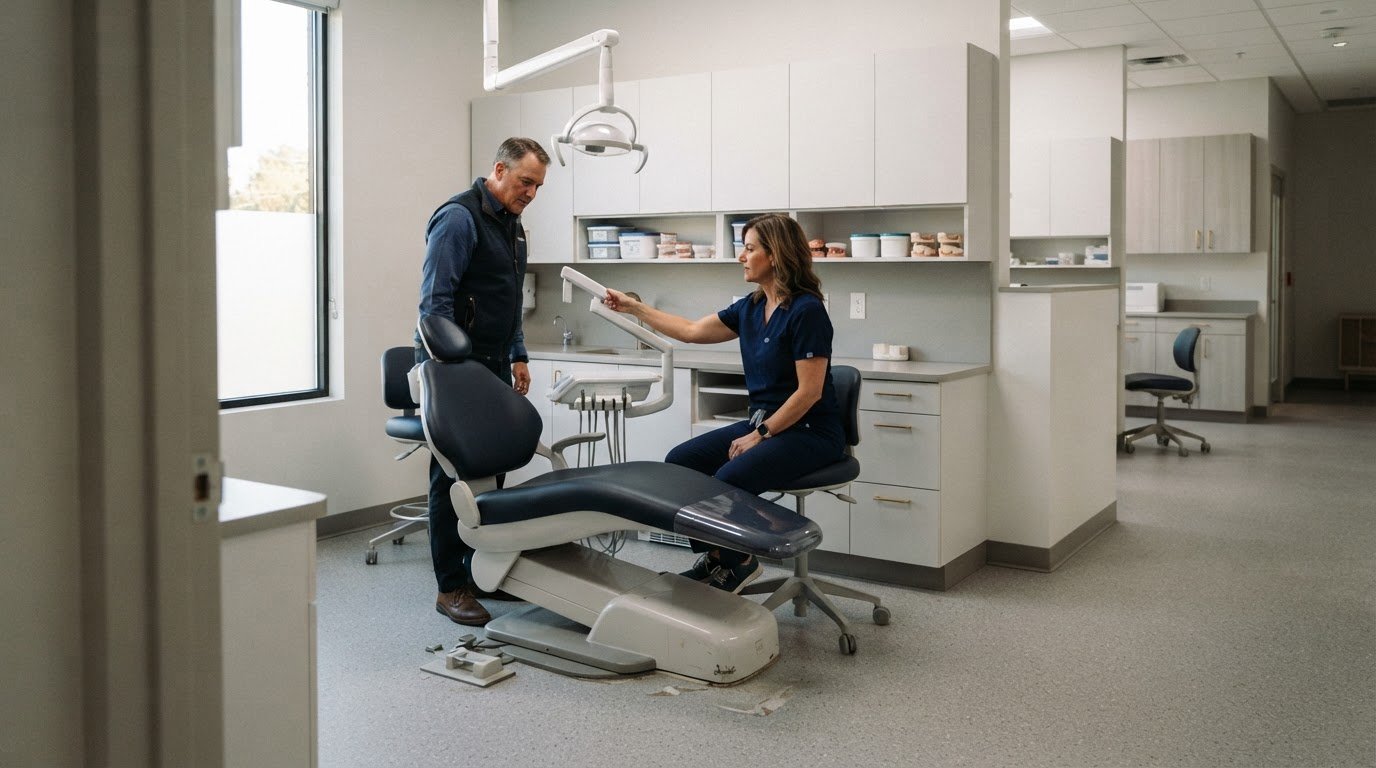
Situation: The clinic remodel needed infrastructure for three orthodontic chairs. Action: The scope also included new flooring and paint throughout the clinic, making the work clear across clinical and finish requirements. Result: These documented project elements show why teams should record operational needs and finishes before construction. A clear baseline makes it easier to distinguish later requests from agreed work.
For change-order tracking, record each request in one log: its description, reason, scope impact, cost implication, schedule effect, decision, and approval status. Link each entry to the affected drawing or specification. Before work proceeds, communicate approved changes to relevant project participants and update the current scope and schedule records.
Late additions can cause delays and extra costs, while an agreed baseline helps limit avoidable changes. The Fenton and Propper Smiles examples, along with education projects such as Richard J. Daley College’s Engineering and Advanced Manufacturing Center, offer practical lessons: define requirements early, assess each change before approval, and document decisions. These steps support flexibility without losing control of the original brief.
Aligning scope, budget, and schedule
Comparable design-build projects reduced planned total project duration by an average of 4 percent, while design-bid-build projects increased it by an average of 5 percent, a 9-percentage-point difference, according to the Federal Highway Administration. These averages describe a comparison, not the outcome for every individual project.
Budget performance is assessed by comparing a project’s construction contract cost with its final construction cost. This comparison shows why a case study should report both figures.
The final amount exceeded the contract cost. Reporting both values makes the budget outcome clear and distinguishes the original commitment from the final result.
It took 10.8 months from notice to proceed through the tenant fit-up permit under one schedule measure. These case studies of successful design-build projects are most useful when readers can compare the baseline, final outcome, and schedule measure together.
Teams can align scope, budget, and schedule by establishing work requirements, budget parameters, and schedule expectations before final design decisions. As design develops, they should review cost implications alongside project details. Strong case studies of successful design-build projects explain how the team handled trade-offs, not just the final outcome.
Measurable outcomes can include planned versus actual duration, contract versus final cost, and delivered functions. The Walter Cronkite School project included three working newsrooms, two television studios, 23 TV edit bays, and a 150-seat theatre-style auditorium. Reporting these completed elements alongside cost and schedule connects delivery results to the intended scope.
The Appleton, Wisconsin, inpatient tower project had a construction contract cost of 141,000,000 and a final construction cost of 148,300,000. The project was scheduled for completion in fall 2018. A case study can also make timing concrete by noting completion four weeks ahead of its contracted completion date.
Communication and stakeholder collaboration
In design-build, architects, designers, and builders collaborate from planning through construction as one integrated team. This structure brings design and construction perspectives into the same discussions. Stakeholders can consider how a proposed requirement affects drawings, sequencing, and delivery before decisions move forward.
Clear communication also gives owners and end users a practical way to follow progress. Regular updates and direct conversations help homeowners stay informed as a project develops. A useful update identifies the current decision, its owner, any open issue, and the next milestone. That format makes it easier to distinguish an agreed direction from a proposal still under discussion.
Richard J. Daley College: coordination around milestones
Situation: Richard J. Daley College’s Engineering and Advanced Manufacturing Center required design development alongside defined permit and fabrication milestones. The team needed to advance the design to the steel fabrication order stage by August 2017. It also needed the foundation permit by October 2017 and the full building permit by November 2017. Action: CannonDesign advanced the design with contractor input every two weeks. Result: The documented cadence connected contractor feedback with design progress and gave the team recurring opportunities to address coordination issues against upcoming milestones.
This example shows how a regular communication rhythm can support complex work better than occasional status summaries. Make each meeting decision-focused: review outstanding design questions, identify affected disciplines, record the agreed action, and assign responsibility. Stakeholders who cannot attend need the same concise decision record, so later discussions start from a shared position.
- Share a current drawing set before each design review.
- Record decisions, owners, and unresolved items after the meeting.
- Escalate conflicts that affect another discipline or project milestone.
- Use a two- to three-minute video walkthrough to explain a completed project to stakeholders.
For homeowners, direct conversations and regular updates make project progress easier to understand. For institutional teams, the Daley College example shows the value of pairing contractor input with scheduled design reviews. In either setting, communication works best when it connects a decision to its impact and identifies who will carry the next action forward.
Explaining project approaches and decisions
Design-build integrates the contractor and designer from the start. In design-bid-build, design is completed before bidding and construction begin. The delivery choice affects when owners coordinate design and construction input, how decisions move forward, and how much control they retain over the process. In either approach, clear decision records help explain changes to scope, budget, and schedule.
Richard J. Daley College: making technical trade-offs visible
Situation: Richard J. Daley College’s Engineering and Advanced Manufacturing Center needed ventilation for high-bay lab and welding areas. The initial concept specified five 15-ton ceiling-hung horizontal air-handling units. It also called for an 8,000-cfm welding-exhaust fan. Action: The design was revised to seven 10-ton units, and the welding-exhaust system increased to 19,000 cfm. Result: The documented design changes show how teams can explain technical decisions through specific equipment requirements. A decision record can state the initial condition, revised design, reason, and affected drawings, making the project logic easier to follow.
Design-build and design-bid-build differ in sequence, not in any universal guarantee of cost, schedule, or risk. Early contractor involvement can bring construction input into design development, while design-bid-build completes design before construction bidding. Owner control depends on the decision process and documented approvals; neither delivery method removes the need to manage risk.
Owners can structure selection and management around clear project criteria. First, define required functions, budget parameters, schedule expectations, and decision authority. Then assess proposals against those priorities and the team’s approach to coordination. During delivery, track design decisions, open issues, approvals, and impacts in a shared record. For technical choices such as Daley College’s ventilation revisions, this creates a traceable link between requirements and the selected solution.
For projects that need integrated development and construction planning, explore a design-build project approach aligned with the asset’s objectives.
The effort to rebuild areas damaged by 9/11 used design-build; its proposal committed to achieving LEED Gold standards. The Chicago college’s initial concept also specified (3) adiabatic dry-cooling towers and a 5,000-cfm centrifugal upblast fan for high-bay exhaust.
In another project, subcontractor modeling and coordination reduced the number of window details drawn by 30 percent.
The Federal Group: Design & Build Development
The Federal Group is a natural next step for property projects that need an integrated design-and-build approach. Through its Federal Holdings division, it operates as a fully integrated design and build developer, aligning project delivery with the development brief.
Consider this approach when shaping a property project and bringing design and construction decisions together. A clear brief, defined priorities, and timely decisions create a strong foundation for delivery. The Federal Group’s Design & Build Development offering supports this need, while Development Finance and Private Equity may also fit a project’s broader investment structure.
To discuss your project and its development requirements, contact The Federal Group.
Set the direction for your next development
Use these case studies of successful design-build projects as a practical guide when shaping your development brief. Before work advances, define what the asset must achieve, how decisions will be made, and which trade-offs matter most. This clarity gives the project team a shared basis for assessing options as design develops.
The Federal Group’s Design & Build Development offering provides an integrated development approach. Development Finance and Private Equity can also support broader project requirements. The next step is a focused discussion about your project’s objectives, delivery priorities, and investment structure.
Contact The Federal Group to discuss your development. A well-defined direction can help turn a complex project into a coordinated plan for progress.