What to do when a bank rejects your development loan
22 November 2026A rejection is a decision about your application, not necessarily about the development itself. Knowing what to do when a bank rejects your development loan starts with getting the specific reasons, then identifying which parts of the income, debt profile or project case need attention. The lender’s decision can offer a useful starting point for understanding what may need attention before you apply again.
A declined application can feel like a setback, especially when it affects project timing. Treat the decision as information: understand the lender’s concerns before applying again. This guide explains how to review a rejection, address income or debt concerns, correct credit-report errors and prepare a stronger case for future financing. It also covers when a different funding structure may fit a development that needs more than a bank loan.
Key Takeaways
- Use the rejection notice to identify whether the lender’s concern relates to income, debt, credit history or the development itself.
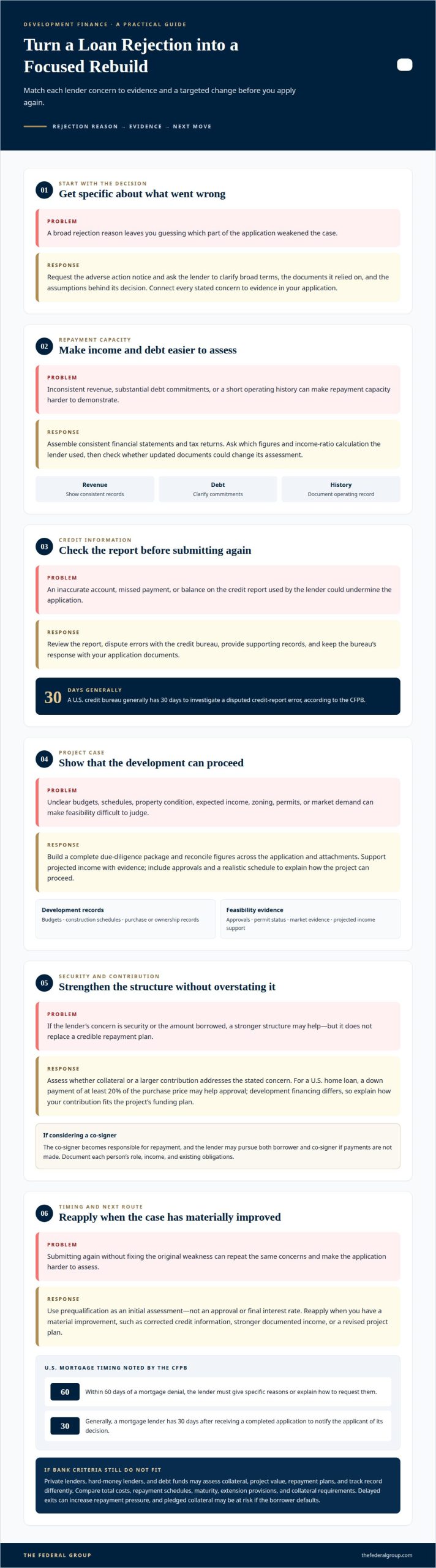
- If you find an error on a U.S. credit report, dispute it; according to the Consumer Financial Protection Bureau, a credit bureau generally has 30 days to investigate.
- For a U.S. mortgage denial, the Consumer Financial Protection Bureau says the lender must provide specific reasons or explain how to request them within 60 days.
- Strengthen a future application by assessing whether collateral, a larger down payment or a co-signer addresses the lender’s concerns, and consider whether another funding structure better fits the project.
1. Requesting and analyzing a bank’s loan rejection reasons
A practical answer to what to do when a bank rejects your development loan is to obtain the adverse action notice and identify each reason it gives. In the United States, ask the lender to explain its decision and the reasons for it. Ask the lender to clarify broad terms and identify the documents or assumptions behind them.
The first step in deciding what to do when a bank rejects your development loan is to connect each concern to evidence. A business application may be declined because revenue is inconsistent, debt limits repayment capacity or operating history is short. Lenders may also question project budgets, schedules, property condition or expected income. For example, an incomplete cost plan can make it difficult to assess whether the funding will support repayment.
Review the credit report used in the decision for inaccurate accounts, missed payments or balances. If you find an error, dispute it with the credit bureau and provide supporting records. According to the Consumer Financial Protection Bureau, a U.S. credit bureau generally has 30 days to investigate a disputed credit-report error. Keep the bureau’s response with your application records.
Alternative U.S. sources for real estate development loans include private lenders, hard-money lenders and debt funds. Their assessments may weigh collateral, project value, repayment plans and the borrower’s track record differently from a bank’s. Consider whether the proposed funding structure fits the project’s stage and cash-flow needs.
Rates, fees, down payments and terms vary by lender and deal structure. Compare total financing costs, repayment schedules, maturity, extension provisions and collateral requirements. Hard-money or private financing may increase repayment pressure if an exit is delayed. Pledged collateral may also be at risk if the borrower defaults.
Local zoning, permits and market conditions can affect a project’s feasibility. Zoning limits may constrain the proposed use, unresolved permits can delay construction, and weak demand can undermine projected income. Present approvals, a realistic schedule and market evidence to show how the development can proceed.
3. Prequalification and reapplying after denial
Before submitting another application, use prequalification to see whether the revised case may fit a lender’s criteria. It can flag potential concerns about income, debt commitments, credit history or project assumptions. Treat it as an initial assessment, not a loan approval or a final interest rate. Ask which figures the lender used, including its income-ratio calculation, and whether updated documents could change the assessment. A clear discussion can help you avoid repeating the same weaknesses in a new application.
For U.S. mortgage applications, the Consumer Financial Protection Bureau says a lender must give the specific reasons for denial or explain how to request them within 60 days. The agency also says a mortgage lender generally has 30 days from receiving a completed application to notify the applicant of its decision under the Equal Credit Opportunity Act. Use the notice to prepare focused questions. Ask which factor carried the most weight, whether any information was incomplete, and what changes could support reconsideration.
Review the credit report and inquiries before reapplying. A hard inquiry usually remains on a U.S. credit report for two years, while its effect on a credit score lasts no more than 12 months. Experian says a hard inquiry lowers a U.S. consumer’s score by less than five points. Mortgage inquiries made within a shopping window of roughly 14 to 45 days count as a single inquiry for scoring, depending on the model. Keep applications within a focused period rather than submitting them sporadically.
Reapply when the application reflects a material improvement, such as corrected credit information, stronger documented income or a revised project plan. Assemble consistent records so the lender can assess repayment capacity and development assumptions together. If bank criteria still conflict with the project’s funding structure, explore project-focused development finance as another route to assess. Compare the proposed repayment schedule and interest exposure against the project’s cash flow before proceeding.
4. Strengthening a future loan application with collateral, a down payment, or a co-signer
Match each change to the lender’s stated concern. If repayment capacity is the issue, adding collateral may strengthen the security package, but it doesn’t replace a credible repayment plan. For a U.S. home loan, a down payment of at least 20% of the purchase price may help approval. Development financing differs from a standard home purchase, so explain how the contribution supports the project’s funding plan and reduces the amount borrowed.
A co-signer can add another responsible party, but the obligation has real consequences. The co-signer becomes responsible for repayment, and the lender may pursue both borrower and co-signer if payments aren’t made. Before applying together, accurately document each person’s role, income and existing obligations. A co-signer does not replace a clear explanation of how project cash flow will cover scheduled payments.
Build a complete due-diligence package around the purpose of the loan. Include consistent financial statements, tax returns, development budgets, construction schedules, purchase or ownership records, and evidence supporting projected income. Reconcile figures across the application and attachments. For example, if the budget gives one construction total but the schedule uses another, resolve the mismatch before submitting. Missing or inaccurate details can delay review or weaken the lender’s assessment.
New businesses may have less operating history to demonstrate revenue and repayment capacity. Traditional banks typically seek at least two years of consistent revenue and market success when assessing business loan applications. A startup can strengthen its case with clear forecasts, documented capital commitments, relevant management experience and a defined repayment source, while distinguishing projections from actual results.
U.S. applicants are also protected against discrimination. The Equal Credit Opportunity Act bars denial on specified grounds, including race, religion, national origin, gender, marital status, age, public-assistance participation or exercising rights under the Consumer Credit Protection Act. For U.S. home loans, the Fair Housing Act also protects applicants based on disability and familial status. Keep records of application communications and seek an explanation if a decision appears tied to a protected characteristic.
4. How can I find out the specific reason my development loan was rejected?
Start with the written denial notice and separate each reason. If it uses broad wording, such as “insufficient repayment capacity,” ask which part of the application led to that conclusion. Request clarification in writing and refer to the application date, project name and disputed assessment. This creates a clear record and helps distinguish a borrower concern from a development concern.
Ask the lender to explain the evidence behind each reason. If it cites weak cash flow, for example, ask whether it assessed operating income, projected development revenue, existing debt or timing assumptions. If it identifies project risk, ask whether the concern is valuation, construction costs, approvals or the proposed exit. Pinpointing the specific assumption helps you decide what to address before applying again.
For a U.S. denial based on a credit report, the lender must provide the numerical credit score used and the key factors that affected it. Compare those factors with the report and your application. If the lender cites an account balance or payment history, check that the reported details match your records. Separate factual errors from legitimate concerns, since each calls for a different response.
Keep a short decision log recording the lender’s stated reason, supporting document and next action. For example, note “cash-flow concern,” the forecast reviewed and whether revised project assumptions address it. Ask whether the lender would reconsider updated information or whether its underwriting decision is final. Avoid sending unrelated documents; targeted evidence is easier to assess.
Once the reason is clear, align the next funding discussion with the actual gap. If a project’s capital structure needs a broader review, discuss your development funding requirements and how they relate to the project plan.
The Federal Group: Bridging Loans
The Federal Group offers Bridging Loans for development projects where short-term funding may suit the immediate need. After a bank rejection, consider this option when the project has a defined funding gap and a clear repayment or exit plan. The right structure depends on the development’s stage, capital needs and financial assumptions.
When a project needs broader capital support, Development Finance and Private Equity may also be relevant. For projects that combine funding with delivery, Design & Build Development brings development together with an integrated design-and-build approach. Each option serves different project needs. Set out the reason for the rejection, funding requirement and project plan to make the next discussion useful.
Contact The Federal Group to discuss your development funding needs.
Shape the next financing decision around the project
Knowing what to do when a bank rejects your development loan means reassessing the project’s capital structure rather than simply repeating the same application. Align the funding route with the development’s stage, delivery requirements and repayment plan. A clear view of these priorities can help you decide which financing conversation to pursue.
The Federal Group offers Development Finance and Private Equity, alongside Design & Build Development. These capabilities can support projects that need capital, an investment partner or an integrated approach to development and delivery. Start by setting out the project’s requirements and the role financing needs to play in moving it forward.
Contact The Federal Group today to discuss your development plans and potential next steps. A bank’s decision need not define the project’s direction; a considered financing strategy can help you move ahead with purpose.
Frequently Asked Questions
Why was my loan declined?
A lender declines an application when its assessment finds that repayment, credit or project assumptions don’t meet its criteria. The issue may be specific: a development company could have sound assets but limited operating income before construction is complete. Separate the decision into borrower finances, project economics and security, then identify which assumption drove the outcome. This helps focus the next discussion.
Why do banks reject real estate development loan applications?
Banks may find a development difficult to assess when expected income depends on future sales or leasing. They may also question the cost to complete, sponsor liquidity, valuation, repayment route or priority of security over the property. For example, a project budget without a clear funding source for later construction stages can make the overall financing plan appear incomplete.
Can I appeal or ask a bank to reconsider a rejected development loan?
You can ask the lender to review its decision, but distinguish reconsideration from a formal appeal process. A useful request identifies the decision and presents new information, such as corrected financial records, a revised cost schedule or further evidence supporting project income. Ask how the lender handles review requests and whether it needs a particular document before reassessing the application.
How can I improve a development loan application after rejection?
Make the next application easier to assess by tying each funding request to a project milestone. Show which costs arise during acquisition, construction and completion, and identify the funding source for each stage. Separate committed capital from projected revenue, then align the repayment route with the expected completion or sale. A clear, consistent application helps lenders follow the project’s financial logic.
What legal rights do borrowers have when a bank denies a business loan?
In the United States, the Equal Credit Opportunity Act protects applicants from discrimination in credit decisions. Credit-report rules also allow consumers to challenge inaccurate information. If a bureau’s investigation leaves a disputed item unresolved, an applicant generally may add a statement explaining their position to the credit file. Keep supporting records and the denial notice together if correcting the item matters to a future application.