Scaling a property development business through investor capital
19 November 2026A larger development pipeline needs more than a larger balance sheet. Scaling a property development business may involve coordinating funding from banks, equity partners and passive investors, while building the team and operating model to match each project’s needs. The right capital structure depends on the project’s scale, risks and funding requirements.
Investor capital can open new opportunities, but growth also raises the demands on decision-making, delivery and communication. A funding plan is most effective when it supports a clear development strategy, rather than dictating one.
This article explains how to align investor contributions with project requirements, refine a growth strategy and build a skilled team with clear responsibilities. It also explores why a defined long-term vision matters as a business moves from individual projects to a broader development pipeline.
Key Takeaways
- Match investor contributions to each project’s funding needs, risk profile and ownership structure, with clear expectations for every capital partner.
- Adapt your strategy as the pipeline grows by aligning project selection, funding decisions and delivery capacity with long-term objectives.
- Define responsibilities across investment, development and delivery so the team can make decisions clearly and coordinate complex projects.
- Set a company vision that guides which opportunities to pursue and gives investors and employees a consistent basis for growth.
1. Capital structures and investor contributions
Growth changes how a development is funded. A project may involve banks, equity partners and passive investors, each with different capital roles and expectations. Define contributions, decision rights, reporting and distributions before committing funds. A single-owner LLC may suit a relatively simple project, while a broader investor base calls for more deliberate governance.
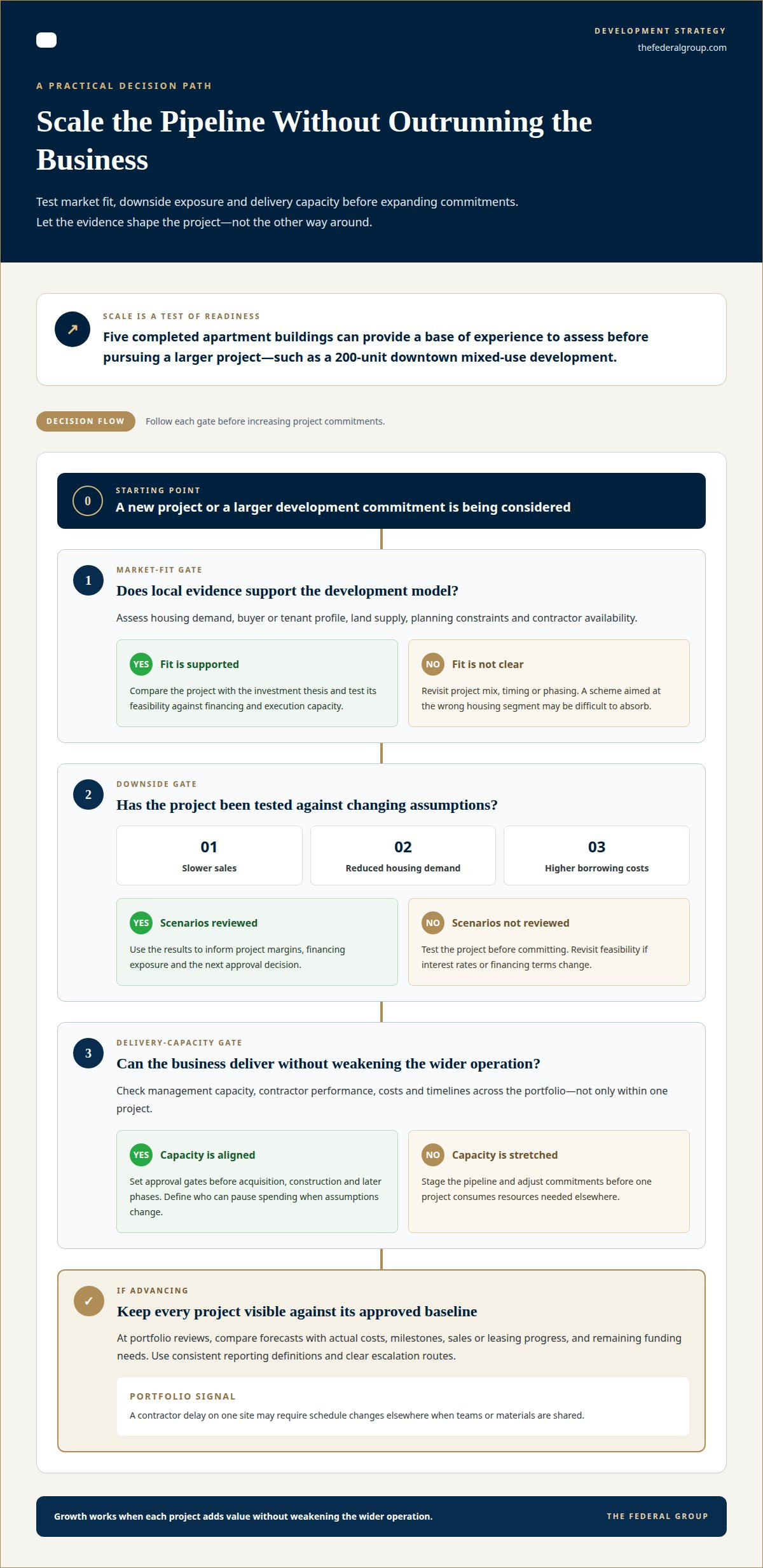
For housing investment, evaluate local demand, achievable rents or sale values, land availability and planning constraints. Then test whether the development model can be repeated without stretching delivery capacity. A developer with five apartment buildings completed has a base of experience to assess before pursuing a larger project, such as a 200-unit downtown mixed-use development. Scalable opportunities align market demand with financing, execution capacity and a clear exit strategy.
A reliable project pipeline starts with clear acquisition criteria and a consistent review process. Track prospective sites from initial screening through due diligence, approvals, funding and delivery, giving each opportunity a visible next step. Compare projects against the same investment strategy, including housing mix, target market and resource demands. This helps maintain a flow of viable opportunities instead of relying on a single acquisition.
Across multiple projects, manage construction costs, timelines and contractors with project-specific budgets, schedules and accountable leads. At regular project meetings, compare commitments, progress and emerging variations with the approved baseline. Shared reporting gives decision-makers visibility across the portfolio, while clear escalation routes help resolve contractor issues before they affect other work.
Investor relationships need disciplined communication. Share the project thesis, capital structure, material risks and reporting cadence in clear terms, then provide consistent updates as milestones change. A relationship led to a £1 million investment in a single UK property development deal, illustrating how trust can support a transaction. Legal, tax and investor-relations advisers can help structure participation and maintain communication; securities counsel may need to navigate Regulation D, according to the U.S. Securities and Exchange Commission.
2. Strategy changes required when scaling
A small developer can make decisions directly, but a larger operation needs repeatable controls. Assess profitability through project margins, overhead, financing exposure and management capacity rather than assuming larger schemes earn more. A larger portfolio may spread central costs across projects, but added coordination and delivery demands can also reduce margins. Growth works when each project adds value without weakening the wider operation.
Scaling increases exposure to delays, cost changes, contractor performance and concentrated demand. Test each project against slower sales, reduced housing demand and higher borrowing costs. Set approval gates before acquisition, construction and later phases, and define who can pause spending when assumptions change. A staged pipeline lets the business adjust commitments before one project consumes resources needed elsewhere.
Local conditions should shape the growth plan from the outset. Assess each market’s housing demand, buyer or tenant profile, land supply, planning constraints and contractor availability before choosing a development model. If demand favours smaller homes, a large scheme focused on another segment may be difficult to absorb. Revisit feasibility when interest rates or financing terms change, then adjust timing, phasing or project mix.
Operating discipline must keep pace with project volume. Establish a portfolio review comparing each development’s forecast with actual costs, milestones, sales or leasing progress, and remaining funding needs. Use consistent reporting definitions so leaders can see which projects are behind plan and why. For example, a contractor delay on one site may require schedule changes elsewhere if teams or materials are shared.
As the business expands, preserve a clear investment thesis while adapting execution to local evidence. A developer entering a new housing market should assess demand and delivery capacity before committing capital, then define measurable approval gates. A structured development strategy can connect market selection, funding decisions and operational readiness without treating growth as a simple increase in project count.
3. Building a skilled team with clear roles
A growing development business needs clear accountability across investment, project delivery, finance and governance. Assign a lead to each function and document who approves acquisitions, scope changes, budgets and delivery milestones. This prevents decisions from circulating between teams without an accountable owner. It also gives investors and project partners a clear route for updates and escalation.
Experience should match the decisions each role carries. João Arantes e Oliveira has over 25 years of private equity experience, a background relevant to investment analysis and capital allocation. Paulo Lameiras Martins has over 30 years of investment banking and executive leadership experience. That experience can inform financing strategy, governance and senior decision-making as a portfolio becomes more complex.
Project delivery requires a distinct capability set. Luís Coutinho Teixeira worked for Teixeira Duarte Group from 2008 to 2022, leading large-scale real estate projects. A development team can translate comparable experience into clear responsibilities for procurement, contractor coordination, programme oversight and reporting. Define decision limits before construction begins, so project leads can resolve routine issues while escalating material changes to senior management.
Map roles across the full development lifecycle, rather than staffing only for construction. An acquisition lead can assess sites, investment staff can test feasibility, delivery leaders can coordinate implementation, and finance staff can track commitments against forecasts. When a project moves from site assessment into delivery, for example, a named handover owner should transfer assumptions, approvals and open risks to the project lead.
Use regular operating reviews to connect responsibilities across active projects. Each lead should report progress, emerging decisions and dependencies in a consistent format. If a planning issue affects the programme, the project lead can raise it promptly, finance can assess the impact, and executives can decide whether to adjust sequencing. Clear role boundaries support faster decisions without removing oversight as the team grows.
4. Defining a clear company vision
A clear vision turns growth ambitions into decisions about which projects to pursue. Define the assets, markets and outcomes the business will prioritize, then use them to screen opportunities. A company focused on housing delivery, for example, can assess proposals against local demand, intended residents and its ability to execute the required development model.
Make the vision practical by translating it into investment criteria. Specify acceptable project types, target locations, delivery capabilities and conditions that would rule out an opportunity. A proposal outside these boundaries may look attractive, but pursuing it can divert management attention and capital from the core strategy. Written criteria give decision-makers a consistent basis for explaining trade-offs.
Connect long-term intent to practical milestones. Leadership can set priorities for the pipeline, delivery capacity and funding approach, then review progress through regular governance meetings. If the vision includes entering a new market, for instance, require local demand analysis, suitable project leadership and a credible delivery plan before advancing an acquisition. This ties ambition to readiness.
Communicate the vision in language employees, investors and project partners can apply. Explain why the business selects certain opportunities, how it defines successful delivery and which risks it will not accept. Teams should be able to use these principles when assessing a design change or schedule decision, rather than relying on an abstract mission statement. Consistency builds alignment across functions.
Review the vision when evidence changes, without reacting to every market shift. Compare actual project outcomes with the assumptions behind the strategy, including demand, delivery performance and available expertise. If repeated projects reveal a mismatch, leadership can revise its criteria and explain the change to stakeholders. Discuss your development vision as you shape the next stage of growth.
The Federal Group
The Federal Group supports developers aligning capital, project delivery and long-term growth. Its Development Finance and Private Equity offerings can help fund projects and development pipelines. For businesses seeking to integrate planning and execution, its Design & Build Development service brings development and delivery together.
Engage when growth plans call for a coordinated approach to financing and implementation, rather than an isolated project decision. The Federal Group works across property finance and development, with Sports Multi-Club Ownership as a separate investment focus. Its finance and development capabilities can support developers considering how capital and delivery expertise fit their next stage.
To discuss your development plans, contact The Federal Group.
Turn a growth ambition into a practical next step
Scaling a property development business means aligning ambition with the capital, expertise and delivery model needed to pursue it. Start by defining the opportunity you want to advance and the support needed to make the plan actionable. A focused discussion with The Federal Group can help clarify how development finance, private equity and design & build development may fit your objectives.
The Federal Group brings investment and development capabilities together for property projects. Consider how these services fit your direction, whether you are preparing a project or planning broader growth. Keep the decision grounded in your strategy and the needs of your development pipeline.
Discuss your plans with The Federal Group and take the next step with clarity and purpose.
Frequently Asked Questions
What are the key steps to scale a property development business?
Start with a project case linking expected demand, delivery scope and funding requirements. Then define approval authority, assign accountable leads and establish portfolio reporting before committing to additional projects. A practical test is whether managers can identify each project’s current decision, next milestone and outstanding dependency from the same dashboard. If they cannot, strengthen operating controls before expanding the pipeline.
How much capital is needed to grow a real estate development company?
The capital required depends on the portfolio, acquisition commitments, development scope, funding structure and timing of cash inflows. Build a project-level cash-flow model that separates land acquisition, predevelopment work, construction draws and business overhead. Consolidate the forecasts to show when capital is needed and where shortfalls could arise. Test how delayed receipts would affect commitments across active projects.
What financing options are available for scaling property development projects?
Options include Development Finance, Private Equity and Bridging Loans, selected according to the project’s stage and capital structure. Development Finance can support project funding needs, while Private Equity brings investor capital into development opportunities. Bridging Loans provide short-term finance. The Federal Group offers these financing options, alongside Design & Build Development for property projects where integrated delivery suits the business’s requirements.
What team roles and systems are needed to scale a property development company?
Assign clear ownership for acquisitions, financial control, project delivery and executive approvals. Support those roles with document control, a decision log and consistent project reporting. The decision log, for example, can record who approved a scope change, the rationale and any follow-up action. Shared systems help teams find current information and track outstanding responsibilities without relying on informal updates.