Presenting Development Opportunities for Committee Review
21 November 2026A long deck cannot rescue an unclear investment case. When presenting development opportunities to an investment committee, lead with the recommendation, value drivers, material risks, unresolved assumptions, and the decision required. Then show how diligence and the financial case support that recommendation.
Evidence matters, but committee members also need to understand which assumptions drive the case, what could change the outcome, and how the opportunity fits their priorities. Make those connections explicit so members can assess the proposal.
This article explains how to frame the investment thesis, present diligence findings transparently, and organize the discussion around the committee’s decision. It also covers how to reconcile figures across the presentation and supporting materials, distinguish open questions from established findings, and make the case defensible without burying it in detail.
Key Takeaways
- Separate verified diligence findings from assumptions, and make each open item’s owner, resolution point, and potential impact clear.
- Build a defensible thesis by linking market position, growth drivers, financial evidence, and material risks to the investment rationale.
- Connect the opportunity to the committee’s strategic priorities and keep deliberations focused on the institutional decision.
- Lead with the recommendation and approval sought, then use a concise narrative and consistent supporting materials to guide review.
Diligence findings and unresolved assumptions
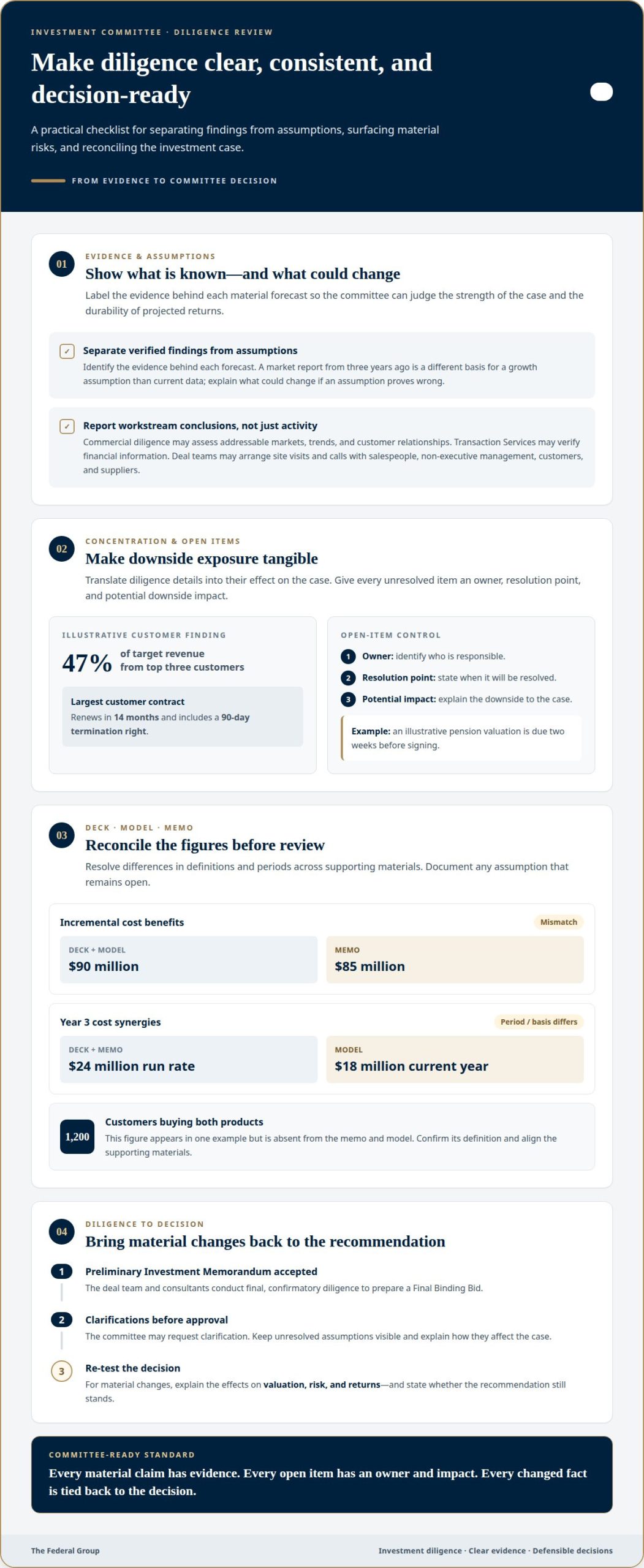
Separate verified findings from assumptions before the meeting. A market report from three years ago provides a different basis for a growth assumption than current data. Label the evidence behind each material forecast and explain what could change if an assumption proves wrong. This helps the committee assess risk and the durability of projected returns.
Clarify each consultant’s role. Management consultants may conduct commercial diligence on addressable markets, trends, and customer relationships. Accounting firms’ Transaction Services groups verify financial information through confirmatory financial diligence. Private equity deal teams may also arrange site visits and calls with salespeople, non-executive management, customers, and suppliers. Present each workstream’s conclusions, not just its activities.
Make customer concentration tangible. In one illustrative finding, the top three customers account for 47 percent of target revenue. The largest customer’s contract renews in fourteen months and includes a ninety day termination right. Show how those facts affect the case, and assign every open item an owner, resolution date, and downside impact. For example, an illustrative pension valuation is due two weeks before signing.
Reconcile figures across the deck, model, and memo. One example reports $90 million in incremental cost benefits in the deck and model, but $85 million in the memo. Another shows year 3 cost synergies as $24 million run rate in the deck and memo, versus $18 million current year in the model. A separate example lists 1,200 customers buying both products, absent from the memo and model. Resolve definitions and document any remaining assumption.
After a Preliminary Investment Memorandum is accepted, the deal team and consultants conduct final, confirmatory diligence to prepare a Final Binding Bid. The committee may request clarification before approval. Bring material changes back to the decision: explain their effects on valuation, risk, and returns, and state whether the recommendation still stands.
Investment thesis and business defensibility
State the recommendation as a concise investment argument, not a project description. Explain the strategic rationale, growth potential, market position, and potential synergies. Keep the thesis to one page, then connect each claim to evidence elsewhere in the presentation. This helps the committee distinguish core value from supporting detail.
Define the target and assess its standalone quality before presenting development upside. Describe the business model, products or services, key customers, and operational strengths and weaknesses. Then assess market size, growth trends, competitors, and demand drivers. Name the sources behind important assumptions and show where the organization has an advantage competitors cannot readily reproduce.
Prepare a financial plan that links historical performance to projections. Show revenue, expenses, EBITDA, cash flow, valuation, and the assumptions behind each measure. For a development project, estimate costs by scope and delivery phase, separating land, construction, professional fees, financing, and other project expenses. Present financing sources, timing, and repayment assumptions alongside a contingency linked to identified risks. Explain how changes in scope or delivery conditions affect the total funding requirement.
Model scenarios around the variables that can change the outcome: costs, schedule, rents, and exit value. Present a base case and a downside case, then use sensitivities to show which assumptions have the greatest effect on returns. For example, show how delayed completion or lower rent changes cash flow and valuation. Keep the underlying assumptions visible rather than obscuring them in blended averages.
Use this section to connect evidence, defensibility, and risk mitigation. A clear recommendation explains why the project merits consideration, what would weaken the case, and how the plan responds. Sound market analysis and transparent financial logic give committee members a basis to challenge the investment and assess its merits.
Strategic oversight and committee priorities
Connect each transaction to the organization’s strategy and fund mandate. Explain how the opportunity supports that strategy, what alternatives were considered, and why the proposed route merits attention. A real estate allocation, for example, may warrant comparison with other investment options rather than assessment in isolation. Ground the discussion in the institution’s objectives, not individual members’ personal experiences.
Strategic oversight also covers the wider portfolio. Committees can dedicate an annual focus to portfolio risk and ESG policies, review fund expenses, and assess how organizational strategy affects the fund. These priorities help put a project in context. If members establish a special subcommittee for alternatives such as private equity or real estate, define its remit and how its findings will inform the full committee.
Make the requested decision explicit. An investment committee may authorize a deal team to submit a First Round Bid, approve a budget for consultants or other deal-related expenses, or discuss an opportunity without granting approval. Distinguish these outcomes in the agenda and presentation. If valuation is changing, specify the decision required now and what remains for later review.
Historical performance needs context. When assessing manager results, committees are advised to consider 3-, 5-, and 10-year horizons or a full market cycle. Relate those periods to the strategy under review, rather than relying on a single short-term result. State what the comparison reveals about performance and risk, then note how that evidence informs the current investment rationale.
Meeting design shapes the quality of oversight. A meeting may last 90 minutes, leaving limited time for broad allocation, spending-policy, and risk-framework discussion. Separate agenda items requiring action from those meant for discussion, and reserve space for strategic questions. This helps the committee weigh immediate transaction decisions against enduring priorities without allowing one topic to crowd out the rest.
Structuring the investment committee presentation
A disciplined approach to presenting development opportunities to an investment committee starts with the decision, not the project history. Put the recommendation, amount, instrument, ownership position, headline valuation, key decision factors, and approval requested on page one. This gives members an immediate frame for reviewing capital at risk and strategic fit. A private equity team may begin with a 2-3 page proposal after management’s presentation and initial discussions.
Build the presentation as a connected narrative: executive summary, market analysis, business overview, financials, investment thesis, risks, and exit strategy. Each section should answer a distinct committee question. Link market position to the growth case, then show how projected performance supports expected returns. This sequence lets members test the logic without searching through disconnected detail.
Make the return bridge visible. Show how entry multiple, growth, margin, debt paydown, and exit multiple contribute to the outcome. Use charts, graphs, or tables when they clarify relationships. Keep labels and assumptions consistent across exhibits so members can trace a figure from the summary to its supporting analysis. When presenting development opportunities to an investment committee, separate key decision points from technical detail.
Distinguish agenda items requiring action from those intended for discussion. Provide the presentation and prior meeting minutes at least a week before the meeting, giving members time to review the material. Rehearse a mock committee discussion and prepare concise responses on valuation, equity structure, risks, and exit scenarios. Answer each question directly, then use the relevant exhibit to support the response. To discuss a private equity opportunity, connect with The Federal Group.
The Federal Group
The Federal Group connects development opportunities with relevant capital and delivery capabilities. Its work spans Development Finance, Private Equity, Design & Build Development, and Sports Multi-Club Ownership. When a project needs a clear investment case, these capabilities offer a natural basis for discussing its financing, ownership, or development structure.
For committee preparation, present a coherent view of the opportunity, with its objectives, assumptions, risks, and decision requirements aligned. The Federal Group is a finance partner and developer, making it relevant when a project moves from investment rationale toward financing or delivery. The right fit depends on the project’s needs and the role required.
To discuss your development opportunity, contact The Federal Group.
Turn committee review into a clear next step
A committee decision marks a transition point for the opportunity. Use its direction to clarify the project’s next priorities, align stakeholders around the approved course, and connect strategic intent to execution. A well-structured approach to presenting development opportunities to an investment committee supports continuity from the initial decision through the next phase of project planning.
The Federal Group offers Development Finance, Private Equity, and Design & Build Development. These capabilities can support a project as it moves from investment consideration toward financing, ownership, or delivery. The next step depends on the opportunity and the committee’s direction.
Contact The Federal Group to discuss your development opportunity. A clear path forward starts with a focused conversation about the project’s objectives and requirements.
Frequently Asked Questions
What to expect?
Presenting development opportunities to an investment committee typically involves a focused presentation followed by questions about the project, its assumptions, and the decision requested. Be ready to explain how key conclusions were reached and to provide clarification or additional information. Confirm whether the meeting is for discussion, an update, or formal approval. Record follow-up questions, who owns each response, and what information is needed.
What should an investment committee presentation for a real estate development opportunity include?
When presenting development opportunities to an investment committee, include the information members need to understand the project, its rationale, and the decision required. Explain the site and proposed use, development plan, market evidence, capital structure, financial outlook, principal risks, and intended exit or long-term ownership approach. Make dependencies visible, such as a lease-up assumption tied to completion timing. Use supporting exhibits for technical detail without obscuring the main decision.
How do you structure an investment committee memo and presentation?
Use the memo as the complete analytical record and the presentation to guide discussion. Organize both around the same recommendation, project assumptions, analysis, and decision request. Give every material claim a clear reference to its supporting exhibit or model input. For example, readers should be able to trace a rent assumption to the relevant market evidence and model line. Align document versions before circulation.
What financial metrics should be presented for a development investment, including IRR, equity multiple, and yield on cost?
Use IRR to show how investment timing affects annualized returns, equity multiple to compare total distributions with contributed equity, and yield on cost to compare stabilized operating income with total development cost. Define each metric and state its assumptions. A strong yield on cost can mask slow delivery or weak cash generation, so interpret metrics alongside timing, funding needs, and exit assumptions.
How do you evaluate market demand, comparable projects, rents, and sales prices for a development opportunity?
Assess demand using evidence on target users, competing supply, absorption, and relevant market trends. Select comparable projects with similar location, use, quality, and delivery stage, then explain meaningful differences. For rents and sale prices, distinguish achieved transactions from asking levels and relate each benchmark to the project’s positioning. If a comparable is less similar, explain why it remains useful and how that affects the assumption.
What due diligence and approvals should be completed before presenting a development deal to an investment committee?
Present findings on site control, planning status, design and construction feasibility, market demand, financial assumptions, and financing structure. Approvals and diligence requirements depend on the project and jurisdiction, so distinguish completed work from outstanding decisions. For each open item, explain its impact on the decision and the proposed path to resolution. Account for material findings from confirmatory diligence before finalizing a binding bid.