Equity Financing Options for Commercial Real Estate Development
20 November 2026Equity financing for commercial real estate development is a capital-stack decision, not a standalone source of funds. It can take the form of preferred or common equity alongside senior debt, mezzanine debt, and real estate incentives. Preferred equity generally receives distributions before common equity, while common equity shares in the project’s remaining upside and risk.
Choosing between these structures means weighing more than the amount of capital required. Project stage, expected cash flow, risk allocation, and the sponsor’s desired balance of control and returns all influence the choice. Preferred equity is an ownership stake with a defined priority in the project’s capital structure, not a conventional loan.
This guide explains how preferred and common equity work, how private equity fits into a development’s funding plan, and how equity can be coordinated with debt and other financing strategies. It outlines the key differences between these options and why the project’s structure matters when assembling capital.
Key Takeaways
- Understand how private equity firms pool limited-partner capital to fund property acquisition, development, improvement, and eventual sale.
- Assess how debt and equity work together in a project’s capital stack, and how each source affects risk and repayment priorities.
- See how loan-to-value ratios shape the equity contribution a development may require and influence financing structure.
- Explore how development finance and private equity can support different project needs, from construction funding to broader investment strategies.
Private equity capital raised from limited partners
Private real estate funds pool limited partners’ capital to acquire, develop, improve, and sell properties. The funding structure determines investor priority, repayment, and the sponsor’s remaining ownership.
Limited Partner Capital
Limited partners contribute capital to a private equity fund, which then invests in commercial property projects. For developers, this can provide acquisition or construction funding without relying solely on property-level borrowing. Some fund strategies involve purchasing an asset, improving its operations, and then selling it. The project plan and return structure help investors assess how their capital will be used.
Development Capital Stacks
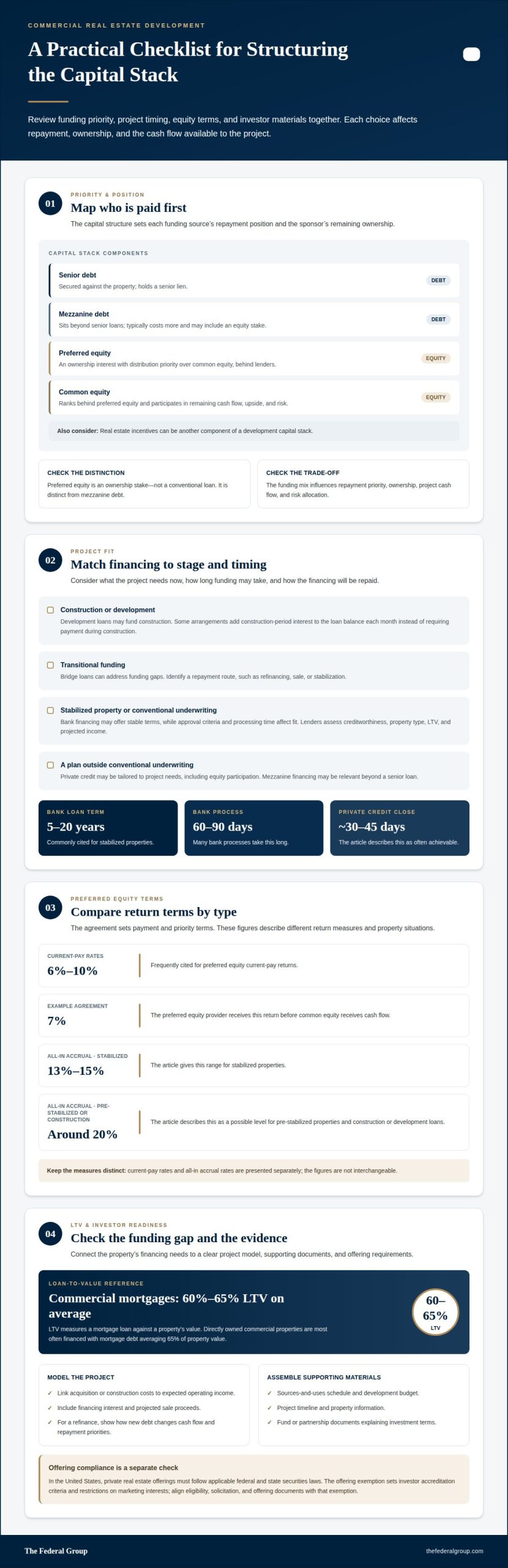
A development capital stack combines funding sources with different repayment positions, including senior debt, mezzanine debt, preferred equity, common equity, and real estate incentives. Senior debt is secured against the property and holds a senior lien; equity bears risk behind debt. Development loans may fund construction, while bridge loans can meet transitional needs. Some development finance arrangements add construction-period interest to the outstanding loan balance each month instead of requiring payment during construction. The capital structure affects cash flow and each source’s position.
Offering Rules and Investor Accreditation
In the United States, private real estate offerings must comply with applicable federal and state securities laws. The offering exemption determines investor accreditation criteria and restrictions on marketing interests. Sponsors should align investor eligibility, solicitation, and offering documents with that exemption. These rules shape who can participate and how a fund raises private capital; they are separate from the project’s financing terms and property-level loan documents.
Investor Projections and Documents
Investors assess financial projections alongside documents explaining the property, capital plan, and investment terms. A useful model connects acquisition or construction costs to expected operating income, financing interest, and projected sale proceeds. Supporting materials commonly include a sources-and-uses schedule, development budget, timeline, property information, and fund or partnership documents. For a refinance, the analysis should show how new debt changes cash flow and repayment priorities. Clear assumptions help investors assess the path from funding to exit.
Debt and equity funding for property acquisitions and development
Commercial property acquisitions and developments commonly combine debt and equity. The mix affects repayment priority, ownership, and available project cash flow.
Traditional bank loans can offer stable terms for commercial properties, but approval criteria and processing timelines shape their fit. Bank loans for stabilized properties commonly run five to 20 years, while many bank processes take 60-90 days. Lenders assess creditworthiness, property type, loan-to-value ratios, and projected income. Market conditions also influence interest rates and underwriting.
Private credit can support properties or plans that do not fit conventional underwriting. Private lenders may tailor terms to a project’s needs, including equity participation, and can often close in approximately 30-45 days. Mezzanine financing sits beyond senior loans in the capital structure, typically at higher cost and sometimes with an equity stake. Short-term bridge loans can address funding gaps, but require a clear repayment route, such as refinancing, sale, or stabilization.
Opportunistic Development and Redevelopment
Opportunistic investment funds projects that require development or redevelopment before sale. This strategy can suit land acquisition, new construction, or repositioning an existing property, where value depends on execution rather than current income alone. A commercial development model can account for buying land, building, securing tenants, and selling after stabilization. Project timing, construction costs, leasing progress, and exit assumptions all shape the funding plan.
Direct Ownership and Joint Ventures
Direct ownership places the property under an investor’s ownership, while a joint venture combines capital and project roles between partners. Directly owned commercial properties are most often financed with mortgage debt averaging 65% of property value. A joint venture can bring together a sponsor’s development capabilities and an investor’s capital, with agreements defining ownership, decision-making, distributions, and exit rights. Those terms influence control and each partner’s exposure to project risk.
For a development requiring multiple sources, a financing analysis can align debt, equity, and project timing. Explore a project-specific financing structure to consider how capital requirements and development plans fit together.
What is a Preferred Equity Investment?
Preferred equity is an ownership interest that receives distributions ahead of common equity but behind lenders with debt claims. Unlike mezzanine debt, it is not a loan that may convert into equity after default. Common equity ranks behind preferred equity in the distribution order and participates in remaining cash flow and project upside.
Investor returns depend on the agreement’s payment and priority terms. Preferred equity current-pay rates are frequently 6% to 10%; an example agreement may give the provider a 7% return before common equity receives cash flow. All-in accrual rates for stabilized properties are 13% to 15%, while pre-stabilized properties and construction or development loans may be around 20%.
Loan-to-value, or LTV, measures a mortgage loan against a property’s value. Commercial real estate mortgages generally average 60% to 65% LTV, while loans in current U.S. conditions typically range from 60% to 70%. That position leaves a larger share of project capitalization to equity. Senior lenders frequently require sponsors to contribute 20% to 40% of total capitalization, so preferred equity can help fill a funding gap.
The remaining value is not automatically the required equity amount, because project costs and lender terms also shape capitalization. In a development, the sponsor’s contribution and preferred equity terms affect control, distributions, and the project’s ability to absorb cost or timing changes.
Refinancing adds another consideration: approximately $875 billion of U.S. commercial and multifamily mortgage debt is scheduled to mature in 2026. Construction loans commonly disburse funds in phases and may require interest-only payments during construction. Those mechanics can affect cash flow before stabilization, making the preferred equity position and payment structure material to project planning.
Financing strategies for development projects
To raise equity, developers define the project, model its funding gap, and match capital to the development plan. They then set investor terms, prepare offering materials, and coordinate commitments with the debt schedule. The sequence matters: land acquisition, construction, leasing, and sale each create different cash-flow needs and investment risks.
Preferred equity can fill a gap between senior debt and common equity, with distributions based on negotiated priority. Mezzanine financing provides capital beyond a senior loan, often at higher cost and sometimes in exchange for an equity stake. The right structure depends on projected operating income, control preferences, repayment timing, and the borrower’s ability to support debt service. Each source creates a different balance of capital, risk, and potential upside.
Public real estate investment trusts offer another route to property exposure. According to the Internal Revenue Service, REITs must distribute 90% of taxable income to shareholders. Tax Increment Financing can support development infrastructure by using future property tax revenue generated by new projects. These options serve distinct purposes: REITs invest across properties, while TIF can help address infrastructure funding around a development.
Short-term construction loans may carry higher interest rates and multiple fees, so the funding plan must account for construction-period cash needs. Soft deposit loans can provide fast, flexible capital for earnest money. A development finance arrangement may also schedule repayments to begin when the project is marketed and sold. For each source, align expected repayment with project milestones and the planned exit, such as refinancing, stabilization, or sale.
The practical advantage comes from coordinating sources rather than selecting them in isolation. For example, a project may combine senior debt, preferred equity, and a TIF-supported infrastructure plan, each tied to a distinct use. Discuss a development capital strategy for a funding structure aligned with the project’s scope and timeline.
The Federal Group: Private Equity
The Federal Group provides Private Equity for investors and developers seeking capital for commercial property projects. Its Development Finance offering can address project funding needs, while its Design & Build Development service integrates financing with project delivery.
This combination can suit projects that need capital alongside an integrated development approach. The right structure depends on the asset, development plan, funding requirements, and the roles investors expect to hold. Private Equity is not a substitute for every financing source, but it can form part of a broader capital strategy alongside development finance.
If your project needs investment or development funding, contact The Federal Group to discuss the right fit.
Set the Direction for Your Next Development
The next step is to turn the project’s investment thesis into a funding plan that reflects its stage, delivery model, and intended exit. A clear view of these priorities helps align equity terms with the development’s operating plan, rather than treating capital as a separate decision. That is the foundation for equity financing for commercial real estate development that supports the project’s objectives.
The Federal Group offers Private Equity, Development Finance, and Design & Build Development. These services can support projects that need investment capital, development funding, or an integrated delivery partner. The right starting point depends on the project’s scope and the role capital must play.
Bring the project’s objectives and funding priorities into the next discussion, then determine which structure best fits the opportunity. Discuss your project with The Federal Group and take the next step toward a considered development plan.
Frequently Asked Questions
What is equity financing for commercial real estate development?
Equity financing brings investors’ capital into a project in exchange for ownership interests and a share of distributions or potential upside. Unlike a mortgage, equity does not create scheduled principal repayment simply because capital was invested. For example, a project company can issue interests to a sponsor and outside investors, with its governing documents setting distribution rights, decision-making authority, and what happens when the property is sold.
What types of equity investors fund commercial real estate development?
Development equity may come from limited partners investing through private funds, investors holding interests directly in a project, or publicly traded real estate investment trusts. These are different channels: a private fund pools investor capital, while a REIT raises capital in public markets to invest in properties. In a project-level structure, common and preferred equity describe investors’ positions and distribution priorities, not separate investor categories.
How much equity is typically required for a commercial real estate development project?
Senior lenders frequently require sponsors to contribute between 20% and 40% of a project’s total capitalization. This contribution is not a universal equity requirement for every project; the financing structure also reflects development costs, projected income or sales, property type, and the sponsor’s track record. A project budget and sources-and-uses schedule help show how sponsor capital, outside equity, and debt combine to fund the plan.
How are development profits and ownership shares structured between sponsors and investors?
Project documents establish ownership interests and the order in which cash is distributed. A waterfall may first direct distributions to preferred equity until its agreed return is met, then allocate remaining proceeds to common equity. The sponsor and investors can also agree to an equity kicker, giving an investor a share of upside above a specified financial hurdle. Ownership percentages and distribution rights are related but need not be identical.
What are the risks and disadvantages of equity financing for developers?
Equity can reduce a sponsor’s ownership percentage and give investors contractual rights over distributions or project decisions. Preferred and common equity carry higher risk and are last to receive repayment if a project fails or is liquidated. For example, construction delays or weaker-than-projected leasing can reduce proceeds available to every equity holder. Before accepting capital, sponsors should assess how the agreement allocates control, losses, and upside.
How do equity financing terms vary by property type, market, and project stage?
Terms reflect the project’s income profile, valuation, development plan, and expected exit. A stabilized property with established operating income presents a different underwriting case from a construction project that depends on completion and future leasing. Property type affects projected rents or sales, while market conditions influence those assumptions. Investor terms are therefore tied to the project’s financial model, sponsor experience, and the risks remaining at each stage.