International Real Estate Developer: From Capital to Delivery
17 October 2026What if the real test of an international real estate developer isn’t finding an opportunity, but aligning capital, design, and construction across markets? A property broker may identify an asset, an investor may provide equity, and a finance provider may structure funding. But when responsibilities are fragmented, decisions and delivery can become harder to coordinate, especially across borders.
That’s why assessing a developer means looking beyond deal sourcing. Consider how its role fits your project’s stage, who manages delivery, and how finance and development expertise connect. This article explains the international developer’s role, distinguishes it from adjacent partners, and sets out practical capabilities to assess as your project moves from opportunity toward delivery.
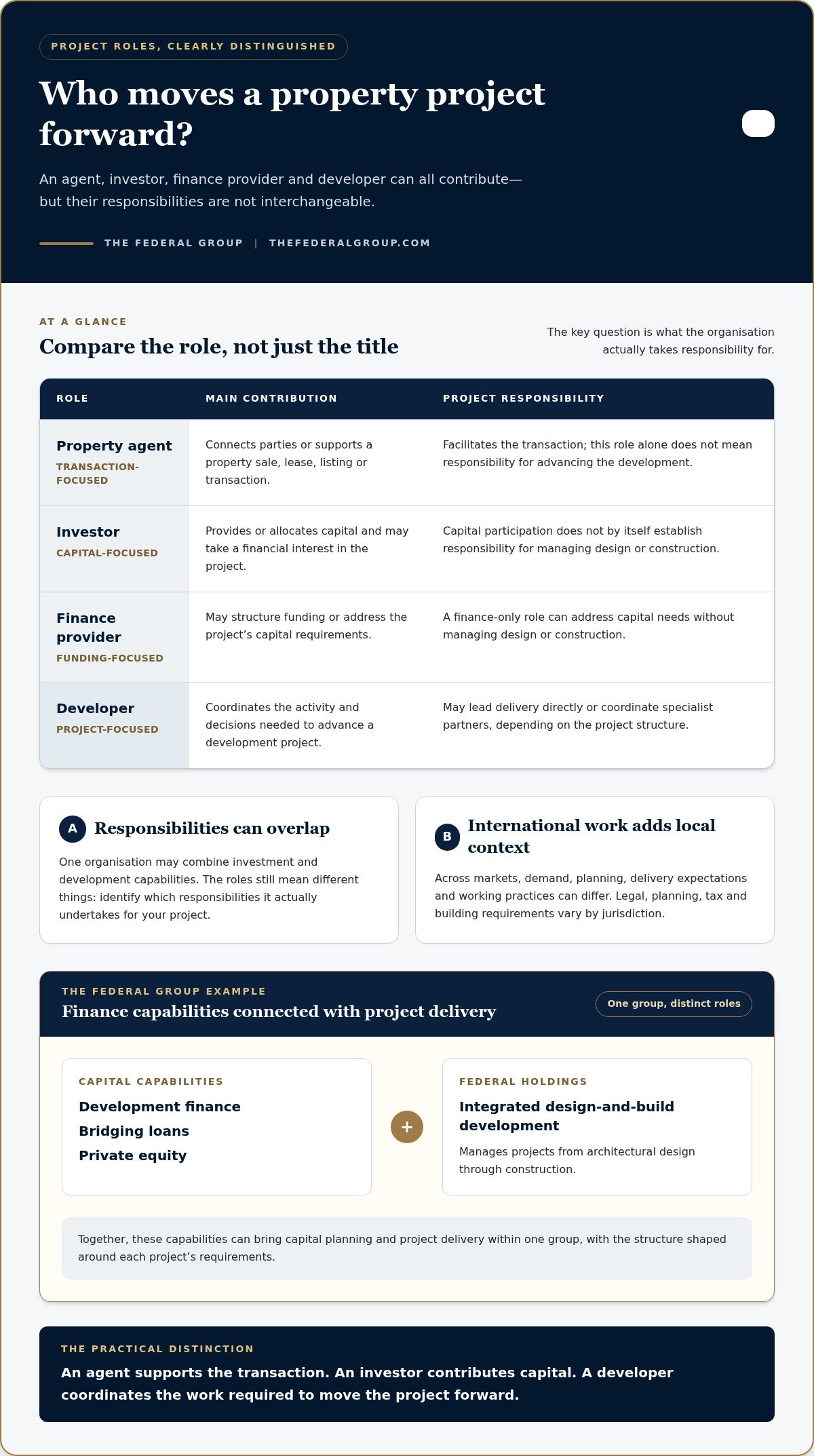
The Federal Group brings development finance, bridging loans, and private equity together with Federal Holdings, its integrated design-and-build development division. Federal Holdings manages projects from architectural design through construction. Together, these capabilities show how capital planning and project delivery can sit within one group, with the structure shaped around each project’s requirements.
Key Takeaways
- An international real estate developer coordinates more than property transactions, bringing project decisions and delivery workstreams together.
- Assess how a developer’s capital capabilities, delivery role, geographic scope, and project-stage fit align with your requirements.
- International projects involve connected workstreams, while legal, planning, tax, and building requirements vary by jurisdiction.
- Use the project sequence from opportunity assessment to delivery as a framework, allowing stages to overlap or change with project needs.
- Understand how The Federal Group’s finance capabilities and Federal Holdings’ design-and-build role can support different parts of a project.
What Does an International Real Estate Developer Actually Do?
An international real estate developer advances a property opportunity by coordinating capital, design, construction, and the decisions needed to move a project forward. Unlike an agent, who facilitates a property transaction or listing, a developer takes responsibility for progressing a development project. The developer may lead work directly or coordinate specialist partners, depending on the project’s structure.
The work starts before construction. A developer assesses whether an opportunity can support a viable project, then shapes its scope and delivery approach. This can involve evaluating the site, setting priorities, coordinating design input, aligning funding with project needs, and managing decisions as plans develop. These activities are interdependent: a change in scope can affect design, construction planning, and capital requirements.
The core purpose remains consistent across borders, but international real estate adds coordination between markets. Local context can influence demand, planning, delivery expectations, and the information needed to assess an opportunity. A useful foundation is understanding international real estate as property activity that crosses national boundaries, while recognising that every project has its own context.
How is a developer different from an agent or investor?
An agent generally facilitates a transaction by connecting parties or supporting a sale or lease. An investor provides or allocates capital and may take a financial interest in a project. A developer coordinates the activity needed to advance the project. These roles can overlap within one organisation, but they are not interchangeable. Identify which responsibilities the organisation actually undertakes.
For example, a finance-only role may address a project’s capital requirements without managing design or construction. A development role may coordinate those delivery workstreams, using internal teams or external specialists. Some organisations combine investment and development capabilities, bringing capital decisions and delivery considerations into the same structure. The division of responsibility depends on the project.
What makes a developer international?
An international real estate developer operates or invests across national markets. International reach means more than advertising properties to overseas buyers: it involves coordinating decisions across borders and accounting for local conditions. Experience in one market should not be assumed to transfer unchanged to another, because requirements and working practices can differ by jurisdiction.
Cross-border work calls for local market insight, clear coordination among project participants, and due diligence shaped around the jurisdiction. A team may need to understand how local planning, tax, legal, and building considerations affect the project, while keeping its development objectives aligned. That does not mean one developer performs every specialist task. It means the development process accounts for those inputs and connects them to project decisions.
To distinguish development capability from property discovery, look for responsibility for advancing the project beyond identification or a transaction. The substance lies in how decisions, capital, design, and construction are coordinated to suit the opportunity and its market context.
Why International Development Requires More Than Local Market Knowledge
Local market insight is essential, but it is only one input in an international project. An international real estate developer must connect market assessment with capital planning, design, construction, and delivery. These workstreams influence one another: a shift in market assumptions can change the project brief, affect funding needs, or alter how delivery is organised. Planning them in isolation can leave dependencies unresolved.
International projects succeed when local context informs every cross-border decision. That means understanding how an opportunity fits its market, then factoring jurisdiction-specific requirements into the project’s scope and delivery plan. Legal, planning, tax, and building requirements vary by jurisdiction, so no single checklist applies everywhere. The relevant considerations depend on the project and where it is being developed.
Other factors can shape planning. Currency movements may affect how capital requirements or future income look across currencies. Counterparties may follow different commercial practices, and approval processes can vary in sequence, documentation, and timing. These are general categories to assess, not legal, tax, or investment advice. Project-specific decisions call for appropriate expertise in the relevant jurisdiction.
Where do cross-border development risks emerge?
Risk can emerge when an assumption made in one market is carried into another without adjustment. Planning pathways, building requirements, market demand, and the roles of local counterparties may differ. Unfamiliar conditions can make early assumptions less reliable, affecting scope, schedules, and capital planning. A disciplined assessment identifies which assumptions need local validation and how changes in one workstream could affect others.
For a practical review, map the project’s dependencies: which market assumptions shape design, which approvals influence construction planning, and which changes could affect capital needs? This connects risk assessment to decisions instead of treating it as a separate document. International real estate organisations such as FIABCI, the International Real Estate Federation provide a wider professional context, but each project still needs assessment grounded in its own market and jurisdiction.
How can integrated capabilities improve coordination?
When finance and delivery teams consider project requirements together, decisions can reflect both capital needs and practical delivery considerations. Clear responsibilities matter: project participants need to know who coordinates design, who oversees construction, how decisions are made, and how changes are communicated. This does not remove jurisdictional complexity, but it can make dependencies and decision pathways easier to manage.
An integrated design-and-build developer model brings design and construction management into a coordinated delivery structure. Federal Holdings, The Federal Group’s design-and-build division, manages projects from architectural design through construction. Its model connects delivery responsibilities, while capital arrangements are tailored to individual project requirements.
For projects where funding and delivery need to be considered together, The Federal Group’s property finance and development capabilities bring those areas within one group. The appropriate structure depends on the project’s scope, market context, and requirements.
How to Assess an International Real Estate Developer
Assess an international real estate developer against the work your project needs, not the breadth of its claims. A finance partner, an adviser, and a development manager can all contribute, but their responsibilities differ. Make those responsibilities clear: identify the capital capability involved, who leads development activity, how local context informs planning, and where accountability sits from the project’s current stage onward.
Which capabilities should the evaluation cover?
Start by separating capital provision from project delivery. Development finance, bridging loans, and private equity are distinct capital capabilities; assess each in relation to the project’s requirements and stage. Then establish whether the organisation’s role is capital-focused or also extends into design and construction. A finance-only role is not the same as direct development management, and an advisory role alone does not establish responsibility for delivery.
Use the matrix below to compare scope and fit. It is a framework, not a ranking: the right structure depends on the responsibilities your project needs covered.
| Dimension | What to assess | How to interpret project fit |
|---|---|---|
| Capital capability | Whether the organisation provides development finance, bridging loans, private equity, or a combination. | Match the capital approach to the project’s requirements and current stage. Avoid assuming the same structure suits every project. |
| Development role | Whether responsibilities stop at finance or extend to coordinating design and construction. | Identify who leads project decisions and manages delivery interfaces. |
| Geographic scope | How international operations and local market considerations inform project planning. | Look for a clear approach to incorporating jurisdiction-specific context, rather than assuming one market model applies everywhere. |
| Project-stage fit | Which phases the organisation’s role covers, from early opportunity assessment through delivery. | Align the proposed scope with the work already completed and the responsibilities still required. |
How should project fit and accountability be compared?
Turn the matrix into a responsibility map. Record the proposed scope, decision-making authority, and interfaces between capital, design, construction, and local inputs. For each workstream, identify who coordinates it, who makes key decisions, and how changes are reflected in the project plan. This helps distinguish a clear development mandate from a funding arrangement or advisory contribution.
Then test the fit against the project itself. An early-stage opportunity may need a different mix of capital and development involvement from a project already progressing through design. Local market considerations should inform assumptions and planning, and the agreed roles should show how that context reaches project decisions. The appropriate structure varies with scope, jurisdiction, and financing needs.
For a closer look at capital structures and their role in development, consult this international property development finance guide. The Federal Group brings development finance, bridging loans, and private equity together with Federal Holdings’ design-and-build development role, which manages projects from architectural design through construction. This is one example of finance and delivery capabilities sitting within a group, without requiring every project to follow the same structure.
How an International Development Project Moves from Opportunity to Delivery
An international development project moves through connected decisions, from assessing an opportunity to reviewing delivery. Each stage shapes the next, so documenting assumptions, responsibilities, and decisions helps keep the project aligned as plans evolve.
A development lifecycle connects opportunity assessment, capital planning, design, construction coordination, and delivery review.
- Assess the opportunity. Set out the project’s objectives and consider how the market context supports them. Record the assumptions behind the initial view and note what needs further evaluation.
- Shape the capital approach. Relate funding requirements to the project plan and its development stage. Document the financing structure under consideration and the assumptions that inform it.
- Plan the design. Translate project objectives into design direction and establish how design decisions will inform delivery. Keep key decisions and changes traceable.
- Coordinate construction. Connect design intent with construction planning and clarify who is responsible for coordinating workstreams and interfaces.
- Review delivery. Compare progress with the agreed scope and decisions. Capture changes, outstanding matters, and lessons that may inform the next project stage.
This sequence is a framework, not a fixed timetable. Stages can overlap, and their order or depth may vary with project scope, jurisdiction, and financing structure. An international real estate developer should make those dependencies visible rather than assume every project follows an identical path.
What happens during opportunity and capital planning?
Opportunity assessment brings the project’s objectives together with its market context. Early feasibility questions help clarify whether the proposed scope and intended use align with the opportunity, and which assumptions need more analysis. Capital planning then considers funding requirements alongside the project plan. Where equity partnership is part of the capital strategy, this real estate private equity partner guide offers further context.
At this stage, document the working scope, key assumptions, open decisions, and who owns each next step. As the project develops, this record helps participants understand why the plan or capital approach changes, without treating early estimates as fixed commitments.
How do design and construction connect to delivery?
Design choices influence construction planning, so changes need to reach the people coordinating delivery. Clear interfaces help participants understand how a design decision affects construction planning, project responsibilities, and the wider scope. Federal Holdings, The Federal Group’s design-and-build development division, manages projects from architectural design through construction.
Review delivery against the current agreed scope, not assumptions that have since changed. Keep the decision record current as the project moves forward. Schedules and outcomes depend on the specific project and its structure. To connect project delivery with capital planning, explore The Federal Group’s property finance and development.
The Federal Group: Connecting Property Finance and Development
The Federal Group is an international property finance partner and developer, bringing capital capabilities together with a dedicated development division. For an international real estate developer, this group structure allows project funding and delivery responsibilities to be considered in the same broader context. Not every project uses every capability or follows the same structure. Project requirements shape how the capabilities fit together.
How do the group’s finance capabilities support development?
The Federal Group provides development finance, bridging loans, and private equity for property projects. These are distinct capital approaches, considered in relation to a project’s needs rather than treated as interchangeable. Development finance and bridging loans provide financing options for property projects, while private equity can form a capital partnership. The appropriate structure depends on the project and its requirements.
Capital planning is most useful when it reflects the project’s scope and stage. Consider the funding approach alongside the development plan, responsibilities, and delivery needs, rather than as a separate decision detached from the work. This gives project stakeholders a clearer view of how financing and delivery considerations relate, without assuming that one set of terms or one structure applies universally.
The Federal Group’s finance capabilities address capital needs, while Federal Holdings leads the development role. The group’s finance and development expertise can be considered together where relevant, with the combination tailored to project requirements.
What does Federal Holdings bring to project delivery?
Federal Holdings operates as a fully integrated design-and-build developer. Its role covers project management from architectural design through final construction, connecting design decisions with the work required to deliver the development. This places design and construction within an integrated delivery model instead of treating them as unrelated phases.
This approach connects with the coordination framework outlined earlier: responsibilities and decisions need to carry across stages. As design develops, its implications for construction planning must remain visible. As project needs evolve, relevant decisions and responsibilities need to stay aligned. Clear coordination across these interfaces supports continuity, while the project’s scope and structure determine how the work is organised.
For stakeholders assessing a development partner, the distinction is practical: The Federal Group provides property finance capabilities, while Federal Holdings leads integrated design-and-build development. The group brings both areas together, with capital and delivery arrangements shaped around the project rather than assumed in advance.
Explore The Federal Group’s international property capabilities to understand how its finance and development expertise may relate to your project.
Set Your Project’s Next Stage in Motion
Turn your project priorities into a clear mandate: define the responsibilities you need covered, the decisions that must stay connected, and the capital and delivery structure that fits the opportunity. A clear mandate helps you assess whether a partner’s role matches the work ahead.
The Federal Group brings international property finance and development capabilities together, with Federal Holdings’ integrated design-and-build role spanning architectural design through construction. For stakeholders considering an international real estate developer, this combination offers a way to consider how project finance and delivery expertise may align, while keeping the structure specific to the project.
Explore The Federal Group’s international property capabilities and discuss how its finance and development expertise could support your project’s next stage.
Frequently Asked Questions
What is an international real estate developer?
An international real estate developer advances property projects across national markets, with its mandate determining how much coordination it undertakes. For example, it may oversee project decisions while a separate agency markets the asset and a capital partner funds part of the plan. The title alone does not establish who controls design, construction, or approvals. Review the scope of work and responsibility matrix to see which functions the developer actually leads.
How is an international real estate developer different from an international property agency?
An international property agency typically focuses on marketing property, introducing parties, or facilitating transactions. A developer’s role is tied to advancing a project, which may involve decisions about its scope, capital, or delivery. For instance, an agency may help bring a buyer and seller together, while a developer coordinates the work needed to progress a redevelopment. Organisations can combine roles, so compare their agreed responsibilities rather than relying on their labels.
Does an international real estate developer need to own the land?
No, land ownership and development responsibility are separate matters. A project may involve a landowner, developer, and capital partner with different roles. Before work advances, clarify who controls the site, who can approve changes, and how each party participates in project decisions. Record these responsibilities in the project documentation, alongside any conditions that affect the developer’s authority. The arrangement depends on the project, jurisdiction, and partnership structure.
How do international developers manage differences in planning rules?
They account for planning requirements jurisdiction by jurisdiction, since approval processes and technical requirements can differ. A useful planning tool is a project tracker that records relevant approvals, responsible parties, dependencies, and current assumptions for each location. For example, a design milestone may depend on a local review being completed. The exact process depends on the site and project scope; general guidance is not a substitute for location-specific legal advice.
What types of finance can support an international property development?
Possible structures include development finance, bridging loans, and private equity. The appropriate approach depends on project needs and the agreed arrangement. Development finance may be considered alongside a project plan, while bridging finance can address short-term funding needs; private equity may involve a capital partnership. The Federal Group provides these capital capabilities for property projects. Terms and suitability depend on the specific project, so no single structure applies to every development.
How can a developer manage currency risk on a cross-border project?
Start by mapping where different currencies enter the project: funding, construction costs, or expected receipts may be denominated differently. Record the relevant currencies, expected timing, and which project assumptions could change if exchange rates move. This makes exposure visible for planning and review. The significance of that exposure depends on the project structure and markets involved. Specific hedging decisions require context-specific financial assessment, not a general rule.
What should investors review before partnering with an international developer?
Investors should review the proposed scope, capital and development roles, decision rights, and how project updates and changes will be documented. For example, clarify who can approve a change to the project brief and how that decision affects other parties’ responsibilities. Consider whether the partner’s capabilities fit the project’s current stage and how local assumptions are addressed. Legal, tax, and investment implications require assessment in the context of the specific project and jurisdiction.