Finding Investors for a Sports Team by Funding Stage
31 October 2026A funding target only works when it matches the team’s stage and capital needs. One listed funding range for National Indoor Football League, Inc. is USD 2 million to USD 5 million, but finding investors for a sports team means looking beyond a headline check size to the right kind of capital and investor fit. Early concepts, established clubs, and expansion plans each make a different case.
It’s natural to start by asking how much an investor might contribute. This guide compares funding stages and investment size, explains how sports-focused and sports-adjacent investors may fit, and outlines ownership rules that shape investment in U.S. professional leagues. You’ll learn what to prepare before approaching investors and how to align your funding strategy with your team’s goals.
Key Takeaways
- Match your funding target to the team’s stage, capital needs, and the scope of its plan.
- Compare sports-focused investors with adjacent capital sources by the strategic value and involvement they can bring.
- Prepare clear financial records and a credible plan so investors can assess performance, revenue potential, and growth.
- Understand league-specific ownership rules before structuring an investment, especially when considering public shareholding or league eligibility.
1. Investor check sizes and funding stages
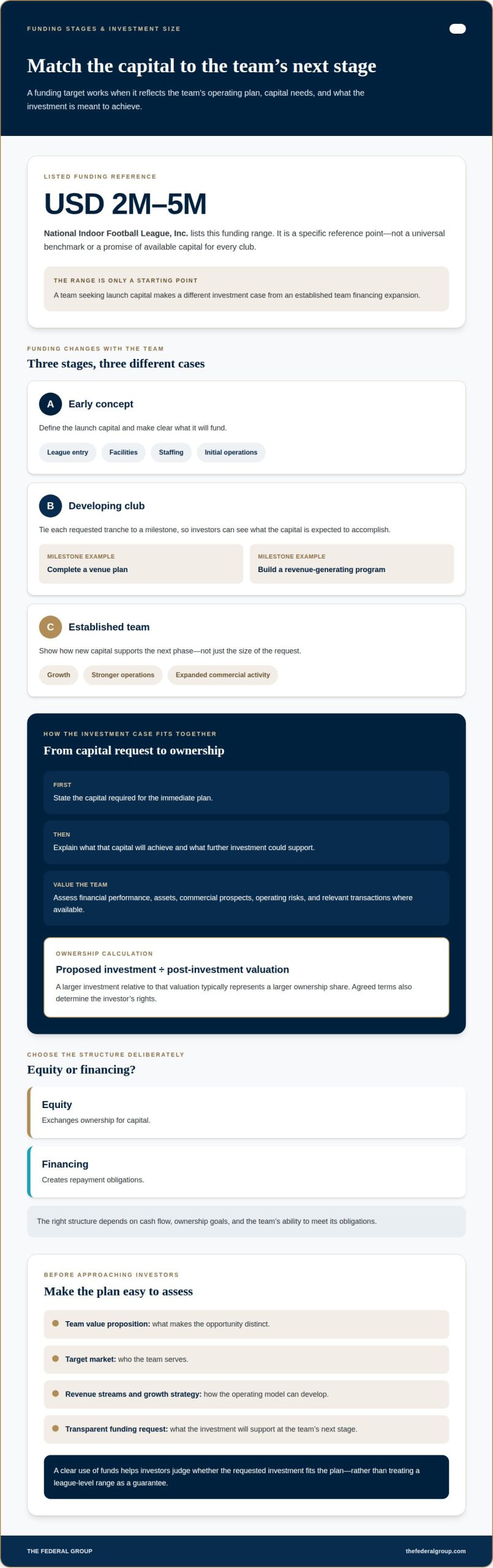
A funding target should reflect the team’s stage, operating plan, and capital requirement. The National Indoor Football League, Inc., based in Lafayette, Louisiana, lists a funding range of USD 2 million to USD 5 million. That range offers a specific reference point, not a universal benchmark for every club. A team seeking launch capital has a different investment case from an established team financing expansion.
At an early stage, define what the investment will fund: league entry, facilities, staffing, or initial operations. A developing club can tie each requested tranche to a milestone, such as completing a venue plan or building a revenue-generating program. An established team can show how new capital will support growth, strengthen operations, or expand commercial activity. A clear use of funds helps investors judge whether the requested investment fits the plan.
To value a team, assess its financial performance, assets, commercial prospects, and operating risks, then compare these with relevant transactions where available. The ownership stake is generally calculated by dividing the proposed investment by the company’s post-investment valuation. A larger investment relative to that valuation typically represents a larger ownership share, while the agreed terms also determine the investor’s rights.
Build the funding proposal in stages. First, state the capital required for the immediate plan. Next, explain what that capital will achieve and what further investment could support. Then distinguish equity, which exchanges ownership for capital, from financing, which creates repayment obligations. The right structure depends on cash flow, ownership goals, and the team’s ability to meet its obligations.
Before approaching investors, prepare a concise plan covering the team’s value proposition, target market, revenue streams, and growth strategy. Pair it with a transparent funding request and explain how the investment supports the team’s next stage. This lets investors assess the opportunity against its specific operating model, rather than treating a league-level range as a promise of available capital.
2. Sports-focused and sports-adjacent investors
Sports-focused investors understand club operations, league dynamics, and fan relationships. They may include experienced team owners, sports investment funds, and operators seeking a strategic stake. Sports-adjacent investors bring expertise from connected sectors such as venue development, media, ticketing, consumer brands, or sports technology. Their industry knowledge can add commercial value as well as capital.
Pitch the opportunity with a concise deck covering the team’s identity, market, business model, capital needs, and growth plan. Explain how an investor’s sector experience could strengthen a specific area, such as venue income or media reach. Finding investors for a sports team works best when the pitch connects the team’s needs with the investor’s objectives.
In the United States, owners can identify prospects through league and team networks, sports-business events, investment professionals, and introductions from existing stakeholders. They can also research firms and individuals already active in sports or related industries. Build a targeted list and approach each prospect with a tailored reason for fit, rather than sending the same proposal to everyone.
Before accepting capital, document the terms in appropriate written agreements, such as an investment or subscription agreement and governing documents. These should define ownership, voting rights, funding obligations, transfer restrictions, and exit terms. Due diligence should examine financial statements, debt, contracts, litigation, league requirements, and the accuracy of the team’s projections. Legal and financial review helps both sides understand the transaction before signing.
Sports investors should assess risks such as operating losses, uncertain revenue, facility commitments, changes in league status, and dependence on key personnel. Returns may come from distributions, growth in the team’s value, or a future sale, depending on the investment structure. Timing and liquidity matter: an ownership stake may be difficult to sell, and revenue and performance can change. A credible pitch explains these risks and the assumptions behind return expectations without promising a result.
For a broader view of sports investment opportunities, consider how a team’s ownership strategy aligns with its long-term plans.
3. Financial data required for sports team investment
Investors need financial records showing how the team earns, spends, and manages capital. Assemble historical income statements, balance sheets, and cash flow statements, then reconcile them with bank records and accounting schedules. Consistent reporting helps investors distinguish recurring performance from one-time events. Explain unusual items, such as a major facility repair or delayed sponsorship payment.
Break revenue into identifiable streams, including ticket sales, sponsorships, merchandise, broadcasting, and league distributions where applicable. Provide evidence for each stream, such as ticketing reports, signed sponsorship agreements, or payment records. Distinguish contracted sponsorship income from prospective partnerships, for example. This helps investors assess revenue concentration and understand which commercial relationships support the team’s operating model.
Detail expenses by function, including player and coaching costs, travel, venue operations, marketing, and administration. Include payroll obligations, vendor commitments, debt balances, repayment terms, and overdue liabilities. A schedule linking each cost to a contract or invoice makes review more efficient. Identify whether expenses are fixed, variable, or dependent on performance, attendance, or facility use.
Provide a cash flow forecast with its assumptions clearly stated. Explain the expected timing of ticket receipts, sponsorship payments, payroll, travel, and venue costs. Include scenarios showing how lower attendance or delayed commercial income could affect liquidity. Investors need to know when cash is required, not just whether projected revenue exceeds projected expenses over a season.
Support growth projections with operational evidence. Link expected ticket demand to historical attendance, planned capacity, and sales activity; link sponsorship projections to current agreements and active proposals. Present the forecast alongside actual results, explaining material differences. A clear capital expenditure schedule should identify each asset, its timing and business purpose, and its expected effect on operations.
Organize these records in a secure, indexed data room. Include accounting statements, revenue contracts, payroll summaries, debt schedules, tax records, and facility agreements. Add a brief reconciliation note wherever management reports differ from formal accounts. This gives investors a traceable view of the team’s financial position and helps them test the assumptions behind their analysis.
4. What ownership rules and investor eligibility requirements apply to U.S. professional sports leagues?
Ownership rules differ by league, so map the proposed investment to the team’s structure and league requirements before negotiating terms. Distinguish buying an interest in a team from buying shares in a league. The NBA is not a publicly traded company, so investors cannot buy NBA stock directly. Any team investment must be structured around the team or its ownership entity.
The Green Bay Packers are the only professional sports team that sells stock directly to the public. Their articles of incorporation limit any individual shareholder to 200,000 shares. The Packers held stock sales in 1923, 1935, 1950, 1997, 2011, and 2022. This unusual model is a specific exception, not a general route for buying ownership in professional teams.
For a proposed transaction, first identify the legal entity that owns the team and the specific interest being offered. Then review the league’s ownership policies, the team’s governing documents, and any transfer or approval procedures that apply to that structure. These materials shape who may hold an interest and what rights come with it. Before signing, a prospective investor should understand voting powers, transfer limits, and governance responsibilities.
Eligibility also depends on the transaction’s details. Prepare clear information about each prospective owner, the source and structure of the investment funds, and the proposed control or influence. Keep the ownership chart consistent across transaction documents and disclosures. For a group investment, define each participant’s stake and decision-making role so the proposed structure is transparent.
Use legal and financial advisers familiar with team transactions to review the relevant documents and prepare required submissions. League rules can affect the investor pool, ownership vehicle, and transaction timeline, so address them before finalizing terms. If you are considering a broader ownership strategy, discuss sports team ownership opportunities as part of your planning.
The Federal Group: Development Finance
The Federal Group can be a strategic capital partner when a team’s growth plan requires investment. Its Development Finance and Private Equity offerings may suit projects with defined funding needs, while its Sports Multi-Club Ownership offering is relevant to investors considering a broader club ownership strategy.
If the plan also involves developing sports facilities, The Federal Group’s Design & Build Development capability connects that ambition with the project’s development requirements. Start with a clear outline of the team, its objectives, capital needs, and proposed ownership structure. This provides a basis for a focused discussion about the role finance, investment, or multi-club ownership could play.
To discuss your team’s investment or ownership plans, contact The Federal Group.
Turn your funding strategy into a clear next move
The next step is to turn your team’s ambition into an investable plan, with a defined purpose for the capital and an ownership structure built around long-term goals. A disciplined approach to finding investors for a sports team helps align the opportunity with the right kind of partner, rather than pursuing capital without a clear strategic fit.
The Federal Group offers Development Finance and Private Equity, alongside Design & Build Development for projects where financing and development plans intersect. These capabilities can support your work to shape a team’s growth strategy, assess its funding structure, or plan facilities for future operations.
Bring your investment priorities and project objectives into a focused discussion. Contact The Federal Group to explore the next step for your team’s plans.
Frequently Asked Questions
How do you find investors for a sports team?
Begin by defining the investment mandate: the ownership available, governance rights, and intended use of capital. Match potential investors to those terms before sharing a confidential overview. Keep a decision log of discussions, open questions, and follow-up commitments. This helps ownership teams manage parallel conversations consistently and spot early whether a prospect’s expectations align with the proposed transaction.
What types of investors fund sports teams, including private equity, family offices, and local businesses?
Private equity firms, family offices, and local businesses can all invest, but their capital structures and decision-making processes differ. A private equity firm typically invests through a fund, while a family office manages a family’s capital; a local business may invest through its corporate structure. Compare each prospect’s authority to commit capital, governance preferences, and investment criteria rather than relying on its label.
How much capital do sports teams typically need to raise, by league and level?
There is no single capital target that applies across leagues and levels. To estimate the amount needed, separate the proposed transaction into acquisition funding, operating liquidity, and planned capital expenditure, then map each category to the team’s league and business model. This makes comparisons between clubs more meaningful and helps owners distinguish the amount needed to complete a transaction from resources reserved for later needs.