How to attract institutional investors and prepare to pitch
8 November 2026A polished pitch alone won’t attract institutional capital. Your project must fit an investor’s mandate and stand up to scrutiny. To understand how to attract institutional investors to your project, identify aligned investors, demonstrate a credible opportunity, and present a clear plan for execution, returns, and risk.
Finding the right capital takes more than a compelling idea. Institutional investors assess whether a project fits their investment criteria, whether its assumptions are supported, and whether the team can deliver. A strong approach answers these questions before the pitch begins.
This guide explains where to build investor connections and what institutions typically assess, including market potential, execution, financial forecasts, and risk management. It also covers how to tailor your pitch, prepare corporate documents, and present the opportunity clearly, so you’re ready to address the questions that matter.
Key Takeaways
- Build investor connections through relevant networks, industry events, pitch competitions, and targeted online research.
- Show how your project’s market opportunity, traction, execution plan, and return potential align with an investor’s mandate.
- Strengthen confidence with clear financial forecasts, transparent assumptions, and a practical plan for managing risk.
- Tailor your pitch and corporate documents to each prospective investor, presenting the opportunity concisely and credibly.
1. Finding investors through pitch competitions, personal networks, and online platforms
Start with a defined investor profile, not a broad search for capital. Identify institutions whose sector focus, project stage, geography, and investment structure match your opportunity. An infrastructure project, for example, needs a different shortlist from an early-stage software company. Before making contact, record each investor’s mandate and decision-making process.
Use existing connections to get relevant introductions. Ask entrepreneurs, accountants, lawyers, and contacts in complementary industries who can connect you with investors that match your focus. At pitch competitions, explain the opportunity concisely and use judges’ feedback to sharpen your case. Business-school entrepreneurship networks and industry associations can also connect founders with potential investors and collaborators.
Accelerators and incubators offer another route into investor networks. Choose a programme that fits your sector and offers access to mentors, investor events, and fundraising guidance. Use it to refine your business model, test assumptions, and rehearse your pitch. Follow up with new connections using a tailored summary, not the same message for everyone.
Industry conferences, pitch events, and investor forums help you build relationships before requesting a meeting. Set a specific goal for each event, such as meeting investors focused on your sector or learning how a particular fund evaluates projects. Online databases and business platforms such as LinkedIn can help you identify decision-makers. Review their stated interests, then send a brief, personal message explaining why your opportunity may be a fit.
In the United States, requirements depend on how you structure the capital raise, who may invest, and how you present the opportunity. Before soliciting investment, have securities counsel assess the offering structure, disclosures, and applicable federal and state rules.
Responsible-investment priorities may also shape an institution’s mandate. The UN Principles for Responsible Investment Initiative is one network to consider when assessing this landscape. If environmental or social outcomes are material to your project, explain them with specific evidence and connect them to the investor’s stated priorities. Strong relationships grow through relevant introductions, informed conversations, and consistent follow-up.
2. How investors assess traction, market size, execution, returns, and fit
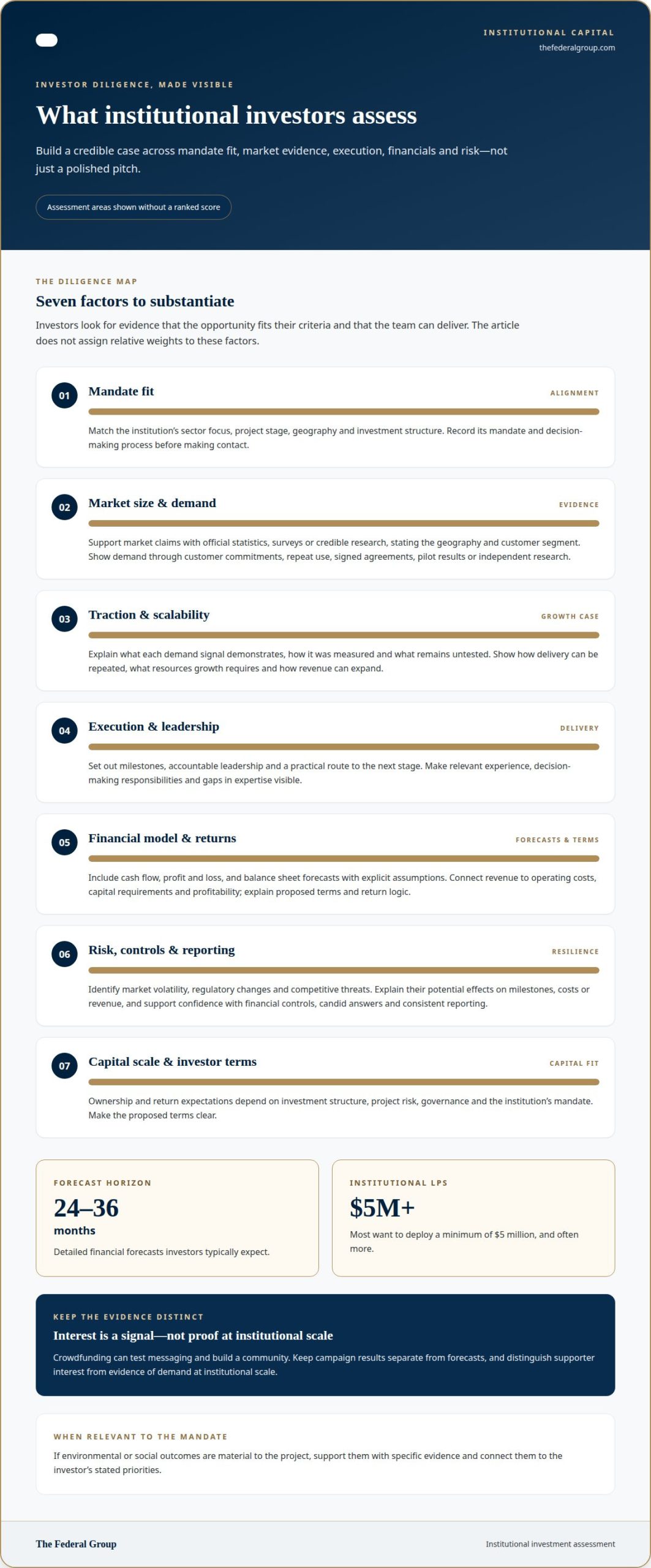
Investors look for evidence that demand goes beyond an attractive concept. Show customer commitments, repeat use, signed agreements, a successful pilot, or independent market research. A property project, for example, can demonstrate demand through tenant interest and local supply analysis. Explain what each signal demonstrates, how you measured it, and what remains untested.
Connect that evidence to a scalable model. Define the addressable market, identify your customers or users, and explain how revenue can grow as the project expands. Show the stages of execution, the resources required, and the competitive advantage that supports growth. Keep the story focused: market need, evidence of traction, business model, and the specific funding opportunity.
Support market-size claims with a clear basis. Use official statistics, surveys, or credible market research, and state the geography and customer segment assessed. A pilot can test assumptions before wider expansion. Compare projected results with observed demand and explain any gap. Investors also assess execution through milestones, accountable leadership, and a practical route from current operations to the next stage.
Demonstrate market demand with pilot results, customer commitments, or focused research showing clear interest. To show scalability, explain how delivery can be repeated, what resources growth requires, and how revenue can expand without undermining execution.
Most institutional LPs want to deploy a minimum of $5 million and often more. Ownership and return expectations depend on the investment structure, project risk, governance, and the institution’s mandate, so present the proposed terms and return logic clearly.
Crowdfunding can combine small contributions from interested individuals with early market exposure. A campaign can test messaging and build a community, while supporters provide evidence of interest, not proof of demand at institutional scale. Keep campaign results separate from forecasts.
For football-related opportunities, The Federal Group Sports Multi-Club Ownership is relevant to investors assessing professional-club investment and portfolio strategy.
3. How investors assess risk, teams, markets, and financial projections
Institutional investors assess whether your team can execute, manage uncertainty, and report performance reliably. They evaluate the entrepreneur as well as the venture, including relevant experience, decision-making responsibilities, and gaps in expertise. A technology company, for example, may need complementary commercial or operational skills. A practical way to attract institutional investors to your project is to make accountability and capability visible.
Unsupported growth assumptions, weak financial controls, unclear decision-making, and unaddressed risks can weaken an investment case. Identify market volatility, regulatory changes, and competitive threats, then explain how each could affect milestones, costs, or revenue. Candid answers in meetings and consistent reporting help establish credibility.
Financial projections should include a cash flow forecast, profit and loss statement, and balance sheet, with assumptions made explicit. Investors typically expect detailed forecasts covering 24-36 months. Connect projected revenue to operating costs, capital requirements, and profitability. Update forecasts against actual performance, and explain material variances rather than obscuring them.
Reliable reporting depends on disciplined financial controls. Keep clear records of income, expenditure, and project commitments so investors can assess how capital is used and how the project performs. Show when funding is needed, which milestones it supports, and how the project expects to generate returns. Clearly distinguish forecast results from actual results.
Government programmes may provide startup financial assistance through direct investment or by arranging meetings with potential investors. Assess these routes alongside venture capital, loans, and revenue-based financing. Revenue-based financing provides capital in exchange for a percentage of ongoing revenue, while a loan follows its agreed repayment terms.
Choose funding based on cash flow, repayment capacity, ownership objectives, and risk profile. A venture with predictable revenue may assess repayment-based options differently from one funding early development. Explain how each structure affects future cash needs and investor returns. If you’re considering how to attract institutional investors to your project, this comparison makes your funding rationale easier to evaluate.
Investors need a coherent path from funding to performance, with clear accountability, risk management, and measurable results. Forecasts that distinguish assumptions from confirmed results give them a stronger basis for assessing execution and long-term prospects.
4. Preparing a professional investor pitch and corporate documents
Research each institution before contacting it. Review its sector focus, investment stage, geography, portfolio, and published criteria. A project’s location can affect market access and operating assumptions, while its stage determines what evidence is available. Sector fit matters because investors often build expertise and mandates around particular industries. Use introductions where possible, but make every message specific to the recipient’s interests.
A pitch deck should summarize the opportunity, product or project, team, business model, market evidence, execution plan, and key financial data. Keep the story concise: define the need, show what sets the venture apart, and explain how funding supports the next milestones. Organize the data room around corporate structure, financial statements and projections, market research, team biographies, material contracts, and risk information.
Fundraising typically moves from investor research to tailored outreach, an introductory meeting, follow-up materials, due diligence, negotiation, and closing documentation. Prepare consistent answers and supporting records for every stage. Mentors can help you rehearse and challenge assumptions before meetings. After each discussion, send relevant materials and track outstanding questions.
Stage, sector, and location shape investor interest because they influence risk, market access, available evidence, and fit with investment criteria. An early-stage project, for example, may need to demonstrate feasibility, while an operating venture can present performance records. A cross-border project should clearly explain its target market and execution context.
Tailor each deck without changing the underlying facts. If an institution prioritizes environmental outcomes, highlight relevant project measures and evidence. If its portfolio emphasizes operational growth, focus on delivery capacity and expansion plans. Don’t send a large bundle of documents before a conversation. Share concise materials that address the investor’s stated priorities.
For a project requiring integrated development expertise, discuss your development project and its investment requirements.
The Federal Group
The Federal Group can be a capital partner when your project needs development expertise. Its services span Development Finance, Private Equity, and Design & Build Development, bringing financing and project delivery together where those needs align. Its Sports Division focuses on Sports Multi-Club Ownership.
For a project seeking institutional investment, fit depends on its sector, stage, structure, and requirements. A conversation can help clarify whether The Federal Group’s financing or development capabilities align with the opportunity and what information is useful to discuss. Prepare a concise project overview, funding requirement, intended use of capital, and current development stage.
Contact The Federal Group to discuss your project and its investment needs.
Turn investor interest into a clear next step
Institutional fundraising is about more than securing capital. It’s also an opportunity to align the funding structure with your project’s development needs and long-term direction. Knowing how to attract institutional investors to your project means making investor readiness part of the project plan, not treating it as a one-time presentation.
The Federal Group offers Development Finance and Private Equity, alongside Design & Build Development. These services can suit projects seeking financing, investment, or an integrated development approach. To start a focused discussion, define your project’s objectives, explain its stage, and outline the capital requirement and intended use. This provides a practical basis for assessing fit and possible next steps.
If you’re ready to discuss your project, contact The Federal Group today. A considered conversation can help you move forward with greater clarity and purpose.
Frequently Asked Questions
What do institutional investors look for in a project before investing?
Institutional investors look for a clear fit with their mandate and evidence that the project can be governed and executed. They also assess who controls key decisions, how performance will be reported, and whether the project’s risks are understood. Clarify the decision-making roles of sponsors, operating partners, and management so investors can see how accountability works in practice.
What financial metrics and projections do institutional investors expect?
Investors expect financial information that connects operating performance to the investment case. Present revenue sources, major cost drivers, cash requirements, and the assumptions behind them. A sensitivity analysis can show how results might change if a key assumption, such as occupancy or sales volume, falls short. Distinguish historical performance from forecasts, and explain material differences between actual results and earlier projections.
How do you identify and contact institutional investors that fit your project?
Compare each institution’s stated mandate and portfolio with your project’s sector, stage, and geography. Prioritize investors with a clear strategic fit, then identify the right investment team or contact through public materials or a relevant introduction. Your initial message should briefly explain the project’s purpose, why the fit is relevant, and what concise information you can share next.
What due diligence do institutional investors conduct, and how should a project prepare?
Due diligence tests whether the project’s claims are supported by consistent records. Investors may examine ownership and governance, contracts, operating data, financial records, key assumptions, and material risks. Prepare an organized data room with clearly named files, current versions, and supporting evidence. Assign someone to coordinate requests, log questions, and ensure responses match the documents and figures already shared.