Real Estate Development Pro Forma: Model Costs and Cash Flow
9 November 2026A project’s projected profit is only as credible as the assumptions and timing behind it. Preparing a real estate development pro forma means bringing projected costs, revenues, financing, and cash flows into one model to assess feasibility and see how funding needs change over time.
Land price and site preparation are only part of the picture. Debt terms affect financing costs, entitlement can shape the schedule, and absorption determines when sales or rental income may arrive. A model that misses these connections can make a viable project look stronger or weaker than it is.
This article explains the pro forma’s purpose and how its core assumptions connect. It covers development costs, debt, entitlement, absorption, and cash flow, showing why the model is a decision tool, not a promise of results.
Key Takeaways
- Use a development pro forma to connect project costs, revenue, financing, and timing in one decision-making model.
- Structure a reusable spreadsheet so land, site work, hard costs, soft costs, and contingency can be adjusted as assumptions change.
- Test how interest-rate assumptions affect financing costs and debt coverage before relying on projected returns.
- Account for entitlement timing, shared costs, and absorption to understand when cash is needed and when revenue may arrive; development finance and private equity can support projects at these stages.
Back-of-the-Envelope Land Development Model – What’s Under the Hood?
A back-of-the-envelope model organizes project assumptions into an initial feasibility view. Its value lies in showing how costs, timing, and revenue interact.
Reusable Construction Pro Forma Spreadsheet
A construction pro forma spreadsheet is a reusable model for testing project inputs and projected cash flows. Separate assumption cells from formulas so land, schedule, costs, and revenue can change without rebuilding calculations. Clear categories also make estimates easier to revise.
Development Timelines and Construction Assumptions
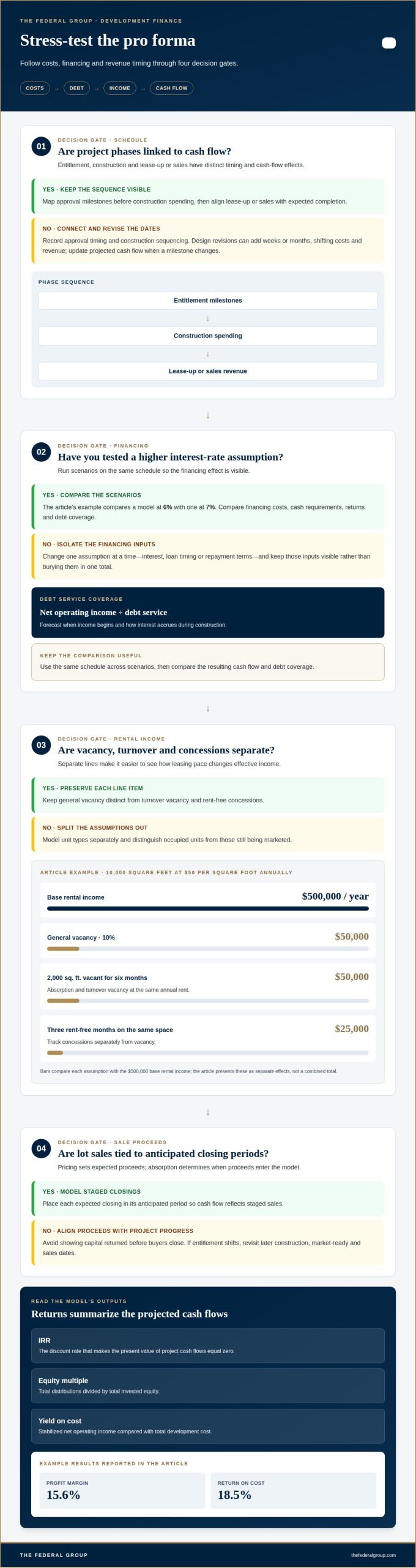
Map entitlement, construction, and lease-up as connected phases with distinct cash-flow effects. Model entitlement milestones before construction spending, then align lease-up or sales with expected completion. Design revisions can add weeks or months to the schedule, shifting costs and revenue. Record assumptions such as approval timing and construction sequencing so that when a milestone changes, projected cash flow updates instead of relying on an outdated estimate.
Construction Costs and Start-Up Operations
Separate construction costs into horizontal site work, vertical building work, and soft costs such as professional fees and project expenses. This shows when spending occurs and which assumptions drive the total. In the four-townhome example, hard costs include contingency, while land and site preparation remain separate. Model construction spending by phase, then add start-up operations and lease-up costs after completion. Maintenance and repairs may cost more than developers expect in a property’s first few years.
Development Return Calculations
Return calculations translate projected cash flows into measures of profitability and capital efficiency. IRR is the discount rate that makes the present value of project cash flows equal zero; the equity multiple divides total distributions by total invested equity. Yield on cost compares stabilized net operating income with total development cost. The example reports a 15.6% profit margin and an 18.5% return on cost.
Debt service coverage and interest-rate assumptions
Debt service coverage compares income available for debt payments with scheduled debt service. Calculate the ratio by dividing net operating income by debt service. For a development, forecast when income begins and how interest accrues during construction.
Interest-rate sensitivity reveals how financing changes projected feasibility. A project modeled at a 6% interest rate might fail if the rate rises to 7%. Run both assumptions through the same schedule, then compare financing costs, cash requirements, and returns. Keep loan timing and repayment structure visible, rather than burying them in one total.
Market data for a development model includes comparable sale prices or rents, demand, absorption, and operating assumptions. Local zoning information establishes permitted uses and development parameters such as density, height, setbacks, and parking. Together, these inputs shape the feasible project, unit mix, and revenue forecast.
Land acquisition assumptions should capture the purchase price, closing timing, and due diligence findings that affect feasibility. Review site conditions, access, utilities, and title matters as potential cost or schedule factors. Entitlement assumptions should reflect the approval pathway, expected milestones, and design changes that could affect construction timing. Keep each assumption separate so revisions flow through the model.
Unit mix and rent assumptions connect the proposed product to projected income. Model each unit type separately, using market-supported rent or sale assumptions and a realistic lease-up sequence. Distinguish occupied units from those still being marketed. Update these inputs together when design changes affect unit count or size.
For running sensitivity tests, change one financing assumption at a time, then compare the resulting cash flow and debt coverage. This isolates the effect of interest, loan timing, or repayment terms. Projects requiring a coordinated capital plan can also consider development capital considerations as part of the financing assessment.
Entitlement, shared costs, absorption, and cash flow
Entitlement milestones and absorption assumptions determine when development costs occur and revenue arrives. Model both alongside cash flow, rather than as isolated inputs.
Rent, Vacancy, and Concessions
Rent and vacancy assumptions convert leasing pace into effective income. For a 10,000-square-foot property at annual market rent of $50 per square foot, base rental income is $500,000 per year. A vacancy allowance matters because a property may not stay fully occupied throughout the year.
Track general vacancy separately from turnover and concessions. If 2,000 square feet sit vacant for six months at annual rent of $50 per square foot, absorption and turnover vacancy total $50,000. Three rent-free months for a new tenant taking the same space create $25,000 in concessions. A 10% general vacancy across 10,000 square feet at that rent represents another $50,000 assumption. Keep each line distinct to see its effect.
Lot Sales Pricing and Absorption
Lot sale pricing sets expected proceeds, while absorption determines when those proceeds enter the model. Rather than treating all sales as one event, model each expected closing in its anticipated period. This reflects staged sales in the cash flow and avoids showing capital returned before buyers close.
Entitlement timing also affects the sales schedule. If an approval milestone shifts, later construction or market-ready dates may move with it. Because forecasts can span months or years before the first tenant moves in, revise expected timing when assumptions change. This keeps projected proceeds aligned with project progress.
Shared Costs and Cash Flow
Shared costs are project expenses allocated across multiple units or lots, such as common infrastructure or property expenses. Assign each cost to the relevant phase and allocation basis so the model shows who bears it and when cash is required. For example, a 2,000-square-foot tenant’s share of $50,000 in annual property taxes is $10,000 in the stated example.
Entitlement expenses may precede sales or rent, creating a period of outflow before absorption generates revenue. Show those costs by timing, then compare them with expected receipts. During lease-up, update assumptions monthly so slower occupancy, rent concessions, and turnover vacancy flow through projected cash balances.
Definition and purpose of a real estate development pro forma
A development pro forma is a forward-looking model that organizes a project’s costs, income, financing, and timing across defined periods. Preparing a real estate development pro forma makes these assumptions visible, helping decision-makers assess feasibility, identify capital needs, and compare projected returns before committing equity. The goal is not to predict every outcome, but to support informed decisions.
A useful model connects inputs rather than presenting disconnected totals. Land, construction, operating costs, debt, and revenue feed a period-by-period cash flow forecast. That forecast supports project-level analysis and, where relevant, partnership-level analysis. It can also distinguish levered returns, which include debt, from unlevered returns, which assess the project before financing.
Comparable properties help inform revenue and valuation assumptions. For example, a property projected to generate $5 million in net operating income would have an example value of $100 million using a 5% comparable-property capitalization rate. The cap rate is an input, not a guarantee of value; changing it changes the implied valuation. The model should show that relationship clearly.
Sensitivity analysis changes one assumption at a time, such as interest, sales pace, or construction costs, to reveal its effect on returns. Scenario analysis combines related assumptions into distinct cases, such as slower lease-up alongside later completion. When preparing a real estate development pro forma, comparing both approaches shows which inputs matter most and how timing affects equity requirements.
A complete pro forma can also track partnership distributions through equity waterfall logic, including promotes and sponsor fees. This clarifies how project proceeds may be allocated after costs and financing. During construction, developers should update assumptions quarterly to keep the model aligned with current progress. The central takeaway is that a pro forma is a decision framework whose value depends on transparent assumptions, connected cash flows, and disciplined updates.
Explore development finance options to consider how project capital can fit into a development plan.
The Federal Group
The Federal Group can connect a development’s financial strategy with its delivery requirements. When a pro forma identifies a need for project capital or an integrated development approach, the group’s Development Finance, Private Equity, and Design & Build Development offerings may support the project’s next stage.
A clear model helps frame decisions about funding, project structure, and execution before commitments are made. The Federal Group works across these areas, giving development teams a point of contact to consider how finance and delivery fit together.
Contact The Federal Group to discuss how your development plans and financial assumptions align.
Turn the Model Into a Decision Framework
Once the assumptions are assembled, keep the pro forma involved in project decisions. Preparing a real estate development pro forma is not just an initial feasibility exercise; it can serve as a shared reference for evaluating changes as the project advances. Define which assumptions to review at each decision point, and record the reasons for any material changes.
This discipline keeps financial projections connected to current project choices. A revised schedule, market outlook, or capital plan can then be assessed against the model’s underlying logic, rather than treated as an isolated adjustment. The goal is to maintain a clear line between assumptions, decisions, and their effects on the project.
If you’re considering the next stage of a development, contact The Federal Group to discuss your project. Bring the project’s objectives and the key questions raised by your model to begin a focused conversation. A well-governed pro forma gives your next decision a stronger foundation.
Frequently Asked Questions
Simplification 101: Why the Real Estate Pro-Forma?
A pro forma simplifies a complex development decision by bringing key assumptions and their financial effects into view. It helps teams identify which variables deserve closer attention before committing capital. For example, test a delayed approval against the expected construction start and revenue schedule to reveal where the project plan depends on timing.
How is a small development pro forma different from a single spec home pro forma?
A small development model may need to track several units, shared site costs, and staggered sales or occupancy. A single spec home model focuses on one property, its construction budget, and expected sale. For multiple units, allocation matters: set a clear basis for shared infrastructure and project expenses, while allowing revenue timing to vary by unit or phase.
What are the limitations of this model?
A pro forma is an estimate built from assumptions, not a comprehensive analysis of every project risk. It cannot establish whether approval will be granted, predict exact construction performance, or control future market conditions. Its usefulness also depends on clearly recorded inputs and timing. Treat the model as a decision framework, not proof that projections will occur.
What are the most common pro forma mistakes?
Common mistakes include counting a shared expense twice, mixing inconsistent time periods, and recording revenue before the related sale or lease-up. Another is changing a key input without updating linked calculations. To reduce these errors, label assumptions separately from formulas, define when each cash flow occurs, and check that every cost and receipt appears once.
What goes into a pro forma for new construction?
A new-construction model brings together acquisition, entitlement, construction, financing, and revenue assumptions. It should also show when each item enters or leaves project cash flow. Organize costs by phase and category, then connect them to the projected completion and sales or leasing schedule. This makes it easier to see whether a revised timeline changes funding needs.
What is a real estate development pro forma and what does it include?
It is a financial model of a proposed property project, including projected costs, income, financing, and cash flows. Its scope can extend beyond the property: partnership-level forecasts can show how project cash flows translate into investor distributions. The model’s format should reflect the plan, including whether the development is intended for sale, ongoing rental income, or both.