Senior Debt vs Mezzanine Finance vs Equity: Key Differences
7 November 2026Mezzanine finance sits between senior debt and equity in the capital stack, but its risks aren’t simply halfway between the two. In the senior debt vs mezzanine finance vs equity comparison, senior lenders rank first for repayment, mezzanine lenders rank behind them, and equity sits last. Mezzanine financing can bridge a funding gap, but it usually costs more than senior debt and may give lenders a share of potential equity upside.
It’s understandable to focus on how much capital each option provides. The ranking matters just as much because it shapes repayment priority, security and the consequences of default. This guide explains how mezzanine debt works, how it differs from senior debt and equity, and how it may be secured.
You’ll also see the trade-offs that influence a capital structure, including borrowing costs, ownership dilution and lender rights. Understanding these distinctions makes it easier to assess where mezzanine finance may fit and what obligations it can bring.
Key Takeaways
- Understand how an intercreditor agreement sets the ground rules between senior and mezzanine lenders, including when payments may be blocked.
- Distinguish a pledge of ownership interests from a mortgage on the property, and see how that difference shapes a lender’s remedies after default.
- Assess whether added capital and reduced equity dilution justify mezzanine debt’s higher borrowing cost and potential ownership-related rights.
- Identify the repayment priorities and control provisions that can influence outcomes for lenders and investors when a project faces financial pressure.
What is mezzanine debt?
Mezzanine debt is hybrid capital: it combines loan obligations with possible equity participation. Its position between senior debt and equity shapes repayment priority, security and potential returns.
Mezzanine Financing as Hybrid Capital
Mezzanine financing is subordinated debt that ranks below senior debt but above equity. It can suit a company that needs capital beyond senior borrowing but wants to limit ownership dilution. Senior debt is borrowing that takes priority for repayment, often provided as a bank loan. Equity financing sells ownership stakes to investors, diluting existing shareholders but adding capital without a loan repayment obligation.
Choose senior debt when repayment capacity and borrowing terms support it. Consider mezzanine financing when senior credit leaves a funding gap and the business can manage the additional repayment burden. Equity may suit a company seeking capital without scheduled debt repayment, provided it accepts shared ownership.
Mezzanine Debt in the Capital Stack
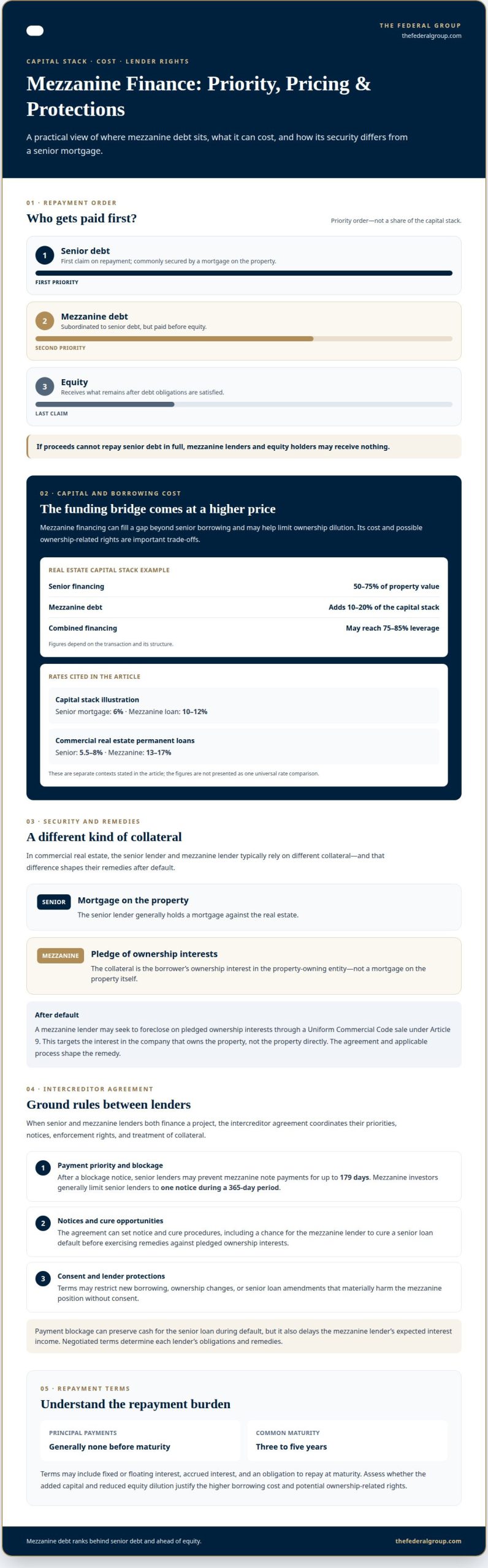
The capital stack ranks financing by repayment priority, with senior debt first, mezzanine debt below it, and equity last. In real estate, senior lenders may provide 50-75% of a property’s value; mezzanine debt can add 10-20% of the capital stack. Combined financing may reach 75-85% leverage, depending on the transaction and its structure.
The senior mortgage carries a 6% interest rate, while the mezzanine loan carries 10-12%. Preferred equity sits within the equity layer, ahead of common equity for distributions, but generally offers priority rights rather than an unconditional repayment promise.
Capital Stack Waterfall
A capital stack waterfall distributes available cash and sale proceeds according to contractual priority. Senior lenders are paid first; mezzanine lenders receive proceeds after senior obligations are satisfied; equity holders receive what remains. This order also applies in default or liquidation, so lower-ranking investors face greater risk of loss.
If proceeds can’t repay senior debt in full, mezzanine lenders and equity holders may receive nothing. If senior debt is repaid, mezzanine lenders are next, followed by equity. This sequence helps explain why mezzanine financing generally costs more than senior debt, while equity has the last claim on proceeds and potential gains.
Intercreditor agreements
An intercreditor agreement sets the rules between senior and mezzanine lenders when both finance a company or property. It defines payment priority, notice obligations, enforcement rights and how each lender’s collateral is treated. This coordination matters because a mezzanine lender’s repayment may depend on the senior loan remaining current. The agreement also clarifies what happens if the borrower defaults.
Senior lenders commonly require this agreement before allowing subordinate financing. Some loan programs prohibit additional debt, while others permit it under negotiated conditions. Those conditions may restrict new borrowing, ownership changes or actions that could weaken the senior lender’s collateral. A mezzanine lender needs clear consent rights and remedies, while the senior lender seeks control over decisions that affect its priority and repayment.
Payment blockage is one important protection. After a blockage notice, senior lenders may prevent mezzanine note payments for up to 179 days. Mezzanine investors generally limit senior lenders to one blockage notice during a 365-day period. These provisions can preserve cash for the senior loan during a borrower default, but they also delay the junior lender’s expected interest income.
The agreement also sets procedures for notices, cure periods, amendments and enforcement. For example, it can give the mezzanine lender a chance to cure a senior loan default before exercising remedies against pledged ownership interests. It may also restrict the senior lender from changing loan terms in ways that materially harm the mezzanine position without consent. Negotiated terms determine each lender’s obligations and available remedies.
Preferred equity is structured differently. It typically relies on recognition terms or provisions in the senior loan documents, rather than the intercreditor agreement used for mezzanine debt. That distinction affects how the capital is documented and which rights apply during financial distress. For sponsors, aligning senior loan terms with subordinate financing documents helps clarify payment restrictions, collateral protections and lender priorities before a default occurs.
Are Mezzanine Loans Secured?
In commercial real estate, mezzanine debt is secured by a pledge of ownership interests in the property-owning entity, not a mortgage on the real estate. Senior lenders generally hold a mortgage against the property, while mezzanine lenders rely on pledged equity as collateral. A mezzanine loan is subordinate to senior debt, so recovery depends on the borrower’s obligations and the rights set out in the financing documents.
After a borrower defaults, a mezzanine lender may seek to foreclose on the pledged ownership interests through a Uniform Commercial Code sale under Article 9. This remedy targets the borrower’s interest in the property-owning company rather than the property itself. The agreement and applicable process shape how the remedy works; the pledge does not give the mezzanine lender the same mortgage claim held by a senior lender.
Rates reflect that repayment priority and security. Commercial real estate senior permanent loans typically carry rates of 5.5-8%, while mezzanine debt interest rates typically fall between 13% and 17%. Mezzanine loans generally require no principal payments before maturity and commonly mature in three to five years. Their terms may include fixed or floating interest, accrued interest, and an obligation to repay at maturity.
Mezzanine interest is typically tax-deductible for the borrower because the financing is structured as a loan. Equity distributions aren’t loan interest, and equity investors hold ownership rather than a repayment claim. Tax treatment depends on the transaction’s facts, so a financing label alone doesn’t determine how it’s treated for every purpose.
Financing documents also allocate control and dilution. Senior debt commonly uses company-asset collateral and covenants; mezzanine debt may use a pledge of ownership interests and include warrants or conversion rights. Those rights can dilute existing ownership if exercised. Equity financing directly sells ownership stakes, while preferred equity generally receives priority distributions over common equity without the same loan repayment obligation.
Mezzanine debt investment risks and benefits
For borrowers, senior debt usually costs less but brings repayment obligations and covenants. Mezzanine adds capital at a higher cost, while equity avoids scheduled loan repayment but dilutes ownership. Investors face the reverse trade-off: debt offers contractual payments and priority, while equity depends more directly on company performance.
Mezzanine Debt Investment Benefits
Mezzanine financing can fill a funding gap while reducing the amount of common equity a sponsor must contribute. For example, senior-only financing at 65% leverage may leave a project short of capital; subordinate financing can increase leverage to 85-90% of project cost. That can preserve more sponsor ownership and operational control than raising the full gap through an equity investment.
For investors, a mezzanine loan combines stated interest with potential upside through warrants or options. Those options may represent 1% to 5% of the issuer’s equity, giving the lender possible participation in growth. The borrower gains access to capital without selling the same ownership share as a comparable equity raise, but must account for the loan’s payment and repayment terms.
Risks and Drawbacks for Borrowers and Investors
Higher leverage increases a borrower’s fixed obligations. If cash flow weakens, interest and maturity payments can strain operations, while default may expose pledged ownership interests to enforcement. Senior debt also brings repayment and covenant pressure, but mezzanine lenders rank behind senior lenders and charge more for the added risk. Equity avoids loan repayment, yet issuing shares reduces existing owners’ percentage stakes.
Investor outcomes differ by position. Senior lenders have first repayment priority but generally receive limited upside from growth. Mezzanine investors face greater loss exposure than senior lenders, and their return may depend on repayment capacity, collateral value and any warrant rights. Equity investors rank last for distributions but can benefit more directly from growth. A warrant can also dilute existing shareholders if exercised.
The decision turns on cash flow, repayment capacity, desired ownership retention and project leverage. A borrower that can support additional payments may use mezzanine capital to bridge a gap; a business unable to carry more debt may favor equity despite the dilution. Compare each structure’s obligations and investor rights before choosing the capital mix.
The Federal Group: Development Finance
The Federal Group supports property projects through Development Finance and Private Equity, giving sponsors financing and investment pathways to consider alongside senior and mezzanine debt. Consider these options when assessing a project’s capital requirements, repayment profile and ownership objectives together. The right structure depends on how funding aligns with project delivery and the sponsor’s intended role.
For developments where financing and execution are closely linked, The Federal Group also operates as a Design & Build Development partner through Federal Holdings. This integrated capability connects development planning with delivery, rather than treating funding and construction as separate considerations. It’s a relevant option for sponsors assessing how capital choices affect the wider development strategy.
Contact The Federal Group to discuss your project’s development finance requirements.
Shape the Next Stage of Your Project
A financing decision should support more than a transaction’s immediate funding need. It should align the capital structure with the project’s delivery plan, ownership objectives and capacity to meet obligations over time. A clear assessment of senior debt vs mezzanine finance vs equity can help sponsors set those priorities before committing to a structure.
The Federal Group brings together Development Finance, Private Equity and Design & Build Development. This combination is relevant when a property project’s financing decisions need to connect with its development and delivery strategy. Discuss your project’s requirements with The Federal Group to consider which capital approach fits its objectives.
Contact The Federal Group to discuss your project. A well-considered funding structure can help you move forward with greater clarity and purpose.
Frequently Asked Questions
How Do Mezzanine Funds Make Money?
Mezzanine funds earn returns through loan interest and, in some deals, equity-linked rights. A fund may receive warrants that allow it to buy shares at a specified price, adding potential upside if the company grows. Loan terms can also include accrued interest or exit fees. For investors, the actual return depends on borrower repayment and whether any equity participation gains value.
What Is Mezzanine Financing?
Mezzanine financing is subordinate capital used when senior borrowing and sponsor equity don’t fully meet a project’s funding needs. For example, a property sponsor may use it to fund part of an acquisition or development while limiting the amount of new ownership sold to investors. Its precise structure depends on repayment terms, security and any rights linked to equity performance.
What Is a Mezzanine-Type Loan?
A mezzanine-type loan has a defined repayment obligation and is commonly supported by a pledge of ownership interests rather than a direct mortgage on real estate. A property company might use one to cover a funding shortfall after arranging senior financing. The loan’s maturity, payment schedule, default remedies and any warrant provisions shape its impact on the borrower.
What is mezzanine financing and how does it work?
Mezzanine financing provides capital under agreed loan terms, often alongside existing senior credit. The borrower receives funds and must meet payment and repayment obligations; the lender accepts a lower repayment position than senior creditors. In a property transaction, pledged interests in the ownership entity may support the loan. An intercreditor agreement coordinates the mezzanine lender’s rights with the senior lender.
How do senior debt, mezzanine finance, and equity compare in priority of repayment?
Senior debt ranks first, mezzanine debt follows, and equity holders receive value only after debt claims are addressed. This order matters most when available cash falls short of repayment obligations. If a sale doesn’t cover the senior loan balance, for instance, the mezzanine lender and equity investors may receive no proceeds. Preferred equity may rank ahead of common equity for distributions, subject to its governing terms.
What are typical interest rates and costs for senior debt vs mezzanine financing vs equity in the U.S.?
U.S. senior business loan rates are typically 3% to 8%, while mezzanine loans are generally described at 12% to 30%. Equity has no stated loan interest rate: its economic cost is the ownership share and potential future value transferred to investors. Actual borrowing costs also depend on loan structure, payment terms, and borrower credit. Compare total obligations, not interest rates alone.