How to Build a Cash Flow Model for Property Development
10 November 2026A development deal can’t be underwritten like a completed building: costs, income and financing unfold over time. Financial modeling for property development brings those moving parts into one framework, usually organized into a Deal Summary and a Cash Flow Model. Together, they connect project assumptions to funding needs and projected investor returns.
That distinction matters. An existing-property model can use known operating cash flows, while a development model must project construction spending, financing draws, leasing or sales, and stabilization. A useful model makes assumptions visible and shows how changes in timing or performance affect cash flow. This guide explains how to build one step by step: define project inputs, map sources and uses, phase costs and debt, forecast revenue, and calculate project-level and investor-level returns. It also shows how to test assumptions that can shift the result, helping you assess financial feasibility, risks, and funding requirements.
Key Takeaways
- Map project costs and funding needs over time, then align construction draws with the development schedule.
- Use stabilized net operating income and a market capitalization rate to frame the project’s exit value.
- Separate development projections from existing-property underwriting, and model revenue by unit type, phase, or floor plate.
- Assess both project-level and investor-level returns, then test how changes to costs, lease-up, and exit assumptions affect them.
Construction draw schedules and loan-to-cost
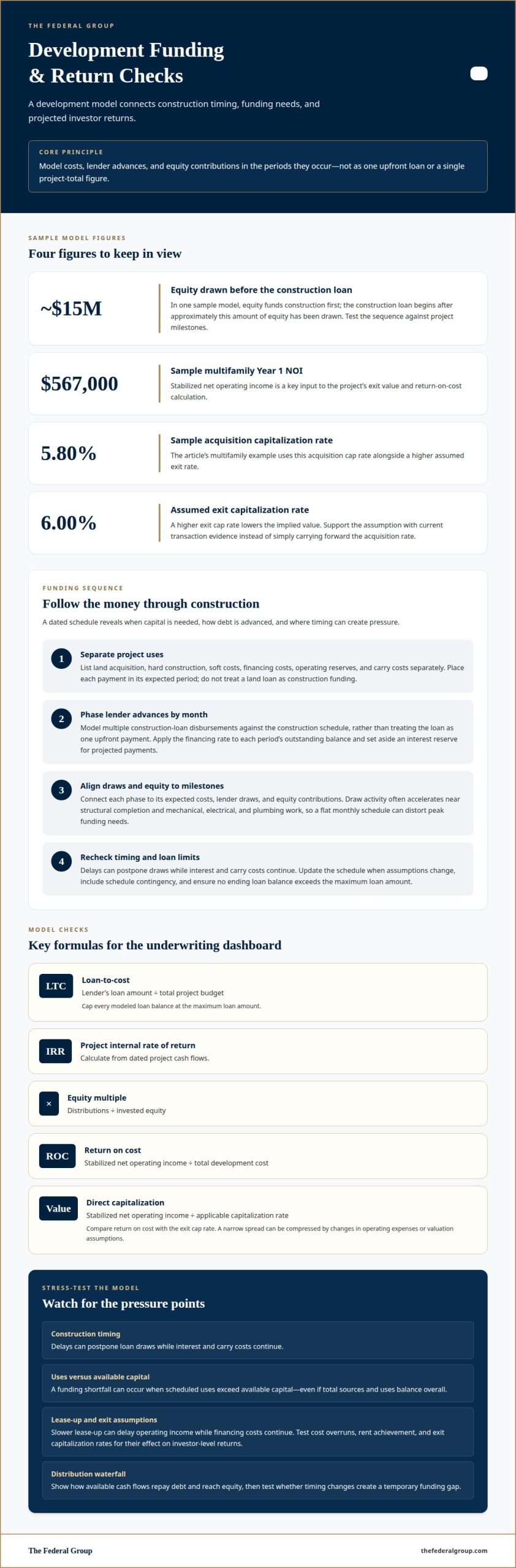
Set loan-to-cost (LTC) as the lender’s loan amount divided by the total project budget, and cap every modeled balance at the maximum loan amount. Calculate project IRR from dated project cash flows, the equity multiple by dividing distributions by invested equity, and return on cost by dividing stabilized net operating income by total development cost.
-
List Land and Construction Expenses
Separate land acquisition from hard construction costs, and place each payment in its expected period. Add soft costs, financing costs, operating reserves, and carry costs to the sources and uses schedule. Keep assumptions visible for commercial real estate projects, and don’t treat the land loan as construction funding. This separation shows how much capital the acquisition requires before construction begins.
-
Map Construction Draws and Interest Reserves
Model lender advances by month against the construction schedule, rather than treating the loan as one upfront payment. According to the National Institute of Standards and Technology (NIST), the example assumes multiple construction-loan disbursements during construction and equipping. Apply the financing rate to each period’s outstanding balance, then set aside an interest reserve for projected payments. Include schedule contingency so delays don’t leave interest underfunded.
-
Align Funding with Construction Timing
Connect each construction phase to its expected costs, lender draws, and equity contributions. Draw activity often accelerates near structural completion and mechanical, electrical, and plumbing work, so a flat monthly schedule can distort peak funding needs. In one sample model, equity funds construction first, then the construction loan begins after approximately $15 million of equity has been drawn. Test that timing against project milestones.
Construction timelines shape financing needs: delays can postpone draws while interest and carry costs continue. Update the schedule when assumptions change, and confirm that no ending loan balance exceeds the maximum amount. This helps financial modeling for property development reflect funding pressure throughout construction, not just the project’s total budget.
Direct capitalization and spread analysis
Common modeling risks include overstated net operating income, unsupported exit capitalization rates, and omitted project uses. These errors distort valuation and investor returns, particularly when capital repayments follow a defined waterfall.
- Calculate direct capitalization by dividing stabilized net operating income by the applicable capitalization rate. One sample multifamily property has Year 1 net operating income of $567,000 and an acquisition capitalization rate of 5.80%; its assumed exit rate rises to 6.00%. A higher exit rate lowers the implied value, so tie the assumption to current transaction evidence rather than simply carrying forward the acquisition rate.
- Compare return on cost with the exit capitalization rate to assess the project’s spread. Return on cost is stabilized net operating income divided by total development cost. If it only narrowly exceeds the exit rate, modest changes in operating expenses or valuation assumptions can compress the spread. Test those inputs with financial analysis rather than relying on a single base case.
- Build sources and uses so every capital source funds a defined project use. Include acquisition, construction, soft and financing costs, reserves, and carry costs in the uses schedule. Then map debt and equity contributions against dated cash flows. A funding shortfall can occur when scheduled uses exceed available capital, even if total sources and uses balance overall.
- Model capital repayments through the project’s actual distribution waterfall. Show how available cash flows repay debt and reach equity, then test whether timing changes create a temporary funding gap. For example, slower lease-up can delay operating income while financing costs continue. Use sensitivity analysis to show how cost overruns, rent achievement, and exit capitalization rates affect investor-level returns.
What is a Real Estate Development Model?
Build the model from parcel-level costs through projected revenue, then test how local conditions and changing assumptions affect feasibility.
-
Identify Development Costs
List land acquisition, building, soft and financing costs, operating reserves, and carry costs as separate inputs. Phase each cost across the development period instead of placing the full amount in one period. For residential or commercial projects, separate site preparation from building work. Include taxes and impact fees as project assumptions where they apply locally, rather than treating them as universal amounts.
-
Underwrite the Land Development
Assess the parcel’s expected use, development sequence, and costs before setting its modeled value. For residential land development, connect the number and mix of homes to expected absorption and sale timing. Local zoning, permit conditions, taxes, and impact fees can affect usable development, costs, and timing. Model their project-specific effects as inputs, rather than assuming the same conditions apply across jurisdictions.
-
Estimate Project Revenue and Sales Prices
Estimate revenue using comparable properties, considering vintage, unit mix, submarket position, and competing supply. Forecast absorption by unit type, phase, or floor plate. Match sales commissions to the timing of sales and closings so cash flows reflect when payments occur.
-
Build the Development Pro Forma
Build the pro forma in sequence: enter assumptions, phase costs, forecast revenue, map financing and operating cash flows, then calculate returns. Make it flexible enough to incorporate updated market data or a changed project structure without rebuilding the analysis. Run sensitivities for construction overruns, rent achievement, lease-up duration, and exit capitalization rates. Compare scenarios to identify which assumptions most affect feasibility.
Development financial modeling compared with existing-property modeling
The key difference is the cash flow being underwritten: an existing asset has operating history, while development depends on future execution. Use a separate model structure for each decision.
- Start an existing-property model with actual income, expenses, occupancy, and known operating performance. For a development, build those outputs from assumptions about construction, completion, leasing or sales, and stabilization. This changes the sequence of calculations: existing-property analysis begins with operating evidence, while a development model must first establish how the asset will be delivered.
- Forecast development revenue at the level that drives absorption. Estimate lease-up or sales by unit type, phase, or floor plate instead of applying one aggregate rate. Existing-property underwriting can draw on current occupancy and rents; development projections must account for future demand and competing supply. Update the pro forma when market evidence or the project plan changes.
- Keep timing visible in development cash flow. A completed commercial building may produce income soon after acquisition, while a new project incurs costs before it reaches stabilization. For example, an illustrative office project spends $100 million on land and construction and assesses whether a 20% annualized return is achievable. The example shows why a development model must connect investment timing to projected income.
- Use different evidence to assess credit and returns. Existing-property calculations can test actual operating income against debt obligations. Development analysis must also account for construction progress, lease-up, and projected stabilization. Keep assumptions editable, then compare the same project under revised timing or performance inputs. This creates a more useful real estate financial analysis than copying an acquisition model’s established cash flows.
For a project that needs an integrated view of development and delivery, discuss your development project.
The Federal Group
The Federal Group can be a natural next step when a development model points to a need for aligned capital and delivery planning. Its Development Finance and Private Equity offerings can help address a project’s funding structure or equity participation. For projects where execution and development planning are closely connected, its fully integrated design-and-build capability may also fit.
A model helps frame the discussion by clarifying project costs, timing, funding requirements, and projected returns. These inputs give stakeholders a structured basis for considering how financing and delivery decisions relate to project objectives. Engage when you’re assessing a development opportunity and want to discuss its capital structure or delivery approach.
Contact The Federal Group to discuss your development project.
Put the Model to Work on Your Next Decision
A development model is most valuable when it informs decisions beyond the initial feasibility review. As a project evolves, use it to assess how updated market evidence, delivery choices, and capital structure affect the investment case. Keep assumptions transparent and revisions traceable so stakeholders can understand what changed and why.
That discipline makes financial modeling for property development an ongoing decision framework, not a static spreadsheet. It brings the project’s commercial objectives and execution plan into the same conversation, especially when funding or delivery choices need strategic alignment.
The Federal Group works across development finance, private equity, and design and build development. If you’re considering how those capabilities could relate to your project, contact The Federal Group to start a conversation. A clear model gives that discussion a strong foundation, and a considered next step can help keep the project moving with purpose.
Frequently Asked Questions
Real Estate Financial Analysis: To Buy, or Not to Buy?
Proceed only when projected cash flows and returns support the project’s investment objectives under realistic assumptions. Review the base case alongside downside scenarios, including slower absorption or higher costs, and identify which inputs most affect the result. A sound decision also considers whether capital will be available when needed, not just whether the final projected value looks attractive.
What is a real estate development financial model and what does it include?
A real estate development financial model is a decision tool that links project assumptions to funding needs and expected returns. It should make the relationship between costs, revenue, financing, and investor distributions traceable. Keep an assumptions log with the date and rationale for each material revision. This helps stakeholders distinguish changes in market evidence from changes in project scope.
What are typical costs in a real estate development budget?
A development budget typically groups costs by purpose and timing, including land, construction, professional and other soft costs, financing, reserves, and project carry. For practical review, separate one-time acquisition items from costs that recur during delivery or operations. Then connect each budget line to the relevant project phase to make omissions or timing mismatches easier to spot.
How do you calculate land residual value for a development project?
Estimate residual land value by subtracting the costs to complete the project and the required developer return from the projected completed value. Use the same project scope and timing throughout the calculation. Then test how residual value changes when sale prices, costs, or delivery assumptions shift. The result is a project-implied land-value ceiling, not a guaranteed purchase price.
What financing assumptions should a property development model include?
Model the proposed loan-to-cost, interest rate, land loan, draw timing, and construction interest reserve. Also show when equity enters, how debt repayments occur, and whether the projected loan balance stays within the assumed lending limit. Test financing against a delayed construction schedule: later draws can change interest accrual and the timing of capital needs, even when the total project budget stays the same.