Large Commercial Bridging Loans: 2026 Developer’s Guide
6 October 2026For developers considering large bridging loans for commercial property, the amount is only one part of the decision. The asset, delivery plan and repayment route all affect whether short-term funding supports the project or leaves a shortfall when the facility ends. An attractive acquisition can still carry significant risk if construction milestones, refinancing or a planned sale do not fit the loan term.
Headline rates and leverage matter, but compare them alongside net proceeds, fees, repayment obligations and the assumptions behind the exit. A funding assessment may consider the property, existing debt, your experience, equity contribution and business plan, not simply the requested facility size.
This guide explains how to assess a large commercial bridging proposal against project cash flow and timing, what to include in a funding case, and how to test the repayment plan. The Federal Group provides property development finance and bridging loans, and its Federal Holdings division manages property projects from design through construction. Use the following sections to assess the transaction, prepare your proposal and identify execution and exit risks before making a funding decision.
Key Takeaways
- Consider bridging finance when a defined transaction, temporary funding need or development milestone has a clear repayment plan.
- Assess how property value, existing debt, title, tenancy, condition, planning position and location may affect diligence and available proceeds.
- Compare large bridging loans for commercial property by net funds, interest treatment, repayment profile and total obligations, not headline terms alone.
- Build a funding proposal that links the transaction and sources and uses to project milestones, supporting documents and evidence for the planned exit.
- Choose a capital partner with relevant commercial property expertise and a clear approach to structuring, diligence, decisions and communication.
When do large bridging loans for commercial property make strategic sense?
A commercial bridging loan is short-term property finance connected to a specific transaction and repayment plan. It may fund an acquisition, support a change in ownership or cover a defined stage of development before another source of capital or sale proceeds repays the facility. For a general introduction, see What is a bridging loan?
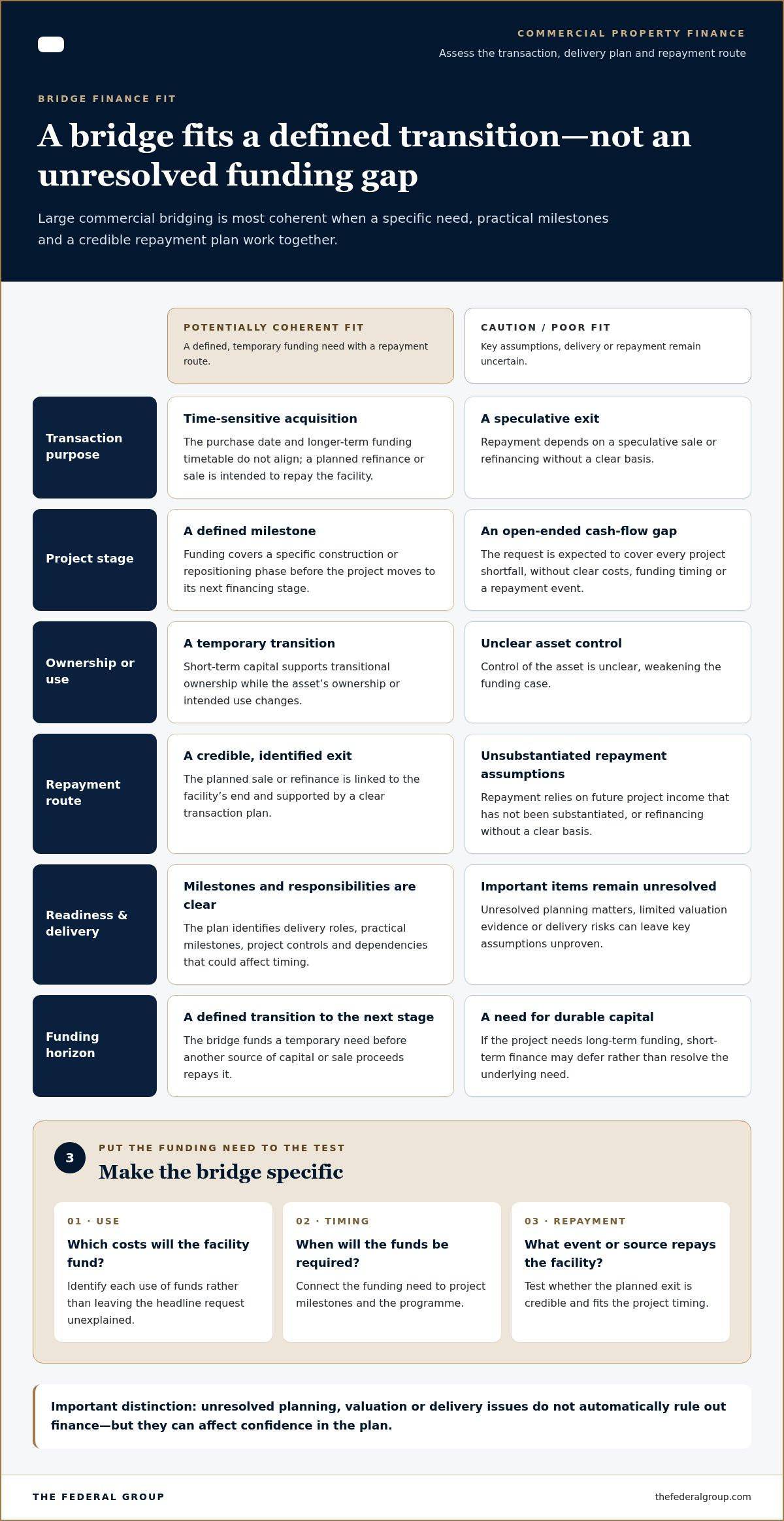
The key question is whether the funding need is temporary and the route to repayment is credible. Large bridging loans for commercial property are not a fit simply because a project requires substantial capital. The asset, borrower’s ability to execute, transaction conditions and repayment plan need to work together. If a project needs long-term funding, or its underlying economics do not support repayment, short-term finance may defer rather than resolve the problem.
Which commercial property situations may justify a bridge?
Bridging may suit a time-sensitive acquisition when the purchase date and longer-term funding timetable do not align. It may also support transitional ownership while a property is prepared for sale or refinancing, or cover a defined funding gap as a project moves to its next stage.
- Acquisition timing: Capital may support a purchase while a planned refinance or sale is arranged.
- Development milestone: Funding may cover a specific construction or repositioning phase before the project moves to its next financing stage.
- Transitional ownership: A bridge may provide temporary capital while an asset’s ownership or intended use changes.
Fit each funding need to specific milestones and the planned repayment route. Avoid assuming a bridge will cover every project cash-flow gap; identify which costs it will fund, when funds are required and what event or source will repay the facility.
When is bridging finance a poor fit?
An uncertain repayment route is a key warning sign. If repayment depends on a speculative sale, refinancing without a clear basis or future project income that has not been substantiated, the exit may not support the facility. Unclear control of the asset can also weaken the funding case.
Unresolved planning matters, limited valuation evidence or delivery risks can leave important assumptions unproven. These factors do not automatically rule out finance, but they can affect confidence in the plan. If the project requires durable capital, assess its long-term funding needs directly. A bridge is most coherent when it funds a defined transition, not when it conceals an unviable scheme or postpones a structural funding shortfall.
How lenders assess a large commercial bridging loan
A funding assessment looks beyond the amount requested to understand the full transaction: what the facility will fund, how existing debt affects the position, what proceeds are needed and how repayment is expected. For large bridging loans for commercial property, connect the asset’s value to the proposed use of funds and the project’s ability to reach its next financing or repayment stage. PNC Bank provides a general overview of how lenders assess a bridge loan, including the role of bridge finance in property transactions.
What makes a commercial asset financeable?
Asset diligence may cover valuation basis, title, occupancy and tenancy, physical condition, planning position and location. These details help explain the property’s current use and its role in the proposed transaction. Their relevance varies by asset and jurisdiction, so do not assume one set of criteria applies to every project.
Keep the property details consistent across valuation materials, the transaction summary and funding request. Explain any difference between current and intended use, and disclose existing debt that relates to the asset. Security requirements and valuation practices vary by jurisdiction, so have the applicable legal and valuation position verified by qualified experts.
Put the proceeds in context. Show how the requested amount relates to the transaction purpose, existing liabilities and project requirements. If the facility includes costs or staged works, identify each use rather than leaving the headline amount unexplained. This gives the funding assessment a clear basis for comparing the request with the asset and repayment route.
How do project and sponsor factors affect the assessment?
Confidence in delivery depends in part on who is responsible for the work and whether the plan is supported by relevant experience, adequate equity and clear project controls. Set out decision-making responsibilities, key delivery roles and how progress and expenditure will be managed. Link the programme to practical milestones rather than relying on a target completion date alone.
Identify dependencies that could affect delivery, such as outstanding planning decisions, third-party approvals, unresolved works or refinancing assumptions. Mark unsettled items clearly and explain how they could affect timing and repayment. Distinguishing confirmed information from conditions that still need to be met makes the funding case easier to assess.
The Federal Group provides property finance and development support for complex property transactions. Through Federal Holdings, it manages projects from architectural design through construction. Learn more about commercial property finance and development.
Compare large commercial bridge structures by proceeds, cash flow, and exit
A headline facility amount does not show how much cash will be available to complete a purchase or fund works. Compare the gross commitment with deductions, existing debt and the timing of each payment. The Comptroller’s Handbook on Commercial Loans provides background on commercial loan underwriting and management. Apply the same attention to detail to a bridge’s cash requirements, facility mechanics and exit.
How do interest treatment and deductions change usable proceeds?
Interest structure affects when cash leaves the project. With serviced interest, payments are due during the term, so the project needs adequate cash flow or a dedicated reserve. Rolled-up interest accrues for later settlement. This can reduce periodic outgoings but increase the amount due at redemption. If interest is retained from the advance, the deduction reduces the funds available at completion. The facility documents set out the exact calculation and payment mechanics.
| Structure | Interest and deductions | Repayment profile, term and net funds |
|---|---|---|
| Serviced | Interest payments fall due during the facility; applicable fees or other deductions may also reduce completion funds. | Requires cash flow during the term. Net funds depend on the gross facility less applicable completion deductions. |
| Rolled-up | Interest accrues for later repayment; confirm how it compounds or is calculated and whether any amount is deducted upfront. | Limits scheduled interest outflow, but increases the redemption obligation. Model the balance against the expected exit date. |
| Retained | An agreed interest amount may be withheld from the advance, alongside any other applicable deductions. | Can mean less cash is available at completion. Check that net proceeds cover the purchase, works, liabilities and contingency through to the exit. |
Illustrative comparison, not a quote: Start with the gross facility, then subtract existing debt to be repaid and all applicable deductions shown in the proposed terms. Compare the resulting net proceeds with a dated schedule of uses. A facility that covers the purchase price may still leave a shortfall once works, transaction obligations and contingency are included. Compare large bridging loans for commercial property using the same assumptions for valuation, drawdown, term and exit to make the differences clear.
Which exit route fits the commercial project?
A sale depends on the asset reaching a saleable condition and allowing realistic time for marketing and completion. Refinancing depends on the property’s expected condition and position at completion, applicable lender criteria and evidence for the proposed take-out. Any other project-specific repayment route should be supported by identifiable funds and a credible timetable. Test each route against possible delays and less favourable assumptions, not just the intended outcome. Treat the exit as a plan that needs evidence, not an automatic event. Explore commercial property finance for project-level capital solutions.
Prepare a funding proposal for a large commercial bridging loan
A strong proposal explains what the transaction requires, how the asset and project will progress, and how the facility will be repaid. For large bridging loans for commercial property, organise the evidence so a capital partner can follow the request from acquisition or works through to the proposed exit. For a wider view of capital options across development projects, see the international property development finance guide.
What should the commercial funding pack contain?
Arrange the pack in a clear sequence. Check that figures and dates match across the summary, supporting documents and financial schedules.
- Summarise the transaction: Identify the borrower, asset, purpose of the facility, amount requested, proposed term and key transaction dates.
- Describe the property and ownership: Include asset details, occupancy and tenancy information, ownership and title materials, available valuation evidence, condition information and relevant planning position.
- Reconcile sources and uses: Show the purchase or refinance requirement, project costs, existing debt and other obligations alongside proposed funding sources. Link the requested proceeds to specific uses.
- Set out delivery milestones: Provide the project programme and relevant construction, planning, leasing or sales evidence. Identify the parties responsible for each key workstream.
- Disclose risks and dependencies: Flag unresolved approvals, information gaps, timing assumptions and cost sensitivities. Explain how a delay or weaker-than-planned outcome could affect funding needs and repayment.
Include documents relevant to the asset and transaction, rather than adding generic material. A concise index helps readers see what each item supports and which information remains outstanding.
How can a developer make the exit case credible?
State the primary repayment route and support it with evidence. For a sale, explain the expected timing and show the asset’s progress toward a saleable condition. For refinancing, describe the intended property position and the assumptions behind the take-out. Identify who is accountable for each milestone and what needs to happen before repayment can proceed.
Build a realistic timetable that allows for relevant steps such as works, approvals, marketing or refinancing diligence. Include contingency actions if a milestone slips or expected proceeds change. If the transaction involves land, the strategic bridging finance for land guide offers relevant context.
Use the pack to make the project’s logic and uncertainties visible. Do not present assumptions as settled outcomes. Discuss a commercial bridging finance proposal with The Federal Group in the context of your property project.
Choose a capital partner for a large commercial property bridge
The right capital partner should understand more than the facility request. For large bridging loans for commercial property, consider how well a partner understands the asset, transaction purpose, project dependencies and repayment route. Look for clear communication about diligence, structure and the decision process. Timings and requirements depend on the transaction, so assess the actual steps rather than relying on assumptions about a standard process.
What distinguishes a finance provider from a strategic capital partner?
A finance provider focuses on the funding request and supporting case. A strategic capital partner can also consider how the transaction fits the wider delivery plan, including milestones, responsibilities and potential transitions between funding stages. This broader view can help shape a more joined-up discussion.
The Federal Group combines international property finance with development capability. Its Federal Holdings division manages projects from architectural design through construction. This integrated perspective can inform project-level discussions while keeping the finance proposal anchored to the asset, transaction and repayment plan.
Assess a partner’s approach to the details, not just general claims of expertise. Look for clarity on:
- Commercial property understanding: Can the partner engage with the asset, transaction structure and project-specific risks?
- Diligence requirements: Are information requests and outstanding items explained clearly?
- Proposed structure: Can the partner show how proceeds, interest treatment, repayment and term relate to the project?
- Decision process and communication: Are responsibilities, next steps and open questions clear?
What are the next steps for a project discussion?
Prepare a concise overview covering the asset, funding purpose, requested proceeds and intended repayment route. Organise the core property and ownership information, valuation materials, sources-and-uses schedule, existing debt details and project programme. Note unresolved matters such as approvals, construction dependencies or assumptions behind a sale or refinance. Separating confirmed information from open questions helps focus the discussion.
If you are weighing short-term bridging against longer-term project funding, use this development finance and bridging loan comparison to consider how each route may fit the project’s needs.
Once the asset, funding requirement and exit assumptions are clear, discuss your project’s capital requirements with The Federal Group’s commercial property finance team.
Move forward with a funding case built for delivery
A strong case for large bridging loans for commercial property connects the asset, project plan and repayment route. Look beyond the headline facility: check usable proceeds, interest and repayment mechanics against project cash flow and timing. Then present a proposal that links the transaction, delivery milestones and exit evidence, while making open questions and dependencies clear.
A suitable capital partner should understand the commercial property context and engage clearly with the transaction structure and delivery requirements. The Federal Group provides international property finance and development expertise. Through Federal Holdings, it manages projects from design through construction, bringing a development perspective to project-level discussions.
With the asset, funding purpose, requested proceeds and exit assumptions organised, you can approach the next decision with greater clarity. Discuss your commercial property finance requirements with The Federal Group.
Frequently Asked Questions
How large can a commercial bridging loan be?
There is no single facility size that suits every commercial property transaction. The amount depends on the asset and its valuation evidence, existing obligations, project purpose, funding requirements and proposed repayment route. Present these together rather than relying on a headline figure, so the request can be assessed in the context of the full transaction. The Federal Group provides property finance solutions for international projects, structured around transaction requirements.
What can a large bridging loan for commercial property be used for?
A large commercial bridging loan can address a defined short-term funding need, such as an acquisition or transition between funding stages. Suitability depends on the project, asset and repayment plan. Explain what the funds will support, when they are needed and how the facility is expected to be repaid. Bridging finance serves a temporary need, so it should not replace a long-term funding strategy when a project requires durable capital.
How do lenders assess a large commercial bridging loan?
A funding assessment may consider the property, its value and legal position, transaction purpose, existing debt, sponsor and project plan, and proposed exit. The weight given to each factor varies by transaction and jurisdiction. A clear proposal links the requested proceeds to the asset and project timetable, then provides evidence for the repayment route. This shows how the funding supports the transaction and what risks or dependencies could affect repayment.
Is a commercial bridging loan suitable for a development project?
It may suit a development with a defined short-term capital need and a credible repayment route. Consider the asset, development stage, execution plan, funding structure and timing as one connected case. Identify dependencies that could affect delivery or repayment rather than treating them as settled. Distinguish temporary finance needs from longer-term capital requirements. Assess how a bridge fits the full transaction, not just its facility size or anticipated speed.
What documents are needed for a commercial bridging loan application?
A funding pack may include asset and ownership information, valuation materials, transaction details, existing debt, sources and uses, project milestones and evidence supporting the intended exit. Requirements vary with the transaction and jurisdiction. Organise the documents consistently, explain how the requested funding supports the project and identify outstanding dependencies. A clear pack helps a capital partner understand the opportunity, funding requirement and risks that could affect delivery or repayment.
How should I compare commercial bridging loan terms?
Compare net proceeds, interest treatment, applicable fees and deductions, repayment profile, facility duration and exit assumptions together. A headline rate or gross facility amount will not show the full effect on project cash flow. Model each structure using transaction-specific assumptions, then test how delays or changes to expected proceeds could affect repayment. Review the facility documents for the exact mechanics rather than relying on generic calculator defaults or headline terms alone.
What is an exit strategy for a commercial bridging loan?
An exit strategy explains how the borrower expects to repay the facility, such as through a sale, refinancing or another transaction-specific source of funds. Set out supporting evidence, realistic timing, key milestones and material dependencies. Stating an intention alone is not a complete repayment case. Align the proposed route with the asset’s condition and progress, project timetable and facility duration, and consider what could change if a milestone is delayed.