USL Soccer Club Ownership: How the Model Works in 2026
9 October 2026What does investing in USL mean: backing a club, or investing in the league? That distinction is central to USL soccer club ownership. Club ownership concerns rights in a particular team, while a league-level investment concerns the league organization. A new revenue-sharing model agreed for 2027 adds another layer by linking club finances more closely with league-wide revenues, but it does not make the two forms of ownership interchangeable.
The lines can seem blurred because league rules shape how clubs operate, while club owners remain responsible for building a local business and managing its assets. For an investor, the practical task is to assess both the club’s own control structure and its obligations within the league.
This article explains how league-level investment differs from club ownership and what to examine in governance, revenue, stadium strategy, and investor roles. It also considers how multi-club ownership can fit into a broader football investment strategy. The Federal Group invests in and manages professional football clubs globally, bringing a wider perspective to the discussion while recognizing that the USL framework has its own structure.
Key Takeaways
- Assess USL soccer club ownership by the rights, responsibilities, and control attached to a specific club, not simply the league it competes in.
- Separate league-wide rules and revenue structures from each club’s governance and operating decisions.
- Compare independent ownership, multi-club investment, and league-level investment by control, capital exposure, and involvement in operations.
- Evaluate an opportunity across sporting, commercial, governance, and financial factors rather than relying on a single headline metric.
- Consider how a multi-club strategy can create a broader investment perspective, while assessing each league’s ownership framework on its own terms.
What Does USL Soccer Club Ownership Actually Mean?
USL soccer club ownership means holding rights and responsibilities connected to a particular team. Depending on the investment structure, those rights may relate to governance, capital, operations, or strategic direction. An investor might provide capital without managing daily operations, while another might hold a formal governance role. The word “owner” alone does not explain either party’s authority, obligations, or economic interest.
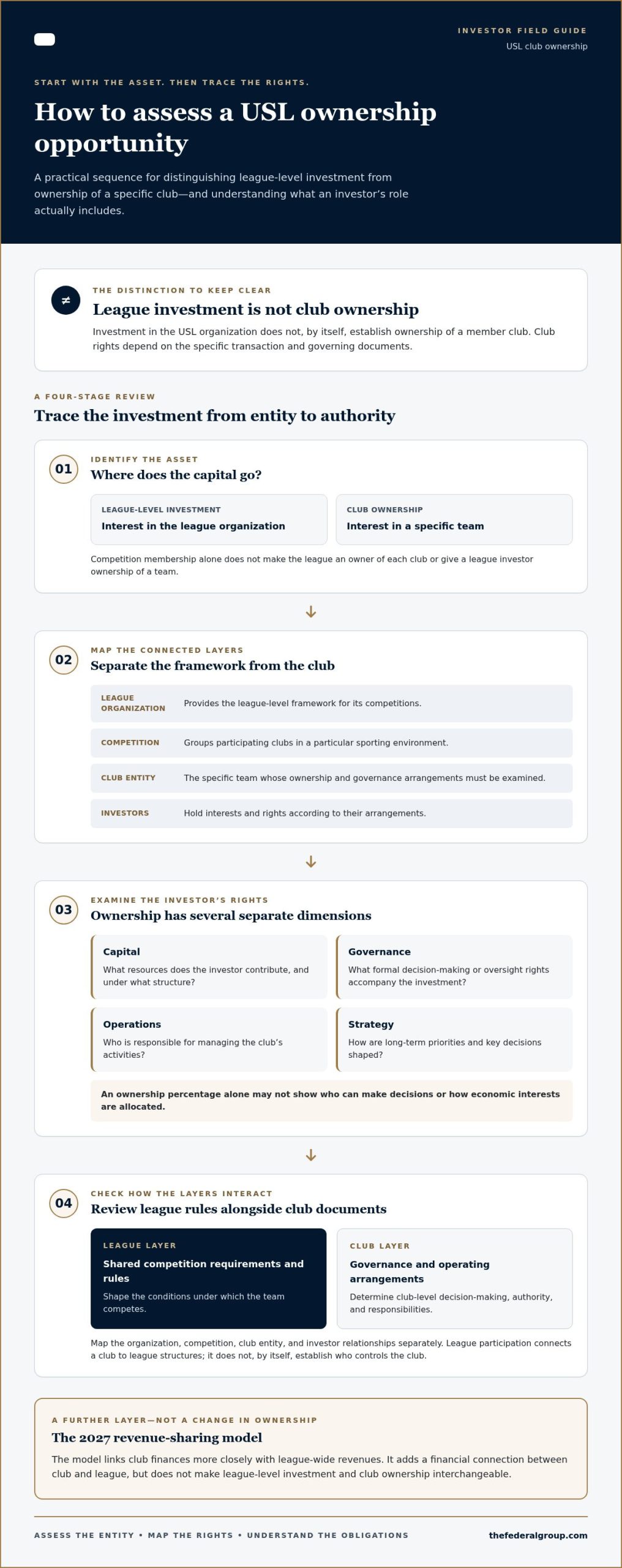
The first question is which asset receives the investment. League investment is capital or an ownership interest in the league-level organization; club ownership is an interest in a specific team, with rights determined by the transaction and governing documents. A league’s competitions and rules connect it to participating clubs, but membership in a competition does not, by itself, make the league an owner of each club or give a league investor ownership of a team. The USL Championship Wikipedia overview provides background on the competition’s structure and place in the U.S. soccer system.
Keep three things distinct: the organization that administers a league, the competition in which a team participates, and the entity or investors with rights in that team. For an investor, mapping these relationships helps show where a rule or decision applies. League rules can shape participation, while club-level documents define particular ownership and decision-making rights.
Does investing in the USL mean owning a USL club?
No. Investing in the USL organization does not, by itself, establish ownership of a member club. The September 2025 BellTower Partners announcement described strategic investment in the USL organization. It is an example of league-level investment, not evidence of a club acquisition. An investment in one entity does not automatically grant rights in another; those rights depend on the specific transaction and its governing documents.
What can club ownership involve?
Assess ownership across separate dimensions rather than assuming one investor controls every aspect of a club. Capital supports financial needs; governance determines formal decision-making rights; operating responsibility concerns management of activities; and strategic direction sets longer-term priorities. One investor might contribute capital while another takes a more active role. Review the investment structure and governing documents to understand the rights attached. The ownership percentage alone may not show who can make decisions or how economic interests are allocated.
- Capital: What resources does the investor contribute, and under what structure?
- Governance: What formal decision-making or oversight rights accompany the investment?
- Operations: Who is responsible for managing the club’s activities?
- Strategy: How are long-term priorities and key decisions shaped?
This distinction supports a more disciplined review: identify the entity receiving capital, then examine the rights that come with it. League affiliation describes where a club competes; on its own, it does not define the ownership arrangement.
How the USL League-and-Club Structure Shapes Ownership
Think of the USL structure as connected layers, not one interchangeable ownership pool. The USL organization provides the league-level framework for its competitions. Competitions such as the USL Championship and USL League One group participating clubs within particular sporting environments. Investors, in turn, hold interests in specific club entities according to their arrangements. A club’s participation connects it to league structures, but that connection does not, by itself, establish who controls the club.
A decision at one layer may affect another without transferring ownership between them. A league can set shared competition requirements, while a club’s investors and governance arrangements determine its own decision-making structure. When assessing an opportunity, map the organization, competition, club entity, and investor relationships separately rather than relying on a broad label such as “USL ownership.”
League structure alone does not establish club control: participation in a USL competition describes a club’s relationship to that competition, while ownership and governance rights depend on the club’s specific arrangements.
Where does the league’s role end and club ownership begin?
At a high level, a league organizes competition and establishes shared rules for participating teams. Those league-wide functions create common operating conditions, but they do not answer every question about a particular club’s internal authority. Who appoints decision-makers, approves major commitments, or directs operations are club-level questions to assess through that club’s governance arrangements.
For an investment review, separate league participation requirements from club governance questions. The first concerns the framework under which the team competes; the second concerns the rights held by investors and decision-makers in the club. A general description of USL rules does not explain the precise obligations of a particular club or the authority of its owners. Review the applicable rules alongside the club documents to understand how the two layers interact.
Why can USL ownership descriptions seem more complex?
Descriptions can blur three distinct relationships: investment in the league organization, investment in an individual club, and shared interests across multiple clubs. Each involves a different asset and may carry different rights, responsibilities, and exposure. “Investing in USL” may refer to the league layer, while “owning a USL club” refers to an interest in a team. A multi-club structure adds another layer: an investor may have interests in multiple teams without those interests becoming league ownership.
Rather than force every arrangement into one ownership template, identify which entity receives capital, which documents set its governance, and how league participation relates to the investment. This map helps distinguish formal control from commercial association or shared strategy. For a wider perspective on professional football investment and multi-club strategy, explore The Federal Group’s global sports investment perspective.
USL Soccer Club Ownership Models: What Investors Should Compare
These three categories help organize an investment review. They are analytical models, not a claim that every USL club follows one standard template. Compare where capital is invested, who holds decision rights, and what the investment connects the investor to. A label such as “club owner” or “league investor” is only a starting point; the documents and structure determine the specifics.
| Dimension | Independent club ownership | Shared or multi-club investment | League-level investment |
|---|---|---|---|
| Control | Focused on rights in one club; authority depends on the investment structure. | May connect an investor to multiple clubs, but does not automatically mean control over each. | Relates to the league-level entity, not inherently to member-club decisions. |
| Governance | Consider the club’s governance documents and investor rights. | Assess rights and governance separately for each relevant club and any shared entity. | Concerns governance at the league or organization level. |
| Capital exposure | Concentrated on one club and its associated needs and risks. | Potentially spread across more than one club, depending on how capital is committed. | Exposure is tied to the league-level investment, not automatically to individual clubs. |
| Operating role | May range from capital provision to active involvement, as agreed. | May include coordination across assets, but the role depends on specific rights and arrangements. | Does not by itself establish an operating role within a member club. |
| League participation | The club participates under applicable league structures and rules. | Each club’s participation and obligations remain relevant to the investment. | An investment in the league does not itself confer a club’s participation or ownership rights. |
How does independent club ownership differ from multi-club investment?
Independent ownership directs attention to one club’s governance, operations, and capital requirements. A multi-club investment adds a portfolio view: investors may consider shared capabilities or strategic coordination across multiple assets. That possibility does not prove shared sporting or commercial control. The actual relationship depends on legal rights, entity structure, and applicable league rules.
What does league-level investment tell a club investor?
League-level investment provides context about investment in the league organization, but it cannot establish the merits, governance, or returns of a particular club. The BellTower Partners announcement is a reported league-level example, not evidence of a club acquisition or a uniform club ownership model. Assess the announcement in its own context rather than using it to draw conclusions about an individual team.
For a club-level assessment, turn the table into a document review. Identify the asset receiving capital, map the investor’s decision rights, and distinguish stated strategic aims from enforceable authority. Then examine how the club’s league participation relates to those rights. This is where USL soccer club ownership analysis becomes specific rather than categorical.
Investors comparing shared structures can also examine financial structuring for multi-club ownership as a separate capital-structure question. This helps clarify how investment may be allocated across assets without assuming that a portfolio approach gives every investor identical control or exposure.
How to Assess a USL Soccer Club Ownership Opportunity
A disciplined review looks beyond the ownership percentage. For USL soccer club ownership, first establish what the investment covers, then assess the rights, operating realities, and assumptions that shape the club’s prospects. Keep sporting, commercial, governance, and financial analysis distinct. A strong case in one area does not settle the questions in the others.
Use this five-step framework to organize the review:
- 1. Identify the asset. Name the exact entity receiving investment and define what it owns or controls. Distinguish the club from related entities, assets, or agreements, including the team’s league participation and venue arrangements.
- 2. Map the rights. Document voting rights, board representation, decision authority, and reserved matters. Identify which decisions require investor approval and whether those rights apply to the club entity, another entity, or both.
- 3. Assess operations. Understand who manages the club and how responsibilities are divided across sporting, commercial, and administrative functions. Review the venue context, local market, audience, and capabilities needed to deliver the club’s operating plan.
- 4. Test assumptions. Compare forecasts for growth, costs, and revenue with documented evidence and clear assumptions. Separate established performance from projections. Examine how changes in attendance, sponsorship, venue terms, or sporting outcomes could affect the plan.
- 5. Review constraints. Identify relevant league participation rules, transaction terms, and jurisdiction-specific requirements. These can affect the rights, obligations, or feasibility of an investment. Have current league rules, transaction documents, and applicable requirements reviewed by qualified professionals before drawing conclusions.
Which ownership and governance questions should come first?
Start with the entity and assets involved, then trace how control works in practice. Who can vote? Is there board representation? Which decisions are reserved for investor approval, and which are delegated to club management? Compare the answers with the transaction documents and applicable league rules. A headline ownership share alone may not reveal decision authority, so base conclusions on current documents and professional review.
How should an investor assess the club beyond its ownership chart?
Examine whether the commercial plan fits the club’s audience, local market, and venue arrangements. Review operating capabilities and sporting strategy alongside community relationships; each can influence the durability of the plan. Test projected growth, costs, and revenue against supporting evidence rather than treating forecasts as outcomes. The aim is to understand how the club functions as an operating business, not just how its ownership is recorded.
For a broader perspective on professional football investment and multi-club strategy, explore The Federal Group’s sports investment approach.
From USL Soccer Club Ownership to a Global Multi-Club Perspective
Once the club, investment rights, and league context are clear, widen the analysis to consider portfolio fit. A multi-club perspective does not replace club-level diligence. It adds another question: how might an investment relate to other professional football assets while preserving a clear understanding of each club’s governance, operating needs, and development priorities?
This distinction matters in USL soccer club ownership because a global investor must assess both the specific opportunity and its place within a wider strategy. Shared investment interests do not automatically mean shared control, identical business plans, or the same sporting priorities. Each club is shaped by its own market, structure, and operating context.
What does a multi-club investor evaluate across markets?
A portfolio review looks for strategic alignment without assuming that clubs can or should operate identically. One club’s market, audience, venue context, and sporting objectives may differ substantially from another’s. The useful question is whether the relationship between assets has a sound rationale and whether that rationale is supported by governance and operating capabilities.
In practice, a disciplined multi-club assessment considers:
- Strategic fit: Whether each club has a defined role within the broader investment approach, without presuming common control.
- Governance: How decision rights, oversight, and accountability work for each asset.
- Local context: How the club’s market, audience, venue arrangements, and community relationships shape its priorities.
- Operating capability: Whether the people and systems responsible for execution match the club’s needs and strategy.
Portfolio logic should inform diligence, not replace it. A relationship that appears strategically attractive still needs a clear operating rationale and evidence-based assumptions. Neither sporting success nor financial performance is guaranteed by the presence of multiple clubs in an investment structure.
How does The Federal Group approach professional club investment?
The Federal Group is an international property finance and development group with a dedicated Sports Division focused on investing in and managing professional football clubs globally. Its perspective connects club-level assessment with broader sports investment, including strategic synergies across multiple sports assets. This describes the group’s investment approach, not a promise of results or a claim of ownership or affiliation with the USL or a USL club.
For investors, a global perspective is useful when it prompts precise questions: Does the strategy fit the individual club? Are governance and operating responsibilities clear? Can proposed synergies be pursued without overlooking local priorities? Those questions keep the analysis grounded in the actual assets and structures involved.
To explore this perspective further, explore The Federal Group’s sports investment approach.
Turn Ownership Analysis Into a Strategic Perspective
Turn an ownership thesis into a clear view of what you want to build, support, or strengthen through a football investment. For USL soccer club ownership, consider the opportunity on its own terms while keeping the wider portfolio in view. A disciplined thesis helps distinguish strategic alignment from assumptions that still need evidence.
The Federal Group’s dedicated Sports Division invests in and manages professional football clubs globally, with a focus on strategic synergies across multiple sports assets. Explore how that perspective connects individual club priorities with broader investment strategy through The Federal Group’s sports investment approach.
Explore The Federal Group’s global sports investment approach to connect club-level priorities with a broader multi-club perspective.
Frequently Asked Questions
Is the USL itself the owner of every USL soccer club?
No. League administration and ownership of a particular club are separate matters, and clubs should not be assumed to share one ownership arrangement. For a specific team, identify the legal entity that holds the club’s relevant assets and review its governance records and relationship with the league. This helps clarify whether a named investor holds equity, decision rights, or another role. Use current league rules and club-specific information when drawing conclusions.
Can an investor own more than one USL soccer club?
Multi-club investment is a possible strategy in professional football, but that does not establish that every ownership structure or competition allows every arrangement. A proposed investment depends on its transaction terms, the investor’s governance rights, and current rules that apply to the clubs and competitions involved. Review each club’s documents independently, including any shared ownership or control provisions, rather than relying on a general statement about multi-club ownership.
What is the difference between investing in the USL and owning a USL club?
Investing in the USL concerns an interest in the league-level organization; owning a club concerns rights tied to a specific club entity. One does not automatically confer the other. The BellTower Partners announcement is a league-level example, not evidence of an individual club acquisition. For a particular club, examine the transaction documents to see which entity receives capital and what rights the investment provides.
Does USL use a single-entity ownership model?
The phrase “single entity” can obscure differences between league organization and club-level arrangements. Commentary has described the USL model as not reducible to a simple choice between single-entity control and independent club ownership, but that framing does not prove how a particular club is structured. For a precise comparison, define what “single entity” means in context, then review current league structures and the club’s legal and governance documents.
How do investors evaluate a USL club ownership opportunity?
Start by identifying the club entity and the rights attached to the proposed investment. Then review governance, operating responsibilities, venue arrangements, league participation, and the commercial plan. For example, compare projected attendance or sponsorship revenue with documented historical evidence rather than treating forecasts as established results. Assess sporting priorities and financial assumptions separately. A checklist can organize diligence, but it cannot guarantee investment performance or replace review of the transaction documents.
What role do league rules play in USL club ownership?
League rules may set conditions relevant to participation, ownership eligibility, governance, or other club obligations. The applicable provisions depend on current rules and the specific competition, so do not rely on an old summary or assume one club’s terms apply to another. Review league requirements alongside the club’s governing documents: one describes competition-related conditions, while the other helps define the club’s internal rights and decision-making.
Does a USL league investment mean club values or returns will rise?
No. A league-level investment announcement does not guarantee that any individual club’s value or investment return will increase. It may indicate investor interest in the broader organization, but each club has its own market conditions, governance, operating risks, and financial profile. Treat any valuation or return projection as specific to the transaction: examine the assumptions, supporting evidence, and relevant club-level information rather than relying on the league announcement alone.