Real Estate Capital Stack: A Practical Guide
8 October 2026The lowest-cost financing can become the most expensive choice if its repayment terms leave a development exposed. Getting the capital stack for real estate development explained in practical terms means looking beyond the headline rate: each funding layer has different repayment priority, risk, control rights, and return expectations.
It’s understandable to focus on how much capital a project can secure. But leverage can narrow flexibility, and the right structure depends on the project’s stage, risk profile, and expected cash flow. Senior debt, mezzanine finance, and equity each serve different roles, with trade-offs that can shape a project from acquisition through delivery and exit.
This guide explains how common funding layers fit together and how to compare their costs, repayment positions, and influence over key decisions. It also offers a practical way to test a structure against project needs and identify questions to resolve before proceeding. The goal is to connect funding choices with the development strategy across the project lifecycle.
Key Takeaways
- Understand how a development capital stack orders funding layers by repayment priority, risk, control, and return expectations.
- See how senior debt, junior capital, and equity can address different project funding needs.
- Compare capital options beyond headline cost by weighing dilution, control, flexibility, and execution risk.
- Start with documented project costs, then test assumptions to build a more resilient funding plan.
- Connect financing choices with delivery strategy, milestones, and the project lifecycle.
What Is a Capital Stack for Real Estate Development?
A real estate development capital stack is the ordered set of funding layers used to finance a property project. Each layer has its own repayment priority, exposure to project risk, influence over decisions, and return expectations. The stack is more than a list of funding sources: it describes how capital enters the project and how available proceeds may be distributed.
To understand the capital stack for real estate development, focus on the project itself. A project-level capital structure describes the funding committed to one development and the terms attached to it. It differs from a company balance sheet, which may include assets and obligations across a business, and from an investor portfolio, which tracks investments across multiple projects or asset types.
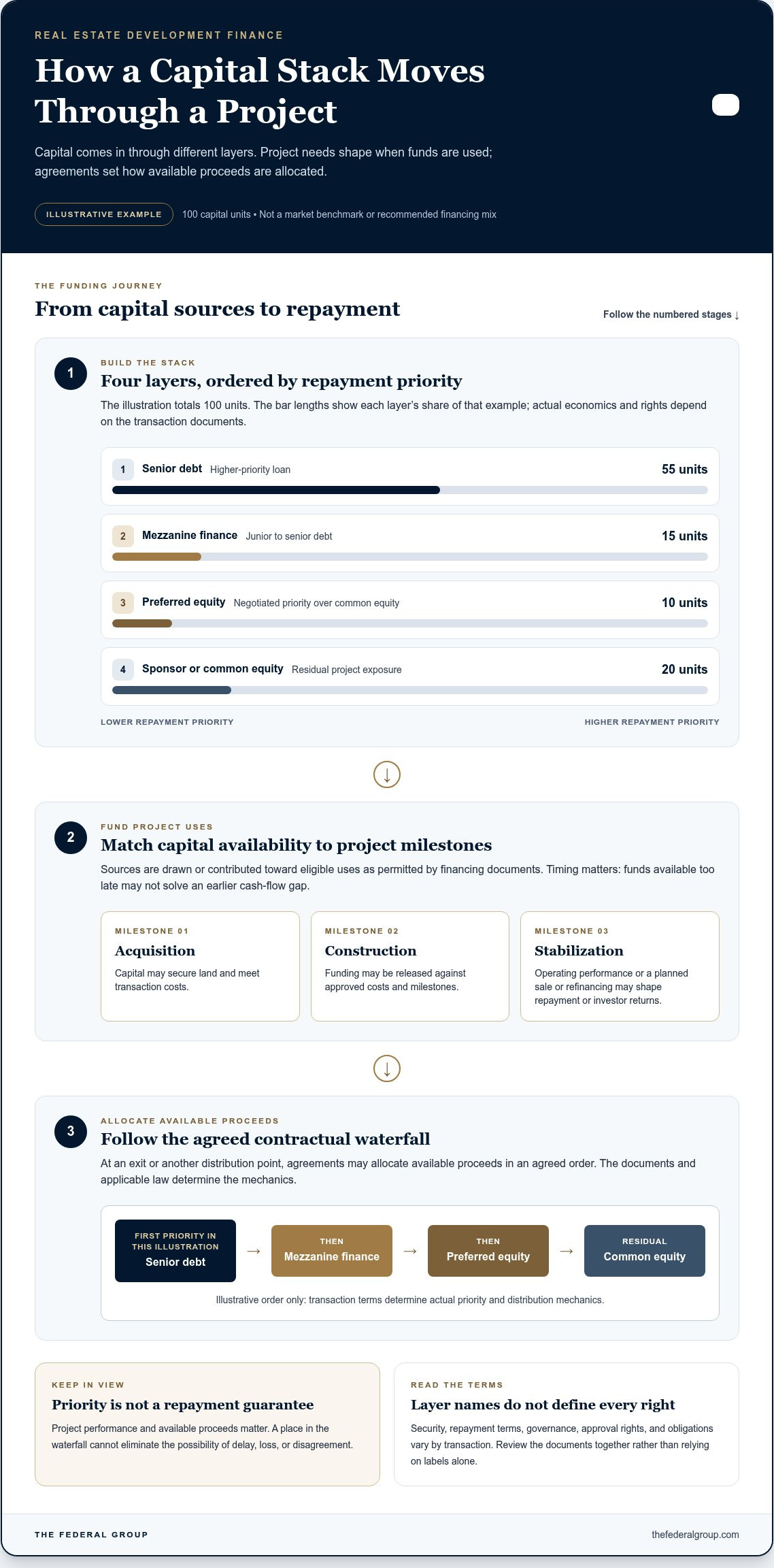
The illustration below uses 100 capital units to show the order of layers. The figures are hypothetical, not market benchmarks or recommended financing proportions.
Illustrative project capital stack, from lower priority to higher priority
- Sponsor or common equity: 20 units
- Preferred equity: 10 units
- Mezzanine finance: 15 units
- Senior debt: 55 units
Which funding layers can appear in a development capital stack?
Projects can use different combinations of capital. Layer names provide a starting point, but the transaction documents determine the actual economics, rights, and obligations.
- Sponsor or common equity is exposed to residual project outcomes. After obligations higher in the agreed payment order are addressed, common equity may receive remaining proceeds, if any.
- Preferred equity is an equity interest with negotiated economic priority relative to common equity. Its return and governance rights depend on the agreed structure.
- Mezzanine finance is junior capital positioned behind senior debt in the payment structure. Its legal form, security arrangements, and rights vary by transaction and jurisdiction.
- Senior debt is a higher-priority loan, subject to agreed security, covenants, repayment terms, and other financing documents.
How do capital priority and project lifecycle connect?
Payment priority is a contractual waterfall, not a guarantee that any layer will be repaid in full. Project performance, available proceeds, and applicable agreements all matter. The stack defines relative claims, but it cannot eliminate the possibility of delay, loss, or disagreement.
A development capital stack allocates project risk and sets the contractual priority for repayment, but priority does not guarantee recovery.
Funding needs can change as a project advances. Acquisition may require capital to secure land and meet transaction costs. Construction funding is drawn as work progresses, making timing, budget assumptions, and conditions for releasing funds important. At stabilization, operating performance or a planned sale or refinancing may shape the route to repayment or investor returns. A structure that fits one milestone may not suit the next, so the funding plan should account for the full project lifecycle.
How Do Debt and Equity Layers Work Together?
Debt and equity meet different needs within a project’s total funding requirement. Capital comes from identified sources and is drawn or contributed toward eligible project uses as permitted by the financing documents. For example, a construction facility may release funds against approved costs and milestones, while equity may fund part of the requirement or cover uses the loan does not address. Timing matters as much as the total: a source available too late may not solve an earlier cash-flow gap.
To understand how a capital stack for real estate development works, trace two flows: money going into approved project uses and proceeds returning through the agreed repayment arrangements. At an exit or other distribution point, documents may set out a waterfall allocating available proceeds among obligations and investors. The order and mechanics depend on the agreements and applicable law, and no position in a waterfall guarantees full repayment.
What distinguishes senior debt, mezzanine finance, and preferred equity?
Senior debt generally has a higher contractual repayment priority than junior capital, with its security position and lender rights set out in the finance documents. Mezzanine finance sits behind senior debt in the agreed structure, but its legal form and rights vary. Preferred equity is an equity interest with negotiated economic priority, not simply another name for mezzanine debt. Its rights arise from its governing agreements and may differ from debt remedies.
Governance rights also vary. A senior lender may have consent rights over specified actions; mezzanine investors or preferred equity holders may have negotiated approval, information, or other rights. These arrangements are not universal. Wall Street Prep outlines the real estate capital stack and the general concept of repayment order. For a specific project, review the documents together rather than inferring control or security from a funding layer’s label.
Where do sponsor equity and private equity fit?
Sponsor or common equity bears residual exposure. After project obligations and higher-priority claims are addressed, common investors may receive remaining proceeds. If performance falls short or proceeds are limited, that residual can shrink or disappear. Test equity return expectations against realistic project assumptions, including costs, timing, income, and exit conditions, rather than treating them as promised outcomes.
Private equity describes a potential source of investment capital, not a separate repayment tier. A private equity investor may participate through a negotiated equity interest, whose position depends on the transaction documents. Development finance and private equity can therefore address different project needs. Their fit depends on funding availability, repayment terms, investor rights, and delivery milestones.
Capital layers differ in priority, risk, and decision rights, so their interaction matters as much as the amount each contributes. The Federal Group provides development finance, bridging loans, and private equity for property projects. Its development finance perspective connects funding considerations with the project lifecycle.
How Should Developers Compare Capital Stack Options?
Compare financing by its effect on the whole project, not just its headline cost. A lower-cost loan may carry tighter covenants or repayment dates, while equity may reduce scheduled debt payments but dilute ownership or allocate decision rights. Test how each source performs under the expected case and less favorable scenarios.
The table is a high-level guide, not a substitute for transaction documents. Terms are negotiated, and a layer’s label alone does not establish its exact rights or obligations.
| Capital layer | Repayment priority | Dilution | Control, flexibility, and execution risk |
|---|---|---|---|
| Senior debt | Typically higher priority than junior capital and equity, under agreed documents. | Usually no ownership dilution. | Covenants and consent rights may limit flexibility. Conditions, security, and coordination with other funders affect execution. |
| Mezzanine finance | Junior to senior debt, subject to the structure and agreements. | Depends on its legal form; it may not involve equity ownership. | Intercreditor arrangements and negotiated rights can add complexity and affect available options. |
| Preferred equity | May have economic priority over common equity, as negotiated. | Can affect ownership economics. | Governance and consent rights vary; coordination with debt terms can influence flexibility and execution. |
| Common equity | Generally residual after project obligations and higher-priority claims. | Shares ownership economics. | May avoid scheduled debt repayments, but investor rights and alignment on project decisions matter. |
More leverage does not automatically improve project returns. It can reduce the equity required at the outset, but it also increases obligations that must be met from project cash flow or exit proceeds. If delivery takes longer, costs rise, or proceeds are weaker than assumed, repayment capacity can come under pressure. Assess whether project cash flow can support the obligations and whether risk is allocated to parties able to bear it.
How do leverage, coverage, and contingency assumptions affect the structure?
Loan-to-cost (LTC) compares the loan amount with total project cost. Loan-to-value (LTV) compares the loan amount with the relevant property value. They answer different questions: LTC tests funding against the budget, while LTV tests it against value. Definitions and inputs can vary by financing documents.
Debt-service coverage compares projected income or cash flow available for debt service with required debt payments over the same period. A delay may defer income while costs continue; an overrun may increase the funding need; weaker proceeds may reduce repayment capacity or refinancing options. Stress-test these assumptions, including contingency needs, before relying on a projected coverage position.
What trade-offs should a developer weigh beyond funding cost?
Assess ownership dilution alongside repayment obligations and potential control provisions. Review covenants and consent requirements for their effect on decisions such as budget changes, additional borrowing, or a revised exit plan. If several funders are involved, intercreditor terms can shape how their rights interact. Test refinancing assumptions against timing and project performance. Security, enforceability, and insolvency outcomes depend on the governing documents and applicable jurisdiction, so jurisdiction-specific advice is essential.
How Can You Assess a Capital Stack for a Specific Project?
A sound assessment starts with the project’s documented uses, then works through funding timing, repayment capacity, and exit assumptions. The idea of a capital stack for real estate development becomes useful when it leads to a tested plan, not just a list of funding sources. Verify each input against current budgets, schedules, agreements, and professional advice.
Use this sequence to build the assessment:
- 1. Document project uses. Itemize land, construction, professional fees, contingency, and other supported project costs. Separate committed amounts from estimates, and record the source and date of each assumption.
- 2. Map the timing. Set out when acquisition costs, construction payments, fees, and contingency may arise. Compare those dates with anticipated equity contributions, loan drawdowns, approval conditions, and construction milestones.
- 3. Identify funding sources and terms. Record which uses each source can fund, when capital is available, and what conditions apply. Distinguish committed funding from indicative discussions or model assumptions.
- 4. Forecast cash flows and obligations. Model expected project income, funding costs, required debt payments, and other obligations over time. Keep assumptions visible so decision-makers can see which inputs drive the funding requirement.
- 5. Test alternatives and risks. Compare the proposed structure with plausible downside and delay cases, then assess whether available capital and repayment timing still align.
- 6. Record a funding plan. Summarize the selected structure, unresolved dependencies, key milestones, and the assumptions that would trigger a review.
What should the project funding model test?
At minimum, test a base case, a downside case, and a delay case. Adjust relevant assumptions rather than inserting unsupported benchmarks: costs may rise, the schedule may extend, expected revenues may weaken, or an intended exit may move. Then check whether capital arrives in time for acquisition and construction requirements, and whether projected cash flow can meet repayment obligations when due.
Pay close attention to timing gaps. A source may cover the total funding need on paper but still miss a payment milestone if draw conditions or equity contributions occur later. State these dependencies clearly. Underwriting inputs require project-specific verification; illustrative model results are not assurances of funding, repayment, or returns.
How do exit routes and cross-border factors shape the stack?
Compare a sale, refinancing, and continued hold as distinct scenarios. Each can imply a different repayment timing and source, but none should be treated as assured. For an international development, flag currency exposure, jurisdiction, tax, security, and documentation for review by relevant experts. These factors can influence how funding is structured and how obligations operate across the project lifecycle. The Definitive Guide to International Property Development Finance is a related resource for considering cross-border funding in context.
For a project-specific assessment of development finance and funding needs across milestones, discuss your development finance requirements.
How Can a Strategic Finance Partner Support the Capital Stack?
A capital structure needs to work in the project’s operating reality, not only in a funding model. A strategic finance partner can assess development finance, bridging finance, and equity against the project’s stage, documented uses, timing, repayment route, and delivery plan. These are distinct capital solutions: development finance can address broader development requirements, bridging finance can meet a defined interim funding need, and private equity can support a project’s investment proposition and ownership structure.
That assessment should connect funding availability to key milestones. Capital for acquisition must align with the transaction timetable; construction funding must reflect when costs arise and work advances; later-stage obligations must fit the project’s expected cash flow or exit plan. Understanding the capital stack for real estate development is only the starting point. The structure must remain coherent as the project moves from acquisition through construction and delivery.
What does an integrated property finance perspective add?
An integrated perspective considers how financing and delivery sequencing affect one another. A change in construction timing, for instance, may affect when funds are needed and when projected income or repayment proceeds could become available. The Federal Group operates internationally in property finance and development, bringing a lifecycle perspective to these connected considerations. Through Federal Holdings, the group manages property projects using an integrated design-and-build model. This context can help connect funding assumptions with project delivery, without treating any particular structure or outcome as assured. The Efficiency of the Integrated Design and Build Developer in 2026 explores the delivery model in more detail.
What should developers prepare before discussing a financing structure?
A clear project brief makes a financing discussion more specific. Organize the core information so funding needs, timing, and risks can be assessed together:
- Project plan: Describe the development, its current stage, key delivery milestones, and intended use or exit route.
- Site or acquisition status: Summarize ownership, transaction progress, and material timing dependencies.
- Budget and schedule: Provide the current cost plan, documented assumptions, contingency, and project timetable.
- Cash-flow assumptions: Show when capital is needed, expected inflows, and the timing of repayment obligations.
- Capital position: Identify capital already committed, the funding sought, and any conditions attached to existing sources.
- Material risks: Set out key delivery, cost, market, currency, or jurisdictional considerations requiring assessment.
These details help distinguish a temporary funding requirement from a broader development capital need and support a structure aligned with project milestones. For further context, The Definitive Guide to International Property Development Finance examines considerations involved in cross-border development funding.
For a project-specific discussion of development finance, bridging finance, or equity in relation to your delivery plan, discuss your project’s capital structure with The Federal Group.
Make the Next Capital Decision with Confidence
A capital structure is not finished when the funding sources are assembled. It should remain a decision framework that can be revisited as project assumptions, delivery conditions, or exit plans change. Set review points around key milestones, and identify which changes would require a fresh look at funding availability, cash flow, or repayment timing. This keeps the financing plan connected to the project as it moves forward.
A clear understanding of the capital stack for real estate development gives decision-makers a basis for weighing trade-offs, testing assumptions, and recognizing when the structure no longer fits the plan. Apply that thinking to the specific development, its priorities, and its risk profile.
Discuss a capital structure for your development project with The Federal Group to connect financing considerations with your project’s delivery plan.
Frequently Asked Questions
Is a capital stack the same as a real estate development budget?
No. A budget estimates what the project will spend, while the capital stack identifies how those costs will be funded and the terms attached to each source. A construction budget line is a use of funds, not a funding source. Compare the budget and capital schedules to identify unfunded costs, timing gaps, and assumptions that need updating.
Can a real estate development have more than one equity layer?
Yes. A project may include sponsor equity, common equity from other investors, and one or more preferred equity interests. Their economic rights can differ, including how distributions are allocated and which decisions require investor consent. For example, two equity classes might have different distribution priorities under the governing documents. Map the arrangement clearly so each investor’s position and the effect of new equity are understood.
What happens if a development project cannot repay its senior debt?
The borrower may be in default if it misses a required payment or breaches another obligation, but the consequences depend on the loan documents and applicable law. The lender’s rights, any notice or cure process, and potential enforcement steps vary by transaction and jurisdiction. Review the relevant documents early, track approaching obligations, and obtain qualified legal and financial advice before agreeing to a restructuring or other response.
How does a capital stack affect a developer’s ownership?
Ownership changes when equity is issued or transferred, while debt generally creates repayment obligations rather than an ownership interest. However, equity terms can affect voting, distributions, and reserved decisions, and debt agreements may also limit certain actions without transferring ownership. Before accepting new capital, compare proposed ownership percentages with governance rights and distribution provisions. A smaller ownership share may still carry meaningful rights, depending on the negotiated documents.
Can a capital stack change after a development loan closes?
Yes, but a change may require approvals or amendments under existing financing and investment documents. Adding equity, replacing a funding source, refinancing, or changing repayment arrangements can affect priorities, security, covenants, and other parties’ rights. Before acting, map the proposed change against the full set of agreements and the project’s cash needs. Treat unapproved funding changes as uncertain, not as available capital in the working plan.
How do developers test whether a capital stack can withstand delays?
Model a delay by shifting expected milestones and income later while keeping unavoidable costs and scheduled obligations visible. Then assess how long available cash can cover the gap, whether committed funding remains accessible under its conditions, and when repayment pressure could emerge. Test more than one delay assumption, document trigger points for review, and update the model as the construction schedule and cash-flow evidence change.