Property Acquisition Bridging Loan: A Strategic Guide
7 October 2026What happens when a compelling property opportunity has a fixed purchase deadline, but longer-term funding isn’t ready? A property acquisition bridging loan may help close that timing gap, particularly when an asset or project doesn’t fit conventional financing criteria. But speed alone doesn’t make the structure sound. The asset, timeline and exit need to align.
Assess acquisition bridging as part of the wider property and capital strategy. The funding must fit the purchase and the project, while the repayment plan needs to stand up to scrutiny. Without a credible exit, refinancing risk can undermine an otherwise promising acquisition.
This guide explains when bridging finance may suit a property acquisition, what information helps assess the proposed structure, and how to plan an exit before committing. It also considers how acquisition funding can connect with construction and the wider project lifecycle, so you can assess both the opportunity and its repayment path.
Key Takeaways
- A property acquisition bridging loan may help address a funding gap, but its fit depends on the asset, transaction, borrower structure and repayment plan.
- Assess the acquisition purpose, asset, due diligence, facility design and exit in sequence. Loan-to-value alone won’t capture the full risk.
- Compare bridging finance with commercial mortgages, development finance and equity by timing, repayment basis and trade-offs.
- Build the repayment plan around an evidenced exit, such as refinancing or asset sale, without assuming either outcome is guaranteed.
- Bring the acquisition case, timetable, capital requirement and intended exit into focus when planning finance for the wider property project.
What a Property Acquisition Bridging Loan Can Fund
A property acquisition bridging loan is short-term finance designed to bridge a transaction or funding gap, such as a purchase that must complete before longer-term capital is ready. The general concept is outlined in Bridge loan. In property transactions, the specific structure depends on the acquisition and the planned repayment route.
It isn’t a universal facility. Suitability depends on the asset, borrower, transaction structure, jurisdiction and exit plan. Bridging finance may address the acquisition stage, while development finance is generally structured around project works such as construction. If a project involves both purchase and redevelopment, consider the acquisition and works together. A bridge is a financing strategy, not proof that the project is viable: the business case, costs, delivery assumptions and repayment plan still need to make sense.
When bridging finance may fit a property acquisition
A bridge may be relevant when a purchase deadline arrives before longer-term funding is available, or when a defined transaction milestone creates a temporary need for capital. For example, a commercial property buyer may be approaching completion while planned longer-term funding remains in process. Bridging finance could be assessed as a way to address that timing gap. Before committing, evaluate the repayment route, the evidence supporting it and the risks if funds are delayed. This illustrates a possible use, not a guaranteed funding outcome.
The key question is whether the gap is temporary and supported by a credible plan. If expected follow-on funding is delayed, unavailable or insufficient, the short-term facility may leave the borrower exposed. Timing, documentation and the sequence of capital sources all matter.
Which acquisitions require a project-specific assessment?
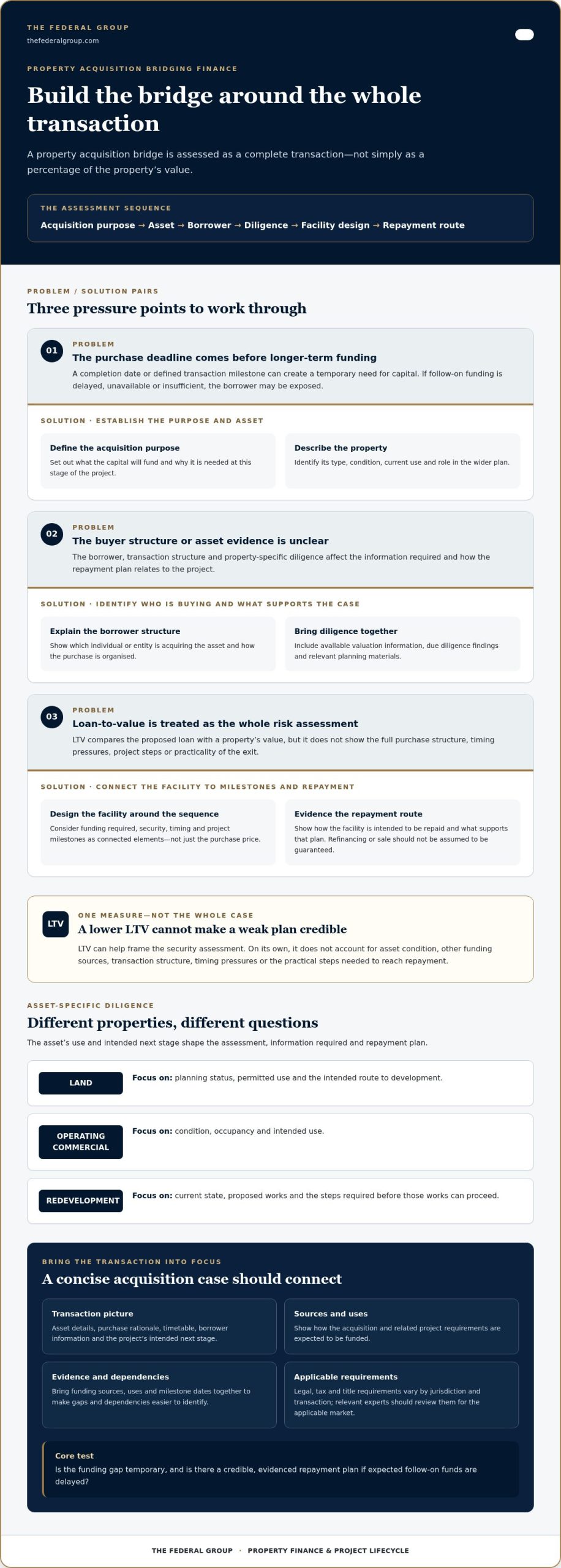
Different assets create different diligence priorities. For land, focus on planning status, permitted use and the intended route to development. For an operating commercial property, condition, occupancy and intended use can shape the assessment. A property intended for redevelopment calls for a clear view of its current state, proposed works and the steps required before those works can proceed.
These factors affect more than the asset description. They influence the transaction structure, information required and how the proposed repayment plan relates to the project. Rules and transaction processes also vary across jurisdictions, so a structure suited to one market may not transfer directly to another. The Federal Group’s international property finance and development expertise connects acquisition funding with the wider project lifecycle, including construction planning where relevant.
How a Property Acquisition Bridging Loan Is Structured
A sound structure connects the purchase purpose to the asset, borrower, transaction timetable and repayment route. A property acquisition bridging loan is assessed as a complete transaction, not simply as a percentage of the property’s value. Use the sequence below to identify where the funding need sits and what evidence supports it.
- Acquisition purpose: Define what the capital will fund and why it’s needed at this stage of the project.
- Asset: Set out the property’s type, condition, current use and role in the wider plan.
- Borrower structure: Explain which individual or entity is acquiring the asset and how the purchase is organised.
- Diligence: Bring together available valuation information, due diligence findings and relevant planning materials.
- Facility design: Consider the required funding, security, timing and project milestones as connected elements.
- Repayment route: Show how the facility is intended to be repaid and what evidence supports that plan.
Loan-to-value (LTV), which compares the proposed loan with a property’s value, can help frame the security assessment. It is only one measure. On its own, it doesn’t account for the purchase structure, asset condition, timing pressures, other funding sources or the practical steps required to reach repayment. A lower LTV cannot make an unclear project plan or weak exit credible.
What information supports an acquisition finance assessment?
Prepare a concise picture of the transaction: asset details, purchase rationale, timetable, borrower information and the project’s intended next stage. Available valuations, diligence findings and planning materials add context, particularly where condition or proposed use affects the plan.
A clear sources-and-uses summary is also valuable. Show how the acquisition and related project requirements are expected to be funded, while allowing for the fact that document needs vary by transaction. Presenting funding sources, uses and milestone dates together makes gaps and dependencies easier to identify.
How are security and funding requirements considered?
Security assessment reflects the asset and the wider transaction. Acquisition costs, intended project works, borrower structure and the timing of other capital can all influence the funding requirement. The proposed facility needs to fit the sequence of events, not just the purchase price. Terms depend on individual underwriting and agreed documentation.
Legal, tax and title requirements vary by jurisdiction and transaction. Relevant experts should review these matters for the applicable market; unresolved issues can affect the structure or timetable. For complex property opportunities, The Federal Group’s property finance brings an international finance perspective to acquisition and development requirements.
Bridging Finance Versus Other Acquisition Funding Routes
The right acquisition capital depends on transaction timing, the asset’s intended use and the project’s wider funding plan. A property acquisition bridging loan may address a short-term purchase need, while other routes may better match long-term ownership, construction or shared investment. No option is universally superior. The structure should fit the project’s milestones and repayment capacity.
| Funding route | Typical purpose | Timing fit | Repayment basis | Principal trade-off |
|---|---|---|---|---|
| Bridging finance | Cover an acquisition or temporary funding gap | Short-term transaction need | Planned repayment, such as refinancing or sale | Can align with a time-sensitive purchase, but depends on a credible exit |
| Commercial mortgage | Finance longer-term ownership of a commercial property | More suited to a settled asset and longer-term funding need | Repayment under the agreed loan structure | May support ownership over time, but may not fit every asset or purchase timetable |
| Development finance | Support construction or redevelopment stages | Aligned with project works and milestones | Repayment linked to the project’s agreed funding plan | Can address development requirements, but acquisition and construction needs must be coordinated |
| Equity | Provide investment capital within a broader project structure | Depends on investment agreement and transaction readiness | Returns depend on agreed shared investment economics | Can reduce reliance on debt, but involves sharing investment outcomes |
When might a bridge differ from longer-term property finance?
A bridge is generally considered for a defined transaction gap, while longer-term property finance is structured around ownership or a project’s continuing capital needs. The distinction is practical: a purchase deadline may come before a longer-term facility can support the asset, but a short-term loan still needs a viable repayment route. Underwriting, security and repayment expectations vary by lender and jurisdiction. For a wider view of international property development finance and a closer comparison of development finance versus bridging loans, consider how each structure aligns with the acquisition and project stages.
When could equity be part of the acquisition strategy?
Debt creates a repayment obligation under agreed terms. Equity involves shared investment economics, with returns and exposure shaped by the agreement. It may complement debt as one part of a broader capital structure, but it isn’t appropriate for every transaction. The choice depends on the project’s funding requirement, ownership objectives and allocation of risk across its lifecycle.
How to Manage Repayment, Timing, and Acquisition Risk
Repayment is the central test of a property acquisition bridging loan. The exit route needs to be credible, supported by evidence and achievable within the facility’s agreed timeline. A planned refinance, asset sale or other repayment source may support the case, but none is assured. Identify what must happen, who is responsible and what could prevent the funds arriving on time.
How can a borrower assess whether an exit is credible?
Map the proposed exit as a sequence, not a single assumption. For refinancing, identify what needs to change before the asset could support longer-term funding and what evidence demonstrates progress. For a sale, assess the steps required to prepare and market the property and complete a transaction. Note the responsible parties, dependencies and timing for each stage.
Separate the preferred route from a fallback. A contingency should be a plausible alternative, not simply the same plan under a different name. If the primary exit is delayed or fails, consider the resulting repayment pressure, potential extension needs and effect on the project’s wider capital plan before committing to the acquisition.
Which execution risks can affect the financing timeline?
Stress-test the timetable against the work required to complete the transaction and reach the exit. Valuation, title review, planning matters, legal documentation and cross-border coordination can all create dependencies. Unresolved diligence may affect transaction certainty, change funding assumptions or delay a milestone. Sequence approvals and documents realistically instead of relying on the most optimistic schedule.
- Confirm dependencies: Identify outstanding diligence, approvals and documentation, and who is responsible for progressing each item.
- Test milestone dates: Allow for steps that must occur in sequence, including acquisition completion and planned project work.
- Plan for delay: Determine how a slower refinance, sale or approval would affect repayment and the project’s other funding requirements.
Where the acquisition involves another jurisdiction, obtain legal, tax and technical advice suited to that market. Requirements and processes differ, and an issue affecting title, planning or documentation can affect both completion and repayment timing. Addressing these matters early helps expose pressure points while there’s still scope to revise the transaction plan.
The Federal Group provides international property finance and bridging finance for projects where acquisition funding needs to align with construction and the wider capital strategy. Explore The Federal Group’s property finance in the context of your project timeline and intended exit.
Plan a Property Acquisition Bridging Loan with The Federal Group
A well-prepared acquisition case connects the opportunity to its funding requirement and intended repayment route. For a property acquisition bridging loan, explain what is being acquired, why the transaction needs short-term capital, how the timetable is expected to unfold and what will repay the facility. This gives the financing discussion a clear basis and places the acquisition within the project’s wider capital strategy.
What should a developer prepare before discussing finance?
Bring together a concise investment rationale and a practical view of the transaction sequence. Include the purchase timetable, capital required and expected milestones between acquisition and repayment. Organize available information on the asset, valuation, due diligence and borrower structure, then identify material gaps or assumptions that could affect timing or viability.
Set out the intended repayment route and the evidence behind it. If the plan depends on refinancing, sale or another source, describe the steps required to reach that outcome and the parties responsible. A clear summary doesn’t need to disguise uncertainty. Identifying dependencies early focuses discussion on the structure, timing and risks that matter to the opportunity.
- Acquisition case: State the investment rationale and the role of the asset in the project.
- Transaction plan: Outline key dates, milestones and any known dependencies.
- Funding requirement: Summarize the capital needed for the acquisition and relevant project stages.
- Repayment assumptions: Explain the intended exit and the evidence supporting its feasibility.
How can integrated development experience inform the wider plan?
Some acquisitions lead into construction or redevelopment; others don’t. Where works form part of the project, consider acquisition funding and delivery requirements in sequence. The Federal Group provides international property finance and short-term bridging finance for property projects, with flexible funding structures that support acquisition and construction.
Through its Federal Holdings division, The Federal Group operates as an integrated design-and-build developer. Where relevant, that capability connects finance considerations with delivery planning across the project lifecycle. Development services aren’t a prerequisite for an acquisition finance discussion. The focus remains on the asset, transaction and funding strategy.
Every opportunity has its own structure, timetable and constraints. For a time-sensitive purchase, assess a project-specific capital solution against the acquisition case, funding requirement and intended exit.
Move Forward with a Clear Acquisition Strategy
A property acquisition bridging loan can help address a defined funding gap, but its suitability rests on the fit between the asset, transaction timeline and repayment plan. Compare it with longer-term finance and equity in the context of the project, and test the exit against realistic milestones rather than assumed outcomes.
Preparation matters. Bring the acquisition rationale, asset information, capital requirement and intended repayment route into one clear view. The Federal Group combines international property development finance expertise with bridging finance for property acquisition and construction. Where a project requires it, Federal Holdings’ integrated design-and-build capability can connect funding considerations with delivery planning.
To explore how a project-specific capital solution could align with your acquisition and wider development plan, discuss your property acquisition finance requirements.
Frequently Asked Questions
Is a property acquisition bridging loan suitable for a commercial purchase?
A property acquisition bridging loan may suit a commercial purchase when short-term capital is needed and there’s a credible repayment plan. Suitability depends on the asset, borrower, security, project purpose and jurisdiction. Assess the intended exit alongside acquisition diligence instead of treating speed as the deciding factor. A project-specific review can show whether bridging finance fits the wider capital strategy and transaction timing.
How does a property acquisition bridging loan work?
A property acquisition bridging loan provides short-term finance for a defined transaction or funding gap. Before agreeing a structure, a lender assesses the borrower, asset, security, transaction and planned repayment route. Funds are applied according to the facility documentation, and repayment follows the agreed terms and exit plan. Requirements and processes vary between lenders and jurisdictions, so assess the structure against the specific acquisition rather than assuming a standard model.
Can a bridging loan be used to buy development property?
Yes, bridging finance can be considered for acquiring property connected to a development project, subject to assessment of the transaction and project. The asset, intended use, planning position, due diligence, funding requirement and repayment plan may all be relevant. Acquisition finance is distinct from funding every stage of construction or redevelopment. Presenting the wider project context clarifies how the purchase facility relates to subsequent works and other planned sources of capital.
What is an exit strategy for a property bridging loan?
An exit strategy is the planned source of repayment for a bridging facility. Depending on the transaction, it may involve refinancing, selling the asset or another documented source of funds. The plan should set out realistic timing, supporting evidence and the steps required to reach repayment. Consider contingencies if a milestone is delayed. A refinance or sale is not guaranteed, so assess the assumptions and risks before committing to the acquisition.
How quickly can a property acquisition bridging loan be arranged?
Timing depends on the asset, borrower information, valuation, due diligence, legal work, transaction complexity and jurisdiction. An organized timetable and documentation can help identify requirements and dependencies early, but they can’t guarantee completion by a particular date. Map the transaction’s critical path, including outstanding approvals and documentation, before setting an exchange or closing expectation. Avoid relying on a generic market timeline when planning a specific acquisition.
What information is needed to assess an acquisition bridging loan?
An initial assessment commonly considers the property, purchase rationale, borrower structure, transaction timetable, funding requirement and intended repayment route. Supporting information may include valuation details, due diligence findings, planning materials and a sources-and-uses summary. Requirements vary with the transaction and jurisdiction. Present assumptions clearly, distinguishing established facts from matters still subject to diligence or documentation, so the structure can be considered against the actual acquisition plan.