When to Use a Bridging Loan for Property: 2026 Guide
4 October 2026An auction completion date is approaching. The property fits the investment plan, but longer-term finance isn’t ready. In that moment, understanding when to use a bridging loan for property purchase means looking beyond speed: the opportunity must justify temporary capital, and a credible repayment route must be in place.
That timing pressure is familiar to property investors and developers. Bridging finance can help meet an acquisition deadline, but it isn’t a default solution for every purchase. The decision depends on the asset, the project’s next stages and how the loan will be repaid, whether through refinancing, a sale or another defined route.
This 2026 guide explains the acquisition scenarios where bridging may fit, how to compare it with longer-term finance and other funding routes, and what to assess before committing. It also connects acquisition funding with later development or construction needs, helping you consider execution risks and downside exposure as part of the wider project plan.
Key Takeaways
- Assess when to use a bridging loan for property purchase by weighing the acquisition deadline against transaction readiness and a credible repayment route.
- Map the funding gap, intended exit and downside scenario before deciding whether short-term finance fits the acquisition.
- Compare bridging finance with development finance, longer-term property debt and equity by purpose, project stage and execution dependencies.
- Stress-test your exit plan for delays, including potential title, valuation, planning, legal, construction and follow-on finance issues.
- Consider acquisition funding alongside later development or construction capital to understand the project’s wider funding requirements.
When to use a bridging loan for a property purchase: the timing gap it can solve
A bridging loan is short-term finance that covers a defined gap between a property acquisition and an expected source of longer-term funding or repayment. The key question in deciding when to use a bridging loan for property purchase is whether the gap is temporary and supported by a workable plan, rather than a sign that the overall project is underfunded.
Three elements need to align: the purchase deadline, the transaction’s readiness to complete and a realistic repayment route. A tight deadline alone isn’t enough. The asset, financing structure, jurisdiction and borrower’s circumstances all affect whether short-term capital fits. For a neutral overview of the concept, see What is a bridging loan?
Which property purchase situations may justify bridging finance?
Bridging finance may suit an acquisition that must complete before another funding event occurs. For example, a buyer might face a fixed completion date while proceeds from another property sale are pending, or longer-term finance may be progressing but not ready in time. A temporary facility may also fund an acquisition ahead of a planned redevelopment or construction phase.
The case is stronger when the purchase is clearly defined, the timing mismatch is specific and the next funding event has a practical route and timeline. Write down what needs to happen between acquisition and repayment, and identify the conditions that could delay each step.
What a bridging loan is, and isn’t, designed to do
A bridging loan is temporary acquisition finance intended to cover a defined funding gap, with repayment tied to a documented exit strategy. That exit might rely on refinancing, a sale or another identified source of funds. It’s distinct from permanent finance intended to support ownership over the longer term.
Speed can help address a transaction deadline, but it doesn’t make an unsound borrowing case viable. If repayment depends on uncertain future funding, an untested sale assumption or project income that may arrive late, the timing gap could become a repayment problem.
Before treating bridging as a solution, trace the sequence from acquisition to repayment. Identify what must happen, what each step depends on and what changes if expected funding is delayed. For a staged property project, consider acquisition capital alongside later development or construction requirements. Bridging finance can serve a defined role within that wider plan, but it shouldn’t be mistaken for the plan itself.
How to assess whether a bridging loan fits your property acquisition
A disciplined assessment starts with the transaction, not the appeal of short-term capital. To decide when to use a bridging loan for property purchase, map the funding need against the acquisition timeline, the asset and the repayment route. A gap that looks temporary on paper can become a project-wide constraint if later capital or key milestones aren’t aligned.
Start with the acquisition and its funding gap
List the purchase milestones, the date funds must be available and the capital required at each stage. Then identify precisely what the bridge would fund, what other capital contributes and which later commitments remain outstanding. Note any conditions attached to other funding, such as approvals or project milestones, so the full funding gap is visible. For a broader view of how acquisition capital can connect with development requirements, see this international property development finance guide.
Test the exit before relying on short-term capital
Name the expected repayment source, such as a sale or refinancing, and record the assumptions behind it. For a sale, consider what needs to happen before the asset can be marketed or transferred. For refinancing, map the outstanding steps and conditions. Then consider how a delayed transaction, a change in asset value or a gap in follow-on funding could affect repayment. Forbes offers an overview of how bridging loans work, including practical features to consider when assessing a facility.
Use a four-part assessment
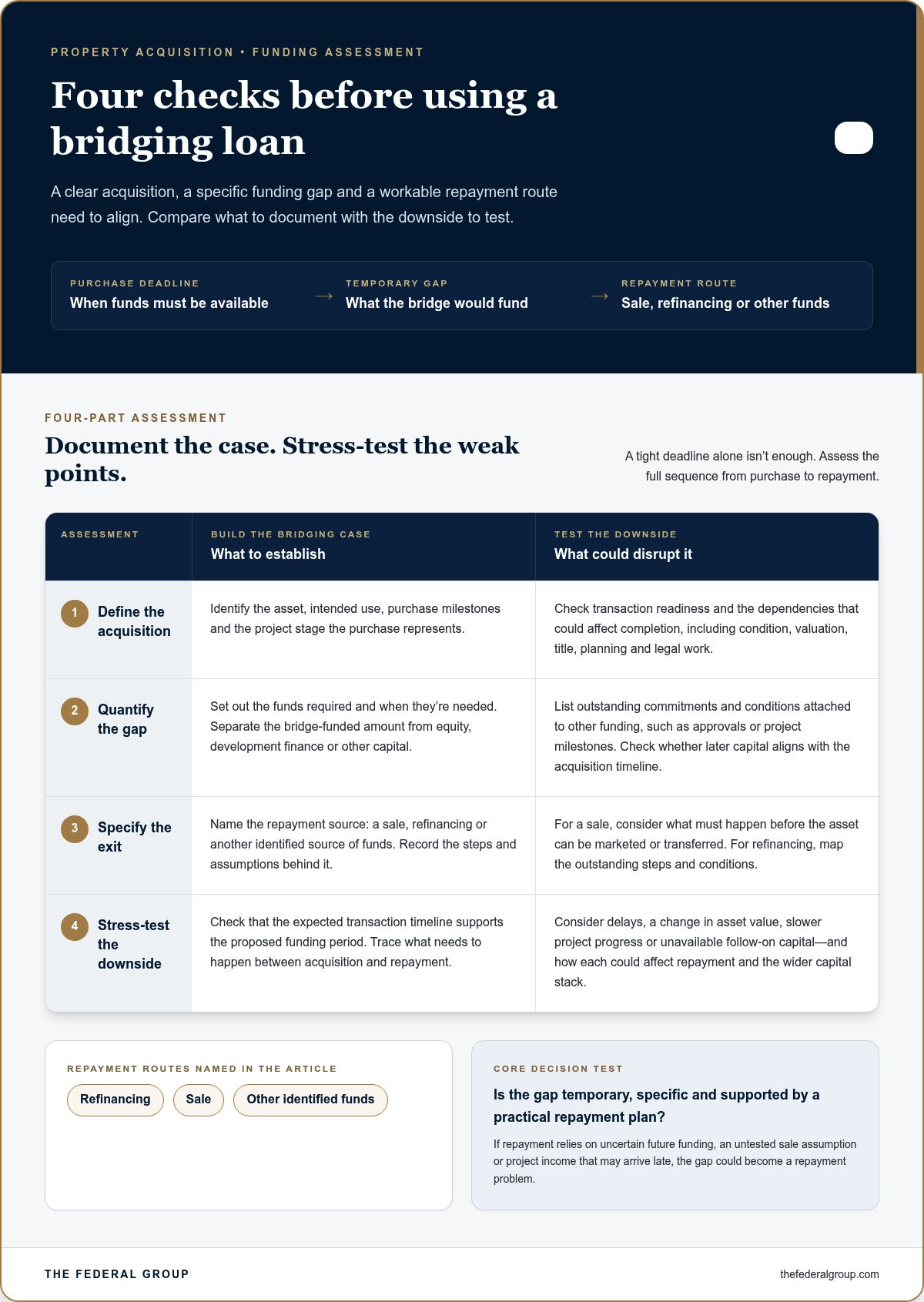
- Define the acquisition. Identify the asset, intended use, purchase milestones and the project stage the purchase represents.
- Quantify the gap. Set out the funds required and when they’re needed. Separate the bridge-funded amount from equity, development finance or other capital, and note any conditions those sources depend on.
- Specify the exit. Record the repayment source and the steps needed to reach it. A credible exit is central to bridging suitability because it connects temporary borrowing to a practical repayment plan.
- Stress-test the downside. Allow for delays and consider how a lower asset value, slower project progress or unavailable follow-on capital would affect the exit and the wider capital stack.
Finally, check that the expected transaction timeline supports the proposed funding period. Account for dependencies that may influence completion or repayment, including the asset’s condition, valuation, title, planning, legal work and construction requirements where relevant. A sound case depends on the full sequence, not just the purchase date.
For property investors and developers, assessing acquisition capital alongside later project requirements can help reveal funding dependencies early. The Federal Group provides bridging loans and development finance for international property projects. Read more about its property finance and development expertise.
Bridging loan or another funding route: compare the acquisition trade-offs
Compare funding by the job it needs to do, not by the product label. Bridging finance may address a short-term acquisition need, while development finance, longer-term property debt and equity can serve different phases or requirements. The right structure depends on the asset, project scope, timing, repayment source and execution dependencies. Routes may also be combined where each has a clearly defined role.
| Funding route | Purpose and project stage | Timing and repayment source | Key dependencies |
|---|---|---|---|
| Bridging finance | Temporary capital for an acquisition or defined funding gap | Supports a time-sensitive purchase; repayment follows a planned exit, such as sale or refinancing | Completion readiness, a credible exit and any conditions attached to the next funding source |
| Development finance | Capital structured around a development project or construction phase | Funding may align with project milestones; repayment depends on the project’s planned exit | Scope, planning, construction requirements and delivery milestones |
| Longer-term property debt | Financing need that continues beyond the acquisition stage | Repayment follows the agreed longer-term debt structure | Asset performance, financing conditions and the duration of ownership |
| Equity | Capital contribution that may support a project’s wider capital structure | Returns depend on the investment arrangement and project outcome | Risk allocation, governance and alignment between capital partners |
This is a high-level comparison, not a ranking. Forbes provides a useful guide to bridging loans covering their uses and practical considerations. Compare the full structure and execution requirements rather than assuming one route is universally cheaper, faster or more suitable.
When bridging finance may fit better than development finance
The distinction often turns on the immediate requirement: is capital needed to acquire the asset, or must funding support a broader development phase? A purchase may precede construction funding, but project scope, construction requirements and milestone timing determine whether acquisition finance alone addresses the need. For land-specific considerations, see the bridging finance for land acquisition guide.
When longer-term debt or equity may be more appropriate
If the financing need extends beyond acquisition, longer-term property debt may align more closely with the holding period and project plan. Equity may merit consideration where sharing project risk or reshaping the capital structure is central. These routes aren’t interchangeable: debt creates a repayment obligation, while equity involves a different allocation of risk and potential returns.
For when to use a bridging loan for property purchase, assess whether it solves a specific acquisition-stage timing need and fits into the next phase of capital. A coherent structure can connect purchase funding with development or construction finance, while making dependencies and repayment responsibilities clear.
Manage bridging loan risks with due diligence and a realistic exit plan
Repayment pressure can rise quickly if the expected exit is delayed. A sale may take longer than anticipated, refinancing may not proceed on the expected timetable, or project milestones may slip. When delays overlap, they can reduce the time available to repay and leave fewer practical options.
Separate transaction risks from financing risks. Transaction risks include title issues, valuation uncertainty, planning approvals, legal work and construction delays. Financing risks include an exit that depends on uncertain refinancing, a future capital source that isn’t secured, or repayment assumptions that leave little room for change. Local legal and regulatory requirements vary by jurisdiction, so account for them in the transaction plan.
What can disrupt a planned repayment exit?
Test the sequence, not just the target repayment date. A delayed approval could push back construction; that may defer completion or sale, while a refinancing application may depend on the asset being ready. A change in asset value could also affect the amount available from a sale or replacement finance. Model a downside case in which these events overlap, then assess whether the acquisition remains viable under that pressure.
Which checks support a more resilient borrowing decision?
Before committing, review the asset and the full chain of dependencies. Confirm the ownership position and legal diligence, examine the asset’s condition, and test whether the valuation assumptions support the proposed exit. For development projects, map planning, construction and follow-on funding milestones against a realistic timeline. Identify a contingency route if the primary exit is delayed, rather than relying on an extension or replacement capital that isn’t arranged.
Before committing, test the title, asset condition, valuation, legal and project milestones, repayment timetable, and a workable contingency if the planned exit slips.
This framework helps establish when to use a bridging loan for property purchase without treating speed as a substitute for due diligence. A robust plan should show how acquisition funding connects to later project stages and what happens if the sequence changes.
For property projects where acquisition and subsequent development or construction capital need to be considered together, read more about property finance with The Federal Group.
How The Federal Group can support a property purchase funding strategy
Acquisition finance is one part of a property project’s capital plan. The funding required to secure an asset may differ from what’s needed to progress planning, development or construction, and the repayment route must connect those stages coherently. The Federal Group provides bridging loans and development finance for international property projects, bringing acquisition and later-stage funding needs into the same strategic discussion.
Link acquisition finance to the wider project lifecycle
A property purchase may be followed by refurbishment, redevelopment or construction, each with its own capital requirements and milestones. A bridging facility may address a defined acquisition-stage need, while development finance can relate to the subsequent project phase. The structure should reflect the asset, project sequence and intended repayment route rather than treating the purchase as a standalone event. For cross-border context, see this international real estate finance partner guide.
Where a project requires delivery capability as well as capital planning, Federal Holdings operates as an integrated design-and-build developer. This lifecycle perspective brings acquisition decisions into the context of construction requirements and later project stages, while recognising that each project has its own structure.
Prepare a focused project discussion
A clear outline of the opportunity helps make the funding question more precise. Before discussing a project funding strategy, organise the key information:
- The asset: its location, current condition and intended use.
- The acquisition timetable: key transaction milestones and when funds are required.
- The capital requirement: the amount needed for the purchase and any anticipated later-stage funding needs.
- The project plan: the intended development or construction phases and their dependencies.
- The proposed exit: the expected repayment source, its assumptions and a contingency if timing or delivery changes.
These details help distinguish an immediate acquisition gap from a broader project funding requirement. They also clarify how capital needs may change as the asset moves from purchase toward development or construction.
The question of when to use a bridging loan for property purchase should be answered in the context of the full project, including its milestones and repayment plan. Read more about how to discuss your property funding strategy with The Federal Group.
Build your property funding strategy around the full project
Bridging finance can help address a defined acquisition timing gap, but it should sit within a wider funding plan. The central test is whether the purchase deadline, transaction requirements and repayment route align. Compare bridging with development finance, longer-term debt and equity according to the asset, project stage and capital requirements, then stress-test the exit for delays and other dependencies.
For property investors and developers, acquisition funding may need to connect with later development or construction capital. The Federal Group provides international property finance and development expertise, including bridging loans and development finance for property projects. Where delivery is part of the wider project scope, Federal Holdings also operates as an integrated design-and-build developer.
If you’re weighing when to use a bridging loan for property purchase, a clear view of your asset, milestones, funding gap and exit can help frame the decision. Discuss your property project with The Federal Group and take the next step with a considered funding strategy.
Frequently Asked Questions
When should you use a bridging loan to purchase a property?
Consider bridging finance when a defined purchase deadline arrives before another expected source of capital is ready, and you have a credible repayment plan. The question of when to use a bridging loan for property purchase depends on the asset, transaction readiness, funding structure and your circumstances. For example, it may help address a timing gap before refinancing or a planned sale, but speed alone doesn’t make the borrowing suitable.
Can a bridging loan be used to buy a commercial or investment property?
Bridging finance can be used for some commercial or investment property acquisitions, depending on the asset, transaction structure, jurisdiction and borrower circumstances. The intended use of the property and the funding plan both matter. Define what the loan will fund, how the purchase will progress and what source will repay it. Don’t assume that a facility suitable for one property or transaction will fit another.
How does a bridging loan differ from development finance for a property purchase?
A bridging loan is generally structured to cover a temporary funding gap, often around an acquisition. Development finance is associated with funding a development project or construction phase. The distinction depends on what capital is needed, when it’s required and which milestones it supports. A project may require acquisition funding first and development capital later, so map the phases and repayment route rather than treating the options as interchangeable.
What happens if the planned exit for a bridging loan is delayed?
A delay can extend the period before repayment and increase financial pressure, depending on the facility’s terms. A sale might take longer, refinancing could be delayed, or approvals and construction milestones may slip. Before borrowing, test how overlapping delays affect the exit and identify a contingency route. If timing changes, review the loan agreement and engage with the relevant finance parties promptly rather than relying on an unconfirmed extension or replacement funding.
Can bridging finance fund a property purchase before long-term finance is arranged?
It may, where the purchase must proceed before longer-term finance is ready and the bridging facility has a credible, documented repayment route. However, expected long-term finance shouldn’t be treated as certain simply because an application or discussion is underway. Assess the conditions and steps still outstanding, the transaction timetable and what happens if that finance is delayed or unavailable. The bridge should address a defined gap, not leave repayment dependent on hope.
What should you assess before using a bridging loan to acquire land?
Review the ownership and title position, valuation assumptions, land condition and transaction requirements. Consider planning status, access and any legal or project dependencies relevant to the intended use, as well as the funding needed after acquisition. Map the route to repayment and the milestones required to reach it. Land purchases can sit at the start of a wider development plan, so assess acquisition capital alongside potential construction or follow-on finance needs.
Is a bridging loan suitable if the property needs development or refurbishment?
It can be considered when the immediate need is acquisition capital and the development or refurbishment plan has a separate, credible funding and repayment structure. If the borrowing must also support works, assess the scope, costs, milestones and capital required through completion. The asset’s condition and project dependencies may affect both timing and exit assumptions. Match the funding route to the project stage, rather than assuming a bridge covers the full development strategy.