Joint Venture Development Finance: 2026 Strategic Guide
5 October 2026The capital behind a development can shape who makes decisions, who carries risk, and how returns are shared. That’s why joint venture development finance is about more than securing funds: the structure needs to align a project’s capital requirements with each partner’s contribution, control, and expectations.
If you’re weighing a funding partner, clarify how cash and non-cash contributions translate into ownership or returns, and whether the partner’s priorities will hold up when difficult decisions arise. The answer depends on the agreed structure. A joint venture may combine equity, loans, or blended capital, each with different implications for governance, repayment, and returns.
This guide explains the main funding structures, the terms that shape control and risk, and the questions to resolve before committing. It also covers what to prepare for a financing discussion, from project fundamentals to each partner’s role. The Federal Group brings together international property finance, private equity, and development delivery capabilities, connecting capital and execution across a project’s lifecycle.
Key Takeaways
- Use joint venture development finance when project partners can align their contributions, decision rights, and share of outcomes.
- Build the financing discussion around the project’s feasibility, site, planning position, costs, timetable, and exit assumptions.
- Compare equity, development finance, bridging loans, and blended capital by repayment expectations, participation, control, and project stage.
- Set governance expectations early, including decision-making, reporting, escalation, and how material changes will be handled.
- Assess a prospective partner’s strategic fit, capital role, communication, governance approach, and ability to support delivery.
What Is Joint Venture Development Finance, and When Does It Fit?
Joint venture development finance brings partners together to fund and deliver a property project. Each party makes agreed contributions and shares project outcomes under a defined structure. Contributions may be financial or operational, and the arrangement sets out returns, decision rights, and exposure to risk. There is no universal formula. The broad concept of a joint venture covers different forms of collaboration; in property development, the focus is the project and each partner’s defined role.
A project-specific JV differs from a standard loan. A lender advances funds under repayment terms, while a JV partner may participate in project ownership, decisions, or returns, depending on the agreement. It also differs from passive equity investment: a capital partner may have a role in governance or bring relevant delivery expertise, rather than contribute funds alone. The precise rights and responsibilities depend on the project documents and governing jurisdiction.
How a property development joint venture is structured
A developer and capital partner may establish a project entity to hold or deliver the development, though arrangements vary. The developer might contribute land, planning or delivery expertise; the capital partner might contribute funding or investment capability. Roles can overlap, too. The agreement should state how contributions are valued, who makes key decisions, how returns are allocated, and what happens if plans or funding needs change. Ownership percentages do not automatically reflect every contribution or determine every right.
When joint venture finance may suit a project
A JV may suit a project with a capital gap, or one where investment and delivery capabilities are stronger when combined. For example, a developer with a viable site and delivery experience could partner with an investor able to provide capital. Before proceeding, they should agree responsibilities, project oversight, and how each party’s contribution affects the arrangement. The fit depends on whether objectives, risk appetite, and time horizons align.
Borrowing may be more suitable when a developer wants capital under defined repayment terms and does not intend to share project outcomes or governance beyond the lender’s agreed protections. A JV can involve shared participation, so weigh that against the funding and capabilities the partner contributes. There is no single ownership split or standard return structure that fits every project.
Project feasibility, funding requirements, delivery capacity, and the intended exit all shape the choice. For broader context on capital options across markets and development stages, see this international property development finance guide. Develop any JV structure around the project and document it in a way that reflects the relevant jurisdiction.
How Joint Venture Development Finance Moves from Concept to Capital
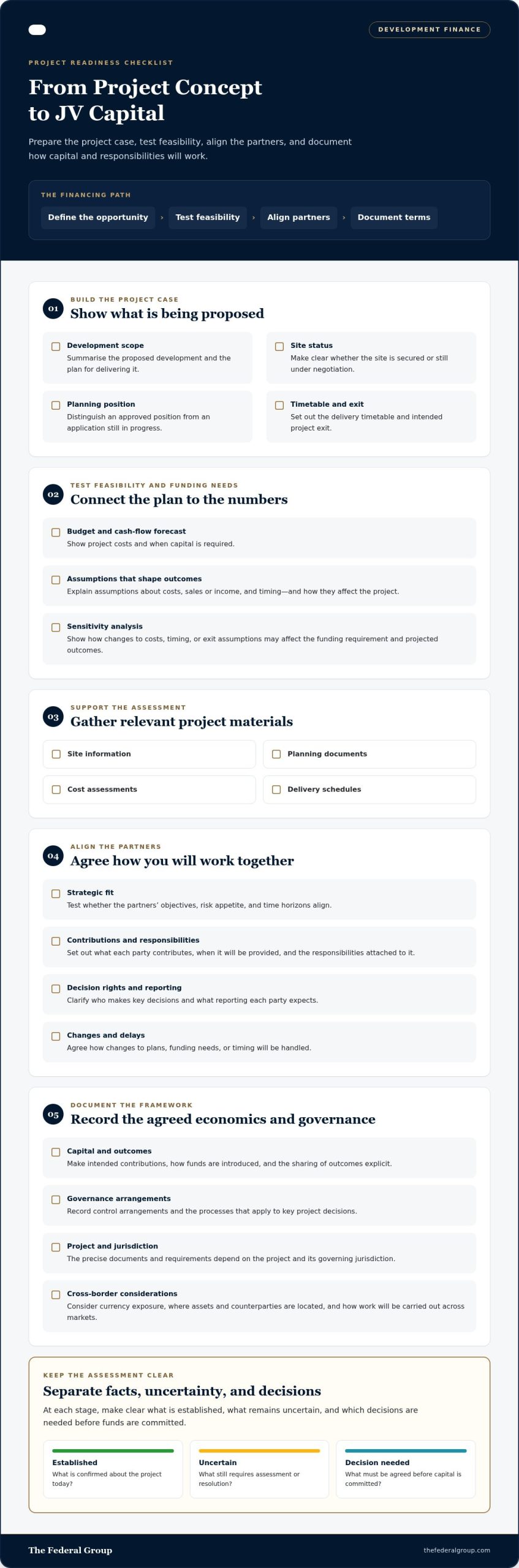
A credible financing discussion starts with a project that can be assessed, not just an attractive concept. Joint venture development finance typically moves from defining the opportunity to testing feasibility, aligning partners, and documenting how capital and responsibilities will be deployed. At each stage, distinguish what is established, what remains uncertain, and what decisions are needed before funds are committed.
What project information supports a financing discussion?
Prepare a concise project case that connects the site to a deliverable plan. Include the proposed development scope, site status, planning position, delivery timetable, and intended exit. A budget and cash-flow forecast should show when capital is required and how assumptions about costs, sales or income, and timing affect the project. Supporting materials might include site information, planning documents, cost assessments, and delivery schedules.
Separate established facts from items still requiring assessment. For example, distinguish a secured site from one under negotiation, or an approved planning position from an application still in progress. Sensitivity analysis can show how changes to costs, timing, or exit assumptions may affect the funding requirement and projected outcomes. This gives potential partners a clearer basis for assessing both opportunity and risk.
From partner alignment to funding documentation
Once the project is sufficiently defined, test strategic fit and agree the practical framework for working together. Before capital is deployed, establish each party’s contribution, when it will be made, and the responsibilities attached to it. Clarify decision rights, reporting expectations, and how changes or delays will be handled. Make intended contributions, control arrangements, and the sharing of outcomes explicit, consistent with the elements outlined in Cornell Law School’s legal definition of a joint venture.
Documentation records the agreed economic terms and governance arrangements, including how funds are introduced and what processes apply to key project decisions. The precise documents and requirements depend on the project and its governing jurisdiction. For cross-border ventures, also consider currency exposure, the location of assets and counterparties, and how work will be carried out across markets. These are planning considerations, not one-size-fits-all legal conclusions.
For wider context on international capital structures and market considerations, consult this international real estate finance guide. Developers considering how finance and delivery expertise can work together can also explore The Federal Group’s property finance and development capabilities.
Equity, Debt, and Hybrid Capital: Compare the JV Finance Choices
Joint venture development finance can combine different forms of capital, but each has distinct implications for repayment, participation, and control. The right structure depends on project risk, partner objectives, timing, and the terms documented between the parties. A joint venture doesn’t have to mean unclear control: define decision rights and escalation procedures alongside the funding arrangements.
The comparison below is a starting point, not a universal template. Actual rights, obligations, and suitability at each project stage depend on the transaction documents.
| Capital approach | Repayment expectations | Participation and control | Potential project-stage fit |
|---|---|---|---|
| Equity | Returns depend on agreed project outcomes; capital isn’t typically structured as a standard scheduled loan repayment. | May involve ownership, shared outcomes, or governance rights, as set out in the agreement. | Projects where a partner’s capital and participation support the wider development plan. |
| Development finance | Repayment follows the agreed financing terms. | Doesn’t automatically grant ownership, though financing documents may define protections and conditions. | Development phases where funding is required against a defined project and delivery plan. |
| Bridging finance | Short-term borrowing with repayment under agreed loan terms. | Usually a financing relationship rather than equity participation; control implications depend on the terms. | Appropriate short-term funding needs, depending on project circumstances and repayment plan. |
| Blended capital | Different portions may have distinct repayment or return arrangements. | Can bring together lenders and equity partners, each with defined rights and priorities. | Projects where one source of capital may not meet all funding needs or stages. |
Equity participation versus development finance
Equity puts capital at risk alongside the project and may give the investor a share of project outcomes or agreed participation rights. It doesn’t guarantee a return. Development finance, by contrast, is advanced under repayment terms rather than in exchange for an automatic share of ownership. Partners should establish how each contribution is treated, how risk is allocated, what claims or priorities apply, and who can decide on key matters. The Real Estate Joint Venture (JV) overview provides additional context on capital and operating partners.
When bridging finance or a blended structure may be considered
Bridging finance may address a short-term funding need when the project circumstances and repayment route support it. A blended structure can assign different roles to debt and equity: debt may provide finance subject to repayment terms, while equity may contribute risk-bearing capital and participate in outcomes. The documents should clarify how these interests interact and which decisions require partner approval. For more on the role private equity can play, read this real estate private equity partner guide.
Governance, Risk, and Returns: Set JV Expectations Before Commitment
A well-defined capital structure still needs clear governance. In joint venture development finance, strong documentation can clarify who decides, how information moves, and what happens when a project departs from plan. It can reduce ambiguity, but it can’t remove development risk or guarantee an outcome.
Separate project risks from partner relationship risks. Project risks include delivery delays, cost changes, market shifts, funding shortfalls, and execution challenges. Relationship risks can arise when partners have different priorities, disagree about spending, or expect different levels of involvement. Identifying both categories helps partners assign responsibilities and agree how to resolve issues before they become disputes.
Which decisions and responsibilities need clear ownership?
Set approval processes for budgets, material scope changes, additional funding needs, and major project decisions. Define who leads day-to-day delivery and which matters require partner approval. Reporting arrangements should specify what information each partner receives, how often updates are provided, and how concerns are escalated when a milestone or assumption changes.
- Decision rights: Identify delegated authority and decisions that require joint approval.
- Reporting: Set expectations for progress, budget, cash flow, and emerging risks.
- Escalation: Agree how partners raise concerns and work through unresolved issues.
- Change controls: Document how changes to scope, costs, or timing are reviewed and approved.
Reflect these arrangements in binding documents prepared for the project and its jurisdiction. Obtain jurisdiction-specific legal and tax advice before finalising entity, governance, or economic terms, as requirements can differ across markets.
How to assess risk and project outcomes
Test assumptions against downside, base, and upside scenarios. A downside case might consider a longer delivery period, higher costs, or a weaker exit market. The base case reflects current project assumptions, while an upside case tests more favourable timing or market conditions. Consider whether a delay could also create a refinancing need or require additional capital.
Then assess how each scenario affects the partners differently. A capital partner may face increased exposure if costs rise, while a developer may take on added delivery demands or a longer period of responsibility. The agreement should explain how funding needs, decision-making, and potential returns respond to changing conditions. Returns depend on documented terms and actual project performance; no split or structure guarantees a particular result.
For a development that needs aligned funding and delivery capabilities, explore The Federal Group’s property finance and development capabilities.
Assessing a Development JV Partner: Next Steps
A strong partner fit is about more than access to capital. The parties need a workable shared view of the project, a clear understanding of their respective roles, and the ability to make decisions together as circumstances change. Use this assessment before committing to joint venture development finance, and resolve gaps while the structure is still being shaped.
A practical partner-fit checklist for developers
Compare expectations directly, then make sure the agreed position is reflected consistently in project plans and partnership documents. Consider whether:
- Strategic fit: Objectives, time horizons, risk appetite, and intended project outcomes are compatible.
- Capital responsibilities: Each contribution, its timing, and the process for addressing further funding needs are clear.
- Decision-making: Partners understand delegated authority, approval requirements, and how they’ll resolve a disagreement.
- Communication: Reporting, access to project information, and escalation routes are agreed in advance.
- Delivery capability: Each party’s operational responsibilities and capacity to meet them are understood.
- Consistent assumptions: Budgets, timetable, project scope, and exit assumptions match across the partnership’s records.
A mismatch doesn’t always rule out a partnership, but it calls for a clear discussion. For example, different expectations about how quickly to sell or whether to hold an asset can affect decisions throughout delivery.
Connecting finance with development capability
A capital partner may contribute more than funding when investment and delivery expertise sit alongside finance. The Federal Group is an international property finance and development group with development finance, bridging loan, and private equity capabilities. Through Federal Holdings, it also operates as an integrated design-and-build developer, managing projects from architectural design through construction.
These connected capabilities can be relevant when a project’s needs span capital and execution. The appropriate role for each capability depends on the project, its requirements, and the agreed arrangement. Assess the fit against your project’s objectives rather than assuming every partnership follows the same model.
If you’re evaluating capital needs alongside delivery objectives, review The Federal Group’s property development capabilities.
Build the Right Partnership Around Your Project
A successful development joint venture starts with alignment, not just capital. The structure should reflect each partner’s contribution, clarify decision rights, and set out how risks and project outcomes are shared. Before committing to joint venture development finance, test the project assumptions and document responsibilities, reporting, and funding expectations clearly.
Choose a capital approach that fits the project’s stage and objectives. Equity, debt, bridging finance, and blended structures each affect repayment, participation, and control differently. Scenario testing can help partners understand how delays, cost changes, or a different exit may affect the project and each party’s position.
The Federal Group brings an international property finance and development focus, with development finance, bridging loans, and private equity capabilities. Through Federal Holdings, it also provides integrated design-and-build development, managing projects from architectural design through construction. This connection between finance, investment, and delivery can inform a broader view of project needs.
Discuss your property development objectives with The Federal Group to explore how finance, investment, and development delivery can fit your project.
Frequently Asked Questions
What is joint venture development finance?
Joint venture development finance funds a property project through partners who agree to contribute resources and share project outcomes under documented terms. One partner may bring capital, while another contributes land, development expertise, or delivery responsibilities. Unlike a conventional loan, a JV partner may participate in project decisions or outcomes rather than simply expect repayment under loan terms. The precise contributions, rights, risks, and returns depend on the project agreement.
How does a property development joint venture work?
A property development JV brings together partners with defined roles, often including a developer and a capital provider. They agree how the project will be funded, what each party contributes, and how responsibilities are managed, sometimes through a project entity. Governance arrangements set out decision rights, reporting, and approval processes. Written agreements record the economic terms and each partner’s obligations, reflecting the project’s specific structure and circumstances.
What is the difference between JV equity and development finance?
JV equity involves a partner contributing capital in exchange for agreed participation in the project’s outcomes, and sometimes governance or ownership rights. Development finance is funding advanced under agreed repayment terms; it doesn’t automatically give the lender an equity share. Control depends on the documents in either structure. Before proceeding, clarify repayment priority, exposure to project risk, decision authority, and how each party’s contribution and potential outcomes are defined.
Can a landowner contribute land instead of cash to a development JV?
Yes. A landowner may contribute land as a non-cash contribution to a development JV, while another partner provides capital, development expertise, or delivery capacity. The parties need to agree how the land will be valued and how that contribution affects ownership, returns, decision rights, and risk allocation. These terms aren’t automatic: they depend on the project structure and documented agreement. Record the valuation basis and any assumptions clearly.
How are profits and risks shared in a development joint venture?
Profit allocation and risk exposure are determined by the JV’s documented terms and the project’s actual performance. The agreement can set out how proceeds are distributed, how project costs and additional funding needs are treated, and what happens if outcomes differ from expectations. There’s no universal split or guaranteed return. Partners should review how downside, base, and upside scenarios affect each party before committing capital or taking on delivery responsibilities.
What happens if a development project is delayed or costs increase?
If timing slips or costs rise, the partners need to follow the agreed reporting, approval, and change-control processes. Scenario planning can help test the effect on cash flow, funding requirements, delivery milestones, and exit assumptions. The documents should clarify who can approve revised budgets or scope, how further capital needs are addressed, and how concerns are escalated. Clear procedures support decisions, but they can’t remove project risk or guarantee a particular outcome.
Can joint venture development finance be used for international projects?
Joint venture development finance can be considered for international projects, but the structure needs to account for the markets involved. Partners should assess jurisdiction, currency exposure, execution arrangements, and how project responsibilities will be managed across locations. Entity, legal, and tax considerations depend on the specific jurisdictions and transaction. Obtain appropriate professional advice before finalising binding arrangements, and document how contributions, decision rights, funding, and project outcomes will work across the partnership.