Multi-Club Soccer Ownership Funding: 2026 Strategic Guide
28 September 2026A multi-club platform can be underfunded even when every club-level deal appears financeable. Effective multi-club soccer ownership funding must cover more than acquisition capital: investors also need to plan for ongoing club requirements, shared platform capabilities and the practical challenges of operating across jurisdictions.
It’s natural to start with the purchase price and expected synergies. But shared scouting, data or commercial resources don’t automatically create savings. Funding decisions made club by club can also leave the wider platform exposed. The capital mix needs to support the strategy and remain resilient if costs rise, growth takes longer or anticipated benefits don’t materialize.
This guide explains how to assess funding needs from acquisition through ownership, compare capital sources against the platform’s objectives and risk profile, and prepare the information and governance investors need before approaching capital partners. It also covers execution risks, including how to balance portfolio-level coordination with each club’s requirements. The aim is to help investors fund a platform around shared capabilities, rather than simply assemble a series of club deals.
Key Takeaways
- Build a platform-wide funding plan that separates each club’s needs from shared capabilities and integration priorities.
- Compare equity, debt and hybrid capital by control, repayment obligations, investment horizon and risk allocation.
- Turn proposed synergies into measurable assumptions so you can assess portfolio value rather than rely on broad claims.
- Prepare an acquisition sequence, diligence materials and capital approval process, then verify legal, tax, league and ownership requirements in each jurisdiction.
- Assess multi-club soccer ownership funding partners for capital capacity, governance approach and international experience, as well as their ability to support the platform’s long-term development.
Why multi-club soccer ownership funding requires a platform-wide plan
Buying a club is only one stage of building a multi-club platform. Investors must also consider the capital required to integrate operations and support each club’s development. For an overview of the ownership model and its structures, see multi-club ownership (MCO).
Platform-wide funding means planning capital across acquisitions, integration and club development, with each decision aligned to the portfolio strategy rather than assessed in isolation. It doesn’t prescribe a single ownership or financing model. Instead, it provides a way to assess how each capital decision serves the wider platform.
What does funding a multi-club soccer group involve?
Separate the capital needed to complete an acquisition from the resources required after closing. A club may need working capital, recruitment support, infrastructure improvements or technology investment. The platform may also need central capabilities, such as shared data systems or commercial expertise. These are distinct funding requirements, even when they contribute to the same long-term plan.
Needs vary by club, league, geography and strategic role. A club focused on developing talent may have different priorities from one positioned for commercial growth. Model each club’s requirements alongside platform-level investment, and don’t assume that one club’s needs or resources will transfer directly to another.
Why a portfolio view matters before the first acquisition
A clear acquisition thesis sets the order and purpose of capital deployment. It should explain why each club belongs in the platform, which capabilities it needs and how it supports the group’s sporting and commercial direction. This helps investors judge whether the sequence is financially and operationally coherent, rather than simply pursuing available deals.
Shared services can support the investment case, but they don’t guarantee savings or returns. Test the costs, implementation requirements and governance needed to make them work. Also examine potential tensions between sporting priorities, such as player development, and commercial objectives. Both may matter, but they can have different timelines, measures of progress and capital requirements.
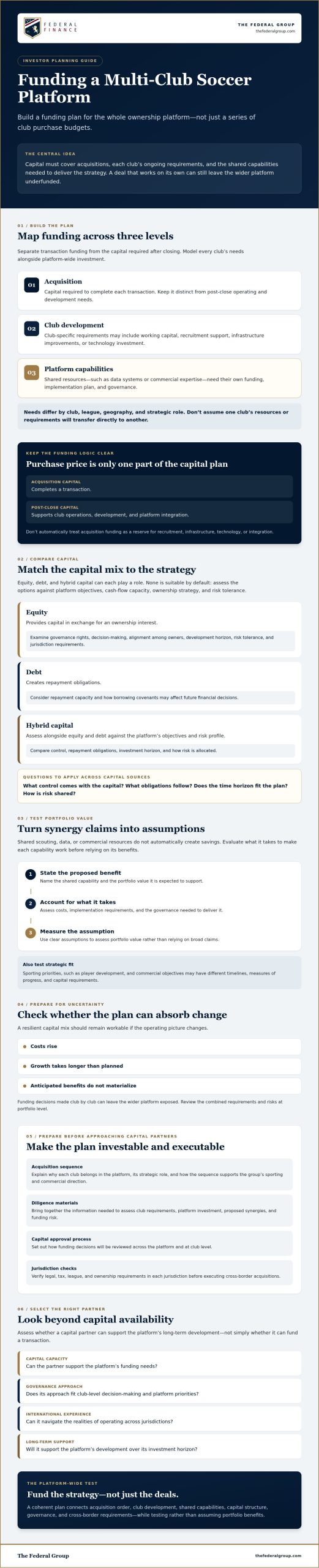
A practical first step is to map capital needs across three levels:
- Acquisition: funds required to complete each transaction.
- Club development: working capital and investment needs specific to each club.
- Platform capabilities: shared resources that enable the strategy, with costs and benefits assessed rather than assumed.
This portfolio map makes multi-club soccer ownership funding more than a collection of purchase budgets. It links capital deployment to the platform’s purpose and gives investors a clearer basis for deciding which opportunities to pursue.
Which capital sources can fund multi-club soccer ownership?
The right capital mix depends on the platform’s objectives, cash-flow capacity, ownership strategy and risk tolerance. Equity, debt and hybrid funding can each play a role, but none is suitable by default. Assess each source against the acquisition plan and the capital required after closing, including club operations and shared platform capabilities.
Keep these uses distinct in the funding plan. Acquisition capital completes a transaction; it shouldn’t automatically be treated as a reserve for recruitment, infrastructure, technology or integration. Investors can compare possible sources in more depth in a dedicated guide to financial structuring for multi-club ownership.
Equity capital: alignment, control and investment horizon
Equity provides capital in exchange for an ownership interest, so investors should examine the associated governance rights and decision-making arrangements. Consider how new investors will align with existing owners on club-level authority, platform priorities and the time horizon for development. Patient capital may suit a strategy focused on long-term sporting and commercial development, but it doesn’t guarantee a particular outcome. Suitability also depends on risk tolerance and the requirements of each jurisdiction.
Debt and hybrid capital: obligations and flexibility
Debt creates repayment obligations. Its covenants, or agreed conditions attached to borrowing, can also affect future financial decisions. Before considering debt, test whether expected cash flows can support scheduled payments under different operating scenarios, including periods when revenue or sporting performance falls short of plan.
Hybrid capital is a broad category that may combine features of debt and equity. Its rights, obligations and availability depend on the specific instrument and transaction, so confirm the terms rather than assuming a structure can be used. Property bridging finance, for example, shouldn’t be presumed suitable for football acquisitions simply because it is available for other asset types.
- Equity: assess dilution, governance rights and alignment with the investment horizon.
- Debt: model repayment capacity and the effect of covenants on flexibility.
- Hybrid capital: verify the instrument, its terms and its relevance to the transaction.
Compare each source by who retains control, when capital must be repaid, how long investors expect to remain committed and who bears the downside if a club or shared capability underperforms. Then identify which portion supports the acquisition and which is reserved for post-acquisition needs. This makes multi-club soccer ownership funding a strategic decision, not just a transaction-level calculation.
Investors considering a strategic partner can review The Federal Group’s sports investment focus while confirming which funding structures may be relevant to a specific mandate.
How to assess portfolio value, funding risk, and claimed synergies
A portfolio thesis should turn strategic intent into assumptions investors can examine. If the case depends on shared scouting, data, commercial or administrative capabilities, specify their implementation costs, responsible decision-makers, expected timing and measures of progress. “Synergy” alone isn’t a funding plan.
Projected synergies are strategic possibilities; verified cash-flow benefits are measurable savings or revenue that have actually been realized. Keep these distinct in valuations and funding decisions. This helps investors assess whether the platform’s value depends on capabilities that can be delivered, rather than benefits that remain aspirational.
Test the investment case club by club and as a portfolio
Start with each club’s strategic role, operating requirements, funding needs and key assumptions. Then assess the portfolio case. Could shared scouting or data systems work across clubs with different processes and priorities? Would central commercial or administrative capabilities improve coordination, and what resources would they require? Treat player movement and shared services as possibilities to test, not guaranteed financial benefits.
Review risks across several dimensions. Financial exposure may include weaker revenue or limited cash-flow capacity. Sporting risk includes relegation or missed performance targets. Operational risk may arise from delayed integration, while governance and cross-border risks depend on the ownership structure and jurisdictions involved. Identify these exposures without assuming any one outcome is inevitable.
Build downside scenarios before committing capital
Scenario analysis shows how funding needs could change if revenue declines, sporting targets are missed, integration takes longer or funding conditions shift. For example, test whether the platform could continue supporting club operations and priority development if a promotion or commercial milestone is delayed. Consider whether capital reserves and decision-making processes remain adequate without relying on rapid asset sales.
For each scenario, document the assumptions, effects on cash needs and potential management response. Label illustrative estimates clearly, and have financial assumptions reviewed independently before relying on them in an investment decision. This makes multi-club soccer ownership funding more resilient to uncertainty and gives capital partners a clearer view of the risks behind projected portfolio value.
What investors should prepare before funding cross-border club acquisitions
Cross-border acquisitions require a coordinated information and approval process. Before approaching capital partners, investors should be ready to explain why each club fits the platform, what resources it will need after closing and how the group will oversee operations across jurisdictions. Treat assumptions as questions to verify, not established facts.
Prepare the investment case and diligence materials
Build the case in sequence: define the platform thesis, set out each club’s strategic role, map acquisition and post-close funding requirements, then identify the conditions needed for capital approval. Assemble verified information for each club so reviewers can test the case instead of relying on a headline valuation or an unsupported synergy claim.
A practical diligence file should cover:
- Financial: historical accounts, cash-flow information, liabilities and forecasts, with assumptions clearly identified.
- Sporting: squad and recruitment plans, performance objectives, and the club’s role within the platform.
- Legal and ownership: ownership structure, relevant agreements, and matters requiring local specialist review.
- Commercial and operational: revenue drivers, key contracts, infrastructure priorities, systems and staffing requirements.
Record the source and date of key information, and flag gaps. For example, distinguish a confirmed contractual obligation from a forecast commercial opportunity. Flag matters requiring legal, tax, financial or sporting expertise for specialist review before including them in the investment case.
Plan governance and regulatory review across jurisdictions
Requirements can vary by country, league and ownership structure. Map the approvals that may apply to each acquisition, then verify current rules with qualified advisers and relevant governing bodies before making commitments. Don’t assume that a process used for one club or jurisdiction applies to another.
Design governance alongside the funding plan. Define who approves capital deployment, who controls club-level spending and which decisions require platform-level review. Set reporting responsibilities, escalation routes and cash controls, including how material variances or urgent funding needs reach decision-makers. A clear framework helps investors understand how oversight works without erasing each club’s distinct operating requirements.
Also identify currency exposure, tax questions and compliance considerations for specialist assessment. Where capital crosses borders, document and review the source, destination and timing of funds in the context of the relevant jurisdictions. This is a preparation framework, not jurisdiction-specific legal or tax advice.
Use this work to build a decision-ready funding file: thesis, diligence findings, open questions, approval map and governance plan. For investors assessing a potential strategic partner, explore The Federal Group’s sports investment focus and confirm the relevance of any specific capital approach to the mandate.
How a strategic capital partner can support multi-club soccer ownership
A capital provider supplies funding under agreed terms. A strategic partner may also contribute to platform development by aligning capital deployment with the group’s long-term sporting and commercial objectives. The distinction matters: investors should establish whether a prospective partner’s role ends at funding or includes an ongoing interest in the platform’s development.
Neither label guarantees suitability. Assess the partner’s capital capacity against the scale and timing of the proposed plan, and clarify which funding instruments they currently consider for professional football investments. Also test whether their approach to governance, club autonomy and portfolio priorities fits the ownership strategy.
What to evaluate in a multi-club ownership funding partner
Look beyond broad claims of experience. Ask how the partner evaluates opportunities, decides where to deploy capital and monitors progress after investment. Confirm whether their relevant experience applies to the clubs, jurisdictions and mandate under consideration. A global profile may be useful, but it doesn’t by itself demonstrate a fit for a specific transaction.
Compare expectations directly. Discuss the investment horizon, appetite for risk, decision rights and balance between club-level autonomy and platform-wide coordination. A partner aligned on these points can help keep strategic priorities clear; misalignment may create friction around capital allocation or development choices.
Useful questions include:
- What evidence is required to assess a club and the wider platform?
- How will investment progress and material changes be reviewed?
- Which decisions sit with the club, the platform and the capital partner?
- Which aspects of the partner’s experience and current mandate are relevant to this opportunity?
When to start a capital-partner conversation
Start with a defined investment thesis, a credible acquisition pipeline, initial diligence and a clear view of funding needs across acquisition and ownership phases. You don’t need every question resolved, but distinguish verified information from assumptions. Identify open points, including approvals to confirm, operating expectations to test and funding structures that remain subject to discussion.
The Federal Group’s Sports Division invests in professional football clubs globally and seeks strategic synergies across sports assets. The group also has private equity and capital solutions experience, but the relevance and availability of any specific funding structure for a sports mandate should be confirmed directly. An early discussion is most productive when investors can explain their platform objectives and outline the questions they need a prospective partner to address.
If your thesis and capital requirements are taking shape, discuss your investment thesis with The Federal Group’s Sports Division. A considered conversation can help establish whether the opportunity and mandate are aligned, without assuming a particular funding structure or outcome.
Build a Stronger Funding Foundation for Your Platform
Effective multi-club soccer ownership funding starts with a portfolio plan, not a series of isolated acquisition budgets. Investors should match capital sources to the platform’s objectives, distinguish verified cash-flow benefits from projected synergies, and test how funding needs change under downside scenarios.
Before approaching capital partners, prepare a clear investment thesis, club-level diligence and a governance framework suited to the jurisdictions involved. Assess a partner not only for capital capacity, but also for alignment on investment horizon, club autonomy and long-term platform priorities.
The Federal Group has a dedicated Sports Division investing in professional football clubs globally, alongside private equity and capital solutions across the group. The relevance of specific capital approaches depends on the individual sports mandate and should be confirmed directly.
Ready to explore whether your platform’s objectives align? Discuss a strategic investment opportunity with The Federal Group. A well-prepared conversation can help clarify the next steps and support a considered path forward.
Frequently Asked Questions
What is multi-club soccer ownership funding?
Multi-club soccer ownership funding is capital used to acquire professional football clubs and support their integration and development within a wider ownership platform. It can cover transaction needs, club-level operations and investment, and shared platform capabilities. The funding plan should distinguish these uses and reflect each club’s role, geography and requirements. There’s no single ownership model or capital structure that fits every group.
How do investors fund a multi-club soccer ownership group?
Investors typically assess equity, debt or a combination of capital sources against the platform’s strategy and risk profile. They should plan separately for acquisitions and post-close needs, such as operations, recruitment, infrastructure or shared capabilities. The appropriate mix depends on factors including control, repayment obligations, cash-flow resilience and investment horizon. Investors should also verify the terms, availability and jurisdictional requirements relevant to each transaction.
Can debt be used to finance professional football club acquisitions?
Debt may be considered for a professional football club acquisition, subject to lender appetite, transaction structure and applicable requirements. It creates repayment obligations, and its covenants may limit financial flexibility. Investors should assess whether cash flows can support those obligations under downside scenarios, including weaker revenue or sporting performance. Don’t assume debt is suitable simply because it’s available for another asset class or transaction type.
What funding sources are used for multi-club ownership?
Common categories to assess include equity, debt and hybrid capital, which may combine features of debt and equity. Equity involves an ownership interest and related governance considerations; debt requires repayment; hybrid structures depend on their specific terms. Investors should confirm what instruments are available for the proposed transaction rather than assume a source will fit. The capital plan should also account for club development and platform needs, not only acquisition costs.
How do investors assess the financial risks of owning multiple soccer clubs?
Assess each club’s financial position and capital needs, then test how risks interact across the portfolio. Consider changes in revenue, cash flow, sporting performance, operating costs, integration timelines and cross-border requirements. Scenario analysis can show whether the platform could continue supporting its clubs if targets are missed or plans are delayed. Clearly label assumptions and illustrative estimates, and arrange independent review before relying on them for investment decisions.
Do multi-club ownership groups benefit from shared services?
Shared services can support coordination across scouting, data, commercial activity or administration, but benefits aren’t automatic. Investors should test whether systems and processes can work across clubs with different needs, what resources implementation requires and how progress will be measured. Treat expected savings or revenue as assumptions until verified. A sound assessment considers both the potential value of shared capabilities and the governance needed to manage them effectively.
What should investors prepare before approaching a football club investment partner?
Prepare a clear investment thesis, acquisition pipeline, club-by-club funding requirements and initial diligence materials. Include verified financial, sporting, legal, commercial and operational information, while separating confirmed facts from assumptions that need specialist review. Map governance responsibilities and approvals to verify in each jurisdiction. Be transparent about open questions, post-close priorities and downside risks. This gives a prospective partner a practical basis to assess strategic alignment and mandate fit.
To discuss your platform’s investment thesis and whether it aligns with The Federal Group’s Sports Division, contact The Federal Group.