Professional Football Club Revenue Streams: 2026 Guide
30 September 2026Revenue alone doesn’t show whether a football club is financially resilient. The revenue streams for professional football clubs can include commercial partnerships, broadcasting income and matchday sales, but each depends on different factors. A club’s league, market and on-pitch performance can shape both how much it earns and how reliably that income returns.
It’s easy to group every cash inflow together, yet player-trading gains and owner contributions shouldn’t be mistaken for recurring operating revenue. The distinction matters when assessing a club’s underlying strength, planning investment or comparing teams with different financial profiles.
This guide explains the principal income categories and how clubs generate them. You’ll learn to assess each stream by recurrence, controllability and dependence on sporting results, while accounting for differences between competitions and markets. It also separates operating income from player trading and investment funding, so you can build a clearer view of a club’s revenue model and its role in long-term strategy.
Key Takeaways
- Map the main revenue streams for professional football clubs, then examine who pays and what drives each income source.
- Compare matchday, broadcasting and commercial income by how regularly it returns and how strongly it depends on results.
- Separate operating revenue from transfer proceeds and owner funding, checking club disclosures to understand how each is reported.
- Assess revenue resilience by testing concentration, controllability and sporting dependence, while comparing clubs in relevant contexts.
- Use a structured revenue review to identify strategic priorities and inform investment decisions without assuming future returns.
Revenue streams for professional football clubs: the main income categories
A club’s revenue is income earned through its sporting and commercial operations and reported under the accounting policies applied to its financial statements. It is not the same as cash raised through borrowing or owner investment. Loans create a repayment obligation, while equity contributions add capital. Neither is operating income earned by selling a product, service or commercial right.
This distinction is central to evaluating the revenue streams for professional football clubs. A headline figure can describe operating activity, but it doesn’t show how the club funds itself overall. Financial statements also differ in scope and reporting period. One club may report by financial year while another presents figures aligned to a season, and income categories may be grouped differently. Before comparing totals, check the reporting period, accounting notes and categories included.
What counts as football club revenue?
Revenue generally reflects income recognized from the club’s activities, subject to its reporting basis. Financing belongs elsewhere in the financial picture: a bank loan is borrowed cash, and an owner’s equity contribution is invested capital, not income generated by operations. These funds may support spending or liquidity, but they don’t show whether the club’s commercial model can sustain itself.
Financial regulation is a related but separate consideration. UEFA’s current framework is the Club Licensing and Financial Sustainability Regulations; for background on the earlier UEFA Financial Fair Play framework, consult this overview. Regulatory tests and accounting presentation shouldn’t be mistaken for revenue categories. Check the club’s own statements and notes to understand what’s included and when it’s recognized.
The three core operating revenue streams
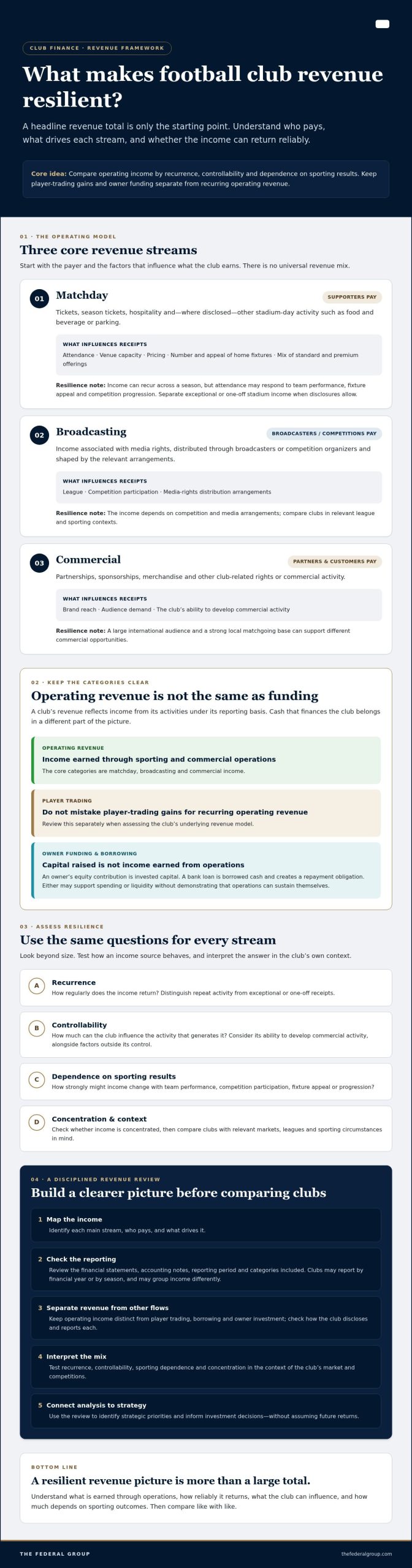
Most club revenue analysis starts with three operating categories. Identify the payer and the factor that drives each one:
- Matchday: Supporters pay for tickets, hospitality or other match-related access. Receipts can reflect attendance, venue capacity, pricing and the number of home fixtures.
- Broadcasting: Broadcasters or competition organizers distribute income associated with media rights. A club’s receipts can depend on its league, competition participation and the relevant distribution arrangements.
- Commercial: Sponsors, retail customers and commercial partners pay for partnerships, merchandise or other club-related rights. Income can depend on brand reach, audience demand and the club’s ability to develop commercial activity.
There’s no universal revenue mix. A large international audience may support different commercial opportunities from a strong local matchgoing base. Competition participation can affect media-related income and the number of fixtures, while league economics shape the wider opportunity. Use these categories as a starting framework, then test each club’s disclosures against its market and sporting context before drawing conclusions.
How matchday, broadcasting, and commercial income work
These three income streams have different payers, payment mechanisms and risk profiles. Tickets and hospitality connect receipts to home fixtures and attendance. Broadcasting income follows media and competition arrangements. Commercial income comes from partners and customers through agreements and sales. When comparing them, consider not only their size but also how consistently they return and how exposed they are to sporting performance.
Matchday revenue: tickets and the live-event experience
Supporters generate matchday income through ticket purchases, season tickets and hospitality packages. Depending on what the club discloses, this category may also include food and beverage sales, parking or other stadium-day activity. Capacity sets a practical ceiling, while attendance, pricing, fixture volume and the mix of standard and premium offerings influence receipts.
Home fixtures can make this income repeat across a season, but the amount isn’t automatically stable. Attendance may respond to team performance, fixture appeal and competition progression. When reviewing accounts, separate ordinary matchday receipts from exceptional events or one-off stadium income where the disclosures allow. One-off receipts may not recur in a typical season.
Broadcasting and commercial partnerships
Broadcasting revenue reaches clubs through media-rights arrangements, often via a league or competition. The distribution method depends on the applicable agreement, so don’t assume every club receives an equal share or that one formula applies across competitions. Participation can also affect exposure: a club qualifying for additional competitions may have a different revenue profile from one playing only domestic fixtures.
Commercial income is not a single deal. It can combine shirt or training-kit sponsorship, other partner agreements, licensing of club marks, merchandise sales and, where reported, stadium events outside matchdays. Contract terms may make sponsorship income predictable for a defined period, while renewals, partner demand, sales volumes and the club’s visibility can affect future receipts. Sporting success can increase exposure, but it doesn’t guarantee a higher commercial return.
The Deloitte Football Money League separates top clubs’ reported income into matchday, broadcasting and commercial categories. For its 2024/25 ranking, the top 20 clubs generated €12.4 billion combined: €5.3 billion commercial, €4.7 billion broadcasting and €2.4 billion matchday revenue. This illustrates how the mix can differ, but it is not a template for every league or club.
For investors and club strategists, the practical question is how each stream may hold up under different sporting and market conditions. The Federal Group’s professional football club investment perspective offers relevant context for considering revenue quality alongside long-term club strategy.
Player trading, owner funding, and other income: what belongs in the revenue picture?
A club can receive cash without earning operating revenue. Transfer receipts, owner contributions and loans all affect its finances, but they represent different transactions and shouldn’t be combined uncritically with matchday, broadcasting or commercial income. To assess revenue streams for professional football clubs, separate what the club earns from operations from player disposals and funding sources.
Are player transfer fees a revenue stream?
A reported transfer fee and accounting profit on a player sale aren’t interchangeable. The fee describes the agreed consideration, though payment may be made in instalments. The club’s accounts may instead report a profit or loss on disposal, calculated with reference to the player registration’s remaining value in the accounts and the applicable accounting treatment.
For example, a club that sells a player for more than the registration’s remaining carrying value may record a disposal profit below the gross fee. The cash received could also arrive over time. This simplified example shows why transfer announcements alone don’t establish how much income was recognized in a particular reporting period. Check the club’s audited statements and notes for its presentation.
Player trading can be financially material, but it’s variable. Proceeds depend on squad decisions, player demand and the timing of sales. A club may choose to retain a player rather than sell, and a strong transfer result in one period doesn’t establish a dependable annual income stream. The Deloitte Football Money League offers a framework for comparing reported club revenue categories. Assess transfer disclosures separately when evaluating player disposals.
Do owner investment and loans count as club revenue?
No. An equity injection increases the capital invested in a club, while a loan provides borrowed funds that generally require repayment. Shareholder support may take different forms, so classify it by the transaction shown in the accounts, not simply by the fact that cash entered the club. These inflows can fund operations or investment, but they aren’t income earned by selling tickets, media rights or commercial services.
The distinction matters: a club’s cash position may improve after funding even if its operating model hasn’t generated more revenue. Review the audited financial statements, cash-flow information and notes for the relevant club and reporting period. Presentation can vary, and accounting labels may not be directly comparable across clubs.
Finally, treat “other” or exceptional income with care. Its source and recurrence may differ substantially between clubs. Identify what generated the receipt, whether it relates to normal operations and whether the disclosure suggests it is likely to recur before including it in an assessment of sustainable income.
How to compare the resilience of professional football club revenue streams
Resilience isn’t simply a matter of having several income categories. Assess each stream by how regularly it returns, how much influence the club has over it, how concentrated it is and how strongly it depends on sporting outcomes. This framework helps distinguish income that appears stable on paper from income exposed to a single partner, competition or season.
A practical framework for evaluating revenue quality
Use disclosed evidence rather than assuming that a contract, sponsor or competition payment will continue unchanged. Review the club’s accounts and notes, then assess each stream by asking:
- Recurrence: Is the income tied to ongoing activity or a one-off event?
- Controllability: Can club decisions meaningfully influence it, or is it set mainly by external agreements and conditions?
- Concentration: Does a large share depend on one partner, competition or income source?
- Sporting dependence: Could results, league position or qualification materially affect the amount?
A multi-year commercial agreement may offer more visibility than a one-off receipt, but renewal and partner demand still matter. Broadcasting income may follow established arrangements while remaining exposed to competition participation and the terms of those arrangements. A diversified mix can reduce reliance on any single source; it doesn’t, on its own, guarantee resilience, profitability or reliable cash flow.
Why club size and competition change the comparison
Compare like with like. Market size and supporter demand shape commercial opportunities; stadium capacity can constrain matchday potential; league position and competition participation affect the context in which some income is generated. A smaller club with a concentrated but recurring income base may have a different risk profile from a larger club with more categories but greater exposure to one competition or partner.
Before comparing figures, align currencies, reporting periods and accounting policies. Check whether the data covers a financial year or a season, and confirm how each club classifies income. Without that context, a difference in reported revenue may reflect timing or presentation as well as underlying business performance.
For multi-club ownership, assess each club on its own first, then consider whether shared commercial capabilities could support the wider portfolio. Shared structures don’t guarantee additional revenue; their value depends on execution and the circumstances of each club. For a portfolio-level perspective, explore The Federal Group’s sports investment approach and consider how revenue quality fits into long-term club strategy.
Turning club revenue analysis into a long-term investment and growth strategy
Revenue analysis becomes useful when it informs decisions, not just comparisons. For investors and club leaders, the objective is to understand what supports the club’s operating model, where exposure sits and which strategic options merit further assessment. A clear process turns the revenue streams for professional football clubs into a practical basis for planning without treating past performance as a promise of future returns.
From revenue map to decision-ready analysis
Build the assessment in sequence. First, classify income as recurring operating revenue, player-disposal results, funding or exceptional items. Next, test durability by reviewing audited accounts, management commentary and relevant competition exposure. Then identify concentration, including reliance on a particular partner, income category or sporting outcome. Finally, assess strategic options against the club’s capabilities, market and objectives.
Keep a record of assumptions and data gaps. A disclosure may not provide enough detail to determine whether a receipt is recurring, or figures may cover periods that don’t align. Verify current reporting before drawing investment conclusions. This discipline separates sustainable operating performance from financing activity and one-off items, helping decision-makers ask precise follow-up questions rather than extrapolate from headline revenue.
Where multi-club ownership fits into the revenue discussion
In a multi-club structure, shared commercial capabilities may create opportunities to coordinate expertise or processes across a portfolio. Treat that as a strategic possibility, not an automatic source of additional revenue. The case depends on execution: governance, clear accountability and a sound understanding of each club’s local market all matter. A model that suits one club may not transfer directly to another.
Pair a group-level view with a standalone assessment of each club. Test whether a proposed shared approach addresses a demonstrated need, who is responsible for delivery and how progress will be measured. This keeps portfolio assumptions grounded in each club’s circumstances.
The Federal Group’s Sports Division invests in and manages professional football clubs globally, bringing a relevant perspective to club investment and multi-club ownership. Revenue quality is one part of that assessment, alongside the club’s broader context and strategic requirements. If you’re considering professional football club investment, you can discuss the opportunity with The Federal Group.
Build a clearer view of a club’s financial future
Understanding the revenue streams for professional football clubs means looking beyond the headline total. Matchday, broadcasting and commercial income each respond to different market and sporting forces, while transfer proceeds, owner contributions and loans need separate treatment. The distinction helps reveal what a club earns through operations and what depends on funding or player sales.
For investment and strategy, assess income by recurrence, controllability, concentration and dependence on sporting outcomes. Then compare clubs within the right league, scale and reporting context. A broad income base can reduce reliance on one source, but it doesn’t remove risk or guarantee sustainable performance.
The Federal Group’s dedicated Sports Division focuses on professional football clubs globally. Its stated approach includes multi-club ownership and strategic coordination across sports assets, with potential synergies requiring careful assessment rather than assumption. If you’re exploring the investment landscape, explore The Federal Group’s global professional football investment perspective.
Sound analysis creates a stronger foundation for informed decisions. To discuss professional football club investment and multi-club ownership, contact The Federal Group.
Frequently Asked Questions
What are the main revenue streams for professional football clubs?
The main operating revenue streams for professional football clubs are matchday, broadcasting and commercial income. Matchday receipts can include tickets and hospitality; broadcasting income comes through media-rights arrangements; commercial revenue may include sponsorship, merchandise and licensing. Some clubs also report other operating income. Player-disposal profits may appear separately, while owner contributions and loans are funding, not revenue earned through operations. Check the club’s accounts to see how each category is presented.
Do football clubs make most of their money from broadcasting?
Not necessarily. The balance depends on the club, league, competition participation and reporting period. In Deloitte’s 2024/25 Football Money League, commercial income was the largest category for the top 20 clubs collectively, ahead of broadcasting and matchday revenue. That ranking describes those leading clubs as a group, not every team. For an individual club, review its accounts and consider how media-rights arrangements and sporting performance affect broadcast receipts.
Are player transfer fees counted as club revenue?
Not always as gross revenue in the same way as ticket sales or sponsorship. A club may receive a transfer fee in instalments, while its accounts report a profit or loss on disposal based on the player registration’s accounting value and relevant treatment. For example, the reported disposal profit may differ from the announced fee. Player trading can be material but variable, so check the club’s financial statements and notes for the period.
Do owner investments count as football club revenue?
No. Owner equity contributions and shareholder support provide capital, while loans provide borrowed funds, not income earned from the club’s operating activities. Both can bring cash into a club, but they shouldn’t be treated as proof that operations generated revenue. To understand the distinction, review the audited statements, cash-flow information and notes for the relevant period. These disclosures can show how funding is classified and help separate operating performance from financial support.
How can you tell whether a football club’s revenue is sustainable?
Assess whether income recurs, how concentrated it is and how much it depends on sporting outcomes or external agreements. Review audited accounts and management commentary for reliance on one competition, partner or one-off receipt. Also distinguish operating income from transfer-related gains and owner funding. Compare figures using consistent reporting periods, currencies and accounting categories. No single measure guarantees future stability, but this review can reveal the main sources of exposure and support more informed decisions.
Can multi-club ownership increase professional football club revenue?
It may create opportunities to coordinate commercial capabilities across clubs, but increased revenue isn’t automatic. The potential depends on execution, governance and how well a shared approach fits each club’s market and audience. Assess each club’s income model independently before looking at portfolio-wide opportunities, and test proposed synergies against evidence. The Federal Group’s dedicated Sports Division invests in professional football clubs globally and takes a multi-club ownership approach, but outcomes depend on strategy and delivery.