Real Estate Capital Raising: A Strategic Guide for 2026
10 October 2026In the first half of 2026, the 10 largest real estate funds accounted for 49% of capital raised, according to With Intelligence. For sponsors, that concentration makes a clear, credible funding case essential. Real estate capital raising is not simply about finding investors. It is about matching a project’s stage, risks and execution requirements with the right kind of capital.
If you are weighing debt against equity, or considering a structure that combines both, start by identifying what the project needs the capital to do. Each approach affects repayment, ownership and the working relationship differently. Capital partners need to understand not only the opportunity, but also its fundamentals, risks and path to delivery.
This guide explains how to assess funding options, prepare an evidence-led case and evaluate a partner’s ability to support the project. It compares development finance, bridging loans and private equity, and explains why execution expertise may matter alongside capital. The goal is a funding strategy grounded in the project itself, not a generic fundraising formula.
Key Takeaways
- Match real estate capital raising to the project’s stage, risk profile and use of funds before selecting a structure.
- Build a clear funding case by linking the asset and development plan to evidence on budgets, timing, approvals and delivery responsibilities.
- Compare development finance, bridging loans, private equity and integrated development by their purpose and implications for repayment, ownership and execution.
- Use five practical preparation steps to define the capital requirement, assess partner fit and organise diligence materials.
- See how The Federal Group brings property finance and development capabilities together, including through Federal Holdings’ design-and-build development.
What Real Estate Capital Raising Means for a Property Project
Real estate capital raising is the process of securing debt, equity or a considered combination of both to fund a defined property project. The right structure depends on what the capital will support, when it is needed and the risks attached to the asset and delivery plan. A land acquisition with unresolved planning requirements presents a different funding case from a project ready to begin construction or an asset nearing completion.
Start with the project’s capital requirement, not a preferred financing product. Map each funding need to its project stage and intended use, such as acquisition, development or construction. Then assess the risk profile: the status of approvals, how certain the costs and timing are, and what needs to happen for the project to progress. These details help determine whether debt, equity or a combined structure is appropriate.
Capital structures sit within broader real estate investing principles and capital structures, but the project’s own facts should guide the decision. There is no universal formula. Scale alone does not determine suitability, and raising capital does not guarantee funding or project performance.
How Does Real Estate Capital Raising Work?
A developer first defines the funding gap: how much capital is required, for which phase and on what timeline. They then present the project to potential capital partners with information that supports assessment, such as details of the asset, proposed plan, budget, schedule, approvals and key risks. Depending on the project and arrangement, a partner may provide debt, invest equity or combine capital with a development role.
Project capital raising means securing funds for a specific property asset or development phase; it is not investor-relations software that organises fundraising workflows or communications. Software may help manage information and investor engagement, while banks and advisers may provide broader financial or advisory services. These activities are distinct from supplying project capital. Keep the funding question clear: what is needed, what will it enable, and what form of partnership fits?
Who Raises Capital for Property Projects?
Developers and sponsors raise capital for individual assets and broader development programs, while individual property investors often look to specialized providers such as Cornerstone Real Estate Investment Services for structured real estate opportunities. In development, requirements vary significantly: one sponsor may need acquisition capital to secure a site, while another may need construction funding or capital to bridge a defined transition between project phases. In each case, the funding case rests on evidence and structure, not simply the project’s size or ambition.
Before approaching a partner, identify what the capital must accomplish and what capabilities the project needs alongside funding. A defined financing requirement may call for a different relationship from a project where development execution is also central. Align the capital partner’s role with the project’s requirements, responsibilities and risk profile. This project-first approach gives both sides a clearer basis for evaluating fit and builds a more credible funding case.
Build a Credible Real Estate Capital-Raising Case
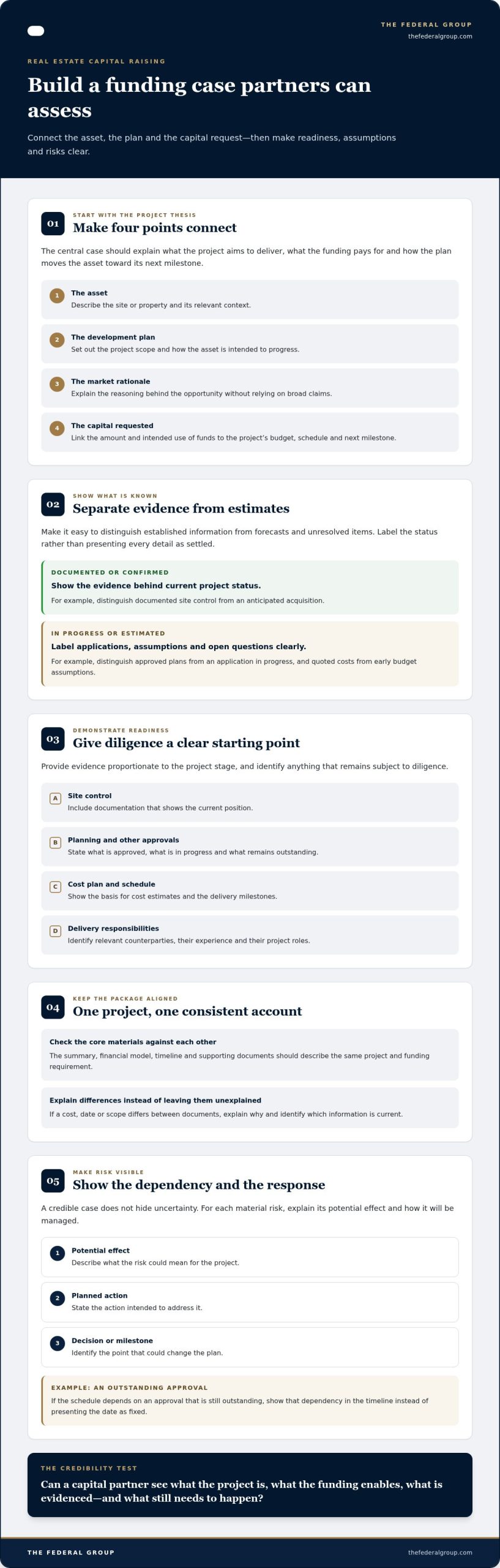
A strong funding case makes the project easy for a capital partner to assess. Its central thesis should connect four points: the asset, the development plan, the market rationale and the capital requested. Explain what the project aims to deliver, what the funding will pay for and how the proposed plan moves the asset toward its next milestone. Keep the narrative concise and support it with evidence.
Separate confirmed information from estimates and open questions. Distinguish documented site control from an anticipated acquisition, approved plans from an application in progress, and quoted costs from early budget assumptions. This helps a reader assess the opportunity without mistaking forecasts for established facts.
What Should a Property Capital-Raising Case Include?
Set out the project scope, site or asset context, development plan and intended use of funds. Connect the capital request to a budget and schedule, identify key milestones, and name the counterparties responsible for delivery. Explain the basis for financial assumptions, such as where cost estimates came from, and identify material risks instead of relying on broad claims about potential.
Check that the summary, financial model, timeline and supporting documents describe the same project and funding requirement. If a cost, date or scope differs between documents, explain why and identify which information is current. A consistent package helps capital partners understand the proposal and see where further diligence is needed.
How Can Developers Demonstrate Readiness and Credibility?
Show the evidence behind the project’s readiness: documentation of site control, the current status of planning and other approvals, a cost plan, delivery milestones, and the experience or roles of relevant project counterparties. Provide information proportionate to the project stage, and label items that remain subject to diligence. A credible case does not hide uncertainty. It makes uncertainty visible and explains how it will be managed.
For each material risk, state its potential effect, the action planned to address it and any decision or milestone that could change the plan. For example, if the schedule depends on an outstanding approval, show that dependency in the timeline instead of presenting the date as fixed. This gives the reader a clearer view of execution readiness and the work that remains.
- Asset and scope: Identify the property, proposed works and project phase the funding will support.
- Capital request: Reconcile the amount sought with the relevant budget and intended uses.
- Evidence and assumptions: Label verified facts, forecasts and items awaiting diligence.
- Delivery and risk: Assign responsibilities, show milestones and pair key risks with practical responses.
Keep the financing context precise. Project-level funding is distinct from investing in a property vehicle. The SEC’s overview of understanding Real Estate Investment Trusts (REITs) describes a separate route to real estate exposure. For developers preparing a project case, the central question is how the proposed capital aligns with the asset, plan and execution requirements.
For an overview of how a property finance partner can assess project requirements, explore The Federal Group’s property finance capabilities.
Compare Real Estate Capital-Raising Options by Project Need
Funding structures differ in purpose, repayment or ownership implications, and the capital partner’s role in delivery. Compare them against the project’s immediate need and longer-term plan rather than assuming one approach is always cheaper, faster or better. Development finance, for example, addresses a different requirement from short-term bridging capital, while private equity changes the ownership relationship.
| Option | Purpose and project context | Repayment or ownership implications | Execution relationship |
|---|---|---|---|
| Development finance | Supports defined development or construction requirements. | Debt with repayment obligations set by the agreed structure and terms. | Capital provision; delivery responsibilities depend on the project arrangements. |
| Bridging loans | Short-term capital for a defined transaction or timing need, such as bridging a gap between project phases. | Debt that must be repaid under the agreed terms. | Provides capital for a transition; it does not by itself assign development responsibilities. |
| Private equity | Investment partnership for a property project where shared equity is appropriate. | Involves an ownership interest, with project-specific arrangements governing the partnership. | May align investor and developer interests, while execution roles are set out separately. |
| Integrated development | Combines development planning with design-and-build delivery for a project. | Funding and ownership depend on the associated capital structure. | Connects development and construction responsibilities within an integrated delivery model. |
The Commercial Real Estate Finance Council (CREFC) focuses on commercial real estate finance, a broad field that includes multiple capital structures. For an individual project, narrow the comparison to four questions: What is the funding for? When is it needed? What are the repayment or ownership implications? Is delivery support also required?
Debt, Bridging Finance, and Private Equity: What Differs?
Debt provides capital with repayment obligations under the agreed structure and terms. Bridging finance is short-term debt for a defined timing or transaction need, so it should fit a clear project phase and repayment plan. Private equity, by contrast, is an ownership-based investment partnership. Project-specific arrangements should clarify how capital, decision-making, responsibilities and ownership interests relate.
These distinctions matter when assessing real estate capital raising. A sponsor seeking temporary capital for a transaction faces a different decision from one seeking an equity partner for a development. Explore the dedicated real estate private equity partner article for a deeper discussion of equity partnerships.
When Does Integrated Development Capability Matter?
Integrated development capability can matter when funding considerations need to connect closely with design, construction and delivery planning. Providing capital alone does not establish who is responsible for those activities. Define the roles clearly, including who manages design coordination, construction and execution, and how those responsibilities relate to the financing structure.
If delivery integration is central to the project, the integrated design-and-build developer article offers a closer look at that model. Choose a structure by weighing capital needs and execution requirements together, then ensure the proposed partner’s role matches the work the project needs.
Prepare for Real Estate Capital Raising in Five Practical Steps
A disciplined preparation sequence turns a project concept into an evidence-based funding discussion. Define the capital need, connect it to the project stage and delivery plan, then assess whether a potential partner’s role fits. Keep the process focused on decisions the project team can support with current information.
- Map the capital requirement. Break the funding need into project phases, intended uses and expected timing. Distinguish acquisition capital from later development or construction needs, and show how each amount relates to the project plan.
- Record the project’s current position. Summarise site or asset status, approvals, existing commitments, delivery responsibilities and known constraints. Flag outstanding decisions that could affect scope, timing or the amount required.
- Test the assumptions. Identify the basis for key cost, schedule and income assumptions. Note which items are supported by documents, which remain estimates and what evidence is needed before presenting them as firm inputs.
- Assess partner fit. Compare the capital partner’s proposed role with the project’s funding and execution requirements. Consider property experience, governance, information expectations, risk allocation and decision-making responsibilities.
- Prepare diligence materials. Organise relevant project records, financial information, approvals and delivery details. Use consistent versions and label open items so a reviewer can distinguish established facts from matters still under assessment.
Funding readiness depends on reliable evidence and clear responsibilities, not presentation polish alone.
How Should Developers Define the Capital Requirement?
Build a phase-by-phase view of the requirement, linking each funding need to its use and expected timing. Record the project’s current status, constraints and decisions still to be made. Then identify assumptions that need support, such as cost estimates or milestone dates, and assign responsibility for obtaining the relevant evidence. This makes gaps visible before they complicate partner discussions.
How Can Developers Assess Capital-Partner Fit?
Check whether the partner’s capital role matches the project’s stage and funding purpose, and whether relevant property experience aligns with the asset and plan. Clarify potential involvement in execution, governance and decision-making, along with reporting expectations and risk allocation. The aim is a workable relationship with responsibilities understood on both sides, not simply a source of capital.
Use this framework to compare possible structures against the project’s requirements before detailed discussions. To explore how development finance and private equity can support different property-project needs, review The Federal Group’s development finance and private equity approach.
How The Federal Group Connects Property Capital and Development
The Federal Group is an international property finance and development group that has operated since 2009. Its work brings together capital options and development capability, allowing property sponsors to consider funding needs alongside delivery requirements.
There is no predetermined structure for real estate capital raising. Start with the asset, project stage, intended use of capital and execution plan. Depending on those requirements, a developer may be considering debt, an equity partnership or a project where development delivery also needs to be addressed. The Federal Group’s relevant capabilities include:
- Development finance for property-project funding requirements.
- Bridging loans for defined short-term property funding needs.
- Private equity through investment partnerships in property developments.
- Design-and-build development through Federal Holdings, the group’s integrated developer.
These capabilities address different needs. Their relevance depends on the project’s facts and the role required from a capital or development partner. Any financing or investment arrangement remains subject to project-specific assessment and agreed terms.
Development Finance, Bridging Loans, and Private Equity
Development finance and bridging loans provide capital for property-project requirements, while private equity can form an ownership-based investment partnership. The distinction matters: debt involves repayment obligations under agreed terms, while equity involves a project-specific ownership arrangement. Developers can frame the discussion around the phase to be funded, the planned use of capital and whether a partnership suits the project.
A clear project case helps establish the type of involvement being considered without assuming that one structure will suit every asset. The Federal Group provides development finance and bridging loans for international property projects and invests through private equity partnerships in property developments.
A Connected View of Capital and Project Delivery
Capital is only one part of a development plan. Federal Holdings operates as an integrated design-and-build developer, connecting development and delivery capabilities within the group. This brings a broader project-lifecycle perspective: funding requirements can be considered alongside plans for design, construction and execution, with responsibilities defined for the specific project.
A financing role does not, by itself, make a capital partner responsible for design or construction. Where delivery involvement is relevant, define how that role relates to the funding structure and the project team’s responsibilities. The Federal Group’s property finance and integrated development capabilities can support a discussion that considers both requirements, without presuming a particular structure or outcome.
Qualified developers with a defined property finance or development requirement are invited to discuss their project with The Federal Group. A focused conversation can begin with the asset, project stage, capital purpose and execution needs shaping the opportunity.
Turn Your Project Plan Into a Clear Next Step
A funding strategy should evolve with the project. When approvals, costs, timing or delivery plans change, revisit the capital requirement and assess whether the proposed structure still fits. Treat each major project milestone as a decision point: update the evidence, identify what has changed and refine the funding discussion. This keeps real estate capital raising connected to execution rather than fixed to an early-stage assumption.
Bring the project’s priorities into focus by considering what must happen next, what capital or development role could support it, and which questions need to be resolved before moving forward. A project-specific conversation can establish whether there is a basis to explore further, without presuming a particular structure or outcome.
Discuss your real estate project with The Federal Group to consider the capital or development requirements shaping your next stage. Start with the asset, project plan and funding need.
Frequently Asked Questions
Is real estate capital raising only for large developers?
No. Developers seeking capital for a single property may also consider funding if the project has a clear purpose and a case that can be assessed. A smaller project still needs coherent information about the asset, expected costs, timing and risks. Scale alone does not establish suitability. The detail and type of capital sought should reflect the project’s complexity, stage and delivery requirements.
Can a developer raise capital before acquiring a property?
Yes. A developer can explore capital before completing an acquisition. The funding discussion can be based on a specific opportunity, with the proposed purchase, current negotiations, due diligence status and acquisition conditions clearly distinguished. Explain whether the site is under offer or secured, what must happen before completion and what could prevent the transaction from proceeding. The structure and assessment depend on the project and agreed arrangements.
How long does real estate capital raising take?
There is no standard timeline for real estate capital raising. The process depends on factors such as project complexity, the proposed structure, the quality of available documentation, outstanding approvals, and the time needed for diligence and negotiation. A well-documented proposal with fewer unresolved questions may be simpler to assess than a project with uncertain costs or multiple counterparties. Developers can help maintain momentum by responding clearly and keeping project information current.
Does real estate capital raising require giving up ownership?
No. Debt financing generally creates repayment obligations rather than transferring an ownership interest, though the specific terms govern the arrangement. Private equity involves an ownership-based investment partnership, with rights and responsibilities defined for that project. When comparing approaches, consider more than the amount of capital: decision-making, governance, reporting and the allocation of project risks can also affect control and the working relationship.
Can international investors fund a real estate development?
Yes. International investment can be part of a property development’s capital plan. Cross-border projects may require additional attention to the investment vehicle, local documentation, tax treatment, currency exposure and the parties’ respective obligations. These details vary by jurisdiction and transaction, so the project team should obtain appropriate legal and tax guidance. For cross-border investors looking at the UK market, collaborating with an investment advisory and management firm like MaddisonV Properties can help navigate local asset oversight and strategy. A clear explanation of where capital will be invested and how the project will be managed helps frame the discussion.
What if a project needs both short-term and development capital?
A project may require capital in stages, such as short-term funding for an acquisition followed by financing for development work. Map each requirement to its timing, purpose and expected repayment or transition point. Show how the funding phases connect and what assumptions support the move between them. Pay particular attention to timing gaps and whether the next phase depends on approvals, further diligence or another financing decision.
Is a capital-raising presentation enough to secure funding?
No. A presentation can explain the opportunity, but it cannot replace evidence or guarantee funding. Capital partners may need to review supporting records, including site and approval information, project budgets, financial assumptions, delivery responsibilities and relevant agreements. Keep the presentation consistent with those materials, and identify estimates or unresolved matters clearly. This gives reviewers a sound basis for assessing the proposal and determining what further diligence is required.