Single Point of Contact for Property Development
29 September 2026What if a single contact makes a property development easier to coordinate, but lacks the authority or expertise to resolve issues across the project? The appeal of a single point of contact for property development is clear: fewer separate relationships to manage across finance, design and construction. But convenience alone won’t prevent delays when decisions affect multiple disciplines.
Look beyond the promise of one conversation. A genuine lead should coordinate responsibilities, information and decisions across relevant project stages, and explain who has authority when issues arise. Without that structure, one contact can become another layer between you and the people doing the work.
This article explains what a single point of contact should coordinate, how integrated delivery compares with separate appointments, and which questions can help you assess a potential partner. It also considers how property finance expertise and design-and-build capability may work together, as they do across The Federal Group and Federal Holdings. The right structure still depends on your project and jurisdiction.
Key Takeaways
- A single point of contact for property development should coordinate project conversations and decisions, not simply pass messages between parties.
- Assess whether the lead has clear authority, relevant capabilities and a defined process for recording decisions and escalating unresolved issues.
- Compare integrated delivery with separate appointments by weighing accountability and coordination effort against specialist choice and oversight needs.
- Look for continuity across project definition, funding discussions, design coordination and delivery oversight, while confirming exactly what the partner will handle.
- The Federal Group’s development finance and private equity, alongside Federal Holdings’ integrated design-and-build capability, may suit some project structures. Confirm scope and jurisdictional fit.
What a Single Point of Contact for Property Development Actually Does
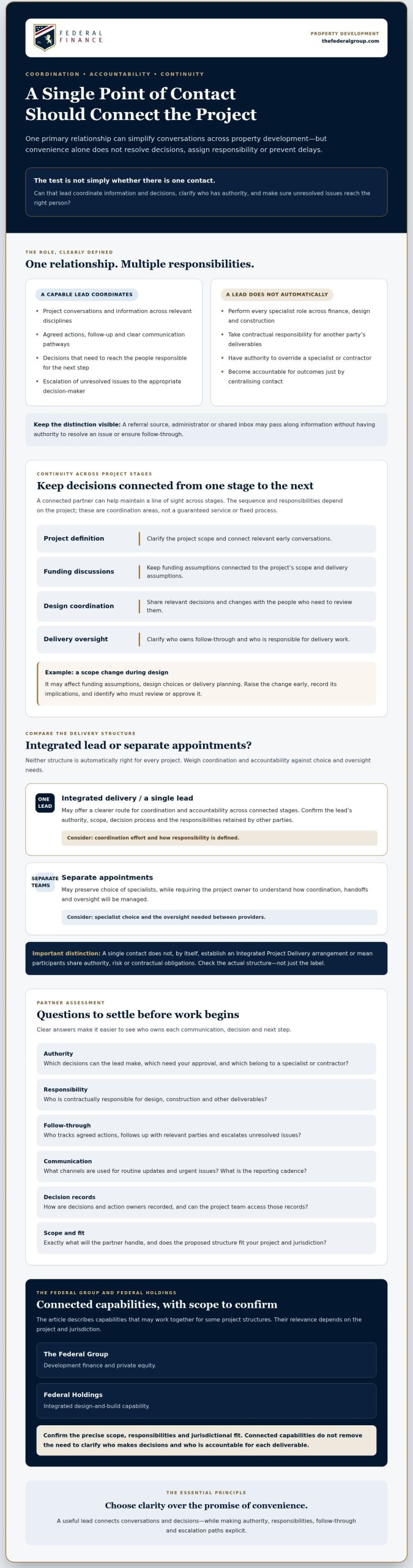
A single point of contact for property development gives the project owner one primary relationship for coordinating relevant conversations, decisions and follow-through. The lead connects disciplines so information reaches the people who need it, instead of leaving you to manage every handoff. That doesn’t mean one person performs every specialist role: finance, design, development and construction may involve different teams or external providers.
Centralising contact is not the same as taking responsibility for project outcomes. A lead may coordinate updates and agreed actions, while contractual responsibility for design, construction or other deliverables remains with the relevant party. Clarify both arrangements at the outset. A referral source may introduce providers, an administrator may circulate information, and a shared inbox may collect queries. None necessarily has authority to resolve issues or ensure someone follows up.
Which project relationships can one lead help coordinate?
The scope depends on the delivery structure. During project definition, for example, a lead might connect funding discussions with design considerations. Later, design decisions may need to be communicated to the construction team. This is an illustration, not a guaranteed sequence or service commitment. External advisers and contractors may still provide specialist advice, make decisions within their remit and remain responsible for their own work.
The principle has some overlap with Integrated project delivery (IPD), which centres collaboration among project participants. A single contact, however, doesn’t establish an IPD arrangement or prove that all parties share authority, risk or contractual obligations. Check the actual structure rather than relying on a label.
What accountability should the contact make clear?
Before work begins, establish who owns each communication and decision pathway. A capable lead should explain who provides updates, tracks agreed actions, follows up with relevant parties and escalates unresolved issues. They should also identify which decisions they can make, which require your approval, and which belong to a specialist or contractor.
Agree practical communication rules in advance: the channel for routine updates, how urgent issues are raised, the reporting cadence and how decisions are recorded. Keep action owners and decisions in a format the project team can access. These arrangements make it easier to spot a stalled decision and identify its next step, without assuming the contact can override another party’s professional or contractual responsibilities.
How an Integrated Property Development Partner Connects Project Stages
Integration matters when decisions at one stage shape the options available at the next. A connected partner can help maintain a line of sight from project definition and funding discussions through design coordination and delivery oversight. This doesn’t mean every project follows the same sequence or that one organisation holds every responsibility. It means relevant assumptions, decisions and constraints have a clearer route across the project team.
Continuity can help prevent a key constraint from disappearing at a handoff. If the project scope changes during design, for example, that change may affect funding assumptions, design choices or delivery planning. A lead who connects those conversations can help identify the dependency and clarify who needs to review it. Integration can improve coordination, but it doesn’t remove commercial, technical or delivery risks. The parties responsible for those risks still need to assess and manage them.
Where finance and development decisions meet
Project scope, funding structure and delivery assumptions are closely related. A change to the intended development may alter what needs to be designed or delivered. Revised delivery assumptions may also affect the information used in funding discussions. Raise changes early, record their implications and identify who must review or approve them. Funding options and suitability depend on the project, so confirm the relevant scope and requirements rather than assuming a particular structure will fit.
How design-and-build integration can reduce handoff friction
When design and construction planning are coordinated, practical delivery considerations can inform design discussions earlier. The U.S. Federal Highway Administration describes the design-build project delivery method as combining design and construction services under a single contract. A project may still involve separately appointed specialists, advisers or contractors, each with defined responsibilities. Confirm how these parties work together, who directs their work and where accountability remains.
Federal Holdings operates as an integrated design-and-build developer, managing projects from architectural design through construction. This is an example of integrated development capability, not a promise that the same arrangement is available or suitable for every project. For more delivery context, explore the general role of an integrated design-and-build developer, then verify responsibilities, project fit and jurisdictional scope with any prospective partner. For an overview of the group’s relevant property capabilities, see The Federal Group’s development capabilities.
Single Lead or Separate Providers: Compare the Development Models
Choosing between a coordinated partner and separately appointed providers is a question of fit, not a contest with one universal winner. A single point of contact for property development can streamline communication across disciplines, while separate appointments may give you direct access to independently selected specialists. The right structure depends on project complexity, your team’s capacity to coordinate work and the level of independent oversight you need.
| Consideration | Coordinated partner | Separate providers |
|---|---|---|
| Accountability | A lead coordinates agreed responsibilities. Clarify which parties remain accountable for their own services and decisions. | Each appointment has a distinct remit, so you’ll need to manage interfaces and resolve gaps between scopes. |
| Coordination effort | Project conversations may be connected through a central relationship, reducing the owner’s role in relaying information. | You manage communication across finance, design and construction, or assign that coordination internally. |
| Specialist choice | Capabilities may be more connected, but confirm how specialists are selected and where you retain choice. | You can appoint specialists individually, subject to your procurement approach and project requirements. |
| Oversight | Ask how progress, decisions and unresolved issues are reported, and who has authority to act. | Direct relationships can support independent oversight, but require clear governance across providers. |
A single contact centralises communication, not necessarily every project risk or responsibility. Coordination can make dependencies more visible, but it doesn’t remove the need to assess specialist work, contractual obligations or delivery risks.
When a single point of contact may suit the project
This model may be useful when several disciplines or project stages need close coordination and your internal team has limited capacity to manage separate appointments, updates and escalations. If development finance and integrated design-and-build capability are both relevant, ask whether a prospective partner can connect those discussions and explain the scope of each role. Confirm what is included for your project.
When separate specialists may be the better fit
Separate appointments may better serve projects that need independent advice, specialist procurement or distinct governance. You can build direct relationships with each provider, but your team must coordinate information, decisions and issues between them. Define responsibilities at each interface and identify who resolves conflicts. Neither structure is automatically superior. Compare the project’s needs, your capacity and the independence you want before deciding.
How to Evaluate a Single Point of Contact Before You Commit
Test the model before agreeing to it. A strong proposal should define what the lead coordinates, what they can decide and where your team or other specialists retain responsibility. Use these steps to turn a broad promise of integration into clear, project-specific commitments.
- 1. Define the scope. Ask which project stages and services are included, which are excluded and which depend on external parties. Clarify whether coordination covers funding discussions, design, construction or only selected stages.
- 2. Confirm authority. Establish what the lead can approve or direct, what needs your sign-off and what remains with separately appointed specialists. A responsibility map should show who owns decisions, updates and issue resolution.
- 3. Test capability. Ask which services are delivered directly and which involve third parties. Request relevant examples of how the proposed team coordinates across project disciplines, without treating past experience as a guarantee of future outcomes.
- 4. Set governance. Agree on decision-makers, reporting intervals, communication channels and documentation practices. Ask how actions and decisions are recorded, how unresolved issues are escalated and who follows through.
- 5. Assess project fit. Discuss the asset type, project scale, timing and your team’s internal capabilities. Confirm how the proposed approach adapts to the relevant jurisdiction, and identify legal, planning and technical matters for qualified local review.
Questions to test capability and accountability
Ask how specialists are coordinated, how responsibilities are divided and how changes are communicated. Who updates you if a decision affects another workstream? Who resolves a gap between providers? A direct, documented answer is more useful than a general assurance that the partner “handles everything.” Confirm exclusions and third-party responsibilities before engagement.
Questions to test governance and project fit
Check that reporting and escalation arrangements match your decision-making process, and that approval rights are explicit. If project funding is part of the decision, use an international property development finance guide to frame your questions, then verify the potential partner’s scope and project fit directly. Requirements and responsibilities may differ by jurisdiction, so don’t assume one delivery structure applies everywhere.
For an overview of the group’s confirmed finance and development capabilities, visit The Federal Group.
How The Federal Group Can Support a More Connected Development Approach
The Federal Group brings together property development finance, bridging loans and private equity. Through Federal Holdings, the group also operates as an integrated design-and-build developer, managing projects from architectural design through construction. These capabilities may be relevant when a development requires connected conversations across funding and delivery. They don’t mean every project follows one structure or that every service is available for every location or development.
For a prospective partner, the practical question is how these capabilities relate to your project’s needs. Clarify which entity or team would be involved, what responsibilities it would take on and which specialists or advisers would remain separately appointed. If equity partnership is under consideration, explore the real estate private equity partner approach alongside other potential funding and delivery requirements, then confirm project fit directly.
A partner with property finance and development capabilities
The group’s finance capabilities include development finance, bridging loans and private equity. Federal Holdings’ integrated design-and-build role may provide another point of connection across project stages. Depending on the agreed scope, finance expertise and design-and-build experience can inform discussions about project assumptions and delivery considerations. That potential coordination is not a guarantee of funding suitability, project availability or outcomes. Confirm the responsibilities and terms relevant to your project and jurisdiction.
When assessing a single point of contact for property development, use the same due-diligence questions for any prospective partner: what is delivered directly, what is coordinated, who holds decision authority, and how are updates and unresolved issues handled? Clear answers help distinguish a connected approach from a broad capability list.
Practical next steps for a project discussion
A concise project brief can make an initial discussion more focused. Include:
- Objectives: the intended development and the decisions you need to progress.
- Location and stage: where the project is and what has already been completed or appointed.
- Constraints: known funding, design, construction or jurisdictional considerations that may affect the project.
- People and coordination: existing advisers or providers, key decision-makers, and the handoffs that need attention.
This information helps establish whether the group’s capabilities align with your requirements. Confirm the appropriate scope and responsibilities for each project rather than making assumptions about them. The Federal Group’s property development capabilities provide further information.
Set a Clear Foundation for Your Next Development
A single point of contact for property development can reduce the coordination burden, but only when the lead’s scope, authority and accountability are clear. Compare an integrated partner with separate providers based on your project’s complexity, internal capacity and need for independent advice. Before committing, confirm who coordinates specialists, records decisions and escalates unresolved issues.
The Federal Group provides development finance, bridging loans and private equity, while Federal Holdings operates as an integrated design-and-build developer. The group works across international property markets, but the right capabilities and responsibilities depend on your project and jurisdiction. Outline your objectives, location, development stage and key coordination needs to make an initial conversation more focused.
If you’re assessing whether these capabilities align with your plans, discuss your property development requirements with The Federal Group. A clear brief can help you explore project fit and the responsibilities that need to be agreed. With the right questions in hand, you can take the next step with greater clarity.
Frequently Asked Questions
What does a single point of contact mean in property development?
It means having one primary relationship to coordinate relevant conversations, decisions and follow-through across a development project. A single point of contact for property development may connect discussions involving finance, design and construction, but doesn’t necessarily perform every specialist role. Before engagement, clarify what the lead handles, what authority they have and which responsibilities remain with you or separately appointed professionals.
Is a single point of contact better than hiring separate property development providers?
Neither model is automatically better; the right choice depends on your project and team. A coordinated lead may reduce the time you spend relaying information between providers. Separate appointments can give you direct relationships with independently selected specialists, while adding coordination demands. Compare accountability, specialist choice, oversight requirements and your internal capacity. Agree who manages handoffs and unresolved issues before selecting either structure.
Can one property development partner provide finance, design, and construction?
Some partners may combine finance capabilities with integrated development, but confirm the precise scope available for your project. The Federal Group provides development finance, bridging loans and private equity. Through Federal Holdings, it also operates as an integrated design-and-build developer managing projects from architectural design through construction. These capabilities don’t mean every service is suitable or available for every project or jurisdiction, so verify responsibilities and project fit directly.
How do I choose a property development partner with one point of contact?
Start by defining your project objectives, location, stage and required capabilities. Ask which services the partner delivers directly, which rely on other parties and what decisions the lead can make. Request a responsibility map showing who owns updates, approvals, action tracking and escalation. Also agree on reporting cadence and documentation practices. Confirm that the proposed scope fits your project and jurisdiction before committing.
What should a single point of contact be responsible for?
Responsibilities should be agreed in writing and may include coordinating relevant project discussions, sharing updates, recording decisions, tracking agreed actions and escalating unresolved issues. The contact should also explain what sits outside their remit and who holds authority for specialist work or approvals. A central relationship doesn’t automatically transfer contractual or professional responsibilities from other providers. Make ownership clear for each workstream and decision.
Does using one development contact remove project risk?
No. A single contact can make dependencies and decisions easier to coordinate, but it can’t remove project, funding, design or construction risks. Risk ownership still depends on the project structure, agreements and the parties responsible for each workstream. Ask how risks are identified, documented and escalated, and who must decide on a response. Maintain appropriate specialist and local review where the project requires it.
When should a property developer use separate specialists instead?
Separate specialists may suit projects that require independent advice, specific procurement choices or distinct governance arrangements. This approach can give you direct relationships with each provider and greater control over appointments. It also means your team must coordinate communication, handoffs and issue escalation across those relationships. Before choosing, map the project’s responsibilities, identify any need for independence, and assess whether you have capacity to manage coordination effectively.