Turnkey Property Developer: How to Choose the Right Partner in 2026
1 October 2026What if one partner could connect design and construction while keeping accountability clear? A turnkey property developer may offer that continuity, but “turnkey” does not define a standard scope. Unless responsibilities, approvals and project controls are explicit, an integrated model can make proposals harder to compare, not easier.
It is reasonable to ask whether consolidating delivery reduces oversight or flexibility. The answer depends on the agreement: what the developer manages, which decisions remain with you, how changes are handled and how progress is reported. Clarify design, construction and project management responsibilities before appointment. Assess any capital solution separately rather than assuming it is part of delivery.
This guide explains what turnkey development can include and how to assess a partner against your project’s complexity and governance needs. You will learn how to compare proposals on a like-for-like basis, which due diligence questions to ask and what to clarify before proceeding. It also considers integrated design-and-build delivery, including Federal Holdings’ role in managing projects from architectural design through final construction.
Key Takeaways
- Turnkey scope varies by contract, so define deliverables, exclusions and decision rights before appointing a partner.
- Assess how a turnkey property developer connects design and construction, including how handoffs and project controls are documented.
- Compare integrated and multi-party delivery against your needs for accountability, flexibility, coordination and owner involvement.
- Use a structured evaluation process to review relevant experience, reporting, risk allocation and financial capability.
- Consider Federal Holdings as an integrated design-and-build example, then verify the specific scope and services available for your project.
What Does a Turnkey Property Developer Deliver? Define the Scope First
A turnkey property developer coordinates an agreed set of development activities through to a defined completion point. The scope depends on the contract and project. The broad idea of a turnkey project is that a provider delivers a completed asset ready for use. In property development, the label alone does not tell you which services are included, who makes decisions or what “complete” means.
Roles differ. A general contractor typically delivers construction under an agreed scope. A consultant provides specialist advice or services without necessarily managing the whole project. A landowner holds an interest in the site, but ownership alone does not make them responsible for design or delivery. A turnkey developer may coordinate multiple stages, but the contract must specify which responsibilities it accepts and which remain with the owner or other parties.
Which project stages may sit within turnkey scope?
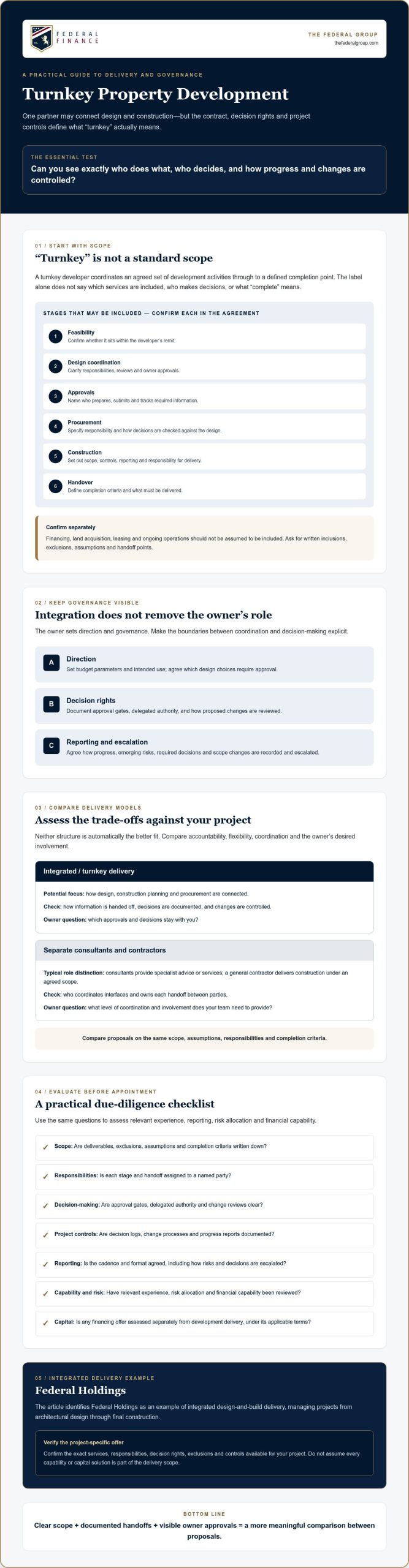
Depending on the agreement, the scope may cover feasibility, design coordination, approvals, procurement, construction and handover. These stages affect one another: design choices can shape procurement and construction planning, while unclear handoffs can leave gaps in accountability. Do not assume the turnkey label includes every stage.
Financing, land acquisition, leasing and ongoing operations require explicit confirmation. Request a written scope and responsibility schedule that names each deliverable, the responsible party, required owner input and key handoff. Clarify exclusions, assumptions and the criteria for completion and handover. This makes proposals easier to compare and helps reveal gaps before appointment.
What decisions typically remain with the property owner?
Integrated delivery does not remove the owner’s role in setting direction and governance. The owner typically establishes budget parameters and intended use, then agrees which design choices require approval. The contract should identify approval gates, delegated authority and how proposed changes are reviewed. This distinguishes routine coordination from authority to change the brief.
Agree on reporting cadence and format before appointment. Specify how progress, emerging risks, decisions required and scope changes will be recorded and escalated. Set out who can approve decisions at each gate and what information they need. A clear governance framework lets a turnkey property developer coordinate delivery while preserving the owner’s oversight.
How an Integrated Property Developer Connects Design, Delivery, and Capital
Design, construction planning and procurement are interdependent. A change to the building layout can affect materials, sequencing and coordination across the delivery team. If these decisions are reviewed in isolation, interfaces may be missed or left unresolved until later stages. Early coordination can bring those dependencies into view, but it does not remove project risk or guarantee a particular outcome.
Early coordination can help manage project interfaces by bringing design assumptions, construction planning and procurement considerations into the same discussion. For a turnkey property developer, the value lies in how responsibilities are connected and governed, not simply in having multiple capabilities under one organization.
Where design-and-build integration can support coordination
Assess whether design intent, buildability, schedule assumptions and budget parameters are considered together as the project develops. Ask how design information reaches the construction team, how procurement decisions are checked against the design, and how issues or proposed changes are recorded. These are useful assessment criteria, not guaranteed features of every integrated model.
Clear handoffs matter. A project plan should identify who prepares and reviews key information, who can make decisions, and which issues require owner approval. Documented controls, such as decision logs, change processes and regular progress reports, make accountability easier to follow. For a closer look at the model, explore what an integrated design and build developer may encompass, then verify the specific scope being offered.
How capital solutions fit alongside development delivery
Development finance may provide capital for a property project, subject to applicable terms and assessment. Bridging loans are short-term lending solutions, while private equity involves an investment interest in a business or project. These are distinct from design-and-build delivery. A provider may offer both development capabilities and capital solutions, but one does not automatically come with the other.
Assess the funding structure separately from delivery scope and authority. Clarify who provides capital, what conditions or obligations apply, how funding decisions relate to project approvals, and who retains control over delivery choices. Federal Holdings manages projects from architectural design through final construction, while The Federal Group also offers development finance, bridging loans and private equity. Confirm the availability and fit of each for the specific engagement. For further context, review international property development finance and compare it with the project’s delivery requirements.
Turnkey Developer vs Separate Consultants and Contractors: Compare the Trade-Offs
An integrated delivery model places multiple project stages with one partner. A multi-party model appoints separate specialists and contractors. Neither is automatically more accountable or flexible. The contract, project complexity and owner’s capacity to oversee delivery determine how each structure works in practice.
A turnkey property developer may offer a more consolidated point of responsibility, but that creates meaningful clarity only when duties, decision rights and interfaces are explicit. Turnkey does not automatically mean less owner control. Owners can retain approval gates and oversight if these are built into the governance arrangements.
| Consideration | Integrated partner | Separate appointments |
|---|---|---|
| Accountability | Responsibilities may be concentrated, subject to the contract’s scope and exclusions. | Each provider is accountable for its appointment; the owner must clarify cross-party responsibility. |
| Interfaces | Fewer organizational handoffs may be required, though internal responsibilities still need definition. | More interfaces may sit between providers and need active coordination. |
| Owner involvement | Can be structured around agreed approval gates and reporting. | May require more direct coordination and decisions across appointments. |
| Flexibility | Changes may need to move through one partner’s processes and contract terms. | Direct relationships with specialists may offer more control over appointments and phasing. |
| Coordination | Review how the partner manages communication across its delivery stages. | Establish who manages schedules, information exchange and issue resolution between providers. |
When a single integrated partner may be worth evaluating
Consider an integrated partner when workstreams are closely connected or your internal team has limited capacity to coordinate delivery. Check whether the provider can cover the required stages and project geography, and request relevant examples of similar work. Organizational convenience is not evidence of capability. Confirm named responsibilities, reporting lines and the process for escalating issues.
When separate appointments may better fit the project
Separate appointments can suit projects that need specialist independence, retained expertise or phased procurement. This approach gives the owner direct relationships with providers, while also placing more responsibility on the owner’s team to coordinate interfaces and resolve decisions. Compare the total oversight required, not just the number of contracts.
Project complexity can shift the balance. Several interdependent packages may increase coordination demands, while a clearly bounded specialist package may be easier to procure separately. Before choosing, compare contract terms for change control, approval authority, reporting and responsibility at each handoff. The right model is the one whose accountability structure matches the project and the owner’s governance capacity.
How to Evaluate a Turnkey Property Developer Before Appointment
A disciplined selection process helps you compare capability, accountability and commercial terms before committing. Give each candidate the same project brief and evaluation criteria, then verify claims rather than relying on presentation materials alone.
- Define the project brief. Set out the intended use, objectives, site context, budget parameters, required stages and owner approval requirements. Identify what is known, what remains uncertain and what you expect the developer to assess.
- Confirm the proposed scope. Map each required activity to a named responsible party. List deliverables, exclusions, interfaces and handover expectations so you can see whether the proposal covers the project you described.
- Test relevant experience. Request comparable project examples and establish what role the candidate actually performed. Verify references independently, and distinguish direct delivery responsibility from work performed by other parties.
- Assess governance and reporting. Review who leads each workstream, who has authority to make decisions, how owner approvals are obtained and how progress, risks and changes are reported.
- Review risk and financial capability. Understand how the proposal allocates responsibility for changes, delays and cost decisions. If the project also needs capital, assess that requirement separately and evaluate any proposed development finance lender on its own terms and criteria.
- Compare and appoint. Align proposals to the same scope and assumptions before comparing headline terms. Resolve gaps, document agreed responsibilities and have qualified advisers review the appointment documents before signing.
Questions to ask during capability and reference checks
Ask for examples that clearly explain the candidate’s role, the stages delivered and the responsibilities retained by the owner or other providers. Confirm who leads design coordination, construction delivery, approvals and handover. Ask how the team records changes, delay notifications, cost decisions and escalations. Specific answers and records are more useful than broad claims of experience.
What to clarify in the proposal and contract
Check deliverables, exclusions, assumptions, milestones, decision rights and change procedures line by line. Clarify reporting expectations, risk allocation, insurance, warranties and dispute processes. Ask qualified legal and other relevant advisers to review the terms for the project and its jurisdiction. If proposals use different assumptions or omit different responsibilities, request clarification before comparing them. A lower headline figure may not represent the same scope.
To assess whether an integrated development approach fits your brief, explore The Federal Group’s development capabilities and verify the specific services, geography and project scope relevant to a prospective engagement.
How The Federal Group Approaches Integrated Property Development
After defining the delivery model and assessing its trade-offs, test a prospective partner against the project’s actual requirements. Federal Holdings is an example of an integrated design-and-build developer: it manages property projects from architectural design through final construction. That lifecycle capability may suit a brief calling for connected delivery across these stages, but the appropriate scope depends on the engagement.
Assess a turnkey property developer on the responsibilities it will accept, not simply on the breadth of its stated capabilities. The Federal Group also offers development finance, private equity and bridging loans. These are wider group capabilities, not automatic inclusions in a design-and-build engagement. Confirm whether the project needs development delivery, capital, or both, and assess each requirement on its own terms.
Where Federal Holdings may fit a development brief
Federal Holdings may merit consideration when a brief calls for design and construction delivery to be managed within an integrated model. Its stated role spans architectural design through final construction, connecting project stages that can otherwise involve multiple handoffs. To explore this model further, consider what an integrated design and build developer may cover, then verify the proposed deliverables and exclusions directly. Confirm availability, geography and fit for the specific project.
A practical first conversation about project fit
Prepare a concise project outline before approaching a potential partner. Include:
- Location and asset type: Identify the project’s geography and the kind of property involved.
- Development stage: Explain whether the project is at an early concept stage or already has defined design and delivery requirements.
- Objectives and constraints: Summarize intended use, key priorities, known site or timing constraints, and owner approval needs.
- Support required: State whether you are exploring development delivery, a capital solution, or both.
This information gives both sides a clearer basis for an initial discussion. Ask which stages could be considered, who would hold responsibility for them, and what further information is needed to determine fit. If capital is part of the brief, discuss it as a separate requirement rather than assuming it forms part of development delivery.
If the project aligns with the group’s stated capabilities, outline the opportunity to The Federal Group for a discussion of potential fit. Confirm the specific services, geography and scope available before proceeding; no delivery model or capital solution should be assumed to suit every project.
Set a Clear Course for Your Development Project
Choosing a turnkey property developer starts with defining the work, decision rights and handoffs your project requires. A well-matched delivery model can connect design and construction, but its value depends on clear scope, relevant experience and governance that preserves your oversight. Compare proposals against the same requirements, and assess any capital need separately from development delivery.
Federal Holdings manages property projects from architectural design through final construction. The Federal Group also provides development finance, private equity and bridging loans, but these are distinct capabilities, not automatic inclusions in a development engagement. Confirm the services, geography and project scope relevant to your opportunity before proceeding.
If you are considering an integrated approach, prepare a brief covering your location, asset type, development stage, objectives and known constraints. Then discuss your property development opportunity with The Federal Group to explore potential fit. A clear brief is a practical starting point for deciding whether the proposed delivery model meets your project’s needs.
Frequently Asked Questions
What is a turnkey property developer?
A turnkey property developer coordinates agreed project stages and delivers them to a defined completion point. The contract determines the actual scope. It may include design coordination and construction, while land acquisition, financing, approvals, leasing or operations may sit elsewhere. Before comparing providers, request a written schedule of deliverables, exclusions, decision rights, owner responsibilities and handover requirements. This makes accountability clearer before you appoint a partner.
What is usually included in turnkey property development?
There is no universal package for turnkey property development. Depending on the agreement, services may include design coordination, procurement, construction and handover. Feasibility work, planning approvals, land acquisition, financing, leasing and ongoing operations need to be confirmed rather than assumed. Ask each developer to identify deliverables, exclusions, dependencies and owner responsibilities in writing. Then compare proposals against the same scope, so differences in assumptions do not obscure what each provider is offering.
Is a turnkey property developer the same as a design-and-build contractor?
Not necessarily, although the roles can overlap. A design-and-build contractor typically combines design and construction responsibilities, while a turnkey developer may coordinate a wider project lifecycle. The terms do not establish a standard scope, so examine the agreement rather than relying on the label. Check which stages are included, who contracts with each provider, and who is accountable for key decisions, handoffs and completion. These details define the actual role.
Does turnkey development mean the property owner loses control?
No. An owner can retain approval rights over budget parameters, major design decisions, scope changes and project milestones. The contract and governance arrangements determine how much authority stays with the owner, not the turnkey label alone. Before appointment, agree on reporting frequency, decision thresholds, escalation routes and which matters require written approval. Clear decision rights preserve oversight without requiring the owner to manage every operational detail of the development.
How do I choose a turnkey property developer?
Start with a clear brief covering the project’s location, intended use, required stages and owner priorities. Assess comparable project experience and verify the candidate’s actual role through references. Review scope exclusions, team responsibilities, reporting, change control and risk allocation. Compare proposals against matched requirements, not just headline terms. Before signing, have qualified legal and technical advisers review the relevant documents. This process helps you assess whether a turnkey property developer fits your project and governance needs.
Can a turnkey property developer also arrange development finance?
Some groups have both development delivery and capital capabilities, but finance is not automatically included in a development proposal. The Federal Group provides development finance, private equity and bridging loans alongside design-and-build development through Federal Holdings. Confirm whether a capital solution is available and relevant to your project, and assess its structure separately from delivery responsibilities and decision authority. Review proposed terms independently and seek appropriate professional advice before relying on any funding arrangement.