Understanding Loan-to-Value in Development Finance
25 September 2026A headline loan-to-value ratio can make a development loan look larger than the funding a project can actually secure. When understanding loan-to-value in development finance, start by checking which valuation sits behind the percentage and what other limits the lender applies.
LTV is a useful measure of leverage, but it is a snapshot, not a complete measure of borrowing capacity. Depending on the lender and facility, the calculation may use projected gross development value rather than the site’s current value. The valuation assumptions can materially affect the result.
This guide explains the LTV formula, the property value a lender may use, and how to interpret the figure alongside loan-to-cost and loan-to-GDV measures. It also looks at how equity and other layers of the capital stack shape a funding structure. By the end, you’ll have a clearer view of why a headline percentage doesn’t guarantee a particular loan amount, and which project details to prepare for a finance discussion.
Key Takeaways
- Start with the basic LTV calculation: the proposed loan divided by the valuation used by the lender.
- Check whether the valuation refers to the current site or projected value at completion, as the basis changes how the ratio should be read.
- Compare LTV with loan-to-cost and loan-to-GDV to see how valuation and project costs offer different views of the proposed funding.
- Before assessing a proposal, clarify the facility amount, assumptions, drawdown conditions, and repayment route.
- Use LTV as one part of a wider review of project value, costs, delivery risk, and funding structure.
Understanding Loan-to-Value in Development Finance: What It Means
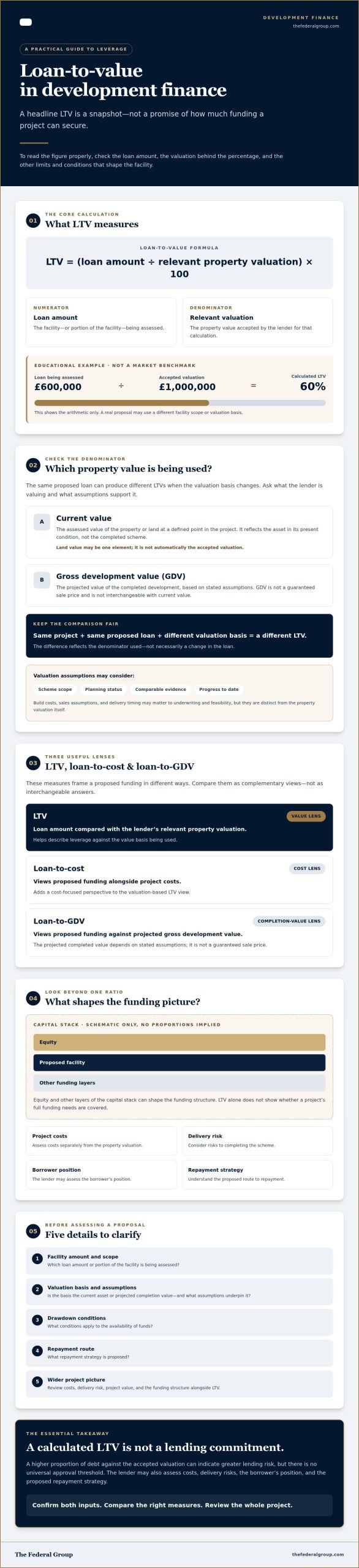
Loan-to-value (LTV) expresses the loan being assessed as a percentage of a property’s relevant valuation. The Loan-to-value (LTV) ratio is a useful starting point, but the calculation depends on what the lender counts as the loan and which valuation it accepts. LTV measures leverage against property value. It does not, by itself, show whether a project’s funding needs are covered.
How is the loan-to-value formula calculated?
Start by confirming the two inputs. The numerator is the loan amount under consideration, although the facility’s scope may vary. The denominator is the property valuation accepted by the lender for that calculation. Don’t assume it means projected sale value. Depending on the facility, project stage, and underwriting approach, the lender may use a different valuation basis.
- Loan amount: the facility or portion of the facility being assessed.
- Relevant valuation: the property value accepted by the lender for that calculation.
Formula: LTV = (loan amount ÷ relevant property valuation) × 100
Educational example, not a market benchmark: If the loan amount being assessed is £600,000 and the lender’s accepted valuation is £1,000,000, the calculation is (£600,000 ÷ £1,000,000) × 100 = 60%. This illustrates the arithmetic only. A real transaction may use a different facility scope or valuation basis, so confirm both inputs before comparing ratios.
Why does LTV matter to a property developer?
LTV helps show how much borrowing is proposed relative to the value assigned to the property. A lender may use the ratio as one indicator of its exposure. A higher proportion of debt against the accepted valuation can indicate greater lending risk, but there is no universal approval threshold. The lender may also assess project costs, delivery risks, the borrower’s position, and the proposed repayment strategy.
A calculated LTV describes the relationship between debt and value. It is not a lending commitment. Even a clearly calculated ratio does not confirm that the full amount will be approved or available on the assumed terms. Before relying on a headline figure, establish the valuation assumptions and facility details behind it. That keeps a useful leverage measure in perspective as you assess the wider funding structure.
Which Property Value Does a Development Finance LTV Use?
The valuation behind a development finance LTV isn’t always the site’s current value. Depending on the facility, project stage, and underwriting approach, a lender may assess the property as it stands or consider its projected value once development is complete. Confirm the basis for the specific transaction before comparing headline ratios.
Current value, land value, and gross development value
Current value is the assessed value of the property or land at a defined point in the project. It reflects the asset in its present condition, not the completed scheme. A site’s land value may be one element of this assessment, but it shouldn’t automatically be treated as the lender’s accepted valuation.
Gross development value (GDV) is the projected value of the completed development, based on stated assumptions. It is not a guaranteed sale price and is not interchangeable with current value. A scheme assessed against GDV may therefore show a different LTV from the same loan assessed against the site’s current value.
The same project can produce different LTVs under different valuation bases. That difference reflects the denominator used in the calculation, not necessarily a change in the proposed loan.
How valuation assumptions shape the ratio
A valuation may consider the scheme’s scope, planning status, comparable evidence, and progress to date. These factors help define what is being valued and on what basis. They are distinct from build costs, sales assumptions, and the delivery timetable. Those details may matter to underwriting and the overall feasibility assessment, but they should not be mistaken for the property valuation itself.
For example, a proposal based on the value of a completed scheme depends on assumptions about what will be delivered. The lender may scrutinise those assumptions alongside planning and project progress, while assessing costs and timing separately. Ask which valuation basis is being used, what assumptions underpin it, and whether the facility relates to the current asset or projected completion value.
Valuation methods and requirements vary by jurisdiction and lender. Confirm the terminology and process relevant to the transaction instead of assuming that an approach used in one market applies elsewhere. For a wider overview of cross-border considerations, consult The Definitive Guide to International Property Development Finance (2026).
For complex projects, it can help to consider valuation alongside funding structure and delivery. The Federal Group is an international property finance partner and developer, bringing property finance and development into the same conversation. Explore The Federal Group’s property finance and development to learn more.
LTV vs Loan-to-Cost and GDV: What Each Measure Tells You
LTV, loan-to-cost (LTC), and loan-to-GDV all relate borrowing to a project, but they use different reference points. LTV compares the loan with a property valuation. LTC compares funding with eligible project costs. Loan-to-GDV compares the loan with the projected value of the completed development. Read together, these measures offer a broader view than any one ratio can provide.
| Measure | Calculation basis | What it helps assess |
|---|---|---|
| LTV | Loan amount ÷ relevant property valuation | Leverage against the value accepted for the assessment |
| LTC | Loan amount ÷ eligible project costs | Funding relative to the costs included in the calculation |
| Loan-to-GDV | Loan amount ÷ projected gross development value | Borrowing relative to the estimated value of the completed scheme |
Terminology and calculation conventions can vary between lenders and markets. In particular, confirm whether “LTV” refers to a current valuation or a projected completed value, and which costs count toward LTC. The labels alone may not reveal the lender’s precise assumptions.
When does loan-to-cost add useful context?
LTC shows how proposed loan funding compares with the project costs a lender considers eligible. The cost base may include some development expenses and exclude others, so don’t assume every budget line is treated the same way. Ask for the lender’s definition and compare it with your cost plan. Reviewing cost assumptions alongside valuation assumptions helps show whether a ratio looks favourable because of the valuation, the costs counted, or both.
How should developers read LTV and GDV together?
Loan-to-GDV focuses on projected completed value when the lender uses that measure. It frames borrowing against the scheme’s anticipated end value, while LTC tests funding against eligible costs and LTV relates funding to the lender’s valuation basis. Each answers a different question about leverage and project economics.
For example, a proposed loan may appear modest relative to projected GDV but represent a larger share of eligible costs. That contrast is a reason to examine the development budget, completion assumptions, and valuation basis. It is not proof that the project is financeable. A lender may consider multiple measures together, and a limit under one measure may affect the facility even if another ratio appears acceptable.
Understanding loan-to-value in development finance means treating LTV as one lens, not a verdict. One favourable ratio does not establish total project financeability. The lender’s assessment may also depend on costs, delivery assumptions, facility structure, and repayment strategy.
How to Assess an LTV Proposal for a Development Project
A headline ratio is useful only if you can trace the assumptions behind it. Review what the proposed facility covers, how funds may be accessed, and what the project must deliver for repayment. This makes understanding loan-to-value in development finance practical: you are testing whether the inputs behind the percentage align, not just reading the figure.
- Confirm the facility amount. Establish whether the stated figure is the total commitment, the amount available for development costs, or another measure. Ask which fees and costs are included, and whether advances are staged or conditional.
- Identify the valuation basis. Confirm which valuation underpins the LTV, when it was assessed, and what assumptions it uses. Ask whether a change in planning, project scope, or progress could trigger a reassessment.
- Review the cost assumptions. Compare the lender’s cost base with your development appraisal and cost plan. Check how construction costs and contingency are treated, and whether the figures match across documents.
- Test the timing. Compare the proposed advance schedule with the project programme. Planning milestones, construction stages, and drawdown conditions should fit the timetable rather than rely on incompatible assumptions.
- Clarify the repayment route. Set out how and when the facility is expected to be repaid. Check that the proposed exit assumptions are consistent with the project’s sales or other repayment strategy.
Questions to ask about the valuation and facility
Request clear answers on what the loan amount includes, which valuation figure and assessment date apply, and how staged advances affect the funding available. Ask what events could lead to revised terms, additional conditions, or a new assessment. These points help distinguish a headline facility from the amount and timing the project can actually rely on.
Documents that help explain the project
Prepare a development appraisal, planning information, cost plan, delivery programme, and relevant valuation. Include a summary of the team’s relevant delivery experience and a clearly described repayment or exit strategy. Check that planning status, construction scope, contingency, timing, and exit assumptions are consistent across the documents. For broader preparation guidance, see Securing Funding for Large-Scale Property Development.
Valuation, legal, tax, and technical advice should suit the transaction and its jurisdiction. Advisers can help test assumptions and identify issues to clarify before you rely on a proposed structure.
If a project has complex funding requirements, discuss your development finance structure with The Federal Group, an international property finance partner and developer.
How Development Finance Partners Put LTV in Context
A development finance assessment connects the property’s stated value with the project expected to realise it. A finance partner may consider the valuation alongside the cost plan, planning position, delivery programme, and repayment strategy. If these inputs rely on different assumptions, a headline LTV can give an incomplete picture of the project’s funding requirements and risks.
Why a single leverage ratio cannot describe the whole project
Check how the valuation assumptions relate to the scheme’s scope and planning status, whether the cost plan covers the work described, and whether the programme supports the expected delivery milestones. The exit assumptions should also fit the project’s stage and anticipated completion. These connections help explain the context behind the numbers instead of treating each document or ratio in isolation.
LTV is one input in a broader underwriting assessment, not a verdict on a project’s viability. The ratio frames leverage against value, while project costs, delivery risks, and the repayment route help explain whether the proposed structure fits the development. This wider view is central to understanding loan-to-value in development finance.
Discussing a project-specific finance structure
Before a finance discussion, bring together the project facts that explain both the asset and the proposed plan:
- Project facts: development scope, planning position, current progress, and delivery experience.
- Valuation assumptions: the valuation figure, its basis, and the assumptions behind it.
- Funding objectives: the amount and timing of funding sought, how it may be drawn, and the intended repayment route.
This preparation makes the conversation more specific and gives a finance partner a clearer basis for considering how the funding structure relates to delivery. The Federal Group is an international property finance partner and developer. Through Federal Holdings, it also undertakes integrated design and build, from architectural design through construction. That capability may be relevant to some project discussions, but it does not mean every finance project uses the group’s design and build services.
For projects spanning markets, international experience can help frame questions about local valuation practice and transaction requirements. It does not mean terminology, lender criteria, or processes are identical across jurisdictions. Confirm the relevant assumptions for each market and transaction.
A project discussion is a way to explore the funding structure in context, not a guarantee of approval or a particular level of funding. Discuss your property project with The Federal Group.
Move Forward with a Clearer Funding Picture
Understanding loan-to-value in development finance means looking beyond the headline percentage. Confirm the valuation basis behind the ratio, compare it with loan-to-cost and loan-to-GDV, and check that facility terms, project assumptions, and repayment plans align. These steps offer a grounded starting point for assessing a proposal without treating any single measure as a funding commitment.
A well-prepared discussion can focus on the project’s specific requirements: its valuation, costs, delivery plan, and funding objectives. The Federal Group provides international property finance and bridging finance, alongside development experience. Through Federal Holdings, it also undertakes integrated design and build, though this may not form part of every finance project.
If you’re considering a development and want to explore its funding structure in context, discuss your property project with The Federal Group.
Frequently Asked Questions
How is loan-to-value calculated in development finance?
Calculate LTV by dividing the loan amount being assessed by the valuation accepted for that transaction, then multiplying by 100. The formula is: LTV = (loan amount ÷ relevant valuation) × 100. Confirm what the loan figure includes and which valuation the lender uses before interpreting the result. Facility scope and valuation conventions can differ, so a percentage without its inputs may be misleading.
Is loan-to-value based on current property value or gross development value?
It depends on the facility and the lender’s assessment. The calculation may use the property’s current assessed value or, where the lender applies that basis, the projected gross development value (GDV) at completion. GDV relies on assumptions about the completed scheme and is not a guaranteed sale price. Ask which value supports the ratio, when it was assessed, and what assumptions underpin it.
What is the difference between LTV and loan-to-cost in development finance?
LTV compares the loan with a relevant property valuation; loan-to-cost (LTC) compares loan funding with eligible project costs. The measures answer different questions: LTV frames leverage against value, while LTC relates borrowing to the costs included in the calculation. Because lenders may define eligible costs differently, compare their stated cost base with your project budget instead of assuming both calculations use identical inputs.
Can a development finance loan have different LTV measures during a project?
Yes. The ratio may differ if the loan amount being assessed changes, the lender uses a new valuation, or the calculation shifts between current value and projected completed value. A changing LTV does not necessarily mean the facility terms automatically change. Check the agreement and ask whether later advances, project milestones, or reassessment can affect the figure, conditions, or amount available.
Does a higher LTV mean a lender will approve more funding?
No. A higher LTV describes a larger loan relative to the valuation used, but it does not promise approval or determine the final facility on its own. A lender may also assess eligible costs, project delivery, planning position, borrower experience, and the repayment route. Treat any quoted ratio as one part of the proposal, then confirm the amount, conditions, and timing of funds available.
What information should developers check before accepting an LTV proposal?
Check the proposed facility amount, valuation basis, and assessment date. Then confirm which fees or costs are included and whether advances are staged or conditional. Compare the lender’s assumptions with the development appraisal, cost plan, and programme. Review what could trigger revised terms, and ensure the repayment strategy is clearly described. Seek valuation, legal, tax, and technical advice suited to the transaction and jurisdiction.
How do valuation assumptions affect development finance LTV?
Because valuation is the denominator in the LTV calculation, changing the accepted value changes the resulting ratio even if the loan amount stays the same. The assessment may reflect the property’s current state or assumptions about a completed scheme, including its scope, planning position, and relevant evidence. Ask what has been assumed and distinguish projected value from current value. Neither should be treated as interchangeable.