Alternatives to Traditional Bank Financing for Property Developers in 2026
12 September 2026The era of the “safe” bank loan as the primary engine for property development has effectively ended. While traditional lenders retreat behind rigid LTV ratios and bureaucratic approval cycles, the most ambitious projects of 2026 are finding life through more agile channels. You’ve likely felt the frustration of a lucrative land acquisition slipping away because a retail bank couldn’t move at the speed of the market. It’s clear that relying solely on legacy institutions is no longer a viable strategy for those operating at scale. Exploring alternatives to traditional bank financing for property developers is now a requirement for maintaining momentum in a volatile global landscape.
We understand that your goal isn’t just to secure debt, but to find a strategic partner who understands the complexities of the development lifecycle. This article demonstrates how to bypass restrictive institutional criteria and secure flexible, high-leverage capital through private equity, bridging loans, and integrated development partnerships. We will examine the mechanics of execution-focused financing and how specialized expertise in niche markets, such as sports infrastructure, can de-risk your most complex international ventures.
Key Takeaways
- Identify why 2026 capital requirements and rigid underwriting have made traditional lenders a bottleneck for high-momentum development projects.
- Access higher leverage and strategic alignment by utilizing real estate private equity and Joint Venture (JV) models for complex international assets.
- Secure critical land acquisition opportunities with the speed of execution provided by specialized bridging loans and short-term capital facilities.
- Navigate the complexities of cross-border development by leveraging alternatives to traditional bank financing for property developers that account for currency and jurisdictional risk.
- De-risk the construction lifecycle and attract more flexible capital by adopting an integrated design and build approach to project management.
Why Traditional Bank Financing Often Fails Modern Property Developers
The financing environment in 2026 has fundamentally shifted. Traditional banks, burdened by heightened capital reserve requirements and a cautious economic outlook, have significantly tightened their lending criteria. For the professional developer, this means that while a project may be viable and lucrative, it often fails to fit the narrow, box-ticking exercises of institutional credit committees. This friction is driving a surge in interest toward alternatives to traditional bank financing for property developers as a means of maintaining project velocity.
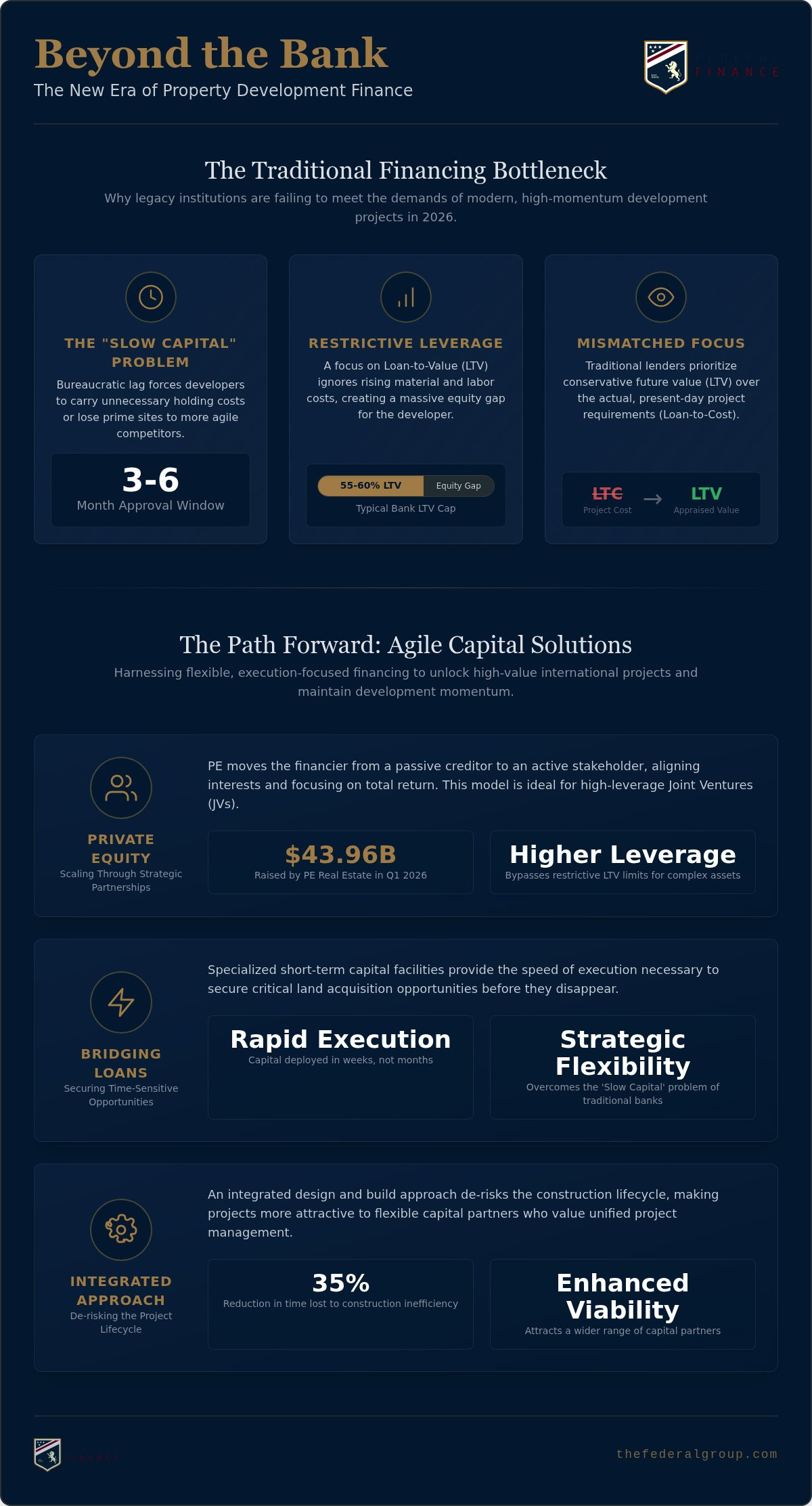
One of the most persistent barriers is the focus on Loan-to-Value (LTV) rather than Loan-to-Cost (LTC). While a bank might offer a competitive interest rate, they often cap their exposure at 55% or 60% of the completed value. In a market where construction material tariffs on steel and aluminum are at 50%, this leaves a massive equity gap. Professional developers require leverage that reflects the actual cost of construction and the strategic value of the site, not just a conservative appraisal of future worth. When a lender’s model ignores the rising cost of labor and materials, the developer is forced to dilute their equity or stall the project entirely.
The “Slow Capital” Problem
Traditional banking is inherently “slow capital.” A typical approval window of three to six months is incompatible with the 2026 market, where land acquisition opportunities disappear in weeks. This bureaucratic lag forces developers to carry unnecessary holding costs or lose the site to a more agile competitor. Banks also rarely quantify the de-risking value of an integrated design approach. They see a project as a series of siloed risks, failing to recognize how unified management reduces the 35% of time typically lost to inefficient construction tasks. Additionally, rigid amortization schedules create immediate cash flow pressure before a project reaches its stabilized phase.
Regulatory Hurdles and Credit Tightening
Global banking regulations in 2026 have institutionalized risk-aversion. With the Federal Reserve’s target funds rate between 3.50% and 3.75%, banks are prioritizing liquidity over development exposure. This credit tightening has transformed non-bank solutions from a secondary option into the primary engine for growth. Developers are increasingly turning to Creative financing techniques to bridge the gap left by reticent retail lenders. Alternative finance is a flexible, non-bank capital solution that prioritizes project viability and execution speed over rigid balance sheet ratios. This shift allows developers to move with the confidence that their capital partner understands the development lifecycle, not just the collateral.
Real Estate Private Equity: Scaling Through Strategic Partnerships
Private equity (PE) represents a fundamental shift in how capital stacks are structured for modern development. In the first quarter of 2026, private real estate strategies successfully raised $43.96 billion, signaling a robust appetite for value-add and opportunistic assets despite broader market fluctuations. For those seeking alternatives to traditional bank financing for property developers, PE offers a path toward higher leverage and shared risk. It moves the financier from a passive creditor to an active stakeholder, aligning interests through the entire project lifecycle.
This model is particularly effective for mid-market developers who are often overlooked by institutional banks but possess high-value international projects. Unlike the rigid underwriting of a retail bank, private equity firms focus on the total return and the strategic merit of the asset. This allows for Joint Venture (JV) structures where the developer provides the expertise and the financier provides the necessary capital to bypass restrictive LTV limits.
Equity vs. Debt: Choosing the Right Capital Stack
The decision between debt and equity is often a choice between cost and capability. Debt is generally less expensive in terms of interest, but it comes with the baggage of restrictive covenants and rigid schedules. Equity, while requiring a share of the project’s upside, provides the flexibility to pursue high-leverage projects that banks would deem too complex. At The Federal Group, we apply this logic to high-potential property and sports ventures. By bringing in a partner who understands the development lifecycle, you can scale your portfolio without the constraints of monthly interest payments during the volatile construction phase.
The Long-Term Value of Strategic Alliances
A real estate private equity partner brings more than just a balance sheet; they provide access to global networks and market intelligence essential for cross-border expansion. In 2026, value-add strategies accounted for 56% of capital raised, highlighting a market preference for partners who can actively improve asset performance. This is particularly relevant in specialized sectors like sports multi-club ownership. These niche markets require technical precision and jurisdictional knowledge that traditional lenders lack. Strategic alliances allow developers to enter these complex markets with a partner who has already navigated the legal and operational hurdles. If you’re looking to diversify into these high-barrier sectors, exploring our private equity solutions can provide the necessary foundation for international growth.
Bridging Loans and Short-Term Capital: Maintaining Development Momentum
In the high-stakes environment of 2026, speed has become the ultimate competitive advantage. While traditional banks struggle with multi-month approval cycles, market opportunities often exist for only a matter of days. As of September 2026, national average interest rates for bridging loans range from 9% to 14.5%, a premium that professional developers are willing to pay for immediate execution. Utilizing alternatives to traditional bank financing for property developers allows you to secure prime assets while institutional competitors remain stalled in bureaucratic review. This agility is essential for maintaining project velocity in volatile markets where the cost of a missed acquisition far outweighs the cost of short-term capital.
Strategic Land Acquisition
Securing a site is only the first step; securing its value requires navigating the complex terrain of planning permissions and entitlements. Bridging loans provide the necessary liquidity to lock in a purchase while these value-adding steps are completed. By leveraging bridging finance for land acquisition, you can fund the gap between an initial purchase and the start of a full construction facility. This strategy de-risks the project by ensuring all permits are in place before committing to long-term debt. Rapid execution ensures you can capitalize on time-sensitive auctions or distressed assets that demand immediate closing cycles.
Bridging for International Markets
International development introduces layers of complexity, from currency fluctuations to diverse regulatory frameworks. Cross-border short-term loans must account for specific jurisdictional legalities, such as the 2026 shifts in foreign property ownership laws seen in various states. The Federal Group provides specialized bridging solutions across international property markets, ensuring that capital flows smoothly across borders. This capability is particularly critical in the professional sports sector, where bridging finance facilitates rapid club acquisitions and infrastructure upgrades. Our specialized Sports Division understands that in global football and multi-club ownership, timing is as critical as the capital itself. Short-term capital solutions ensure that your international portfolio continues to scale without being hindered by the slow pace of legacy banking systems.
Structuring Cross-Border Finance for High-Value International Projects
International development in 2026 requires a sophisticated understanding of geopolitical friction and regulatory tightening. As states increasingly enact laws to restrict foreign ownership, such as Indiana’s P.L. 131-2026, the landscape for international property development finance has become a minefield for the uninitiated. Professional developers are increasingly seeking alternatives to traditional bank financing for property developers to navigate these jurisdictional hurdles without compromising project speed or execution quality. Global agility is now a prerequisite for success.
Managing currency risk and local legalities is paramount. With the EU’s anti-money laundering package imposing a €10,000 cap on large cash payments and the OECD pushing for greater tax transparency, the disclosure requirements for global capital have reached an institutional high. A partner with global reach can neutralize these risks by structuring capital through compliant, multi-jurisdictional vehicles. This expertise is equally vital when deploying capital into professional football clubs and sports assets worldwide, where the valuation of the real estate often mirrors the performance of the team.
Global Capital Deployment Strategies
Structuring a multi-jurisdictional capital stack requires more than just capital; it demands an international real estate finance partner who understands the local nuances of each market. Private equity plays a central role here, providing the flexibility to move capital across borders with greater efficiency than institutional lenders. By leveraging global market expertise, developers can deliver strategic growth in emerging enterprise zones, such as those designated under the Maryland Transit and Housing Opportunity Act of 2026. This allows for the designation of zones near rail transit stations, making businesses eligible for significant tax credits and incentives.
Risk Mitigation in Cross-Border Development
The Federal Group’s methodology for international project acquisition focuses on identifying and neutralizing political and economic risks before capital is committed. We integrate design and build standards across different global regions to ensure consistency and quality, regardless of the local construction environment. This holistic approach de-risks the development by controlling every variable from acquisition to completion. Utilizing these alternatives to traditional bank financing for property developers ensures that regulatory uncertainty does not stall your momentum. If you are ready to scale your international portfolio with a specialist who understands the global landscape, contact our international finance division today.
The Integrated Design and Build Advantage: A New Frontier in Development Finance
The traditional separation of design and finance creates a structural vulnerability that alternative lenders are increasingly unwilling to accept. In a market where 98% of construction projects experience cost overruns or delays, the siloed approach of legacy banking is a liability. An integrated design and build developer offers a unified solution that addresses these risks at the source. By controlling the entire lifecycle, from architectural conception to final delivery, developers provide a level of transparency and predictability that makes them the preferred choice for those seeking alternatives to traditional bank financing for property developers.
The Synergy of Finance and Execution
Integration eliminates the friction between capital providers and construction teams. When the financier and the builder operate under the same strategic umbrella, the 35% of time typically lost to inefficient tasks is recovered through streamlined communication. This model provides private equity investors with real-time oversight and data-driven milestones, utilizing AI to reduce construction estimates by over 50% and cut total project costs by up to 20%. Integrated design-build models effectively eliminate the “communication gap” that typically leads to expensive cost overruns and missed delivery windows, providing a superior framework for alternatives to traditional bank financing for property developers.
The Future of Property Development Finance
The year 2026 marks a definitive shift toward the “finance-and-build” partner. As a development finance lender with deep roots in both capital markets and physical construction, The Federal Group represents the logical evolution of the industry. We move beyond the reactive nature of retail banking by proactively managing the execution phase via Federal Holdings. This integrated ecosystem allows us to deploy modular construction techniques that can reduce project timelines by up to 60%, ensuring that capital is deployed efficiently and returns are realized faster. The future of the industry belongs to those who can master both the balance sheet and the build site. Partner with The Federal Group for your next international development.
Securing the Future of Global Development
The landscape of 2026 demands a departure from the slow, restrictive models of legacy banking. Success now hinges on your ability to deploy capital with precision and speed, whether through the agility of bridging loans or the deep strategic alignment of private equity partnerships. By integrating design and construction expertise directly with finance, developers can effectively neutralize the risks of cost overruns and regulatory friction that often stall high-value projects. These integrated models provide the transparency and execution speed necessary to secure prime assets in an increasingly competitive global market.
Navigating these alternatives to traditional bank financing for property developers requires a partner who understands the entire project lifecycle. The Federal Group offers over 15 years of international property expertise and a fully integrated design and build division to ensure your vision reaches completion. Our global reach across the US, UK, and international markets ensures your capital remains as mobile as your ambitions. Contact The Federal Group to discuss your international property finance requirements. Your next project deserves a capital partner that matches your momentum and understands the gravity of your goals.
Frequently Asked Questions
What are the main advantages of private equity over bank loans for developers?
Private equity provides higher leverage and strategic alignment that traditional debt cannot match. While banks focus on rigid Loan-to-Value (LTV) ratios, private equity partners prioritize the project’s internal rate of return and long-term viability. This model moves the financier into a stakeholder role, offering the flexibility to fund complex, high-stakes projects. It’s one of the most effective alternatives to traditional bank financing for property developers seeking to scale portfolios without restrictive covenants.
How quickly can a bridging loan be secured for international land acquisition?
Bridging loans can typically be secured in a matter of days or weeks, compared to the three to six months required by institutional banks. This speed of execution is critical for international land acquisition where market volatility and competition demand rapid closing. At The Federal Group, we leverage our global reach to provide short-term capital that allows developers to lock in prime assets before legacy banking bureaucracy can process an application.
Why is an integrated design and build model considered a financing alternative?
An integrated design and build model acts as a financing alternative by fundamentally de-risking the construction phase. Because the developer manages the entire lifecycle from architectural design to final construction, capital providers gain greater certainty regarding timelines and costs. This unified approach reduces the 35% of time typically lost to inefficient communication. Lenders are more likely to offer flexible terms when they see an ecosystem approach that minimizes potential cost overruns.
What does cross-border property finance involve for US-based developers?
For US-based developers, cross-border property finance involves managing currency fluctuations, local jurisdictional legalities, and shifting international regulations. It requires a partner with established global reach to navigate compliance standards like the EU’s anti-money laundering package or specific state-level restrictions on foreign ownership. Structuring capital stacks across different regions ensures that US developers can capture international growth while neutralizing the political and economic risks inherent in multi-jurisdictional projects.
Can alternative financing be used for professional sports club acquisitions?
Alternative financing is frequently deployed for professional sports club acquisitions, particularly in global football. The Federal Group’s dedicated Sports Division specializes in using private equity and bridging loans to facilitate multi-club ownership and infrastructure upgrades. Traditional banks often lack the specialized knowledge to value sports assets correctly. Alternative solutions provide the technical precision and rapid capital deployment needed to compete in high-barrier markets where timing and industry expertise are paramount.
Is alternative finance more expensive than traditional bank financing in 2026?
Alternative finance typically carries a higher interest rate than traditional bank loans in 2026, but it offers significantly higher leverage and speed. While bridging loan rates range from 9% to 14.5%, the ability to secure land quickly often results in a higher overall return on investment. Developers use these alternatives to traditional bank financing for property developers to bypass the opportunity costs of stalled projects and the rigid capital requirements of retail institutions.
How does The Federal Group structure joint venture partnerships?
The Federal Group structures joint venture partnerships by aligning our capital and strategic oversight with the developer’s local expertise. We focus on high-potential property and sports ventures where a shared-risk model can unlock greater scale. Unlike passive lenders, we act as a heavyweight partner, managing the project’s lifecycle through our Federal Holdings division. This approach ensures that both parties are incentivized to achieve the highest possible asset performance and project completion speed.
What criteria do alternative lenders use compared to traditional banks?
Traditional banks prioritize historical credit data, rigid LTV caps, and liquid collateral. In contrast, alternative lenders focus on project viability, execution speed, and the developer’s track record in specific niche markets. They evaluate the total development lifecycle and the value-add potential of the asset rather than just a conservative appraisal. This allows for more creative capital structures that accommodate the rising costs of construction materials and the complexities of international development.