The Definitive Guide to International Property Development Finance (2026)
21 July 2026Global real estate investment volumes reached a staggering $888.6 billion last year, yet most developers find their ambitions capped by a 60 percent senior debt ceiling that refuses to budge. Successfully navigating international property development finance in 2026 requires a shift from traditional brokerage to a sophisticated, integrated capital strategy.
You’re likely aware that fragmented funding sources and currency fluctuations can erode margins before the first stone is laid. It’s a high-stakes environment where a disconnect between your financier and the build-phase execution often leads to costly delays. This guide provides the technical roadmap to master complex capital structures and deploy integrated development strategies that secure your global projects. We’ll examine the current 7 to 10 percent senior debt landscape, the critical role of mezzanine layers in 2026, and how a unified partnership can accelerate your capital deployment across international borders.
Key Takeaways
- Understand how to architect a multi-layered capital stack that bypasses the limitations of traditional banking and maximizes leverage beyond the 60 percent senior debt ceiling.
- Learn to utilize bridging loans as a strategic tool for rapid land acquisition, ensuring you secure prime sites while permanent funding structures are finalized.
- Master the complexities of international property development finance by aligning private equity and mezzanine debt into a cohesive, cross-border funding strategy.
- Discover how an integrated “Design & Build” model de-risks the construction phase by eliminating the friction between capital providers and build-phase execution.
- Shift from transactional brokerage to a heavyweight partnership that provides the scale and technical precision required for high-stakes global ventures.
Understanding the International Property Development Finance Landscape
Success in the global arena requires more than just capital; it demands a sophisticated architecture of funding that aligns with the specific friction points of cross-border ventures. At its core, international property development finance is a multi-layered capital solution engineered to navigate the complexities of multi-jurisdictional Special Purpose Vehicles (SPVs), diverse tax regimes, and fluctuating currency markets. While domestic developers might rely on local credit lines, high-value international projects necessitate an ecosystem that integrates private equity, senior debt, and agile bridging solutions.
Traditional domestic banking often fails the modern developer because its risk frameworks are tethered to local borders. These institutions frequently lack the appetite for the regulatory intricacies inherent in International real estate markets, leading to prohibitive delays or conservative leverage caps. In contrast, an institutional partner provides a cohesive funding strategy that manages the three critical stages of the project lifecycle: land acquisition, construction tranches, and exit refinancing. This distinction marks the difference between a transactional broker, who merely facilitates a connection, and a heavyweight partner who manages risk through every phase of the development.
The Shift Toward Alternative Capital in 2026
Institutional investors and family offices are increasingly filling the void left by traditional retail banks. In 2026, private debt and equity have become the primary drivers of large-scale developments due to their superior agility. Securing prime international sites requires the ability to move at the speed of the market, often deploying capital within days rather than months. Alternative finance in 2026 represents a decentralized capital ecosystem that prioritizes project viability and speed over the rigid, balance-sheet-driven criteria of traditional lending institutions.
Key Jurisdictions and Market Dynamics
The financing environment varies significantly between the UK, the US, and emerging European markets. For instance, while the US market remains robust for residential ground-up projects, European markets often require more nuanced navigation of ESG regulations and local planning permissions. Regulatory differences directly impact the speed of capital deployment. A partner with a global footprint understands these local dynamics, ensuring that capital isn’t just available, but also structured to comply with regional legal requirements without sacrificing momentum.
Optimizing the Capital Stack: Senior Debt, Mezzanine, and Private Equity
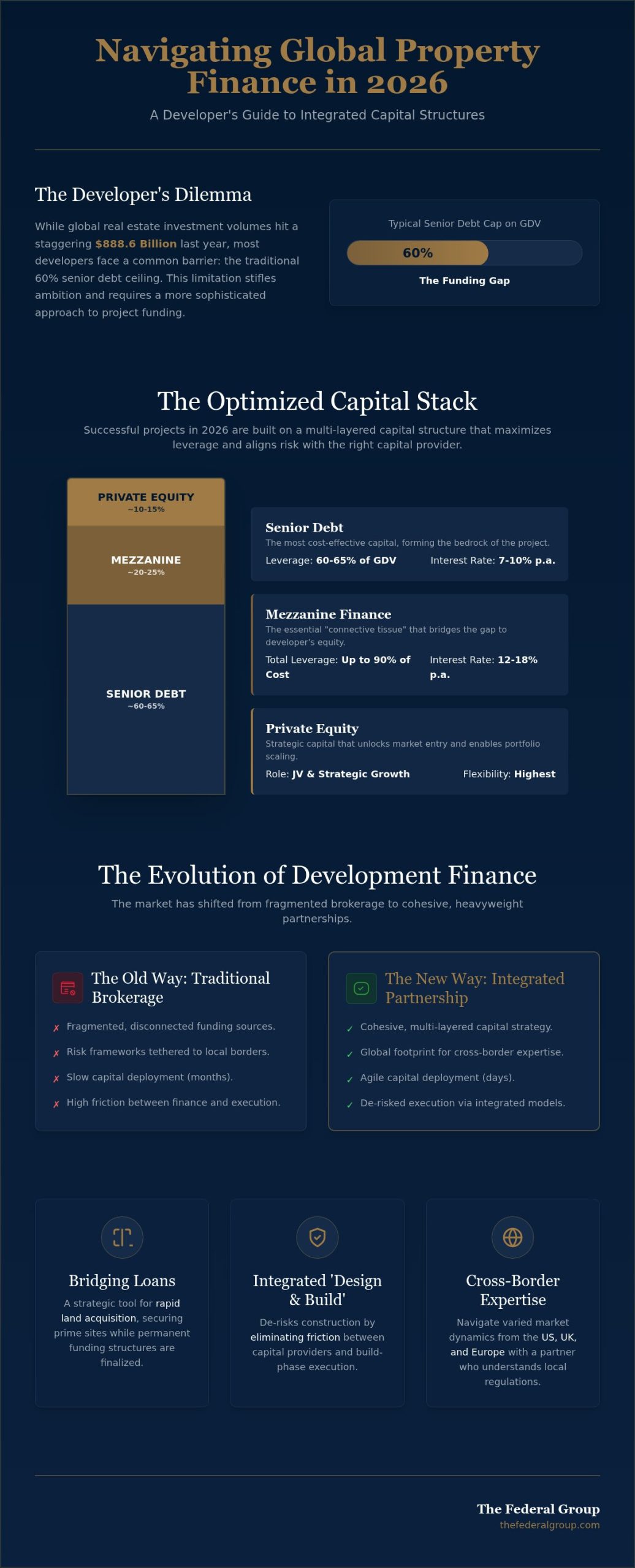
The architecture of a high-value project depends entirely on the stability of its capital stack. In the current market, international property development finance has moved beyond simple bank loans toward a sophisticated hierarchy of risk and return. This stack typically begins with senior debt, which serves as the bedrock of the project. While senior lenders in 2026 remain disciplined, often capping their exposure at 60 to 65 percent of the Gross Development Value (GDV), this layer provides the most cost-effective capital, with interest rates typically priced between 7 and 10 percent per annum.
When senior debt hits its ceiling, mezzanine finance becomes the essential connective tissue. This layer bridges the gap between senior debt and the developer’s equity, allowing for higher leverage that can reach 85 or even 90 percent of total development costs. Current rates for mezzanine tranches fall between 12 and 18 percent, reflecting the increased risk profile. Developers looking at emerging markets often benchmark their risk profiles against institutions like the U.S. International Development Finance Corporation (DFC) to ensure cross-border compliance and institutional-grade structuring. Aligning these layers requires an institutional perspective rather than a simple brokerage mindset. You can explore how we structure these Private Equity and debt solutions to maximize your project’s potential.
Private Equity Partnerships for Developers
Private equity represents the most flexible and strategic layer of the stack. Beyond providing raw capital, equity partners facilitate market entry into jurisdictions where local nuances might otherwise stall a project. Structuring joint ventures (JVs) allows developers to scale global portfolios without over-leveraging their own balance sheets. Understanding the evolving expectations of a real estate private equity partner in 2026 is essential, as the most effective partners now function as integrated operators rather than passive capital providers. At The Federal Group, our approach to strategic equity investment focuses on long-term value creation, positioning us as a heavyweight partner that shares in both the risk and the visionary ambition of the development.
Tranche Funding and Construction Milestones
Capital deployment is rarely a lump-sum event; it’s a methodical process governed by project progress. Lenders release funds in construction tranches, triggered by verified milestones and detailed Quantity Surveyor (QS) reports. This mechanism de-risks the project for all stakeholders by ensuring that capital flow matches physical asset growth. The tranche mechanism ensures capital is deployed in surgical increments, protecting the lender’s exposure while providing the developer with the liquid momentum needed to meet 2026 construction timelines.
Navigating Cross-Border Risks and Bridging Loan Strategies
The biggest objection to scaling global portfolios isn’t the lack of opportunity; it’s the friction of capital movement. Cross-border projects operate in a high-stakes environment where traditional timelines often result in lost acquisitions. Successfully executing international property development finance requires a dual focus on rapid deployment and rigorous risk mitigation. Special Purpose Vehicles (SPVs) are essential here, providing a ring-fenced structure that isolates liability and optimizes tax efficiency across different legal regimes.
Currency volatility remains a significant threat to construction margins. When materials are sourced in one currency and funded in another, a minor shift can erase projected profits. Hedging strategies and currency-linked construction contracts are no longer optional for high-value ventures. For developers looking to deepen their understanding of these variables, NYU’s International Real Estate Investment and Development curriculum highlights how critical market analysis and risk assessment have become in the modern era. Managing these risks requires a partner who views finance as an integrated part of the project lifecycle.
Bridging Finance for Rapid Land Acquisition
Speed is the ultimate currency in competitive markets. When a prime site becomes available, the window for due diligence and acquisition is often measured in weeks. Bridging loans provide the necessary liquidity to secure the asset while the more complex, long-term development finance is being structured. Understanding the strategic distinction between development finance vs bridging loan structures is essential for deploying the right capital vehicle at the right moment in your project lifecycle. This short-term capital solution acts as a strategic bridge, ensuring that developers don’t lose momentum. At The Federal Group, we specialize in these high-velocity bridging solutions, offering the scale of an institutional lender with the decisiveness of a niche partner.
Legal and Regulatory Compliance in 2026
The regulatory landscape in 2026 has become increasingly transparent and demanding. Managing Anti-Money Laundering (AML) and Know Your Customer (KYC) protocols across multiple jurisdictions requires a partner with specialized expertise. New global tax transparency standards have changed how development structures are audited and maintained. Ensuring project viability now depends on a proactive approach to compliance. We integrate these regulatory requirements into the early stages of project planning, de-risking the venture for all stakeholders and ensuring a seamless path to completion.
The Integrated Advantage: Design, Build, and Finance Synergy
Traditional development often suffers from a fundamental disconnect between the boardroom and the building site. When lenders and contractors operate in silos, the resulting friction leads to budget drift and operational delays. By adopting an integrated model, developers can bridge this gap, ensuring that capital flow is perfectly synchronized with construction milestones. This synergy is particularly vital in international property development finance, where multi-jurisdictional complexities already strain project timelines and increase the risk of miscommunication.
Integrated project management de-risks the construction phase by providing the financier with direct oversight of the build. Instead of relying on delayed third-party reports, an integrated developer-financier makes real-time adjustments based on live site data. This alignment doesn’t just protect the lender; it enhances capital efficiency for the developer. By reducing the time between a funding request and its deployment, you can maintain construction momentum and drive a higher internal rate of return (IRR) across your global portfolio. It’s a shift from reactive problem-solving to proactive project orchestration. Developers who want to go deeper on this topic will find that our guide on financing a design build project provides a detailed roadmap for synchronizing capital tranches with compressed delivery schedules in the current market.
Federal Holdings: A Case for Full Lifecycle Integration
The silo effect between architects, contractors, and lenders is a primary cause of project failure in the high-value sector. Through Federal Holdings, we eliminate this fragmentation by managing the entire lifecycle from initial architectural design to final exit. This approach allows for strategic design choices that prioritize high-spec construction while remaining strictly within the financial guardrails of the capital stack. When your design team and your finance partner share the same objectives, project friction disappears. You can partner with us for your next Design & Build Development project to experience this seamless execution.
Alternative Asset Classes: Sports Infrastructure and Development
The rise of professional sports as an institutional asset class has created unique opportunities for property development. Professional football clubs often serve as anchors for broader commercial hubs, training facilities, and residential schemes. Leveraging our specialized Sports Division, we identify high-potential multi-club ownership opportunities that drive significant real estate value. There is a powerful synergy between sports multi-club ownership and commercial development, where the global reach of a club enhances the desirability and valuation of the surrounding property assets. This integrated approach allows developers to tap into stable, high-yield sectors that traditional financiers frequently overlook.
Partnering with The Federal Group for Global Scale
Transitioning from a local developer to a global heavyweight requires more than just access to capital; it demands a partner who understands the visceral reality of construction as deeply as the technicalities of a balance sheet. The Federal Group functions as an authoritative strategic partner for high-stakes international ventures. We move beyond the limitations of traditional brokerage by providing an integrated ecosystem where international property development finance meets industrial-scale development expertise. This dual-lens perspective allows us to de-risk complex projects before they ever reach the build phase.
Scaling internationally in 2026 involves navigating a landscape where speed and certainty are paramount. Whether you’re deploying capital for high-value residential schemes or complex mixed-use developments, our group provides the stability needed to execute at scale. We offer a comprehensive suite of solutions, from high-velocity Bridging Loans for site acquisition to long-term real estate private equity partner arrangements that provide both capital reserves and operational expertise for scaling global property portfolios. Our role is to act as the catalyst for your expansion, providing the institutional weight required to secure prime opportunities in competitive global markets.
Customized Capital Solutions for Complex Projects
Standardized funding models often fail when applied to specialized asset classes like sports infrastructure or large-scale mixed-use projects. We tailor our funding structures to the specific operational requirements of each development, ensuring that the capital stack supports the project’s long-term vision. Our commitment to strategic growth means we don’t just fund projects; we invest in the visionary potential of your portfolio. To begin a partnership, our team conducts a rigorous project evaluation and consultation to align our resources with your development milestones.
Global Reach, Specialist Insight
Entering a new jurisdiction is a high-risk endeavor without local market intelligence and a global network. We leverage our worldwide presence to act as a connector of international opportunities, providing the specialist insight needed to enter new markets with confidence. By combining institutional-grade Development Finance with the specialized knowledge of our Sports and Design & Build divisions, we offer a level of integration that’s unique in the current market. Take the next step in your global expansion and Partner with The Federal Group to secure the capital and expertise your project demands.
Scaling Global Portfolios with Integrated Precision
The evolution of the global property market demands a move away from fragmented, transactional funding models. Success now hinges on your ability to synchronize capital deployment with physical construction milestones through a unified architecture. By integrating Design & Build capabilities through Federal Holdings and leveraging specialized insight from our Sports Division, we eliminate the traditional friction points that stall high-value projects.
Mastering international property development finance in 2026 requires more than just high leverage; it necessitates a partner who can navigate complex cross-border structures with institutional authority. Whether you’re acquiring land via agile bridging solutions or scaling a multi-club sports portfolio, the stability of your capital partner determines the ceiling of your ambition. We provide the scale and technical precision needed to transform visionary concepts into completed global assets.
Secure your next international development with a strategic capital partner.
The path to global scale is open to those who prioritize integration and expert oversight. We look forward to building the future of international real estate alongside you.
Frequently Asked Questions
What is international property development finance?
It’s a multi-layered capital solution designed for cross-border projects, incorporating senior debt, mezzanine finance, and equity. Unlike domestic lending, international property development finance accounts for currency volatility, multi-jurisdictional tax laws, and the complex risk profiles of international Special Purpose Vehicles (SPVs). This sophisticated architecture allows developers to manage the unique friction points of global markets while maintaining the liquidity necessary for large-scale construction tranches.
How do bridging loans work for international land acquisition?
Bridging loans provide high-velocity liquidity to secure prime international sites while long-term funding is being structured. These short-term facilities allow developers to act within days, bypassing the lengthy due diligence periods of traditional banks. This ensures you don’t lose competitive assets in fast-moving markets. Once the site is secured, these loans are typically refinanced into a permanent development finance package as the project enters the build phase.
What are the benefits of an integrated design and build developer?
An integrated model eliminates the friction between architects, contractors, and lenders by housing all functions under one institutional umbrella. This alignment reduces budget drift and ensures that construction tranches are released based on real-time site data rather than delayed third-party reports. By removing the silo effect, you de-risk the construction phase and ensure that high-spec design choices stay within the financial guardrails of the capital stack.
Can I get development finance for professional sports infrastructure?
Yes, specialized capital solutions are available for sports-related developments, including stadium upgrades and training facilities. The Federal Group leverages its specialized Sports Division to identify and fund high-potential opportunities. We often link sports multi-club ownership with broader commercial real estate ventures, providing the institutional weight required to scale these unique asset classes. This approach turns professional sports infrastructure into a stable, high-yield component of a global portfolio.
How does private equity differ from traditional development loans?
Private equity provides strategic, high-leverage capital that often involves a joint venture partnership rather than a simple debt obligation. While traditional loans focus on rigid senior debt ceilings, private equity allows for greater flexibility in scaling global portfolios. This layer of the stack is essential for entering new jurisdictions where local nuances require a partner who shares in both the risk and the visionary ambition of the development.
What jurisdictions does The Federal Group operate in for finance?
The group maintains a global reach, focusing on prime markets in the UK, the US, and across Europe. Our international footprint allows us to navigate local regulatory environments and 2026 tax transparency standards with precision. We provide the specialist insight necessary for developers to enter diverse markets with institutional confidence, acting as a connector of international opportunities while managing the legal complexities of multi-jurisdictional SPVs.
What is the typical LTV for international development projects in 2026?
In 2026, senior lenders typically cap loan-to-cost (LTC) at 65 to 75 percent, while senior loan-to-GDV rarely exceeds 60 to 65 percent for residential projects. By layering mezzanine finance or private equity into your international property development finance strategy, you can achieve a combined leverage of 85 to 90 percent of total development costs. For a detailed breakdown of how these two capital vehicles compare in practice, our guide on development finance vs bridging loan structures provides the strategic framework to optimize your stack. This structure maximizes your equity efficiency while maintaining the stability required by institutional lenders.
How does the Federal Holdings division de-risk my investment?
Federal Holdings de-risks projects by managing the full lifecycle from architectural design to final construction and exit. This integrated oversight ensures that high-spec construction remains within financial guardrails, preventing the cost overruns and communication failures that plague siloed models. By maintaining direct control over the build phase, we provide financiers with real-time site data, ensuring that capital flow is perfectly synchronized with the physical growth of the asset.