The Elite Development Finance Lender: An Integrated Case Study for 2026
18 August 2026In a 2026 market where nonresidential construction costs have climbed by 5% and material volatility is the new baseline, the greatest risk to your project isn’t the cost of steel; it’s the fragmentation of your capital stack. You likely recognize that traditional banks often retreat into rigid lending criteria just when international projects require the most agility. It’s an exhausting cycle to manage separate relationships for bridging, private equity, and construction oversight while your ROI erodes through avoidable delays. Partnering with a specialized development finance lender should provide more than just a loan; it should offer a strategic bridge across the entire project lifecycle.
This integrated case study reveals how a sophisticated development finance lender structures capital to de-risk high-value international projects and accelerate your return on investment. You’ll discover the mechanics of full-lifecycle funding that moves seamlessly from land acquisition to final build. We will explore how blending private equity with technical design and build expertise creates the stability needed for ambitious, industrial-scale developments in an unpredictable global economy.
Key Takeaways
- Understand why the role of a modern development finance lender has evolved from a passive capital provider to a strategic partner capable of navigating 2026’s volatile construction landscape.
- Learn how the “Integrated Design & Build” model de-risks high-value projects by aligning architectural oversight with capital deployment from inception to completion.
- Examine the mechanics of a $100M+ international case study to see how sophisticated structuring overcomes cross-border regulatory hurdles and maintains development momentum.
- Discover how to optimize your capital stack by balancing senior debt, mezzanine finance, and private equity to secure high-leverage funding and accelerate ROI.
- Explore the advantages of partnering with a global specialist that offers unique diversification opportunities across property and professional sports investment.
The Role of a Strategic Development Finance Lender in 2026
A development finance lender is a partner providing holistic capital solutions for project acquisition and construction. In 2026, this role has moved far beyond the provision of simple credit lines or competitive interest rates. Professional developers now require a strategic partner capable of absorbing the complexities of international markets and shifting regulatory frameworks. The modern development finance lender acts as an extension of the developer’s executive team, offering the stability and scale of an institution with the precision of a specialist consultancy.
Global trade conflicts and supply chain volatility have made construction material costs unpredictable. With nonresidential construction costs rising by approximately 5% in 2025 and continuing that trend into 2026, capital deployment must be surgical. New disclosure laws, such as Texas HB 700 and California SB 362, have increased the administrative burden on traditional lenders, often slowing their response times. This regulatory shift, combined with fluctuating prices for copper and nickel, makes the speed of a specialist development finance lender a critical competitive advantage. Professional developers are moving away from traditional retail banks because these institutions often lack the nuanced understanding of industrial-scale property development risks.
The Shift Toward Integrated Capital Solutions
Project momentum dies when capital is fragmented. Managing separate relationships for land acquisition, mezzanine debt, and construction creates friction that high-value projects simply can’t afford. When financing is siloed, delays in one tranche often trigger a domino effect across the entire timeline. The Federal Group eliminates this risk by facilitating project acquisition through flexible, consolidated funding structures. Our cross-border expertise ensures that international capital deployment remains seamless, even when navigating the unique supply and demand dynamics of different global regions. We focus on the full lifecycle approach, ensuring that capital is ready before it’s needed.
Institutional vs. Specialist Lending Models
Traditional retail banks often lack the appetite for the design and build risks inherent in large-scale development. They prioritize rigid, one-size-fits-all criteria over the visionary potential of a project. In contrast, specialist firms backed by private equity offer the agility to move at the speed of the market. They possess the technical depth to understand architectural and construction risks from the inside. Securing early momentum is vital; this is where bridging loans play a transformative role. By providing rapid liquidity during the initial development stages, a specialist lender ensures that a project doesn’t stall before the first shovel hits the ground. This proactive stance positions the lender as a heavyweight partner rather than a mere service provider.
The Integrated Funding Model: Bridging the Gap Between Capital and Construction
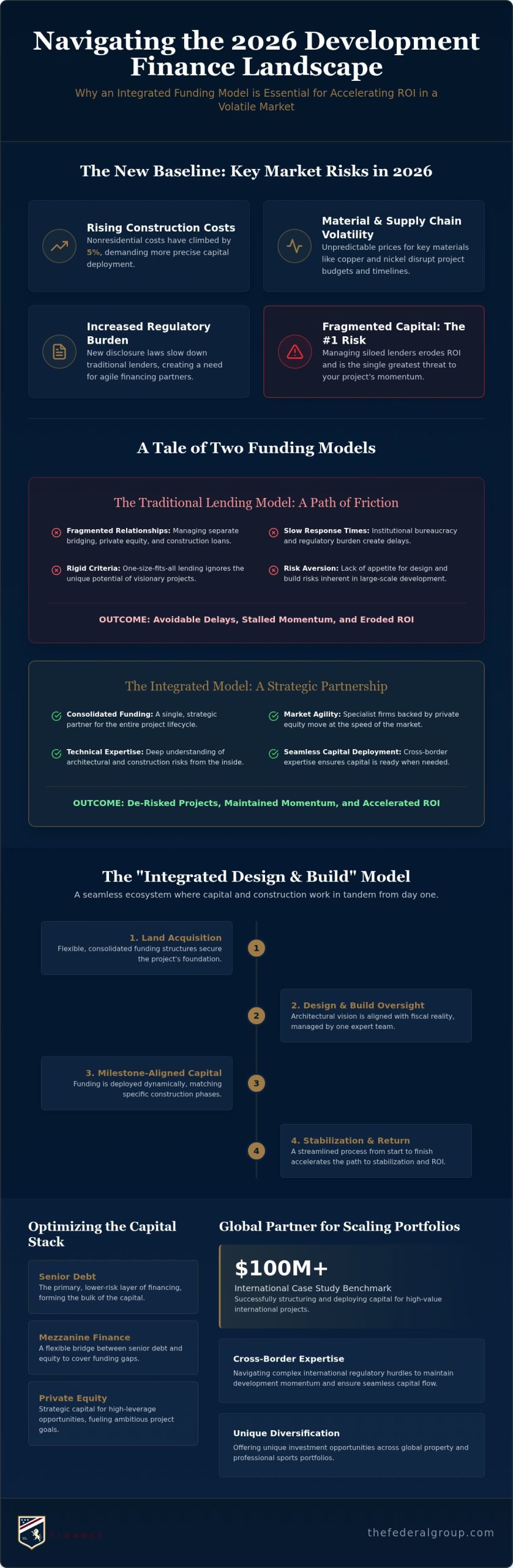
The Federal Group’s “Integrated Design & Build” philosophy addresses the fundamental disconnect between capital providers and construction teams. Most financing structures fail because the financier and the builder operate in silos, creating misaligned incentives and communication breakdowns. By consolidating these functions, we de-risk high-stakes projects through direct expertise. Federal Holdings manages the entire lifecycle, ensuring that architectural vision remains consistent with fiscal reality. This “One Partner” approach reduces friction, eliminates costly delays, and speeds up the transition from land acquisition to stabilization. It creates a seamless ecosystem where capital and construction work in tandem, rather than in opposition.
Structuring Finance for Full Lifecycle Property Development
Aligning capital deployment with specific construction milestones is essential for maximizing ROI. A sophisticated development finance lender understands that funding must be as dynamic as the build itself. Utilizing an integrated design and build developer allows for a more streamlined project delivery, cutting out the typical bureaucratic delays found in fragmented models. In-house architectural consulting informs our lending decisions, providing a level of precision that external third parties cannot match. This synergy between development finance and private equity allows for the scaling of global portfolios with confidence. It ensures that every dollar is deployed exactly when the project requires it, protecting your equity and maintaining momentum.
Mitigating Construction Risk with Expert Oversight
Traditional lenders often struggle with high-value international project risks because they lack technical depth. They see spreadsheets; they don’t see the structural or design nuances that can derail a multi-million-dollar development. We mitigate these risks by applying expert oversight at every stage. Our technical design knowledge allows us to identify potential build issues before they become financial liabilities. This de-risks the project for all stakeholders. Whether you’re navigating complex urban zoning or managing industrial-scale builds, having a development finance lender who understands the physical reality of construction is invaluable. You can partner with a strategic financier to secure the expertise your next project demands. This proactive management ensures project stability from the moment of land acquisition through to final asset stabilization.
Case Study: Deploying Capital for High-Value International Projects
Consider a $100M mixed-use development requiring rapid entry into a competitive European market. Navigating cross-border regulations while maintaining development momentum is a significant hurdle for many firms. A standard development finance lender often lacks the infrastructure to move quickly enough, leading to missed opportunities or fragmented funding. In this scenario, the developer faced a bidding war for a prime urban site where traditional bank timelines would have guaranteed a loss. The project demanded a tiered capital stack that could pivot from immediate acquisition to long-term construction without the friction of multiple third-party approvals.
Phase 1: Land Acquisition and Bridging Finance
Securing the site required immediate liquidity that only a specialist partner could provide. By utilizing bridging finance for land acquisition, the developer bypassed the lengthy approval cycles of retail institutions. This agile capital prevented competitor outbidding and established a firm foundation for the project. Transitioning from this short-term bridge to long-term development finance was handled internally. This internal transition ensured no loss of momentum between phases, as the same underwriting team understood the project’s long-term feasibility from day one. It allowed the developer to focus on zoning and permitting while the capital remained stable and secure.
Phase 2: Integrated Design, Build, and Capital Deployment
Once the site was secured, the Federal Holdings design team coordinated directly with the finance structure. Drawdown schedules weren’t based on arbitrary calendar dates but on real-world construction progress verified by in-house experts. Our private equity arm provided the necessary equity cushion, which allowed the developer to secure senior debt on more favorable terms than a standalone project would typically command. This alignment between architectural vision and capital deployment ensured that the build remained on schedule despite the material cost volatility seen throughout 2026. Because our development finance lender team understands the physical build, we don’t need to wait for external surveyors to validate every brick laid.
The Strategic Outcome for the Developer
The results were clear. By consolidating the financier and the developer into a single ecosystem, the project timeline was accelerated by four months. The developer achieved an optimized debt-to-equity ratio that maximized their internal rate of return. Our integrated finance model reduced the cost of capital by 15% through comprehensive risk mitigation and technical oversight. This reduction in cost wasn’t just about rates; it was about the efficiency of capital. Securing a real estate private equity partner provides the long-term stability and visionary energy needed to scale global portfolios across multiple jurisdictions with confidence.
Navigating the 2026 Capital Stack: From Senior Debt to Private Equity
The capital stack for high-potential property developments has become increasingly complex as we move through 2026. A development finance lender must offer more than just a single layer of debt; they must understand how each instrument interacts to protect the project’s viability. This hierarchy of capital determines the order of repayment and the level of risk each stakeholder assumes. While senior debt remains the bedrock, the rise of preferred equity and the strategic use of mezzanine finance are now essential for projects with a Gross Development Value (GDV) exceeding $100M. Strategic developers prioritize a stack that balances cost against flexibility, ensuring the project remains resilient through construction volatility.
Comparison of Debt and Equity Instruments
Senior mortgage debt is the traditional starting point. It offers the lowest cost of capital but requires the highest level of security. In 2026, LTV expectations for senior debt typically hover between 55% and 65%, depending on the asset class and jurisdiction. Mezzanine financing fills the critical gap between this senior layer and the developer’s equity. It carries a higher interest rate but allows for higher leverage, often pushing the total loan-to-cost (LTC) toward 80% or 90%. Private equity represents the top of the stack. Trading a portion of equity for scale and expertise is a strategic move for developers looking to offload risk while accessing the visionary energy of an institutional partner. Preferred equity has also seen a rise in international projects, offering fixed returns with equity-like characteristics that don’t dilute control as heavily as common equity.
Structuring Development Finance for Mixed-Use Projects
Mixed-use assets present unique challenges. Retail, residential, and commercial components each carry different risk profiles and exit strategies. A sophisticated development finance lender structures multi-tranche funding to account for these nuances. This approach ensures that the residential phase doesn’t stall because of retail market fluctuations or commercial leasing delays. Optimizing the stack for tax efficiency in cross-border jurisdictions is equally vital, as fragmented capital can lead to significant leakage. Strategic partners like The Federal Group add the most value at the “Common Equity” layer, providing the stability and capital depth required to anchor the entire project. You can structure your next capital stack with a partner that understands these technical intricacies. This holistic structuring protects the developer’s interests while ensuring that every tranche of capital is deployed with technical precision and global compliance.
The Federal Group: Your Partner for Scaling Global Portfolios
Choosing a development finance lender is a decision that dictates the trajectory of your entire portfolio. Since 2009, The Federal Group has operated as a heavyweight partner for developers who require more than just a capital source. We provide a visionary ecosystem where private equity, bridging loans, and integrated design and build expertise converge. This allows high-stakes international projects to move from concept to completion with quiet confidence and institutional stability. Our role is to act as a proactive connector of opportunities, managing every stage of the project lifecycle to ensure your ambitions are realized without the friction of fragmented financing.
Global Reach, Specialist Insight
We operate as an international real estate finance partner across the US, UK, and Europe. This geographic breadth is matched by a multi-disciplinary depth that few traditional institutions can replicate. Beyond industrial-scale property, we offer a unique intersection of finance and professional sports investment. Our Sports Division facilitates multi-club ownership, representing a sophisticated new asset class for the modern developer looking to diversify into professional football club acquisition. This strategic synergy allows our partners to leverage property expertise within the high-growth environment of global sports, creating a diversified portfolio that is resilient to regional market shifts.
Next Steps for High-Value Development Ventures
Initiating a partnership begins with a comprehensive review of your project’s fundamentals. We prioritize ventures that present a clear “Design & Build” roadmap, as this alignment is critical for securing high-leverage funding quickly. When preparing your project proposal for a private equity or development finance lender inquiry, focus on the technical feasibility and the risk mitigation strategies already in place. We don’t just look at interest rates; we look at the lifecycle potential of the asset and the strength of the integrated team behind it. This thoroughness ensures that once capital is deployed, the project maintains its momentum through to the final build.
Our process moves methodically from initial inquiry to bespoke capital deployment. We analyze the specific requirements of your cross-border project, whether it involves rapid land acquisition or complex multi-tranche construction funding. You can contact The Federal Group to discuss a tailored capital solution that aligns with your long-term scaling objectives. By partnering with a specialist that manages every stage of the lifecycle, you ensure your portfolio remains resilient, well-connected, and results-driven in an increasingly complex global market.
Securing the Future of Global Development
The 2026 landscape demands an evolution from traditional borrowing to strategic partnership. You’ve seen how an integrated model bridges the gap between capital and construction, effectively eliminating the friction that often stalls high-value projects. By aligning architectural oversight with surgical capital deployment, developers protect their equity against market volatility and escalating build costs. A specialized development finance lender provides the stability and technical depth required to navigate complex, cross-border jurisdictions with precision. It’s no longer enough to secure a loan; you must secure a partner that understands the physical reality of the build.
Success in modern property development requires a partner that manages the full project lifecycle. The Federal Group brings over 15 years of international property finance expertise to every venture. Whether you’re utilizing our Integrated Design & Build division through Federal Holdings or exploring the unique asset class of multi-club ownership through our Global Sports Division, we provide the scale and visionary energy your portfolio needs to thrive. Partner with The Federal Group for your next high-value development project to transform your vision into a stable, high-yield reality. The opportunities for global growth are vast, and it’s time to capture them with confidence.
Frequently Asked Questions
What is the difference between a development finance lender and a traditional bank?
A specialized development finance lender prioritizes project feasibility and developer experience over rigid, one-size-fits-all credit criteria. Unlike traditional banks that don’t always adapt to market volatility, these lenders provide agile capital stacks tailored to industrial-scale builds. They possess the technical depth to understand construction risks from the inside. This specialized focus allows for faster decision-making and more flexible funding structures, positioning the lender as a strategic partner rather than just a passive service provider.
How does bridging finance work for international land acquisition?
Bridging loans provide rapid liquidity to secure prime international sites before competitors can outbid you. This short-term capital bypasses the lengthy approval cycles of retail institutions, allowing developers to act with institutional speed. Once the land’s secured and the initial development stages are underway, the bridge naturally transitions into a long-term development finance structure. This seamless progression ensures that project momentum isn’t lost during the critical early phases of acquisition and permitting.
What are the typical requirements to qualify for high-value development finance in 2026?
Qualification for high-leverage funding in 2026 centers on a combination of developer track record, project viability, and a clear Design and Build roadmap. Lenders evaluate the Gross Development Value (GDV) alongside the borrower’s equity contribution and day-one land leverage. You’ll need to demonstrate a thorough understanding of current market trends, such as the 5% rise in nonresidential construction costs observed in 2025. A comprehensive proposal including architectural feasibility and risk mitigation strategies is essential.
Can The Federal Group provide both debt and private equity for a single project?
Yes, our integrated funding model allows us to provide both senior debt and private equity for high-potential developments. This consolidated approach eliminates the friction of managing fragmented capital from multiple third-party providers. By anchoring the Common Equity layer, we provide the stability required to secure the rest of the capital stack on more favorable terms. This synergy protects the developer’s interests and ensures that every tranche of capital’s deployed with technical precision and global compliance.
How does the integrated design and build model affect my financing options?
The integrated design and build model significantly expands your financing options by de-risking the project for the development finance lender. When architectural oversight and construction management are consolidated with the financier, drawdown schedules align with real-world build milestones rather than arbitrary dates. This transparency reduces the lender’s exposure to technical risks and often leads to more competitive terms. It streamlines the entire project lifecycle, allowing for faster capital deployment and an accelerated return on investment.
What role does private equity play in professional sports multi-club ownership?
Private equity acts as the primary vehicle for scaling professional football club investments within a multi-club ownership model. It provides the visionary energy and capital depth needed to acquire and modernize clubs across different jurisdictions. This asset class offers developers a unique opportunity to diversify their portfolios beyond traditional property. By leveraging institutional finance expertise, investors can apply rigorous fiscal discipline to sports assets, creating a resilient ecosystem that benefits from global media rights and commercial growth.
Does The Federal Group offer cross-border property finance for US-based developers?
We provide comprehensive cross-border finance solutions for developers based in the US, UK, and Europe. Our team understands the unique regulatory requirements of each jurisdiction, including new disclosure laws like Texas HB 700 and California SB 362. This international reach allows US-based developers to scale their portfolios into European markets with the support of a partner that manages every stage of the project lifecycle. We facilitate seamless capital deployment regardless of where the asset’s located.
What is the typical timeline for capital deployment on a large-scale project?
Capital deployment through a specialist partner is significantly faster than the months-long cycles typical of retail banks. While timelines vary based on project complexity, our proactive underwriting process allows for rapid liquidity during land acquisition through bridging loans. Once the initial structure’s in place, construction drawdowns are verified by in-house experts to ensure they match actual build progress. This efficiency reflects a business environment where time’s a premium asset and clarity’s paramount for maintaining project momentum.