International Real Estate Finance Partner: 2026 Guide
3 August 2026A “wall of maturities” nearing $1 trillion in US commercial real estate loans is hitting the market in 2026, yet many developers still struggle with fragmented capital and slow approvals. Securing the right international real estate finance partner has become the definitive factor between a stalled land acquisition and a successful global deployment. You’ve likely experienced the frustration of lenders who don’t understand the ground-level reality of construction or the friction of moving capital across complex jurisdictions.
It’s a common pain point in high-stakes development, but it shouldn’t be your project’s bottleneck. This guide will help you master the complexities of modern capital stacks and show how an integrated partner secures high-value development success. We’ll examine strategies for seamless cross-border flow, the risk-reduction benefits of integrated design-build oversight, and how to diversify into high-growth asset classes like professional sports multi-club ownership. By the end, you’ll understand how to align your financing with the operational reality of global property development.
Key Takeaways
- Understand the 2026 transition from traditional bank lending toward private equity and alternative capital to secure project momentum.
- Discover how a fully integrated design-and-build approach de-risks large-scale developments by managing the entire lifecycle from architecture to final deployment.
- Learn the essential criteria for selecting an international real estate finance partner with the multijurisdictional expertise required for cross-border capital flow.
- Explore the strategic synergies of the multi-club ownership model and why professional sports are emerging as a sophisticated real estate asset class.
- Master the optimization of your capital stack through the strategic use of senior debt, mezzanine finance, and preferred equity in volatile markets.
The Evolving Landscape of International Real Estate Finance in 2026
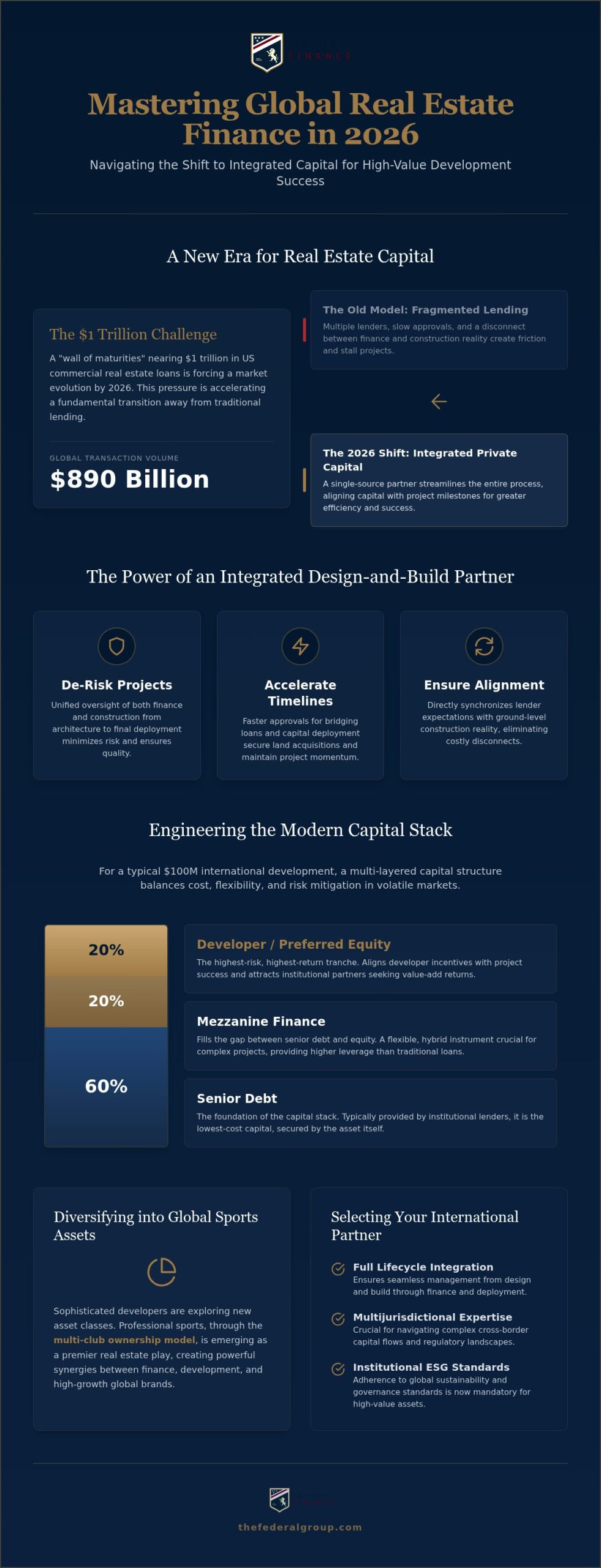
Traditional banking channels are no longer the primary engine for large-scale development. As of August 2026, the global market is processing a “wall of maturities” totaling nearly $1 trillion in the United States alone. This pressure has accelerated a transition toward private credit and alternative capital. Global real estate transactions have climbed to $890 billion, but success in this environment requires more than just liquidity. It demands an international real estate finance partner capable of bridging the gap between high-level capital deployment and the technical reality of construction.
Cross-border projects in 2026 require more than sophisticated legal architecture; they require operational synergy. The rise of the integrated developer-financier model reflects a market that no longer tolerates the disconnect between a lender’s spreadsheet and a project’s physical progress. By unifying these roles, partners can navigate the friction of moving capital across jurisdictions while maintaining strict oversight of the design-build phase.
Navigating Global Market Volatility and Interest Rate Trends
Market yields in 2026 are under constant pressure from shifting fiscal policies. With the US Federal Funds Rate holding between 3.75% and 4.00% and the European Central Bank adjusting benchmarks, traditional floating-rate debt has become a liability for cross-border projects. Strategic partners provide a buffer against this volatility by deploying long-term private equity rather than relying on brittle, short-term bank facilities. This stability allows developers to focus on asset management and tenant quality rather than refinancing risks. An integrated partner serves as a high-velocity catalyst for capital efficiency, synchronizing debt structures with construction timelines to eliminate idle liquidity.
The Shift Toward Institutional Private Equity
The era of fragmented bilateral lending is closing. Modern developers are moving away from managing multiple lenders across different jurisdictions, a process that often leads to stalled land acquisitions and mismatched incentives. Instead, they’re seeking a single-source institutional property investment partner to streamline the entire capital stack. This consolidation reduces administrative friction and ensures that capital deployment aligns with global ESG and sustainability standards, which are now mandatory for institutional-grade assets.
- Reduced project risk through unified oversight of both finance and construction.
- Faster bridging loan approvals to secure land acquisitions before competitors.
- Direct alignment between lender expectations and the ground-level construction reality.
The integrated developer-financier model eliminates the disconnect that typically plagues international projects. It ensures that the partner providing the capital also understands the architectural and engineering milestones required to protect that investment. Choosing the right international real estate finance partner in 2026 means selecting a specialist who manages the full lifecycle of capital and construction under one roof.
Structuring the Capital Stack for High-Value International Projects
In 2026, the complexity of mixed-use and hospitality developments necessitates a multi-layered approach to capital. An international real estate finance partner doesn’t just provide a loan; they engineer a stack that balances the cost of capital with operational flexibility. According to the Emerging Trends in Real Estate® report, the shift toward income-driven returns means every layer of the stack must be stress-tested against long-term interest rates. Senior debt remains the foundation, but the true differentiation occurs in the mezzanine and equity tranches where risk is mitigated through precise structuring.
Balancing risk and reward in high-stakes construction requires a methodical approach to leverage. For a typical $100 million international development, a partner might structure a 60% senior debt facility, a 20% mezzanine layer, and 20% developer equity. This layering protects the project from market dislocations while providing the liquidity needed for rapid mobilization. When these components are managed by a single integrated partner, the friction between different lenders disappears, allowing for a more resilient project lifecycle.
Mezzanine Finance and Preferred Equity Structures
Mezzanine capital serves as the vital link between senior debt and developer equity. In high-alpha projects, this layer reduces the developer’s direct equity requirement, allowing for greater portfolio diversification across different jurisdictions. Preferred equity structures often include profit participation tranches, aligning the interests of the financier with the project’s ultimate success. Implementing property finance for high-value projects requires a partner who understands how to layer these instruments without over-leveraging the asset. This middle-tier capital is especially essential for hospitality developments where the ramp-up period requires a flexible repayment schedule.
Bridging Loans for Strategic Land Acquisition
Speed is the primary currency in international land acquisition. In competitive markets, waiting for permanent property development loans can result in lost opportunities. Bridging loans provide the necessary short-term liquidity to secure high-value sites instantly. This fast-track capital maintains development momentum while the long-term institutional structuring is finalized. An international real estate finance partner with a specialized bridging division can bypass the bureaucratic delays typical of retail banking. This capability ensures that land is acquired at the right valuation before market pressures shift the price point. If you are looking to optimize your next project’s financial architecture, consulting with an integrated specialist can reveal hidden efficiencies in your capital stack.
The Power of an Integrated Design-and-Build Finance Partner
The traditional wall between the financier and the contractor often creates a vacuum of accountability. In large-scale international development, this disconnect leads to cost overruns and timeline slippage that can erode project yields. Selecting an international real estate finance partner that operates as an integrated developer-financier eliminates this friction. By managing the full lifecycle from initial architecture to final capital deployment, an integrated partner ensures that every dollar spent aligns with the project’s physical progress. This ecosystem approach provides a level of stability that fragmented lending models simply cannot match.
Financial transparency is the cornerstone of this integrated model. Instead of relying on delayed third-party reports, stakeholders receive real-time data from the construction site directly to the boardroom. This visibility allows for proactive adjustments rather than reactive crisis management. When the entity providing the capital also oversees the design-build phase, the interests of the lender and the developer are perfectly synchronized. It’s a strategic shift that transforms finance from a passive resource into an active tool for project success.
De-risking Projects Through Integrated Design
Early-stage architectural involvement is not merely a creative necessity; it is a financial safeguard. When design intent is established alongside the 2026 property development capital stack, the project’s technical feasibility is validated before the first shovel hits the ground. This eliminates the common friction between the financier and the general contractor regarding change orders or material substitutions. Integrated oversight lowers insurance and risk premiums by providing lenders with direct visibility into the technical feasibility and safety standards of the build. This foresight ensures that the capital allocated is sufficient to cover the true reality of the construction lifecycle.
Synergy Between Capital and Construction
The Federal Holdings approach exemplifies the ‘fully integrated’ advantage by operating as a specialized integrated design and build developer. This in-house expertise allows the partner to validate loan security through a deep understanding of structural requirements and local planning nuances. Because the development expertise is internal, the draw-down process is streamlined based on verified project milestones rather than arbitrary dates. This is where a specialized international real estate finance partner provides a distinct competitive advantage. It accelerates the pace of development while maintaining the rigorous oversight required to protect institutional capital in complex global markets.
- Reduced timeline slippage through synchronized design and procurement cycles.
- Elimination of ‘blind’ lending by using in-house engineering to verify site progress.
- Enhanced capital efficiency by matching funding tranches to specific construction phases.
Diversifying into Global Sports and Multi-Club Assets
Professional football clubs aren’t just cultural icons; they’re sophisticated real estate ecosystems. In 2026, institutional investors view these clubs through the lens of property development and precinct regeneration. The stadium is the anchor, but the surrounding land offers immense value through mixed-use residential, hospitality, and retail integration. This shift requires a specialized international real estate finance partner who understands both the intricacies of the sports industry and the technical requirements of industrial-scale development. Success in this sector depends on a partner’s ability to see beyond the pitch and value the underlying property assets effectively.
The match-day experience is expanding into a year-round revenue stream. Precinct redevelopment transforms underutilized urban areas into vibrant commercial hubs that drive consistent cash flow. This transition relies on the expertise of a dedicated Sports Division to manage the global asset portfolio. It’s about capitalizing on the physical footprint of the club to create a destination that serves the community every day of the week, not just during ninety minutes of play.
Professional Football as a Real Estate Asset Class
Valuing the underlying property assets of professional sports clubs requires a technical precision that traditional lenders often lack. Beyond the stadium’s seats, the value lies in training facilities, youth academies, and the surrounding commercial land. High-value stakeholders are increasingly using precinct redevelopment to modernize these assets and maximize their yield. This strategy requires an integrated approach where the financier also understands the architectural and planning challenges of large-scale sports infrastructure. By focusing on asset management and tenant quality within the stadium precinct, investors can secure stability in a high-stakes market. A global sports investment group with data-driven valuation capabilities is essential for accurately pricing these complex, multi-layered assets.
Financing Multi-Club Ownership (MCO) Models
Multi-club ownership has become the dominant model for scaling global sports portfolios. This structure allows for strategic synergies across multiple international sports entities, sharing operational costs and talent networks. Structuring debt across these jurisdictions requires a partner with multijurisdictional presence and deep private equity expertise. Investors typically use a combination of bridging loans for rapid acquisition and long-term private equity to fund the subsequent infrastructure development. This allows for rapid scaling while maintaining a manageable capital stack. A rigorous approach to financial structuring for multi-club ownership is essential for navigating UEFA’s regulatory thresholds and ensuring compliance across all jurisdictions.
Integrated finance is the key to scaling these portfolios successfully. By layering debt and equity across multiple clubs, investors can create long-term value that transcends individual match results. The MCO model isn’t just about diversification; it’s about building a global scale that attracts high-value institutional interest. If you’re ready to explore high-yield opportunities in this specialized sector, you can partner with our Sports Division to secure your next acquisition and manage the full lifecycle of your sports assets.
- Strategic synergies that reduce operational overhead across multiple clubs.
- Precinct regeneration to drive non-matchday revenue through retail and hospitality.
- Bridging finance to capitalize on acquisition opportunities before they leave the market.
Selecting Your International Real Estate Finance Partner
The choice of an international real estate finance partner is a strategic decision that determines the resilience of your global portfolio. In a 2026 market defined by rapid interest rate shifts and institutional “walls of maturities,” selecting a partner based solely on the lowest cost of capital is a high-risk strategy. You need a partner that understands the operational friction of international development. This means vetting for a multijurisdictional presence and a proven track record of navigating the regulatory nuances of the US, UK, and European markets simultaneously.
Speed is the second essential metric. In competitive land acquisition scenarios, the ability to deploy bridging loans within days rather than months is what separates market leaders from those left behind. An effective partner doesn’t just offer debt; they offer a vision that aligns with the developer’s full project lifecycle. They should possess the private equity reserves to support a project from the initial land grab through to the final stabilization of the asset, ensuring that capital flow remains uninterrupted regardless of broader market volatility.
Criteria for Global Scalability
Evaluating a partner’s scalability requires looking beyond their balance sheet. You must assess the depth of their specialized development finance reserves and their ability to structure complex, multi-layered capital stacks across different currencies. A partner who operates as a fully integrated design and build developer provides a level of security that pure-debt lenders cannot match. This integration ensures they understand the technical milestones of your build, reducing the likelihood of funding delays during critical construction phases. When vetting potential partners, prioritize those with established teams on the ground in your target jurisdictions to ensure local expertise is always accessible.
The Federal Group: Your 2026 Strategic Partner
The Federal Group represents the evolution of the international real estate finance partner. By combining sophisticated capital solutions with the design-build excellence of Federal Holdings, we provide an ecosystem that manages every stage of a project’s lifecycle. Our partners benefit from a unified approach where finance and construction are synchronized to eliminate waste and maximize project yields. This integrated model is particularly effective for high-alpha ventures, including the complex redevelopment of professional sports precincts and mixed-use hospitality assets.
Accessing specialized funding through our Sports Division allows investors to capitalize on the unique synergies of multi-club ownership while maintaining the security of institutional-grade property finance. Whether you are securing a strategic land site with a bridging loan or scaling a global football portfolio, our team provides the technical precision and capital depth required for success. The next step in securing your development’s future is a direct consultation to align our integrated solutions with your 2026 growth objectives.
- Multijurisdictional expertise across major global markets to ensure seamless capital flow.
- Integrated design-build capabilities through Federal Holdings to de-risk construction phases.
- Niche asset specialization in professional sports and high-value mixed-use developments.
- Rapid deployment of bridging finance to capitalize on time-sensitive acquisition opportunities.
Securing Your Global Development Legacy in 2026
The transition toward an integrated developer-financier model isn’t just a trend; it’s a necessary evolution for navigating a trillion-dollar wall of maturities and shifting global yields. Success in this high-stakes environment depends on your ability to unify capital deployment with ground-level construction oversight. By bridging the gap between sophisticated private equity and technical design-build expertise, you eliminate the friction that typically stalls international land acquisitions and complex redevelopments.
Selecting the right international real estate finance partner allows you to capitalize on emerging opportunities, from mixed-use hospitality precincts to the strategic growth of multi-club sports ownership. The Federal Group provides the scale and specialized expertise required to master these complexities. As a fully integrated developer and strategic bridging finance specialist, we ensure your project maintains momentum from initial site acquisition through to final stabilization.
Partner with The Federal Group for your next high-value development to leverage our specialized Sports Division and institutional-grade capital structures. Your next global milestone is within reach.
Frequently Asked Questions
What defines an international real estate finance partner in 2026?
An international real estate finance partner is an integrated entity that provides cross-border capital solutions and operational oversight across multiple jurisdictions. Unlike traditional lenders, these partners manage the full project lifecycle through development finance and private equity. They specialize in navigating complex regulatory environments while ensuring that capital deployment remains synchronized with the physical progress of high-value developments in global markets.
How do bridging loans differ from traditional development finance?
Bridging loans are short-term liquidity instruments designed for rapid deployment, whereas traditional development finance covers the multi-year construction phase. Developers use bridging capital to secure strategic land acquisitions or solve immediate liquidity gaps before long-term institutional funding is finalized. These loans prioritize speed and flexibility, allowing stakeholders to capitalize on time-sensitive opportunities that traditional banking structures might miss due to bureaucratic delays.
Why is integrated design-build important for international property finance?
Integrated design-build de-risks the capital stack by unifying the financier and the contractor under a single umbrella of accountability. This model eliminates the friction typically found in cross-border projects where lenders are disconnected from construction realities. By managing both the architecture and the funding, a partner can reduce cost overruns and timeline slippage, providing a level of transparency that protects institutional project yields.
Can real estate finance be used for professional football club acquisitions?
Yes, professional sports clubs are increasingly viewed as sophisticated real estate asset classes where finance is secured against underlying property. Acquisitions often leverage the value of stadiums, training facilities, and surrounding land for precinct redevelopment. Using an international real estate finance partner with a specialized sports division ensures that the acquisition capital is structured to maximize the commercial potential of these high-alpha property assets.
What are the benefits of a multi-club ownership strategy in sports?
Multi-club ownership (MCO) creates global scale and strategic synergies by sharing talent, infrastructure, and commercial resources across different leagues. This model attracts institutional investors by diversifying geographical risk and maximizing the value of stadium precincts through mixed-use development. It allows for a more efficient capital stack, as debt can be structured across a portfolio of international sports entities rather than a single club.
How does a private equity partnership help scale a property portfolio?
Private equity provides the long-term, stable capital required for high-stakes projects that traditional retail banks often avoid. It allows developers to deploy capital more aggressively across diverse asset classes while maintaining a balanced debt-to-equity ratio. A private equity partner brings strategic insight and institutional weight, helping to scale portfolios into emerging sectors like professional sports or specialized hospitality with greater speed and security.
What jurisdictions does The Federal Group cover for property finance?
The Federal Group operates as a specialized international real estate finance partner with a primary focus on the United Kingdom, the United States, and European markets. This multijurisdictional presence is essential for facilitating seamless cross-border capital flow for institutional-scale developments. Our teams provide the local expertise required to navigate different tax regimes and planning laws, ensuring that global deployments are executed with technical precision.
What is the typical duration for an international bridging loan?
International bridging loans typically range from 6 to 24 months in duration. They are structured as temporary facilities designed to secure assets or bridge liquidity gaps until a project transitions to permanent development loans or is exited through a sale. This short-term nature provides the agility needed for rapid land acquisition, allowing developers to maintain momentum while their long-term financial architecture is being finalized.