The Efficiency of the Integrated Design and Build Developer in 2026
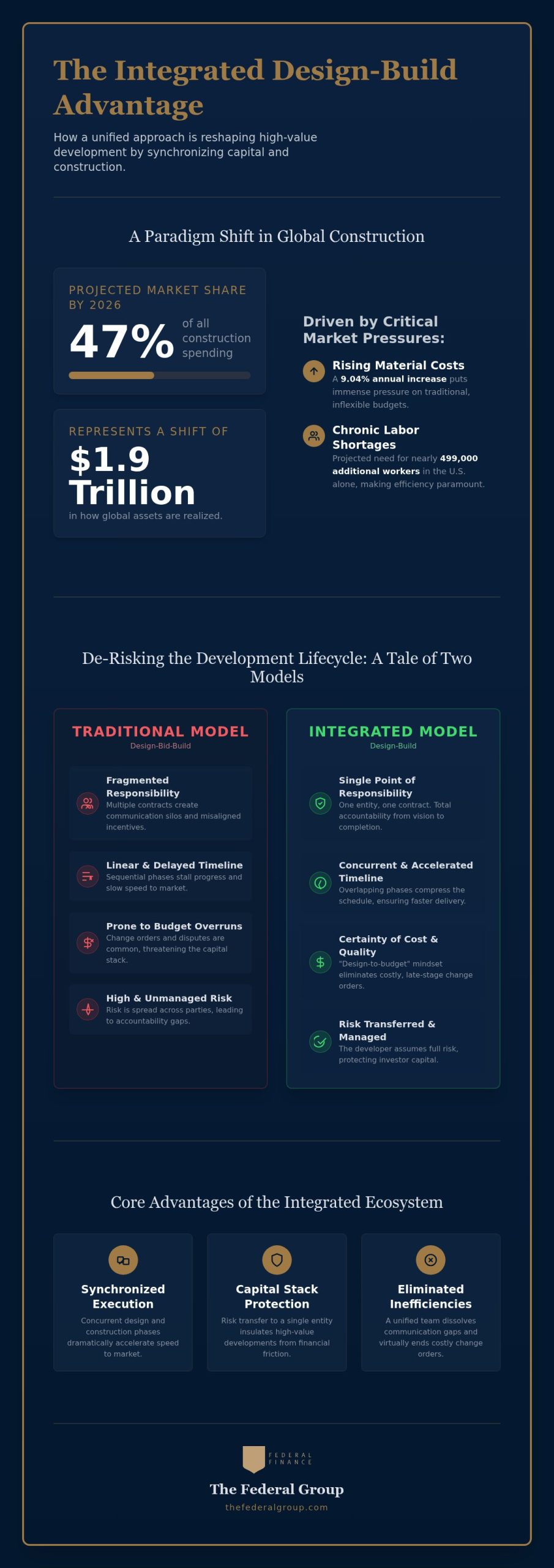
5 August 2026By the end of 2026, the integrated design-build model is projected to account for over 47% of all construction spending, representing a $1.9 trillion shift in how global assets are realized. For the sophisticated investor, the traditional separation of architectural vision and construction execution is no longer a viable strategy in a market defined by a 9.04% annual increase in material costs and chronic labor shortages. Engaging a specialized integrated design and build developer has become the requisite standard for those seeking to insulate high-value developments from the friction of fragmented workflows.
You likely recognize that communication silos and misaligned incentives between architects and contractors are the primary drivers of budget overruns and delayed speed to market. This article demonstrates how a fully synchronized model eliminates these inefficiencies by aligning the capital stack with technical execution from day one. We’ll explore how this integrated approach provides certainty of cost and quality, simplifies the management of complex international asset classes, and ultimately enhances ROI through superior project lifecycle control.
Key Takeaways
- Understand how the integrated design and build developer model provides a single point of responsibility, streamlining the transition from architectural vision to physical completion.
- Discover how concurrent design and construction phases accelerate speed to market while virtually eliminating the budget overruns associated with traditional change orders.
- Learn the mechanics of risk transfer and how shifting accountability to a single entity protects the capital stack of high-value international developments.
- Identify the essential criteria for evaluating a partner’s ability to manage both the financial complexity of private equity and the technical demands of large-scale construction.
- Explore the competitive advantage of synchronizing development finance with the build lifecycle to ensure absolute certainty of cost and quality.
What is an Integrated Design and Build Developer in 2026?
In 2026, an integrated design and build developer is defined as a single-contract entity that manages every project phase, from initial architectural vision through to final construction and commissioning. This model moves beyond the capabilities of a traditional builder by incorporating the entire development lifecycle within one organizational framework. The primary objective is to dissolve the friction between design intent and construction reality. By consolidating these functions, the developer assumes a single point of responsibility, offering high-value stakeholders a level of accountability and transparency that fragmented models cannot replicate.
The industry is currently witnessing a transition toward capital-aware development. This shift is driven by the necessity of aligning design decisions with real-time financial data and construction costs. In an environment where the Construction Materials Producer Price Index has shown volatility, a developer who understands the capital stack is better equipped to protect investor margins. It’s no longer enough to simply build; the modern developer must orchestrate the financial and physical aspects of a project in total unison.
The Evolution of the Design-Build Model
Modern property development has moved past the linear, often adversarial, nature of the traditional Design-Bid-Build approach. High-stakes international projects now require the maturity of the design-build framework, which has been enhanced by AI-driven generative design and Building Information Modeling (BIM). By 2026, digital twins have become standard, allowing developers to simulate construction phases and energy efficiency benchmarks before a single worker arrives on site. This technological integration ensures that global market expertise is applied at the earliest design stage, de-risking the project from the outset.
Key Stakeholders in the Integrated Ecosystem
The developer functions as the central orchestrator of the Architectural, Engineering, and Construction (AEC) teams. For institutional investors, this structure simplifies reporting and provides a clear view of project health without the need to manage multiple cross-border partners. Working with a specialized property development investment group allows stakeholders to leverage integrated finance solutions. This alignment ensures that private equity and development finance are synchronized with the physical build, creating a robust ecosystem where every participant is focused on a singular, successful outcome. This synergy is particularly vital in 2026, as the U.S. construction industry faces a projected need for nearly 499,000 additional workers, making efficiency the ultimate currency.
The Single Source Advantage: Efficiency and Speed to Market
Speed to market is the primary differentiator for high-value developments in 2026. The traditional linear model, where design must be finalized before bidding begins, often creates a stagnant timeline. In contrast, an integrated design and build developer utilizes concurrent project phases to compress the schedule. By overlapping the design and construction cycles, site preparation and foundation work can begin while the final interior details are still being refined. This approach doesn’t just save time; it ensures that the project remains responsive to shifting market demands.
One of the most significant financial drains in traditional development is the prevalence of change orders. These typically arise from a disconnect between the architect’s plans and the contractor’s field reality. By involving construction experts during the initial conceptualization, an integrated firm identifies potential structural conflicts early. This proactive involvement creates a “design-to-budget” environment where the architectural vision is protected rather than compromised by late-stage cost-cutting. Accurate pre-construction data is also a prerequisite for securing international property development finance, as institutional lenders prioritize projects with verified cost certainty and clear execution paths.
Eliminating the Communication Gap
Friction often occurs when a creative vision meets structural and financial reality. Utilizing a framework of Integrated Design allows for a multidisciplinary team to work in a unified feedback loop. Lessons captured from previous builds are immediately applied to new designs, ensuring that every aesthetic choice is technically feasible. Real-time budgeting tools allow the team to see the immediate financial impact of design changes, preventing the “sticker shock” that often halts projects during the bidding phase. This synergy keeps the creative momentum high while maintaining strict adherence to the capital stack.
Optimizing the Supply Chain and Procurement
With the Construction Materials Producer Price Index showing a 9.04% increase in the year leading up to June 2026, procurement strategy has become a critical risk management tool. Integrated developers leverage their scale to secure long-lead items, such as specialized HVAC systems or structural steel, far earlier than a traditional contractor could. This developer-level procurement power allows for the hedging of material costs against future volatility. Institutional partners often find that leveraging a finance-led development partner provides the necessary stability to navigate these global supply chain complexities. Procurement integration ensures that long-lead materials are secured well before they can become critical-path delays on the construction site.
Integrated vs. Traditional: De-risking the Development Lifecycle
Traditional property development often relies on a fragmented “Design-Bid-Build” sequence. This linear approach creates a high-risk environment where the asset owner must mediate between an architect’s vision and a contractor’s technical limitations. In contrast, an design-build project delivery system consolidates these functions. By engaging an integrated design and build developer, stakeholders benefit from a total transfer of operational risk. The developer assumes full liability for design errors, omissions, and construction delays, providing a level of security that fragmented contracts simply cannot offer.
A common objection to this model is the perceived lack of price competition. However, traditional bidding frequently leads to artificially low initial quotes followed by aggressive change orders that inflate the final cost. The integrated model optimizes the total lifecycle cost by identifying technical hurdles before they reach the construction site. This is particularly vital when utilizing bridging finance for land acquisition. Lenders are more inclined to provide capital when they see a clear, de-risked path from site purchase to project completion, rather than a speculative plan prone to inter-party disputes.
Financial Certainty and Cost Control
Financial stability in 2026 requires more than just a budget; it requires a Guaranteed Maximum Price (GMP). Within an integrated framework, the developer provides cost certainty much earlier in the project lifecycle. Because the construction team is involved in the design phase, “value engineering” happens in real-time. This prevents the adversarial relationships common in traditional models, where budget overruns lead to finger-pointing between the creative and technical teams. Instead, every participant is incentivized to maintain the budget while preserving the asset’s quality. Partnering with a specialized development finance lender that understands full-lifecycle funding ensures that capital is structured to support this cost certainty from land acquisition through to final build.
Risk Mitigation for Private Equity Partners
For a real estate private equity partner, the primary concern is a clean and profitable exit. An integrated developer simplifies this process by providing a single point of accountability for the entire build. This structure reduces the legal complexity of cross-border developments and streamlines the due diligence process for future institutional buyers. When warranties and project documentation are consolidated within one firm, the risk of litigation and technical disputes is significantly diminished. In a market where material costs have risen by 9.04% annually, this consolidated oversight is the most effective way to protect the capital stack and ensure long-term ROI. Institutional stakeholders seeking to maximize returns should explore how engaging a full lifecycle property developer consolidates disparate phases into a single, high-performance ecosystem that protects margins from the initial concept.
Selecting an Integrated Design and Build Developer
Selecting the right partner is a high-stakes decision that dictates the long-term viability of an international asset. You must distinguish between a firm that is truly unified and one that merely operates as a temporary joint venture. A joint venture often lacks the deep-rooted technical and cultural alignment necessary to manage complex projects; it frequently reverts to the same communication silos that plague traditional models. A true integrated design and build developer possesses a permanent, internal structure where architects, engineers, and construction managers share a single set of KPIs and a unified technological stack.
The ideal partner must also demonstrate a proven track record as an international real estate finance partner. Physical development cannot be separated from the capital stack; the developer must understand how design choices impact debt covenants and equity returns. This financial literacy ensures that the project remains bankable from inception through to the final exit. You should prioritize firms that manage the entire lifecycle, from architecture to construction, as this single point of responsibility is the most effective de-risking factor for private equity stakeholders. Many investors still operate under outdated assumptions about how capital partners function; understanding the top myths about property development investment groups in 2026 can help you identify the right integrated partner with greater confidence.
The Importance of In-House Expertise
Integration shouldn’t be a euphemism for subcontracted services managed under one roof. You need to evaluate the depth of the firm’s in-house studio and field teams. Ask how their construction managers interact with the design software during the conceptual phase. If the firm uses Building Information Modeling (BIM) to its full potential, the transition between design and construction is invisible. This internal synergy prevents the technical errors and “lost in translation” moments that occur when external consultants misinterpret a project’s intent. True efficiency is found when the design studio and the field teams operate as a single, cohesive unit.
Global Reach and Local Knowledge
Navigating cross-border regulatory compliance requires a developer with established local networks and a sophisticated understanding of regional planning laws. Whether it’s the 2024 IECC energy codes or specific state-level carbon mandates, the developer must be proactive in their compliance strategy. They need to manage site acquisition and planning with the foresight of a local expert while maintaining the scale of a global corporation. International experience is non-negotiable because it provides the institutional foresight required to navigate the volatile intersection of global finance and local building regulations. To see how our execution arm can streamline your next project, consult with our development specialists.
The Federal Group: Synchronising Capital and Construction
The Federal Group operates at the precise intersection of institutional finance and large-scale physical development. Through our Federal Holdings division, we function as a fully integrated design and build developer, providing a seamless transition between the capital stack and the construction site. This ecosystem approach distinguishes our operations from firms that focus purely on construction logistics. We recognize that for high-stakes property and sports ventures, the financial structure is as critical as the architectural foundation. By aligning our private equity and development finance expertise with our physical execution arm, we eliminate the friction that typically occurs between lenders and builders.
Our model is built on the reality of the 2026 market, where material volatility and labor shortages demand a developer who can pivot with financial authority. We don’t just manage a project; we own the responsibility for its success. This integrated perspective allows us to view every design choice through the lens of long-term asset value and investor security, ensuring that the visionary energy of a development is always grounded in fiscal reality.
Federal Holdings: Full Lifecycle Management
We manage property projects from the initial concept through to final delivery and asset management. This continuity ensures that the original vision remains intact while adhering to strict financial parameters. Having a financier’s perspective during the architectural design phase allows us to identify potential ROI bottlenecks before they manifest in the field. Our team specializes in managing the entire lifecycle, from architecture to construction, which serves as a major de-risking factor for our private equity partners. This commitment to delivering high-potential developments is backed by a global reach that spans both international property and professional sports markets, providing a level of scale and sophistication that niche consultancies cannot match.
The Synergy of Finance and Development
Our capital solutions, including private equity and specialized bridging loans, are designed to streamline the construction process for our partners. By integrating bridging finance for rapid project acquisition, we allow stakeholders to move with the speed required in a competitive global market. This synergy eliminates the delays often found when developers must wait for third-party lenders to approve drawdowns or design changes. We offer a single point of responsibility that de-risks the entire project lifecycle, ensuring that capital is deployed efficiently and quality is never compromised. Whether you are developing a stadium complex or a multi-use international asset, our integrated model provides the certainty of cost and quality that the current market demands. Contact The Federal Group to discuss your next integrated project.
Securing Strategic Advantage in Global Development
The transition toward a unified project delivery system is no longer a luxury but a requirement for institutional stakeholders. By 2026, the ability to synchronize the capital stack with technical execution has become the primary driver of project viability. Engaging an integrated design and build developer allows you to bypass the friction of fragmented contracts, ensuring that architectural vision and financial reality remain in total alignment. This model provides the single point of responsibility necessary to insulate high-value assets from market volatility and labor shortages.
The Federal Group offers a unique ecosystem approach through our Federal Holdings division, where international development finance expertise meets world-class construction management. Our ability to leverage private equity and sports division synergies ensures that every project is positioned for a clean exit and superior ROI. We invite you to explore how our integrated solutions can de-risk your portfolio and accelerate your speed to market in an increasingly complex global environment. We look forward to helping you realize your most ambitious development goals.
Partner with The Federal Group for Your Next Integrated Development
Frequently Asked Questions
What is the main difference between design-build and integrated design-build?
Standard design-build is a project delivery system, whereas an integrated design and build developer manages the entire ecosystem, including development finance and private equity. This holistic approach ensures that architectural intent remains synchronized with the capital stack. Traditional models often focus solely on the contract, but integration prioritizes the long-term asset value and operational efficiency from the earliest conceptual stage.
Is an integrated design and build developer more expensive than traditional contractors?
Total project costs are typically lower in the integrated model due to the virtual elimination of adversarial change orders and delays. While traditional contractors might provide a lower initial bid, those figures often inflate during the build phase. An integrated developer provides cost certainty through a Guaranteed Maximum Price (GMP) and value engineering, identifying potential financial risks before they impact the construction site.
How does the integrated model accelerate project timelines in 2026?
Overlapping the design and construction phases allows site preparation to begin while final interior details are still being refined. In 2026, the use of digital twins and real-time BIM data enables the team to simulate construction hurdles before they occur. This concurrency significantly compresses the delivery schedule, allowing assets to reach the market and begin generating returns much faster than linear models.
Can an integrated developer handle international cross-border projects?
Sophisticated integrated developers possess the global reach and local planning expertise required to navigate cross-border regulatory environments. They manage site acquisition and compliance with regional energy codes while maintaining institutional-grade reporting for international stakeholders. This capability is essential for high-value developments where understanding the intersection of global finance and local building mandates is a non-negotiable requirement for success.
What role does private equity play in an integrated development model?
Private equity provides the essential capital stack that fuels the design and build process from inception. In an integrated model, equity partners benefit from a de-risked environment where a single entity is accountable for the project’s physical and financial health. This alignment simplifies the due diligence process and ensures a cleaner exit strategy, as the integrated design and build developer manages the entire lifecycle to protect investor margins.
How does an integrated developer handle design changes during construction?
Design changes are managed through real-time feedback loops between the architectural studio and the field teams. Because the developer possesses in-house expertise in both disciplines, the financial and structural impact of a change is calculated immediately. This prevents the “lost in translation” moments that occur in fragmented models, ensuring that any modifications remain within the established budget and timeline constraints.
Why is a ‘single point of responsibility’ important for institutional investors?
Institutional investors prioritize a single point of responsibility because it transfers operational and legal risk to the developer. This structure eliminates the finger-pointing common in traditional models when budget overruns or technical errors occur. Having one accountable partner simplifies project oversight and provides a transparent view of project health, which is vital for maintaining the security of large-scale institutional investments.
Does the integrated model work for sports-related property developments?
The integrated model is exceptionally effective for sports-related developments, such as stadium complexes or training facilities, which require complex technical and financial synchronization. These projects often involve multi-club ownership structures that demand a high level of specialized expertise in financial structuring for multi-club ownership, including the use of Special Purpose Vehicles and holding company frameworks to maximize commercial synergies. An integrated developer manages the unique requirements of sports infrastructure while ensuring the project remains a viable commercial asset within a broader global portfolio.