The Strategic Role of a Real Estate Private Equity Partner in 2026
27 July 2026In 2026, the era of the passive institutional investor is officially over. With real estate fundraising hitting a nine-year low in the first half of the year, securing a real estate private equity partner is no longer just about the check; it’s about finding an integrated operator who can navigate a tightening regulatory environment. The recent passage of the 21st Century ROAD to Housing Act has fundamentally shifted the landscape for institutional investors, making vertical integration and specialized asset classes more critical than ever.
You likely recognize that capital constraints and complex cross-border regulations are the primary barriers to acquiring high-potential, large-scale projects. This article explores how a strategic real estate private equity partner provides the capital reserves and operational expertise required to scale global property portfolios effectively. We will examine the shift toward operationally intensive assets, the integration of AI-driven data, and the growing synergy between property development and international sports ventures. Discover how a vertically integrated approach de-risks complex developments and opens doors to diversified, high-value markets.
Key Takeaways
- Learn why a real estate private equity partner is essential for providing risk-aligned growth capital that exceeds the limitations of traditional senior debt.
- Understand how Joint Venture structures and the strategic placement of preferred equity can align interests and optimize your project’s capital stack.
- Compare the flexibility and high leverage of private equity against the restrictive covenants of traditional development finance to determine the best fit for your portfolio.
- Identify the operational advantages of partnering with firms that offer vertical integration, combining design-and-build expertise with institutional finance.
- Discover how to scale into international markets and specialized assets, such as professional sports ventures, through a fully integrated partnership model.
Defining the Role of a Real Estate Private Equity Partner
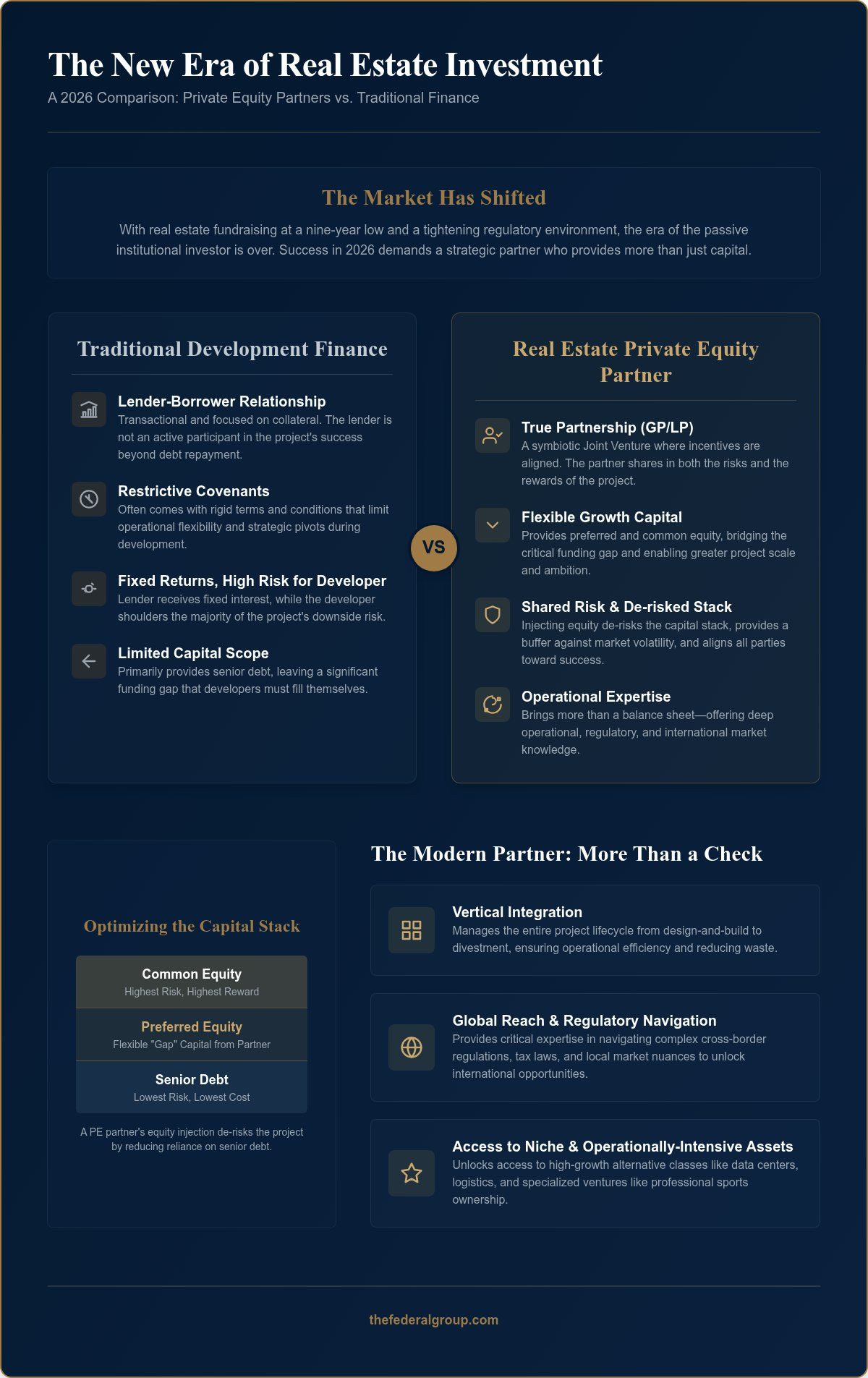
The role of a real estate private equity partner has evolved far beyond the provision of senior debt. In the current market, these entities offer risk-aligned growth capital that functions as the lifeblood of large-scale, high-potential developments. Unlike traditional lenders who prioritize collateral and fixed returns, an equity partner shares in the project’s success, aligning their incentives with the developer’s long-term vision. This relationship often takes the form of Private equity real estate ventures where the distinction between General Partners (GP) and Limited Partners (LP) is clearly defined. The GP typically manages the day-to-day operations and execution, while the LP provides the bulk of the capital. It’s a structure that balances specialized expertise with massive financial scale.
Equity partners bridge the critical gap between traditional bank financing and the total project cost. With commercial mortgage rates currently ranging from 5.64% to 12.75% as of July 2026, developers face significant hurdles when relying solely on debt. A strategic partner provides the “gap” capital that allows projects to move from planning to completion without over-leveraging the asset. This shift toward institutional-grade partnerships reflects a global market that demands stability, scale, and specialized expertise. By injecting equity rather than debt, these partners de-risk the capital stack and provide the flexibility needed to weather economic shifts.
Capital vs. Strategy: What Makes a Partner?
A true partner isn’t a passive investor. They bring more than just a balance sheet to the table. Strategic partners offer operational integration, often managing the entire lifecycle of a project from design to divestment. Developers now favor equity over high-leverage debt because it provides a buffer against market volatility. In international property finance, local market expertise is non-negotiable. A partner with a global reach can navigate cross-border regulations that would otherwise stall a project. They understand the nuances of regional zoning laws, tax implications, and cultural business practices. This proactive approach ensures that every dollar of capital is backed by a robust execution strategy.
The 2026 Landscape for Private Equity in Property
In 2026, capital deployment is gravitating toward operationally intensive assets. We see a marked rise in alternative classes like data centers, logistics hubs, and specialized sports-related assets. Investors aren’t just looking for buildings; they’re looking for ecosystems with secular demand drivers. Partnerships in 2026 prioritize three core pillars:
- Risk mitigation through diversified asset allocation across international borders.
- Operational efficiency via integrated design-and-build models that reduce waste.
- Strategic access to niche markets, including multi-club sports ownership and renewables.
A modern real estate private equity partner acts as the primary catalyst for project scalability by providing the operational depth and institutional credibility required to unlock complex global opportunities. This approach ensures that capital isn’t just deployed; it’s optimized for maximum impact within a diversified international portfolio.
The Mechanics of Real Estate Equity Partnerships
Effective partnerships in 2026 rely on meticulously crafted Joint Venture (JV) structures. These arrangements align the interests of both parties by distributing risk and reward based on specific performance milestones. Unlike a standard loan agreement, a JV with a real estate private equity partner creates a symbiotic relationship where the partner provides operational oversight alongside capital. This is particularly vital when navigating the complexities of international property development finance, where regulatory nuances can derail a project without experienced guidance. By sharing the burden of execution, these structures ensure that the partner is as invested in the project’s success as the developer.
The internal mechanics of these deals hinge on the positioning of equity within the capital stack. Preferred equity often acts as a flexible bridge, sitting between senior debt and common equity. It provides the partner with priority in the payment waterfall, offering a layer of security while allowing the developer to retain more of the project’s ultimate upside. For developers, this mezzanine-style flexibility is often the difference between a stalled project and a successful ground-break. It allows for higher leverage than traditional banks offer, while maintaining a structure that remains palatable to institutional stakeholders. Understanding the full spectrum of strategic real estate equity partnership models available in 2026 is essential for developers seeking to optimize their capital stack and align interests from the outset.
Structuring the Capital Stack for Maximum ROI
A sophisticated partner does more than fill a funding gap; they optimize the entire financial structure. By introducing significant equity, they lower the project’s overall leverage, which significantly improves creditworthiness in the eyes of senior lenders. This often leads to more favorable terms on the remaining debt. Planning for liquidity is equally critical. We prioritize clear exit strategies, whether through a secondary sale, refinancing, or a structured buyout, ensuring all stakeholders have a transparent path to realization. Developers seeking to optimize their next high-value project can explore our integrated private equity solutions to secure a more robust financial foundation.
Risk Management and Due Diligence
Institutional partners perform exhaustive due diligence that extends beyond financial modeling. In 2026, this includes assessing “skin in the game”, ensuring that all parties have a meaningful financial stake to maintain alignment. The rise of vertical integration is a key de-risking factor. Partners who possess in-house design-and-build capabilities can identify potential construction bottlenecks before they impact the budget. This integrated approach is essential for managing cross-border regulatory risks, especially in a year where policy shifts like the ROAD to Housing Act have introduced new layers of complexity to asset acquisition. We mitigate these risks through:
- Rigorous stress-testing of cash flow projections against current commercial mortgage rates.
- Deep-dive analysis of local zoning and international property finance regulations.
- Verification of vertical integration capabilities to ensure project timelines are met.
This level of scrutiny ensures that every real estate private equity partner involvement adds a layer of institutional security, making the project more attractive to subsequent rounds of financing or eventual buyers.
Private Equity vs. Traditional Development Finance
Traditional bank loans often appeal to developers due to their lower nominal interest rates. However, these facilities come with rigid constraints and conservative Loan-to-Value (LTV) ratios that rarely exceed 60% or 65% in the current climate. This leaves a significant capital gap that can stall high-potential projects before they break ground. In contrast, a real estate private equity partner provides the depth of capital required to fund the entire development lifecycle. While this model involves a share of the project’s profits, it eliminates the restrictive covenants that often accompany institutional debt. It’s a shift from a purely transactional relationship to a performance-based alliance. Developers navigating this transition can benefit from understanding how private equity for property developers has become the primary engine for global scale in a market where traditional institutions lack the agility to handle complex, cross-border projects.
Speed of execution is another critical differentiator. Institutional banks are frequently bogged down by layers of bureaucratic committees and inflexible risk models. A private equity partner operates with the agility of a specialist, often moving from initial due diligence to capital deployment in a fraction of the time. This speed is vital in competitive global markets where time-sensitive acquisitions are the norm. Furthermore, equity partnerships preserve developer liquidity. By reducing the amount of personal capital tied up in a single asset, developers can diversify their focus and manage multiple concurrent projects without overextending their balance sheets.
When to Choose Equity Over Debt
Large-scale projects with long horizons often outgrow the capacity of senior debt alone. When standard bridging loans are insufficient to carry a project through its full development phase, a property development joint venture finance model becomes the logical choice. It’s ultimately a question of project success probability. A developer might prefer 100% ownership of a project that struggles for funding, but a 50% stake in a fully capitalized, institutional-grade development is often more lucrative. Equity partners provide the financial floor necessary for ambitious growth.
Control and Governance in Equity Models
Partnering with a real estate private equity partner introduces a structured governance dynamic. Decision-making rights are typically shared, which requires a high level of transparency and rigorous reporting standards. Institutional partners expect clear financial oversight and regular updates on project milestones. This shouldn’t be viewed as a loss of control, but rather as an infusion of discipline. A strategic partner adds value through their global network, proprietary market data, and operational insights. They act as a sophisticated sounding board, de-risking the venture through collaborative governance and ensuring the project meets the high standards required for an eventual institutional exit.
Key Criteria for Selecting an Institutional Real Estate Partner
Selecting a real estate private equity partner isn’t merely about accepting the highest bid or the most aggressive leverage. It requires a rigorous assessment of institutional reliability and the capacity for follow-on funding. In a market where commercial mortgage rates remain volatile, you need a partner with the liquidity to support a project through its entire lifecycle, even if market conditions shift. Financial stability ensures that the venture isn’t compromised during unexpected economic cycles. Beyond the balance sheet, cultural and strategic alignment is paramount. Both parties must share a synchronized vision for the asset’s development and eventual exit, ensuring that governance doesn’t become a bottleneck for progress.
A proven track record in complex asset classes is equally vital. Whether you’re developing high-density multifamily units or specialized logistics hubs, your partner should bring deep sector expertise. This expertise acts as a secondary layer of due diligence, identifying risks that a purely financial investor might overlook. By choosing a partner with a history of successful execution in similar high-potential developments, you gain more than capital; you gain an institutional ally that understands the operational nuances of the asset class.
The Value of Vertical Integration
Friction in capital deployment often stems from a disconnect between the financier and the project team. Choosing a real estate private equity partner with vertical integration provides a distinct advantage by closing this gap. The Federal Holdings model illustrates this efficiency perfectly. Operational since 2009, this fully integrated approach combines design-and-build capabilities with strategic finance. By maintaining in-house project management, we ensure that architectural vision and financial feasibility are aligned from the outset. This de-risks the construction phase, providing real-time cost control and oversight that prevents the budget overruns common in non-integrated ventures.
Global Reach and Cross-Border Expertise
Managing international property finance requires a partner who can navigate regional shifts with precision. A partner with a diverse global portfolio can identify emerging opportunities in the US, UK, and emerging markets while mitigating localized risks. For instance, the recent passage of the 21st Century ROAD to Housing Act in the US has fundamentally changed the landscape for institutional single-family acquisitions. A partner with cross-border expertise already has the infrastructure to adapt to these regulatory changes. They leverage international networks to facilitate smoother project acquisitions and structured exits, ensuring your portfolio remains resilient across different jurisdictions. This breadth of perspective is essential for scaling a property portfolio on a truly global scale.
To secure a partner that combines institutional stability with specialized development expertise, partner with The Federal Group for your next high-value project.
Scaling Global Portfolios with The Federal Group
The Federal Group represents the evolution of the real estate private equity partner. We aren’t merely a source of capital; we’re an integrated ecosystem of finance and development expertise. Operational since 2009, our firm has mastered the art of vertical integration through Federal Holdings. This allows us to manage every facet of a project’s lifecycle, from the initial architectural concept to the final divestment. By combining development finance, private equity, and design-and-build capabilities, we provide a seamless path to completion for high-potential property developments across the globe. Our structure is designed for maximum scalability, addressing the capital constraints and regulatory hurdles that often stall ambitious ventures.
We provide comprehensive capital solutions that adapt to your specific project needs. Whether you require bridging finance for land acquisition to secure a time-sensitive asset or long-term equity to fund a ground-up development, our approach is always strategic. We don’t just provide funding; we provide a partnership that adds operational value. This is especially critical in 2026, where the ability to manage multiple concurrent projects without overextending internal resources is a significant competitive advantage. We act as a stabilizer and a catalyst, ensuring your portfolio has the institutional weight required to thrive in a complex global market.
Innovative Asset Classes: The Sports Division
One of our most distinct advantages in 2026 is our specialized Sports Division. We recognize the profound synergy between professional sports ventures and large-scale property development. Investing in professional football clubs through multi-club ownership models isn’t just about the sport; it’s a strategic real estate play. Sports stadiums act as anchors for massive commercial and residential ecosystems. We leverage these synergies to drive value in the surrounding property developments, creating vibrant, high-yield districts that benefit from the consistent foot traffic and global brand recognition of professional sports. This future-facing model allows our partners to diversify into niche, high-potential assets that traditional investors often overlook.
Partnering for the Future of Development
Initiating a partnership with The Federal Group begins with a shared commitment to high-impact, international projects. We prioritize developments that demonstrate long-term secular demand, from logistics hubs to sustainable urban centers. In a volatile 2026 market where real estate fundraising has faced significant headwinds, our integrated model offers a stable foundation for growth. We provide the strategic capital and operational depth required to navigate the complexities of modern finance. Our advantage lies in our ability to de-risk projects through design-and-build integration while providing the global reach necessary for international diversification. We’re ready to help you scale your global property portfolio with the confidence and precision that only an integrated real estate private equity partner can offer.
Securing Scalable Growth in a Globalized Market
Success in the 2026 property market demands a transition from fragmented, debt-heavy financing toward integrated operational partnerships. A sophisticated real estate private equity partner does more than provide liquidity; they offer the institutional stability and sector-specific expertise required to navigate a tightening regulatory landscape. By prioritizing vertical integration and cross-border agility, developers can effectively overcome capital constraints and maintain the momentum necessary for large-scale global expansion.
The Federal Group has served as a cornerstone for high-potential developments since 2009. Our legacy of strategic capital deployment is reinforced by a global footprint that spans international property markets and professional sports ventures. Through Federal Holdings, we deliver a fully integrated design-and-build model that ensures every project is optimized for both architectural excellence and financial realization. This ecosystem approach provides the security and scale needed to thrive in today’s high-stakes environment.
Explore strategic equity partnerships with The Federal Group to unlock the full potential of your international property portfolio. We look forward to realizing your most ambitious project goals together.
Frequently Asked Questions
What is the typical investment horizon for a real estate private equity partner?
A typical investment horizon ranges from three to seven years. This timeframe allows for the completion of the development phase, lease-up, and stabilization before an institutional exit. Partners prioritize projects with a clear path to liquidity, ensuring capital is recycled efficiently into new opportunities within a predictable window.
How does a private equity partnership affect a developer’s control over a project?
Partnerships involve shared governance rather than total autonomy. While the developer maintains control over daily operations, a real estate private equity partner usually holds approval rights on major milestones, such as budget changes, financing restructures, or asset sales. This structure ensures institutional oversight and protects the integrity of the capital stack.
Can a private equity partner help with bridging loans for land acquisition?
Yes, integrated partners often provide bridging finance for land acquisition to facilitate rapid land acquisition. These short-term facilities allow developers to secure high-potential sites before long-term development finance or equity is fully structured. It’s a critical tool for maintaining momentum in competitive international markets where speed is a primary advantage.
What is the difference between a real estate private equity fund and a strategic partner?
A fund is typically a passive pool of capital focused purely on financial returns. A strategic real estate private equity partner provides operational depth, such as vertical integration or specialized market access. They act as an extension of the development team, adding value through design, build, and management expertise rather than just writing a check.
What sectors of real estate are currently most attractive to private equity in 2026?
Investors are currently prioritizing operationally intensive assets with strong secular drivers. Data centers, logistics hubs, and senior housing are leading the market due to their resilient demand profiles. There is also a growing appetite for sports-related assets and multi-club ownership models that anchor large-scale, mixed-use property ecosystems.
How does vertical integration in development finance reduce investor risk?
Vertical integration reduces risk by unifying the financial and construction phases under one management entity. This alignment minimizes the friction often found between third-party contractors and lenders. It allows for better cost control, more accurate timelines, and real-time mitigation of construction-related bottlenecks that could otherwise lead to budget overruns.
What geographic regions does The Federal Group prioritize for private equity investment?
The Federal Group focuses on high-value opportunities within the US, the UK, and key emerging markets. Our global reach allows us to leverage diverse regulatory environments and identify regions with the highest potential for integrated development. We specifically target areas where property ventures can be synergized with professional sports markets.
Is private equity suitable for smaller-scale property developments?
Private equity is usually reserved for institutional-scale projects with significant capital requirements. However, it can be suitable for smaller-scale developments if they possess unique strategic value or serve as high-growth entry points into new markets. Most partners seek a minimum project value to justify the extensive due diligence and operational resources required.