Strategic Bridging Finance for Land: 2026 Developer Guide
31 July 2026In the high-stakes property market of 2026, the speed of capital deployment has become the ultimate competitive advantage. You’ve likely seen prime development opportunities vanish because a traditional lender’s approval process couldn’t match the seller’s timeline. Utilizing bridging finance for land acquisition isn’t just about covering a temporary shortfall. It’s a strategic maneuver to lock down high-value assets while your competitors are still stuck in committee. Speed is the currency of the modern developer, and delay is the primary driver of missed yields.
We recognize the friction inherent in managing high capital requirements for sites without planning permission or the complexity of cross-border transactions. This guide provides the blueprint to master these short-term mechanics, ensuring you secure the site quickly and maintain development momentum. You’ll learn how to leverage current 65% to 75% LTV ratios effectively, bridge the gap to a construction loan, and utilize an integrated approach to de-risk your entire project lifecycle. We’ll examine the specific 2026 benchmarks and exit strategies that transform a simple loan into a powerful tool for global scale and institutional-grade development.
Key Takeaways
- Understand how the speed of capital deployment serves as a strategic advantage to secure high-value land assets before competitors can react.
- Discover the mechanics of structuring bridging finance for land acquisition based on Gross Development Value and rigorous site due diligence.
- Learn how planning permission status dictates risk-reward profiles, directly influencing LTV ratios and interest rates in the 2026 market.
- Master the development of a credible exit strategy, the most scrutinized component of any high-stakes bridging application.
- Explore the benefits of an integrated partnership that connects bespoke financing with full-lifecycle design and build expertise.
Understanding Bridging Finance for Land Acquisition in 2026
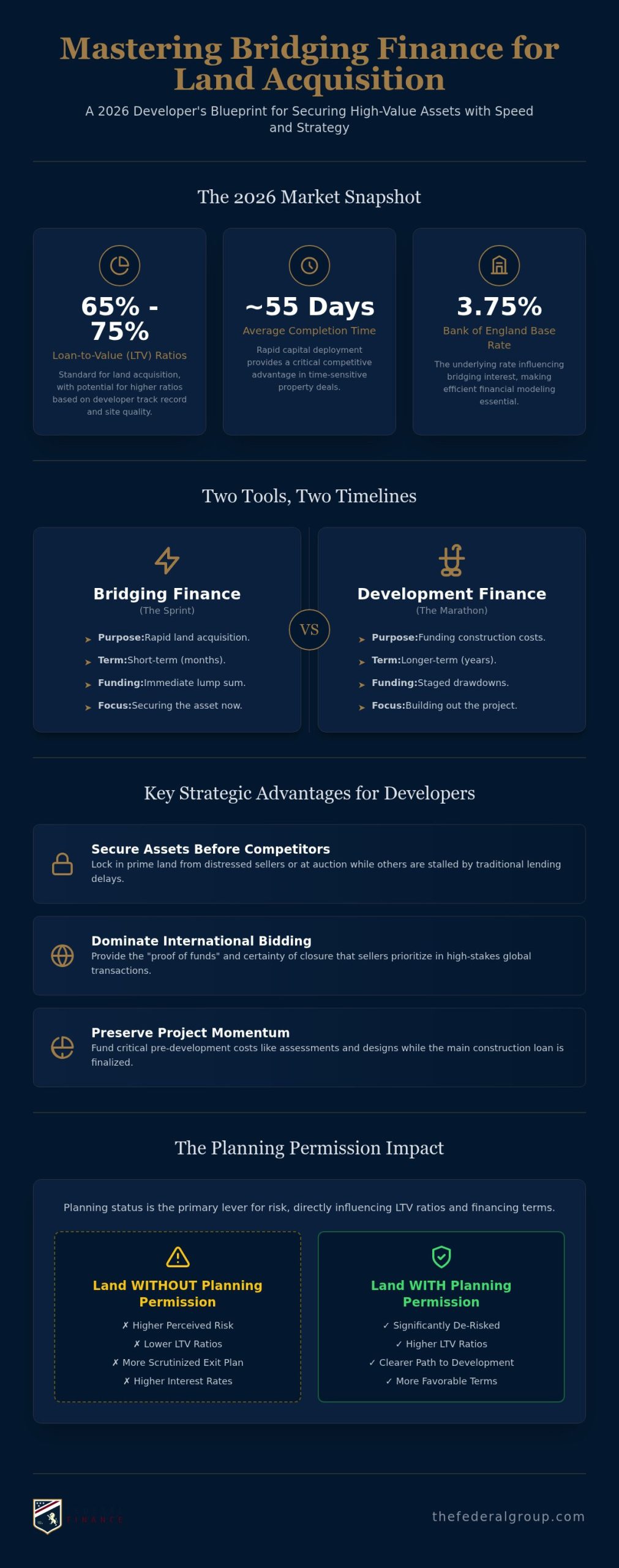
In the current economic landscape, bridging finance for land acquisition serves as a vital tactical tool for developers aiming to capitalize on time-sensitive opportunities. This asset-backed, short-term funding solution allows for the rapid purchase of land, often before planning permission is finalized or long-term funding is secured. In 2026, with the Bank of England base rate holding at 3.75%, the ability to deploy capital quickly is a fundamental competitive advantage. While Understanding bridge loans is essential for any real estate professional, applying this capital to raw land requires a specialized understanding of asset liquidity and exit feasibility. This isn’t merely a loan; it’s a strategic bridge to a project’s future value.
There is a distinct functional difference between these short-term facilities and comprehensive international property development finance. Development finance typically covers the construction phase and is released in stages. In contrast, bridging finance is designed for immediate deployment. It fills the liquidity gap, allowing developers to maintain momentum while finalizing the complexities of a multi-year build. In a market where the average bridging completion time is approximately 55 days, speed remains the primary driver for high-stakes land deals. For developers who cannot afford to wait, fast bridging loans for property development can fund in as little as 24 to 72 hours, providing a decisive edge in competitive acquisition scenarios.
The Mechanics of Asset-Backed Land Loans
Lenders view land through a different risk lens than completed residential or commercial assets. Because land doesn’t generate immediate rental yield, the focus shifts entirely to the “as-is” value and the viability of the future development. Most 2026 land deals are structured with a first-charge security, giving the lender primary claim over the asset. Brownfield sites often command more favorable terms than greenfield land due to their existing infrastructure and higher likelihood of securing planning approval. Current market averages show lenders offering LTV ratios between 65% and 75% for these assets, though experienced developers with strong track records can often push these boundaries.
Strategic Benefits for Professional Developers
For the institutional-scale developer, the advantages of bridging finance for land acquisition extend beyond simple speed. It provides the necessary “proof of funds” required to compete in international bidding wars, where sellers prioritize certainty of closure. This capital also covers critical pre-development costs. You can use it to fund environmental impact assessments or final architectural designs while the site is already under your control. By securing the land quickly from distressed sellers or at auction, you lock in the asset’s potential before the broader market can inflate the price. It’s about securing the site today to build the ecosystem of tomorrow.
How to Structure a Bridging Loan for Land Purchase
Structuring a successful deployment of bridging finance for land acquisition requires more than a simple application. It demands a rigorous architectural approach to the financial stack. Developers must move beyond surface-level appraisals to ensure the loan structure aligns with the project’s specific risk profile and timeline. Success rests on three primary pillars: valuation precision, cross-border due diligence, and a bulletproof exit strategy. In a market where the Bank of England’s base rate sits at 3.75%, the margin for error in financial modeling is slim.
Step 1: Financial Assessment and GDV Projection
The foundation of any land deal is the balance between Loan-to-Value (LTV) and Loan-to-Cost (LTC). While lenders in 2026 typically offer LTV ratios between 65% and 75% of the “as-is” value, the ultimate metric is the Gross Development Value. Gross Development Value (GDV) is the projected market value of the completed project once all construction and landscaping are finalized. Most professional developers prefer to roll up interest. This allows the interest to be added to the loan balance rather than paid monthly, which preserves vital cash flow during the sensitive pre-development phase. It’s a strategic choice that prioritizes liquidity over immediate debt service.
Step 2: Navigating International Due Diligence
Acquiring land across borders introduces layers of complexity that standard retail lenders aren’t equipped to manage. You’ve got to account for foreign exchange (FX) volatility and navigate disparate legal frameworks that vary significantly by jurisdiction. Specialized valuations are mandatory to uncover “red flags” such as restrictive covenants, historical land use issues, or environmental contamination. These factors can stall a project for years if not identified before drawdown. High-value stakeholders require a partner who possesses the global reach to verify these details on the ground.
Step 3: Securing Bespoke Capital Solutions
The current bridging loan market shows a clear divide between high-street options and institutional private debt. For projects with significant scale, commercial bridging finance offers the flexibility needed for non-standard assets or complex ownership structures. Expect arrangement fees to hover around 2%, with average monthly rates currently near 0.88%. If you’re managing a complex site, partnering with an integrated specialist early ensures your capital structure supports your long-term vision rather than just your immediate purchase. This approach allows you to negotiate terms that reflect your track record and the unique potential of the asset.
Financing Land With vs. Without Planning Permission
The planning status of a site is the single most significant factor in determining the cost and structure of bridging finance for land acquisition. For the visionary developer, the distinction between “raw land” and “shovel-ready” sites isn’t just about risk; it’s about the strategic deployment of capital to capture valuation uplift. While 2026 market conditions favor assets with existing permissions, there is substantial alpha to be found in navigating the complexities of the planning process. Understanding how lenders weigh these risks against potential “Planning Gain” is essential for maximizing leverage on high-potential land assets.
Strategies for Raw Land Acquisition
Purchasing land without planning permission is inherently speculative. Lenders mitigate this uncertainty by offering lower LTV ratios, typically ranging from 50% to 60% of the purchase price. Because the primary exit strategy—refinancing into a construction loan—hinges entirely on a successful planning outcome, your track record becomes your most valuable asset. Specialized lenders require evidence of previous successful applications in similar jurisdictions before committing capital. In cases where the capital requirement exceeds typical bridging thresholds, engaging a real estate private equity partner can provide the necessary mezzanine support to close the gap. This integrated capital stack allows you to secure the site and fund the professional fees required to move the project through the planning lifecycle.
Optimizing Shovel-Ready Site Purchases
Sites with full planning consent are considered de-risked assets, commanding higher LTVs and more competitive interest rates. The primary goal here is the seamless transition from an acquisition bridge to ground-up construction finance. Speed is vital; every day spent on a bridging facility after permission is granted is a day of higher-cost capital. Underwriting for these high-leverage deals is rigorous, often referencing standards such as the Interagency Guidance on Leveraged Lending to ensure the project’s debt remains sustainable. By hitting pre-construction milestones during the bridging term, you solidify your exit strategy and demonstrate to future lenders that the project is ready for immediate deployment. This methodical approach ensures that your short-term capital serves as a launchpad for long-term development success.
Structuring the Exit Strategy: The Key to De-risking
Lenders don’t just evaluate the collateral; they scrutinize the exit door. The exit strategy is the pivot point of any successful application for bridging finance for land acquisition. Because these facilities are short-term, with 24-month terms being the standard for complex land deals, the path to repayment must be transparent from day one. In a stabilized 2026 market where the Bank of England base rate is 3.75%, capital providers prioritize certainty over speculative upside. If your exit isn’t credible, your application won’t progress beyond the initial appraisal phase. Lenders need to see a logical, documented conclusion to their involvement.
Refinancing into Senior Development Debt
Aligning your bridge terms with future senior debt requirements is paramount for long-term project health. You’ve got to ensure the bridge term accounts for the time required for planning approvals and the subsequent senior loan appraisal process. A bridge loan facilitates the transition to a construction facility by providing the immediate liquidity needed to hold the asset while long-term financing is finalized. Timing is critical. You should initiate the refinance process at least four to five months before the bridge expires to avoid extension penalties or dangerous funding gaps. Most institutional lenders look for a seamless handover between the bridge and the development finance to maintain momentum.
Exit via Site Sale or Joint Venture
Some developers use bridging to capitalize on “planning gain.” By securing the site, obtaining permissions, and then selling it as a shovel-ready project, you can achieve significant capital recovery without the construction risk. In 2026, international buyer demand for de-risked urban sites remains robust, making a site sale a highly liquid exit route. Alternatively, a Joint Venture (JV) can serve as an exit by bringing in an equity partner to buy out the bridge lender and fund the build. This allows you to retain a stake in the project while recycling your initial capital for new acquisitions. It’s a common tactic for developers looking to scale their portfolios quickly without over-leveraging.
Contingency planning is no longer optional. If planning delays occur, you need a secondary exit, such as a bridge-to-development product that transitions into a construction loan upon hitting specific milestones. This hybrid approach de-risks the project lifecycle for both the developer and the lender. Market shifts are a reality, and having a “Plan B” ensures you aren’t forced into a distressed sale. For a deeper understanding of how short-term capital sustains momentum across the full project lifecycle, our comprehensive guide on bridging loans and commercial development covers the mechanics of securing assets quickly and maintaining velocity through to refinance. If you’re ready to secure your next high-value site, speak with our capital experts to structure a facility with a built-in exit strategy that protects your equity.
The Federal Group: Integrated Capital for Global Land Acquisition
The Federal Group operates at the intersection of high-level finance and industrial-scale development. We don’t view bridging finance for land acquisition as an isolated transaction, but as the initial phase of a comprehensive project lifecycle. Our ecosystem approach integrates bespoke capital deployment with the technical expertise of Federal Holdings, our dedicated integrated design and build developer arm. This synergy allows us to manage risk more effectively than traditional lenders who lack on-the-ground development insight. For international developers, this means access to a partner that understands the visionary energy required for large-scale urban transformation.
Our capabilities extend across major international property markets, providing a seamless conduit for cross-border capital. We specialize in navigating the regulatory shifts of 2026, ensuring that liquidity is available exactly when a competitive bid requires it. Beyond standard debt, we facilitate strategic private equity partnerships for projects with exceptional yield potential. This holistic model de-risks the acquisition phase and establishes a stable foundation for the subsequent construction and completion stages. We prioritize words that imply completion, security, and specialized expertise, favoring a lexicon that sounds both institutional and modern.
Why a Specialist Partner Matters
Generic lenders often struggle with the complexity of bridging finance for land acquisition when dealing with non-standard assets or cross-border legalities. We leverage deep market intelligence to secure favorable terms that reflect the true potential of an asset rather than just its current state. Our role is proactive; we act as a strategic partner, identifying potential hurdles in land zoning or title issues before they impact your timeline. In a recent facilitation for an international developer, we deployed fast bridging loans for property development in under four weeks to secure a prime brownfield site, allowing the client to beat out several institutional competitors who were slowed by traditional bank approvals.
Next Steps: Securing Your Next Land Asset
Success in the 2026 market demands early engagement. Involving a finance partner during the initial site appraisal phase allows for a more robust financial structure and a faster path to drawdown. To prepare for an institutional-grade application, ensure your Gross Development Value projections are grounded in current data and your exit strategy is thoroughly documented. Our global team is ready to provide tailored capital solutions that match your ambition. Contact us today to discuss how our integrated finance and development expertise can secure your next high-value land asset and maintain your project’s momentum.
Advancing Your 2026 Development Pipeline
Mastering bridging finance for land acquisition is no longer just about securing capital. It’s about deploying a strategic tool that turns market volatility into an entry point for high-value assets. You’ve seen how precise structuring, from GDV projections to bulletproof exit strategies, de-risks the transition to long-term development debt. By aligning your short-term liquidity with a clear vision for planning gain and site optimization, you position your projects for institutional-grade success in an increasingly competitive global market.
The Federal Group offers more than just financing. We provide an integrated ecosystem of international property finance expertise and design-and-build capabilities that manage your project from site identification through to completion. Our strategic capital solutions are built for the scale of your ambition, ensuring you have a heavyweight partner at every stage of the development lifecycle. We’re ready to help you navigate complex cross-border challenges with confidence and precision.
Partner with The Federal Group for Your Next Land Acquisition and transform your vision into a landmark reality. The right site is waiting; the right capital makes it yours.
Frequently Asked Questions
How much can I borrow for a bridging loan on land in 2026?
Borrowers can typically access between 65% and 75% of the land’s current “as-is” market value. While the market average leverage for land assets sits near 60% LTV, experienced developers with a proven track record may secure up to 80% on a loan-to-cost basis from certain specialist lenders.
Can I get bridging finance for land without planning permission?
Yes, securing bridging finance for land acquisition is possible for sites without existing planning permission. These “raw land” facilities generally carry lower LTV ratios, often between 50% and 60%, and require a robust narrative regarding the site’s future development potential and the developer’s experience in navigating the planning lifecycle.
What are the typical interest rates for land bridging finance?
Interest rates in the 2026 market typically range from 7.75% to 12% annually. With the Bank of England base rate currently at 3.75%, the average monthly interest rate for these short-term facilities is approximately 0.88%, though specific pricing depends on the asset class and the borrower’s history.
How fast can a bridging loan for land acquisition be completed?
The average completion time for a land bridge is approximately 55 days. For developers who have their due diligence, valuations, and legal paperwork prepared in advance, capital deployment can occur much faster, sometimes in as little as 2 to 4 weeks to meet critical purchase deadlines.
Do I need a large deposit for land bridging finance?
Yes, you’ll generally need to provide an equity contribution of 25% to 40% of the purchase price. This deposit ensures a sufficient safety margin for the lender and aligns with institutional standards for high-stakes property development, though additional security on other assets can sometimes reduce the required cash outlay.
What happens if my exit strategy for a land bridge fails?
If your primary exit strategy stalls, you risk incurring extension fees or moving onto more expensive default interest rates. It’s critical to maintain a “Plan B,” such as a bridge-to-development product or a pre-arranged site sale, to protect your equity and prevent the lender from taking control of the asset.
Is bridging finance available for international land acquisitions?
Specialized bridging solutions are available for international projects through partners with global reach and cross-border expertise. These facilities are designed to handle the legal complexities and currency risks inherent in foreign markets, providing the sophisticated capital structure needed for large-scale global development.
Can bridging finance cover pre-development and architectural costs?
Yes, bridging funds are frequently deployed to cover professional fees, environmental reports, and architectural designs. This liquidity allows you to maintain project momentum and add value through the planning gain process while the site is already under your control, ensuring you’re ready for the construction phase.