Commercial Real Estate Development Partner: How to Choose the Right Strategic Fit in 2026
2 October 2026Choosing a commercial real estate development partner means looking beyond a compelling portfolio or financing offer. You need to understand which capabilities your project requires, how funding and execution will work together, and who will guide key decisions.
Before committing to a partnership, get a clear picture of each party’s responsibilities. Fragmented roles can complicate delivery, while polished websites can make very different firms look comparable. A strong fit connects capital, execution capabilities, and project priorities through a clearly defined plan.
This article offers a practical framework for assessing that fit in 2026. It covers a partner’s role in development finance or private equity, its approach to project delivery, and the questions to resolve before moving forward. The Federal Group brings property finance and development into the same strategic conversation. Through Federal Holdings, it also operates as an integrated design-and-build developer, managing projects from architectural design through construction. Use the guidance below to compare capabilities, clarify responsibilities, and focus a discussion on your project’s needs.
Key Takeaways
- Define the role your project needs before comparing potential partners with lenders, contractors, brokers, or consultants.
- Map capital planning, design, construction, and decision-making to identify where coordination matters and where separate specialists may be needed.
- Assess a commercial real estate development partner’s relevant experience, capital capabilities, delivery approach, and communication against consistent criteria.
- Set milestones, reporting expectations, and approval responsibilities to coordinate the partnership from project definition through delivery.
- Consider how The Federal Group brings property finance and development together, including Federal Holdings’ integrated design-and-build approach.
What a Commercial Real Estate Development Partner Does, and When You Need One
A commercial real estate development partner helps coordinate the expertise, resources, and decisions needed to move a property project forward. Depending on the agreed structure, the partner may connect capital planning with design and delivery, or take responsibility for a defined part of development. The key is to specify the role rather than assume it from the title.
Development brings together land, finance, design, construction, and professional advice. The overview of real estate development describes this broad process and the range of participants involved. A partner adds value when it brings clarity and coordination to the roles the project needs, not simply when it appears in the project structure.
How a development partner differs from a lender or contractor
A lender provides capital under agreed financing terms. That can support a project, but providing finance alone does not make the lender responsible for design choices, construction delivery, or wider project coordination. A contractor carries out construction work defined by its agreement. A development partner may coordinate broader workstreams, but its remit still needs to be established in the project structure.
Other participants have distinct roles. A broker facilitates property or investment transactions, while a standalone consultant provides specialist advice. Both can contribute valuable expertise without taking responsibility for the overall development strategy. Some projects assign each function to a separate party; others bring capital and development execution into a more integrated arrangement.
When a commercial property project may benefit from a partner
A commercial real estate development partner may be useful when a project needs capital expertise and delivery capabilities to work in tandem. For example, a landowner with a viable site but limited development capacity may need a coordinated route from planning into construction. A developer managing several specialists may also benefit from a clearly defined counterpart who can help align decisions across the work.
Complexity matters more than size alone. A smaller project can involve challenging site conditions, multiple stakeholders, or a demanding sequence of decisions. A larger project may have a straightforward delivery structure and an experienced internal team. Identify where coordination, resources, or decision-making capacity are missing, then assess whether a partner’s proposed role addresses that gap.
Start by mapping the project’s needs: which party supplies capital, who leads development decisions, who manages construction, and where specialist advice fits. Then define responsibilities, approvals, and communication in the partnership structure. This helps distinguish strategic alignment from a collection of separate services and gives you a clear basis for assessing how capital and execution should work together.
How Capital, Design, and Delivery Align in a Commercial Development Partnership
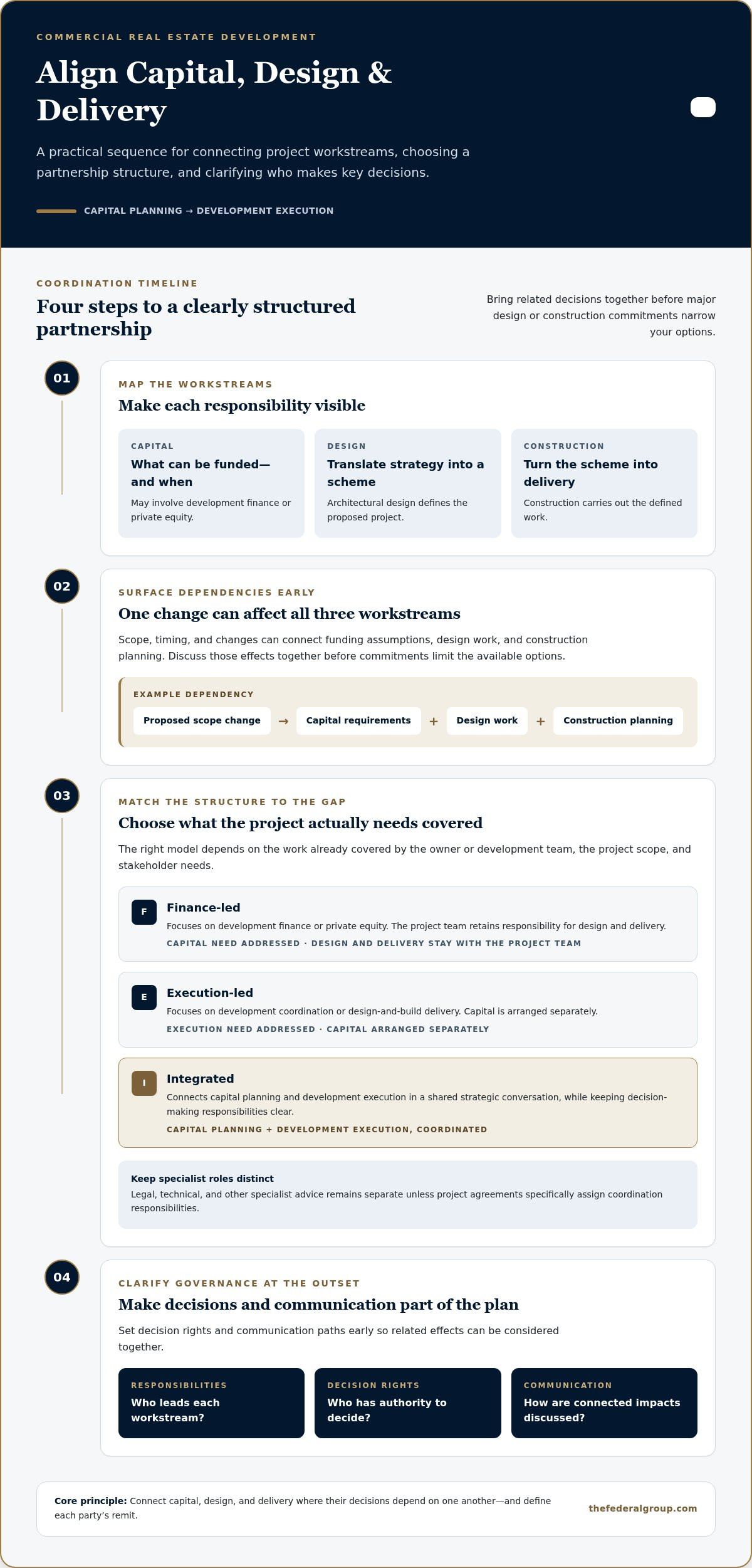
A strong development plan connects its workstreams before major commitments are made. Capital planning shapes what can be funded and when. Design translates the project strategy into a defined scheme, and construction turns that scheme into delivery. Decisions about scope, timing, and changes affect all three. When these conversations happen in isolation, a design choice may conflict with funding assumptions or delivery requirements.
MIT Professional Education’s overview of the real estate development process includes feasibility, risk assessment, and contract negotiation. Early coordination helps stakeholders identify dependencies before design or construction commitments narrow their options. For example, a proposed scope change may affect capital requirements, design work, and construction planning. Set decision rights and communication paths at the outset so those effects can be considered together.
What coordinated development responsibilities can include
Capital can take different forms. Development finance provides funding for a project, while private equity involves investment in the project or venture. Neither automatically includes design or construction. In an integrated design-and-build model, architectural design and construction are managed within a connected development approach. Legal, technical, and other specialist advice remains distinct unless the project agreements specifically assign coordination responsibilities.
How project structure shapes the partnership model
The right structure depends on the work already covered by the owner or development team, the project scope, and stakeholder needs. A capital partner may address a funding requirement while the owner coordinates design and delivery. An execution-led partner may manage development and construction while capital is arranged separately. An integrated model connects capital planning and development execution in a shared strategic conversation, while still making decision-making responsibilities clear.
Partnership model
- Finance-led: Focuses on development finance or private equity; the project team retains responsibility for design and delivery.
- Execution-led: Focuses on development coordination or design-and-build delivery; capital is arranged separately.
- Integrated: Connects capital planning and development execution, with responsibilities and approvals set out in the agreed structure.
Use this comparison as a starting point, not a fixed template. A landowner with an established design and construction team may prioritize capital support. A developer with funding in place may instead need an integrated delivery approach. Federal Holdings operates as an integrated design-and-build developer, managing projects from architectural design through construction. Read the integrated design-and-build developer guide to learn how that model can connect project stages. For a broader view of The Federal Group’s property finance and development approach, visit The Federal Group.
How to Evaluate a Commercial Real Estate Development Partner
Assess a potential partner against the project you intend to deliver, not the breadth of its marketing claims. The same firm may suit one asset strategy or development stage and be less aligned with another. Use the framework below to compare evidence, responsibilities, and decision-making consistently.
Strategic fit means alignment between project objectives, assigned responsibilities, and the decisions required to deliver the plan.
A project-specific assessment framework
- Match experience to the project. Compare completed or current project evidence with your asset strategy, geography, and development stage. Experience in early feasibility does not necessarily demonstrate capability in construction delivery. Separate documented project details from general claims about sector expertise.
- Map capital capabilities to requirements. Identify whether the project needs development finance, private equity, or a combination of capital approaches. Consider how the proposed funding role fits the project plan and how capital decisions connect with delivery milestones. The international property development finance guide provides further context on financing considerations.
- Test the delivery approach. Establish which development stages the partner will coordinate and which remain with the project owner or separate specialists. A design-and-build approach, for example, may connect architectural design and construction, while technical, legal, and other specialist work is assigned separately.
- Compare resources with complexity. Consider the number of stakeholders, interfaces, and material decisions involved, not just the asset’s size. A project with several workstreams may need more active coordination than a larger project with a simpler delivery structure.
- Review communication and governance. Define who leads decisions, approves scope changes, reports progress, and coordinates stakeholders. Record how responsibilities and project risks are allocated so accountability remains clear when plans change.
Assess governance, communication, and risk ownership
Clear governance turns a proposed partnership into an operating structure. Establish approval thresholds, reporting cadence, escalation routes, and responsibility for key project risks in the relevant agreements. For a joint venture, distinguish the capital partner’s role from the operating partner’s role. The Real Estate Joint Venture (JV) overview explains this common distinction. Allocate responsibilities to reflect the project structure rather than relying on assumptions.
Compare each candidate against the same criteria and note where the evidence is strong, incomplete, or outside the project’s needs. This creates a disciplined basis for discussion and helps separate a compelling presentation from a workable strategic fit.
How to Structure the Partnership Across the Development Lifecycle
A partnership needs to work as the project moves from initial definition to design, construction, and delivery. Responsibilities may shift between stages, but decision rights should remain clear. A commercial real estate development partner can coordinate the work it has agreed to lead, while the project owner and specialist participants retain their defined roles.
Aligning responsibilities early reduces avoidable ambiguity at handoffs between project stages. That does not mean every project needs the same structure. It means recording agreed objectives, scope, stakeholders, approvals, and the process for handling changes.
Set objectives and responsibilities before execution
At project definition, document the intended asset strategy, core scope, key stakeholders, and decisions that require owner approval. Assign each major responsibility to a named party, including capital planning, design coordination, construction delivery, reporting, and stakeholder communication. Align the capital plan with the development programme so funding assumptions and delivery requirements inform one another from the outset.
Record the assumptions behind the plan, including the agreed scope and intended sequence of work. When someone proposes a change, document what is changing, who reviews it, which approvals are required, and how it affects related workstreams. A consistent record helps participants work from the same project information instead of relying on informal updates.
Maintain coordination through design and construction
Design choices can affect project scope, programme, and construction coordination. Establish review points for significant design decisions and define how their implications will be assessed before approval. During construction, milestone reporting can track progress against the agreed programme, outstanding decisions, scope changes, and issues requiring escalation. Set the reporting format and cadence to suit the project rather than assuming one timetable works for every development.
At delivery, clarify what completion means for each party’s responsibilities, how remaining items will be recorded, and who coordinates the transition to the next phase. This connects the original project objectives with the work delivered.
Projects involving multiple countries or financing jurisdictions may need closer coordination among capital, development, and local project participants. The international real estate finance partner guide offers additional context for considering cross-border financing relationships.
For a partnership discussion grounded in coordinated finance and development execution, explore The Federal Group’s property finance and development approach.
The Federal Group’s Integrated Approach to Commercial Real Estate Development
The Federal Group brings international property finance and development expertise into the same project conversation. A commercial real estate development partner can contribute effectively when capital capabilities and execution responsibilities are assessed against the project’s objectives, stage, and structure. The goal is to understand how each role may support the wider plan, rather than assume every project needs the same arrangement.
Connect property finance with development execution
The Federal Group provides development finance, bridging loans, and private equity. These are distinct capital capabilities that can be considered in relation to a project’s financing needs and structure. Federal Holdings has a complementary role as an integrated design-and-build developer, managing projects from architectural design through construction. Finance addresses capital; design-and-build development connects design and delivery. Keeping those roles distinct helps define responsibilities within the project.
Considering these capabilities in one strategic discussion can clarify how funding relates to execution decisions and project priorities. The appropriate structure depends on the opportunity and agreed responsibilities. For additional context on how finance and development capabilities can connect, review the development finance lender case study.
Start a focused commercial development conversation
A productive first discussion begins with a concise project brief. Set out:
- Objectives: What the project is intended to achieve.
- Stage: Whether it is at concept, planning, design, or another point in development.
- Location and asset strategy: The project’s setting and intended direction.
- Priorities: The current capital, development, or delivery questions that need attention.
This information provides a practical basis for discussing strategic fit, potential capital approaches, and how development responsibilities could be structured. It also separates immediate priorities from matters that will be resolved later as the plan develops.
The Federal Group’s international property finance and development scope supports a joined-up perspective on complex opportunities. If you’re assessing a project and want to explore how finance and development execution could align, explore a development partnership.
Build the Right Partnership Around Your Project
The right commercial real estate development partner is defined by fit, not by the number of services it promotes. Align capital capabilities with project priorities, compare relevant experience with your asset strategy and development stage, and establish clear responsibilities for decisions, reporting, and delivery.
Partnership structure matters throughout the lifecycle. Clear roles from project definition through construction connect financing assumptions with execution while keeping approvals and accountability visible. The Federal Group provides development finance, bridging loans, and private equity, while Federal Holdings operates as an integrated design-and-build developer.
If you’re considering how these capabilities could support a commercial property opportunity, start with the project’s objectives, current stage, and priorities. Discuss your commercial development opportunity with The Federal Group and explore a partnership structure aligned with your goals.
Frequently Asked Questions
What does a commercial real estate development partner do?
A commercial real estate development partner helps coordinate the expertise, resources, and decisions needed to advance a property project. Depending on the agreed structure, its role may include capital support, development coordination, or design-and-build execution. The title alone does not define the scope. Specify who leads each workstream, makes decisions, and manages handoffs so all parties understand how the partnership supports the project.
How do I choose a commercial real estate development partner?
Choose a commercial real estate development partner by comparing its relevant experience and capabilities with your project’s asset strategy, location, stage, and complexity. Look for specific evidence related to your needs, then assess how capital planning and delivery responsibilities fit the project structure. Clarify decision rights, reporting, and risk allocation before proceeding. Applying the same criteria to each candidate makes it easier to compare firms whose websites emphasize different services or projects.
What is the difference between a development partner and a development finance lender?
A development finance lender provides capital under agreed financing terms. That role alone does not make the lender responsible for delivering the project. A development partner may take on broader responsibilities, such as coordinating development work or connecting capital considerations with execution. The exact scope depends on the agreements. In some structures, one organization may contribute financing and development capabilities through distinct business divisions; in others, those roles sit with separate parties.
Can one partner provide both development finance and design-and-build services?
Yes. The Federal Group provides development finance, bridging loans, and private equity, while Federal Holdings operates as an integrated design-and-build developer, managing projects from architectural design through construction. These are distinct capabilities, even when considered within the same group. The project structure should specify which entity or party is responsible for each role, how decisions are coordinated, and how finance planning connects with development execution.
What should a commercial real estate development partnership agreement cover?
A partnership agreement should document each party’s responsibilities, capital commitments, decision authority, approval processes, reporting expectations, and approach to changes in project scope. It should also address how risks and returns are allocated, how disputes or deadlocks are handled, and what happens at exit or project completion. The terms should reflect the specific ownership and operating structure. Clear documentation helps prevent assumptions from becoming disagreements as the project advances.
When should a developer bring a partner into a commercial property project?
Consider bringing in a partner when the project needs capital, development execution, or coordination beyond the team’s current capacity. An earlier discussion can help connect funding assumptions with the proposed scope and delivery approach before major commitments are made. Timing depends on the project: a developer may seek finance during planning or design-and-build capability when delivery responsibilities need to be established. First identify the gap the partnership is intended to address.
How can an integrated development partner help coordinate a project?
An integrated development partner can connect related workstreams, such as design development and construction, within a coordinated delivery approach. This can make it easier to assess how a design decision affects scope, programme, and construction planning. Integration does not remove the need to define responsibilities or involve specialist professionals where required. Set out approval rights, reporting, and handoffs so the project owner and partner share a clear view of progress and decisions.