Cross-Border Property Investment: A Strategic Guide for 2026
13 October 2026A compelling overseas property opportunity can lose its appeal when local execution fails to match the investment thesis. Cross-border property investment involves more than choosing a promising market: unfamiliar laws, tax treatment and market practices can make opportunities difficult to compare, while currency movements and distance add further risks.
A sound investment case accounts for how capital enters and exits, how returns may change when converted into another currency, and who will oversee delivery and reporting locally. Strong headline projections alone cannot answer those questions.
This guide provides a practical framework for screening markets and opportunities against your objectives and capacity to oversee a project. It covers investment structures, currency exposure, local execution and what to consider when choosing a capital partner with international property capabilities. The aim is to help you assess opportunities with greater discipline and make informed decisions about where and how to invest.
Key Takeaways
- Assess cross-border property investment against your objectives and operating capacity, not headline market appeal alone.
- Compare investment structures by ownership, decision rights, information access and reliance on local operators.
- Separate a market’s overall potential from the feasibility and assumptions of a specific asset or project.
- Use a consistent due-diligence sequence to examine jurisdiction, asset fundamentals, governance and delivery risks.
- Consider how an international capital partner with finance and development capabilities could support project-specific execution.
Cross-Border Property Investment: What Changes When Capital Crosses Borders?
Cross-border property investment is the allocation of capital to property assets or ventures outside the investor’s home jurisdiction. The investor takes an economic interest in an overseas property or development, directly or through an investment structure. Cross-border property finance is different: it describes capital from another country funding a project. If the project is domestic to the investor, the funding crosses a border, but the property investment itself may not.
The distinction matters because providing capital and owning or participating in an overseas asset create different exposures. An investor may hold an interest in a development abroad, while an international lender may finance a project without taking the same ownership position. International real estate spans many transaction types and market influences. A useful investment decision starts by identifying what the investor will own, control and depend on.
Why investors consider property opportunities in other countries
International markets can offer access to demand, property types or development opportunities that are unavailable or less compelling in an investor’s home market. Local market cycles and the forces shaping demand can differ between jurisdictions. That difference may support a portfolio diversification objective, but it does not guarantee lower risk. Overseas assets can still fall in value, produce weaker-than-expected income or be difficult to sell.
Cross-border exposure can also provide access to a specific local development opportunity. Institutional investors and sovereign-scale allocators like the Vieyra Family Office often assess overseas opportunities where a location, intended use or development plan directly fits their long-term mandate. Make the rationale specific enough to test rather than relying on a broad assumption that an unfamiliar or emerging market will outperform.
- Market access: Does the location provide exposure to demand or asset types that fit the investment strategy?
- Diversification: How might the investment perform alongside existing holdings, and which risks could remain correlated?
- Development access: Is the opportunity backed by a credible project plan and local execution capacity?
What makes an international property investment different
International investing adds country-level exposure to the familiar work of assessing an asset. The property still needs to make sense on its own merits: location, condition, income potential, costs and the assumptions behind its business plan all matter. Separately, the investor must understand how the jurisdiction’s political, legal and economic environment could affect ownership, operations, returns or exit options. Currency movements can also change the value of income and proceeds when measured in the investor’s home currency.
Distance can make information harder to obtain and decisions harder to oversee. Time zones, local reporting practices and reliance on partners may affect how quickly an investor identifies a delivery issue or responds to changing conditions. Before advancing, frame the initial screen around four questions:
- What asset or venture will the investment hold an interest in?
- Which market, currency and jurisdiction-specific exposures could affect the plan?
- Who will provide local information, make operating decisions and report progress?
- Can the investor oversee the project and manage its risks with the capacity available?
These questions help distinguish a compelling market narrative from an opportunity that can be evaluated and actively managed. International exposure is neither inherently safer nor more profitable. Its suitability depends on the investor’s objectives, structure and ability to govern execution.
How Cross-Border Property Investment Structures Shape Control and Exposure
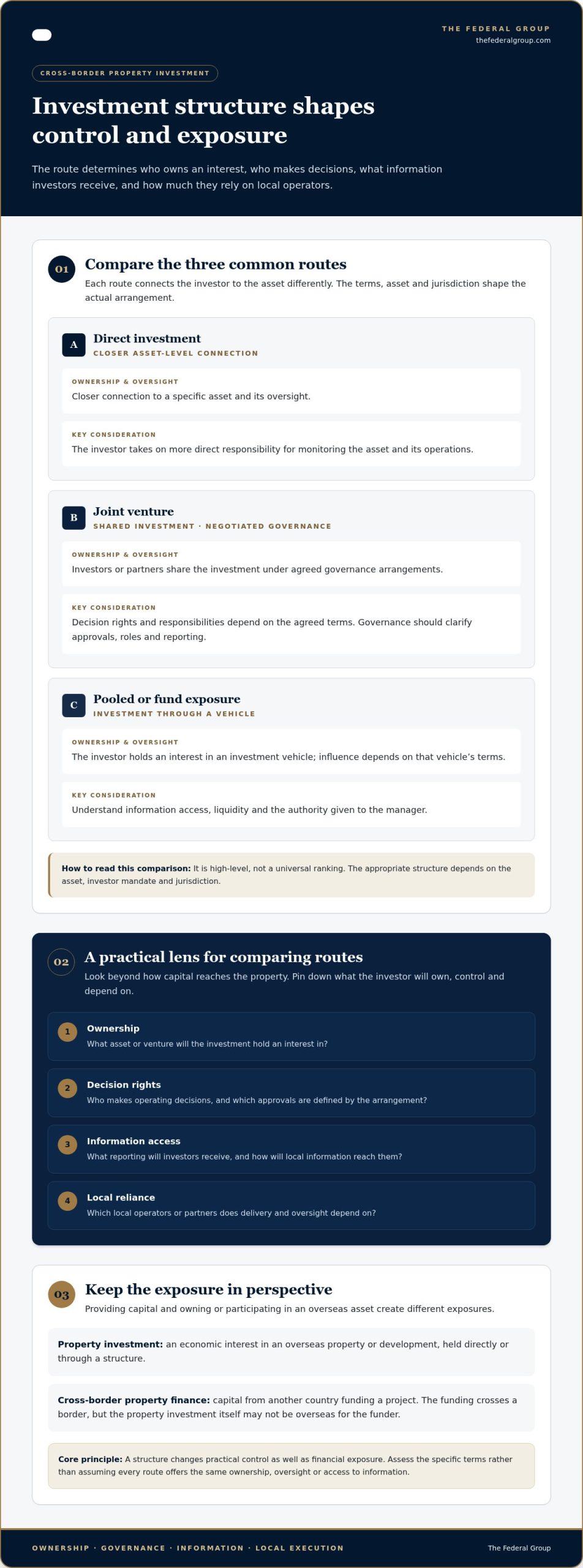
The investment route determines more than how capital reaches a property. It shapes who holds ownership, who makes decisions, what information investors receive and how much they rely on local operators. In cross-border property investment, those choices affect practical control as well as financial exposure.
Direct investment, joint ventures and fund exposure
Direct investment can provide closer asset-level ownership and a more direct role in oversight, but it also brings greater responsibility for monitoring the asset and its operations. A joint venture combines investors or partners under negotiated governance arrangements, so decision rights and responsibilities depend on the agreed terms. Pooled or fund exposure gives an investor an interest in a broader investment vehicle, but influence, reporting and liquidity depend on that vehicle’s specific terms. The Bank for International Settlements examines market dynamics and financial stability considerations in Cross-border investments in commercial real estate.
| Route | Ownership and control | Key consideration |
|---|---|---|
| Direct investment | Closer connection to a specific asset and its oversight | Investor takes on more direct monitoring responsibility |
| Joint venture | Shared investment with negotiated decision rights | Governance must clarify approvals, roles and reporting |
| Pooled or fund exposure | Investment through a vehicle, with influence set by its terms | Understand information access, liquidity and manager authority |
This is a high-level comparison, not a universal ranking. The appropriate structure depends on the asset, investor mandate and jurisdiction. Tax treatment, securities requirements and foreign ownership rules also vary by jurisdiction and structure. Do not assume a route available in one market works the same way elsewhere.
How governance and capital partners affect investor control
Formal ownership does not automatically provide effective oversight. Before committing, establish which decisions require investor approval, what counts as a reserved matter, how often performance and project progress will be reported, and what information those reports will include. Subject to transaction documents and applicable rules, approval rights may cover material changes to the business plan, budgets or project direction.
A local operating partner can contribute market knowledge and execution capacity, but responsibilities and accountability should be clear. Identify who controls day-to-day delivery, how issues are escalated and how investors can measure progress against the agreed plan. The international property development finance guide explains financing mechanics that can help clarify how capital fits within a project structure.
Match the route to the level of involvement your mandate requires. Investors seeking closer asset-level oversight may need a different arrangement from those prioritising pooled exposure. A joint venture can align capital with local execution under negotiated governance. For projects where financing and delivery need to be considered together, The Federal Group’s international property finance and development capabilities are relevant to the discussion.
How to Compare Cross-Border Property Markets and Investment Routes
A disciplined comparison separates the appeal of a market from the merits of an individual project. A country may attract capital, yet a particular asset can still have weak demand, unrealistic rent assumptions or limited exit options. Market growth alone does not establish investment suitability; the asset, structure and investor’s capacity to execute must also withstand scrutiny.
For cross-border property investment, apply the same criteria to each shortlisted market, asset and route. This prevents a strong headline narrative from outweighing practical weaknesses. Record the evidence and assumptions behind each assessment, and flag data that is not directly comparable across countries.
Which market signals deserve attention?
Build a market screen using current, comparable sources. Review demand drivers alongside supply, vacancy, rents and transaction activity. Consider whether financing conditions support the proposed plan and whether the market has enough liquidity for the intended investment horizon. No single indicator settles the question. Rising rents, for example, need to be considered alongside supply and affordability.
Separate durable drivers, such as sustained employment or infrastructure demand, from short-term sentiment. Then test whether those broad conditions support demand for the asset type and location under review.
- Demand and supply: Examine who uses or rents the asset, competing stock, vacancy and the development pipeline.
- Asset fundamentals: Test location, condition, achievable rents and the evidence behind the business plan.
- Liquidity and execution: Assess transaction activity, financing conditions, local delivery capacity and realistic exit routes.
For example, strong market-wide demand may not support a project if competing supply is concentrated in its immediate area. Treat forecasts as assumptions to test, not established outcomes.
How to compare investment routes against your mandate
Score direct ownership, a joint venture and pooled exposure against the same objectives. A route offering closer involvement may demand more oversight, while a shared or pooled arrangement may change decision rights and information access. Compare each option on control, reporting, governance, operating commitment, investment horizon and exit considerations. Assess actual rights and obligations rather than relying on the structure’s label.
- Control: Which decisions can the investor make or approve?
- Information: What asset and performance reporting is available, and how often?
- Operating involvement: Can the investor oversee local delivery at the required level?
- Exit: What conditions, approvals or timing assumptions could affect a sale or transfer?
Apply the framework first to market and asset feasibility, then compare routes against the same mandate. A private equity partnership can involve distinct governance and capital considerations. The assessment should record what supports the opportunity, what remains uncertain and whether the investor can manage the execution required.
A Cross-Border Property Investment Due-Diligence Framework
A consistent sequence turns an international opportunity into a set of testable decisions. For cross-border property investment, due diligence should connect the investor’s mandate to the jurisdiction, asset, governance and ongoing oversight. Legal, tax and regulatory details vary by location, so verify them against current local sources rather than assumptions drawn from another market.
- Define the mandate. Set out the investment objective, time horizon, acceptable level of operating involvement and capacity to oversee the project. Decide what would make the opportunity unsuitable before reviewing projections.
- Screen the jurisdiction. Examine ownership rules, planning pathways, relevant tax treatment, currency exposure and the ability to repatriate capital or proceeds. Identify which points need current local legal or tax review.
- Test the asset and business plan. Assess title, condition, project feasibility and demand assumptions. Check the evidence supporting rents, occupancy, development costs and timing, and distinguish verified information from forecasts.
- Structure governance. Document decision rights, reporting responsibilities, approval matters and escalation routes. Define who is accountable for local execution and what information investors need to monitor progress.
- Monitor delivery. Set milestone reviews before capital deployment, then track performance against the agreed plan. Establish how delays, budget changes or material shifts in leasing assumptions will be reported and addressed.
Test the jurisdiction, asset and business plan
Focus jurisdiction diligence on the rules that directly affect the proposed ownership and project. Confirm the relevant ownership framework and planning process using current local sources, and assess how applicable tax treatment may affect projected cash flows. Do not assume that a structure or planning route used in one country will translate to another.
At the asset level, examine title and condition alongside project feasibility and the demand case. Compare the base case with downside scenarios. What happens if construction takes longer, leasing changes or financing becomes constrained? Use assumptions grounded in the specific project, not a generic return threshold. These scenarios show where the plan is resilient and where it depends on conditions that may not hold.
Plan for currency, governance and ongoing oversight
Exchange-rate movements can change the home-currency value of overseas income or sale proceeds. They can also affect the amount of home-currency capital needed to meet obligations in the local currency. Make currency assumptions visible in the financial analysis, and consider how different movements could affect cash needs and outcomes.
Before committing funds, agree on reporting intervals, milestone reviews and named accountability for delivery. Set an escalation route for missed milestones or material changes, so distance does not delay decisions. For projects that need aligned financing and execution, The Federal Group’s international property finance and development capabilities bring those considerations together.
How The Federal Group Connects Capital and Property Development
A robust approach to cross-border property investment considers the capital plan alongside the project’s delivery requirements. The Federal Group is an international property finance and development group. It provides development finance and bridging loans, invests through private equity, and delivers property development through its Federal Holdings division. These capabilities are relevant when a project needs its capital and execution requirements considered together. The right approach depends on the asset, jurisdiction and investment mandate.
An integrated perspective on capital and execution
Financing choices affect a project’s ability to progress, while development decisions shape how capital is deployed and managed. The Federal Group provides development finance for property projects and bridging loans for short-term financing needs. It also invests in property developments through private equity. Each has a different role, and suitability depends on the project’s requirements and structure.
Through Federal Holdings, The Federal Group manages property projects through an integrated design-and-build model, from architectural design through construction. Considering finance alongside development helps frame questions about capital timing, project stages, delivery responsibilities and the assumptions behind the business plan. That perspective is particularly relevant when investment depends on execution as well as asset selection. It connects the investment thesis to the practical requirements of delivering a property project without treating projected outcomes as assured.
A strategic capital partner can engage with a project’s financing needs and execution context. The value of the relationship rests on fit: the partner’s capabilities should relate to the project’s stage, objectives and delivery model. Keep the discussion grounded in the opportunity’s facts rather than assuming that one structure or source of capital is suitable for every project.
What a strategic project discussion should establish
A focused discussion should make the opportunity clear enough to assess its requirements and principal assumptions. A concise project overview can cover:
- Asset and jurisdiction: The property or venture, its location and relevant market context.
- Development stage: What has been completed, what remains and the intended delivery plan.
- Investment structure: The proposed ownership or participation route and its governance needs.
- Capital requirements: The project’s funding needs, timing and how capital relates to planned work.
- Key assumptions: The demand, delivery and financial factors underpinning the investment case.
Clarifying these points connects the investor’s objectives with the project’s financing and execution requirements. It also provides a disciplined basis for assessing whether the opportunity and a potential partnership align. To discuss a project, explore The Federal Group.
Make the Next Decision with Clarity
Turn research into a decision you can act on. Set out what needs to be true for an opportunity to proceed, which assumptions still need evidence, and what conditions would prompt you to pause or revise the plan. This discipline helps keep capital allocation aligned with your objectives as a cross-border property investment moves from analysis toward execution.
A clear project brief makes the next conversation more productive. Define the opportunity, intended investment approach and desired outcomes, and note the open questions that could affect delivery. The Federal Group brings international property finance and development capabilities to projects where capital and execution need to be considered together.
Explore The Federal Group’s international property capabilities and outline the project you are assessing.
Frequently Asked Questions
What is cross-border property investment?
Cross-border property investment means allocating capital to property assets or ventures outside the investor’s home jurisdiction. For example, an investor based in one country may acquire an interest in a development in another. That differs from a domestic project funded by an overseas lender, where the financing is international but the property investment may remain domestic. Investment routes can include direct ownership, a joint venture or pooled exposure, with rules varying by country.
Is cross-border property investment riskier than domestic property investment?
Not automatically. Risk depends on the asset, market, investment structure and the investor’s ability to exercise oversight. International activity may add currency exposure, unfamiliar local practices or greater challenges in accessing information. Domestic projects also face market shifts, construction delays and changes in tenant demand. Compare opportunities using consistent assumptions, including costs and exit conditions, and rely on current evidence. Overseas exposure alone does not determine whether an investment is safer or more profitable.
How do investors make money from cross-border property investment?
Potential value may come from rental or other property income, successful development or an increase in asset value. The investor’s share depends on the ownership or participation structure, project performance and agreed terms. Realized results can be affected by operating costs, taxes, financing obligations and currency conversion. For instance, a completed development may achieve less income than projected if leasing takes longer. Returns are not assured, and outcomes vary by asset, market and investment terms.
What happens if currency exchange rates move against an overseas property investor?
An adverse exchange-rate move can reduce the home-currency value of overseas income or sale proceeds and increase the home-currency amount needed to meet local costs or debt obligations. The impact depends on the currencies involved and when payments occur. Investors can model several exchange-rate scenarios, including changes during acquisition, operation and exit, to see how capital needs and reported results may shift. Risk-management arrangements may affect exposure, but currency risk cannot always be eliminated.
How should an investor compare property markets in different countries?
Apply the same comparison framework to each market: assess demand, supply, asset fundamentals, transaction liquidity, ownership rules, taxation, currency and local execution capacity. Then distinguish broad national indicators from evidence about the specific property, such as nearby competing supply or achievable rents. Use recent, comparable sources and test the business plan under less favourable conditions. A rise in headline transaction activity can provide context, but it does not prove a particular project is suitable.
Can a foreign investor buy property in another country?
Possibly, but the answer depends on the jurisdiction, asset type and investor structure. A market may permit some forms of foreign ownership while applying restrictions, approvals or disclosure requirements to others. For instance, international investors looking to buy off plan property dubai benefit from designated freehold zones and regulated escrow frameworks, whereas other jurisdictions may restrict foreign land purchases entirely. Before committing capital, establish which current local rules apply to the proposed asset and ownership route. Also account for related tax and transaction implications. A general rule from one country should not be treated as guidance for another; requirements need jurisdiction-specific review.
What due diligence is important before an international property investment?
Review the jurisdiction and ownership route, then assess the property’s title, condition, planning position and feasibility. Examine the financial model, including assumptions behind income, costs and timing, and consider how currency movements could affect cash needs. Establish who makes decisions, what reporting investors receive and how issues will be escalated. Tailor the checks to the asset and local market, then use the findings to adjust, proceed with or decline the investment.