International Real Estate Joint Ventures: A 2026 Strategic Guide to Cross-Border Partnerships
13 September 2026In the high-stakes arena of 2026 property development, the traditional “capital-only” partner is no longer just a luxury; they’re a liability. You likely recognize that securing a successful international real estate joint venture requires more than just a signed term sheet. It demands an intricate alignment of local operational expertise and institutional financial vision. Without this synergy, even the most promising cross-border projects can succumb to disparate regulatory environments, currency volatility, and the friction of misaligned interests.
This guide provides the strategic blueprint to master cross-border capital alignment and structural modeling. We’ll show you how to build a scalable JV framework that secures capital deployment while insulating high-value projects from risk. You’ll learn how to identify partners who bring more than just a balance sheet to the table. We’ll examine the latest shifts in global markets, from Qatar’s liberalized ownership laws to Hungary’s evolving land-use scrutiny. By the end of this guide, you’ll have the tools to manage the complex lifecycle of international assets with the confidence of a seasoned global expert.
Key Takeaways
- Understand how the 2026 international real estate joint venture has transitioned from a simple funding vehicle into a sophisticated, integrated lifecycle partnership.
- Identify the most effective structural models for cross-border projects by comparing Pari Passu and Waterfall distribution frameworks within Special Purpose Vehicles (SPVs).
- Deploy advanced risk mitigation strategies to manage currency volatility and political exposure across diverse regulatory environments.
- Master a five-step roadmap for defining your investment thesis and structuring a capital stack that aligns local developer interests with international institutional capital.
- Leverage the “integrated partner” model to unify design, construction, and finance, ensuring project stability from inception to exit.
The Evolution of the International Real Estate Joint Venture in 2026
By 2026, the international joint venture has transitioned from a tactical financial arrangement into a sophisticated vehicle for global market entry. Traditional models often treated finance and execution as separate silos, but today’s high-value partnerships prioritize integrated capital alignment. This shift ensures that the financier, developer, and operator share a single lifecycle vision for the asset. This evolution is driven by a move away from simple equity sharing toward comprehensive, integrated lifecycle partnerships that manage every stage of a project’s development.
The core drivers behind this evolution are clear. Institutional investors seek geographic diversification to hedge against regional downturns and currency fluctuations. Simultaneously, developers require local expertise to navigate increasingly granular regulatory frameworks. By pooling risk, partners can tackle industrial-scale projects that would be prohibitive for a single entity. Siloed finance models often fail in 2026 because they lack the agility to respond to rapid shifts in cross-border logistics and local policy. An international real estate joint venture succeeds when it functions as a unified ecosystem rather than a collection of disparate interests.
Why Global Developers are Prioritizing Equity Partnerships
In complex jurisdictions like the US and UK, having “boots on the ground” is no longer optional; it’s a requirement for project viability. Regulatory environments are becoming more localized, requiring partners who understand specific municipal codes and tax implications. Accessing specialized capital through real estate private equity partners allows developers to bridge the gap between local opportunity and global liquidity. This institutional credibility is often the deciding factor in securing large-scale land acquisitions and navigating the planning permissions process in competitive urban markets. It provides the stability needed to attract further debt financing on favorable terms.
The Rise of Integrated Design-Build JV Models
The integrated design and build developer model is gaining significant momentum. Traditional JVs often suffer from friction between the developer and the contractor, where conflicting incentives lead to cost overruns and delays. An integrated approach eliminates this conflict by aligning all parties under shared goals from the initial design phase. This synergy ensures that construction is value-engineered for both operational performance and long-term profitability. By unifying design, construction, and finance, partners can speed up project delivery and reduce the administrative friction typically found in third-party procurement. This model offers a level of security and efficiency that traditional, fragmented partnerships simply cannot match.
Structural Models: Comparing JV Frameworks for Cross-Border Projects
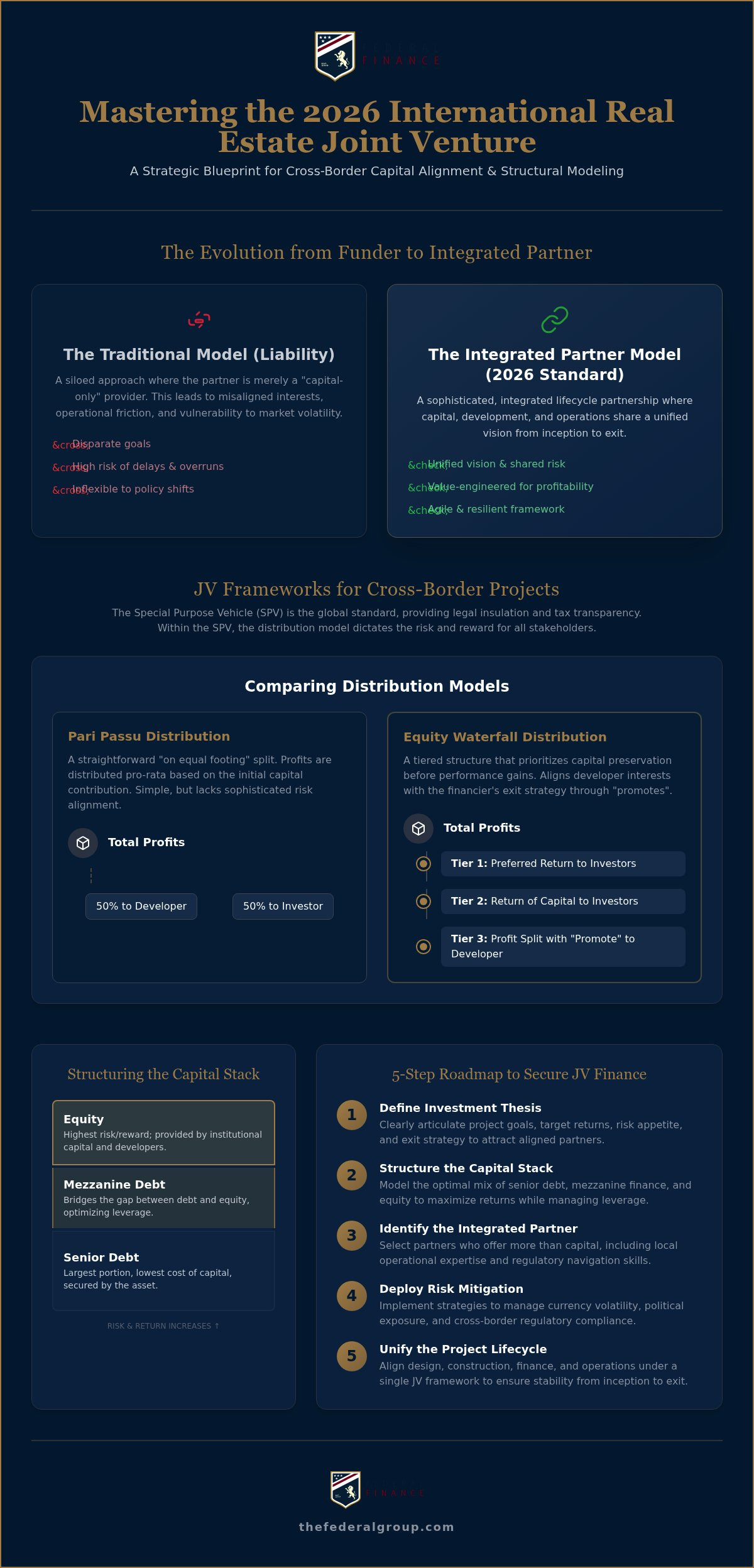
The Special Purpose Vehicle (SPV) remains the global standard for ring-fencing assets and liabilities within an international real estate joint venture. Whether utilizing a Hungarian Kft for asset acquisition or a Jersey Private Fund (JPF) for rapid regulatory approval, the SPV provides the necessary legal insulation and tax transparency required by institutional capital. Within these entities, the choice between Pari Passu and Waterfall distribution structures dictates the risk-reward profile for all stakeholders. While Pari Passu offers a straightforward pro-rata split, the Waterfall model allows for sophisticated financial engineering that prioritizes capital preservation before performance-based gains.
Mezzanine debt often serves as the bridge within the capital stack, optimizing the equity-to-debt ratio and enhancing overall returns. By layering mezzanine finance, partners can reduce the initial equity requirement while maintaining control over the project’s direction. This is frequently paired with a “promote” structure, which grants the operating partner a disproportionate share of profits once specific performance milestones are achieved. This mechanism ensures that the developer’s interests are strictly aligned with the financier’s exit strategy.
Equity Waterfall Mechanics in 2026
High-value partnerships typically begin with a preferred return, ensuring investors receive a baseline yield before the operating partner participates in the “promote.” The “catch-up” provision then allows the developer to reach a predetermined percentage of the total profits, followed by a “carried interest” tier for outsized performance. Internal Rate of Return (IRR) hurdles in 2026 are increasingly calibrated against regional inflation and risk-free rates, with core-plus international projects often targeting benchmarks between 10% and 14% to account for heightened cross-border volatility.
Control and Governance in International SPVs
Effective governance hinges on clearly defined “Major Decision Rights,” which typically include the approval of financing terms, the timing of divestment, and any fundamental changes to the project scope. Deadlock resolution mechanisms, such as “buy-sell” provisions or independent arbitration, are essential to prevent project paralysis during disputes. Transparent reporting and robust fund administration are the final pillars of a secure structure. For those seeking to optimize their capital stack, engaging with a specialized private equity partner can provide the necessary structural expertise to navigate these complexities.
Risk Mitigation and Capital Deployment Strategies
Securing an international real estate joint venture in 2026 requires more than just capital; it demands a defensive posture against market volatility. Currency risk remains the primary obstacle for cross-border partners. Sophisticated developers mitigate this by utilizing local-denominated international property development finance, which aligns debt service with the asset’s local revenue stream. This strategy, paired with forward-contract hedging, protects the internal rate of return (IRR) from sudden foreign exchange swings. Political risk also remains a critical factor. For instance, the stricter land-use scrutiny in Hungary or the evolving foreign-acquisition processes in Vietnam require partners to maintain deep ties with local regulatory bodies to ensure project continuity.
Bridging loans play a vital role in maintaining development momentum, especially when institutional capital calls face administrative delays. They provide the necessary liquidity to keep construction on schedule while long-term financing or equity tranches are finalized. Strategic jurisdictional selection is equally important for tax efficiency. Using structures like the Jersey Private Fund (JPF), which offers regulatory approval within 24 hours as of June 2026, allows for rapid deployment while ensuring the international real estate joint venture remains compliant with evolving global standards.
Navigating Cross-Border Legal and Tax Compliance
The implementation of AIFMD II and global minimum tax standards has fundamentally changed how JVs are structured. Partners must account for withholding taxes on profit repatriation, which can vary significantly. For example, Qatar’s 2026 regulations maintain a 5% withholding tax on dividends unless overridden by a double taxation treaty. Utilizing bilateral investment treaties (BITs) provides an additional layer of protection, offering legal recourse against discriminatory regulatory changes. This level of planning ensures that profits aren’t eroded by unforeseen fiscal burdens or shifting compliance requirements in the host nation.
Operational De-risking via Integrated Development
Institutional development finance lenders increasingly favor integrated design-build partners. This preference stems from the reduced construction risk inherent in a unified delivery model. By using pre-vetted supply chains and standardized ESG reporting across the portfolio, an integrated partner minimizes the volatility associated with third-party contractors. This approach doesn’t just speed up delivery; it creates a transparent, data-driven environment that satisfies the stringent reporting requirements of 2026’s ESG-focused investors. It transforms the project from a speculative build into a predictable, institutional-grade asset.
How to Secure High-Value JV Finance: A 5-Step Roadmap
Securing capital for an international real estate joint venture in 2026 requires a methodical approach that prioritizes transparency and strategic alignment. The process begins with a clearly defined investment thesis that articulates your local market edge, such as specialized knowledge of Qatari tourism zones or Hungarian industrial land-use trends. Once the thesis is established, you must structure the Special Purpose Vehicle (SPV) and the capital stack, balancing senior debt with equity tranches to optimize the weighted average cost of capital. Identifying the right international real estate finance partner is the third and most critical step, as this partner must provide more than just liquidity; they must offer institutional stability and cross-border expertise.
The roadmap concludes with rigorous multidisciplinary due diligence and the finalization of governance protocols. This includes legal, financial, and technical audits that meet 2026 ESG standards. Finally, partners must codify capital call schedules and decision rights to prevent project paralysis during the development phase. Following this structured progression ensures that the venture is built on a foundation of mutual accountability and financial resilience.
Preparing the JV Prospectus for Institutional Capital
A compelling prospectus must highlight key performance metrics, including the Internal Rate of Return (IRR), Equity Multiple, and Yield-on-Cost projections. Institutional investors in 2026 demand a clear “Exit Strategy” that accounts for secondary market liquidity and potential recapitalization events. In the context of 2026 prime-market caps, development yield is defined as the stabilized net operating income divided by total project cost, typically requiring a spread of 150 to 200 basis points over the exit cap rate to justify the risk of a cross-border venture. This data-driven approach provides the security high-value stakeholders require before committing substantial capital.
The Role of Private Equity in Scaling Global Portfolios
Private equity plays a vital role in bridging the gap between traditional bank debt and developer equity, particularly for complex or industrial-scale projects. Many developers are now leveraging “Family Office” capital to target niche high-growth sectors that institutional lenders may overlook. A significant trend in 2026 is the rise of property assets linked to sports multi-club ownership. These specialized ventures, which include stadium-anchored mixed-use developments and elite training facilities, have emerged as a resilient new asset class within the international real estate joint venture landscape. To explore how integrated capital can accelerate your next project, consider the advantages of a specialized private equity partner with global reach.
The Federal Group Approach: Integrated Capital and Development
The Federal Group transcends the role of a traditional financier by operating as an integrated principal in every international real estate joint venture. We provide a seamless bridge between institutional capital and industrial-scale development. This synergy is powered by the dual expertise of Federal Holdings, our design-build arm, and Federal Finance, our specialized lending division. By unifying these functions, we eliminate the friction points that typically derail cross-border projects. Our partners gain access to a stable, visionary ecosystem that manages risk through direct operational control rather than third-party oversight. This integrated model ensures that every project is built on a foundation of financial precision and architectural excellence.
Our bridging and private equity solutions are engineered for the pace of 2026 markets. We prioritize speed and flexibility, allowing developers to capitalize on time-sensitive opportunities without the bureaucratic delays of retail banking. Whether it’s a complex urban redevelopment or a specialized sports infrastructure project, our capital deployment is as agile as it is secure. This responsiveness is critical in high-stakes environments where land acquisition and planning windows are narrow. By providing both the capital and the technical execution, we offer a level of project security that fragmented partnerships cannot replicate.
From Concept to Completion: Full Lifecycle Integration
We manage the entire project lifecycle, from initial architectural design to final construction and asset management. This holistic oversight ensures that every design choice is value-engineered for long-term financial performance. A critical component of this integration is our ability to provide bridging finance for land acquisition. This allows our partners to secure prime sites instantly while the long-term JV structure is finalized. For international investors, a single-source partner reduces administrative overhead and provides a clear, accountable line of responsibility for project success. We remove the developer-contractor conflict by aligning all incentives toward the same exit milestones.
Partnering with The Federal Group in 2026
Our criteria for an international real estate joint venture focus on high-value projects with a clear path to institutional exit. We seek partners who possess deep local market insight and share our commitment to ESG-integrated development. Beyond traditional asset classes, we invite strategic inquiries regarding our sports division. Our unique expertise in sports multi-club ownership offers a diversified entry point into stadium-anchored real estate and elite training facilities. To discuss strategic capital deployment or explore our current portfolio, contact our global offices to speak with a specialist partner. We are ready to deploy the capital and expertise required to bring your most ambitious visions to fruition.
Securing the Future of Global Property Partnerships
The landscape of 2026 demands a shift from passive investment to active, integrated collaboration. Success in an international real estate joint venture hinges on the ability to unify financial engineering with operational excellence. We’ve explored how mastering SPV structuring and deploying advanced risk-mitigation strategies allows developers to unlock high-value opportunities in volatile jurisdictions. The integration of design, construction, and finance is no longer just an efficiency play; it’s a prerequisite for institutional-grade project security.
Since 2009, The Federal Group has established a global track record by combining specialized expertise in international property finance with the integrated design and build capabilities of Federal Holdings. Whether you’re targeting traditional commercial assets or exploring the high-growth potential of sports private equity, your vision requires a partner with the scale and technical precision to deliver. We’re ready to help you navigate these complexities and secure the capital required for your next landmark development.
Partner with The Federal Group for your next international real estate joint venture and transform cross-border challenges into scalable, high-value success.
Frequently Asked Questions
What are the primary benefits of an international real estate joint venture?
The primary benefits include access to local expertise, risk pooling, and capital diversification. It allows institutional investors to enter complex markets like the US or UK with local operational insight. This synergy mitigates entry barriers and provides a defensive posture against regional economic shifts. By combining global liquidity with regional knowledge, partners can tackle industrial-scale projects that would be prohibitive for a single entity acting alone.
How do waterfall distributions work in a cross-border real estate JV?
Waterfall distributions prioritize capital preservation through a tiered payout structure. Typically, investors receive a preferred return on their initial capital before the operating partner participates in a performance-based gain or “promote.” In 2026, these are often structured with hurdle rates tied to regional inflation benchmarks. This ensures that the developer’s incentives remain strictly aligned with the financier’s exit strategy, rewarding outsized performance only after the baseline yield is secured.
What is the role of an SPV in international property development?
A Special Purpose Vehicle (SPV) serves to ring-fence assets and liabilities for a specific project. It provides legal insulation for the parent companies and offers a transparent structure for tax compliance. In an international real estate joint venture, the SPV is often established in a jurisdiction that offers regulatory speed, such as Jersey or Hungary. This ensures that the venture remains compliant with global standards while protecting the partners’ broader balance sheets.
How can developers mitigate currency risk in international JVs?
Developers mitigate currency risk by utilizing local-denominated debt and forward-contract hedging. Aligning the project’s financing with its eventual revenue stream prevents profit erosion from sudden foreign exchange swings. Using specialized bridging loans or development finance in the host country’s currency provides a natural hedge. This approach protects the internal rate of return (IRR) from volatility, ensuring that cross-border capital deployment remains stable throughout the construction and stabilization phases of the asset lifecycle.
Why is integrated design and build more efficient for JV partners?
Integrated design and build eliminates the traditional conflict between developers and third-party contractors. By unifying these functions under a single partner like Federal Holdings, the project benefits from value-engineered design and streamlined procurement. This reduces administrative friction and prevents the cost overruns often associated with fragmented project management. For JV partners, this model provides a data-driven environment that speeds up delivery and ensures the asset meets institutional-grade performance standards.
Can private equity be used for international bridging loans in a JV?
Private equity is frequently used to provide flexible bridging loans that traditional retail banks cannot offer. It serves as an agile capital source to secure land acquisitions or maintain momentum during capital call delays. This type of finance is essential for high-stakes projects where speed is a competitive advantage. By leveraging private equity, an international real estate joint venture can maintain liquidity and bridge the gap between initial site control and long-term institutional funding.
What makes a ‘good’ international real estate finance partner in 2026?
A superior partner offers institutional stability paired with niche operational expertise. They should possess a global track record and the ability to manage the entire project lifecycle, from design to construction. In 2026, a good partner also brings specialized knowledge of evolving ESG standards and cross-border regulatory shifts. They act as a strategic principal rather than just a lender, ensuring that the capital stack is optimized for both risk mitigation and long-term growth.
How does sports multi-club ownership intersect with real estate investment?
Sports multi-club ownership creates unique synergies through stadium-anchored mixed-use developments and elite training infrastructure. These assets serve as resilient anchors for broader real estate portfolios, driving consistent footfall and commercial revenue. By investing in professional football clubs on a global scale, The Federal Group’s Sports Division identifies opportunities where athletic success and property value appreciation converge. This specialized asset class offers a diversified entry point for partners seeking alternatives to traditional commercial sectors.