Large Project Development Finance: 2026 Strategic Guide
11 October 2026A large development can be fully capitalised on paper and still stall when funding milestones fall out of step with planning, procurement or construction. For sponsors assessing development finance for large projects, the central question is not simply how much capital is available. It is how to structure funding around delivery so critical phases are not left exposed.
That concern is well-founded. Large capital requirements may call for more than one funding route, while complex timelines and cross-border considerations can make drawdowns and coordination harder to manage. Capital works best as part of a wider project strategy, aligned with the assets, risks and milestones it must support.
This guide explains how large-project finance is structured and assessed, from capital components and funding milestones to the fit between financing and delivery needs. You will learn how to compare approaches against project scale and risk, and what to look for in a strategic finance partner. It also considers how development finance, private equity and integrated design-and-build capabilities can support continuity across a project’s lifecycle.
Key Takeaways
- Assess development finance for large projects against acquisition, construction and delivery milestones, not just the headline capital requirement.
- Compare debt, equity and combined structures by considering control, repayment obligations and how project risk is shared.
- Strengthen funding readiness by defining scope, evidencing feasibility, mapping risks and documenting governance.
- Align project plans, budgets, permissions, timelines and exit assumptions to give funders a clearer basis for assessment.
- Consider how finance and integrated development capabilities can work together to support continuity across a project’s lifecycle.
Why Large Property Projects Need a Project-Led Finance Strategy
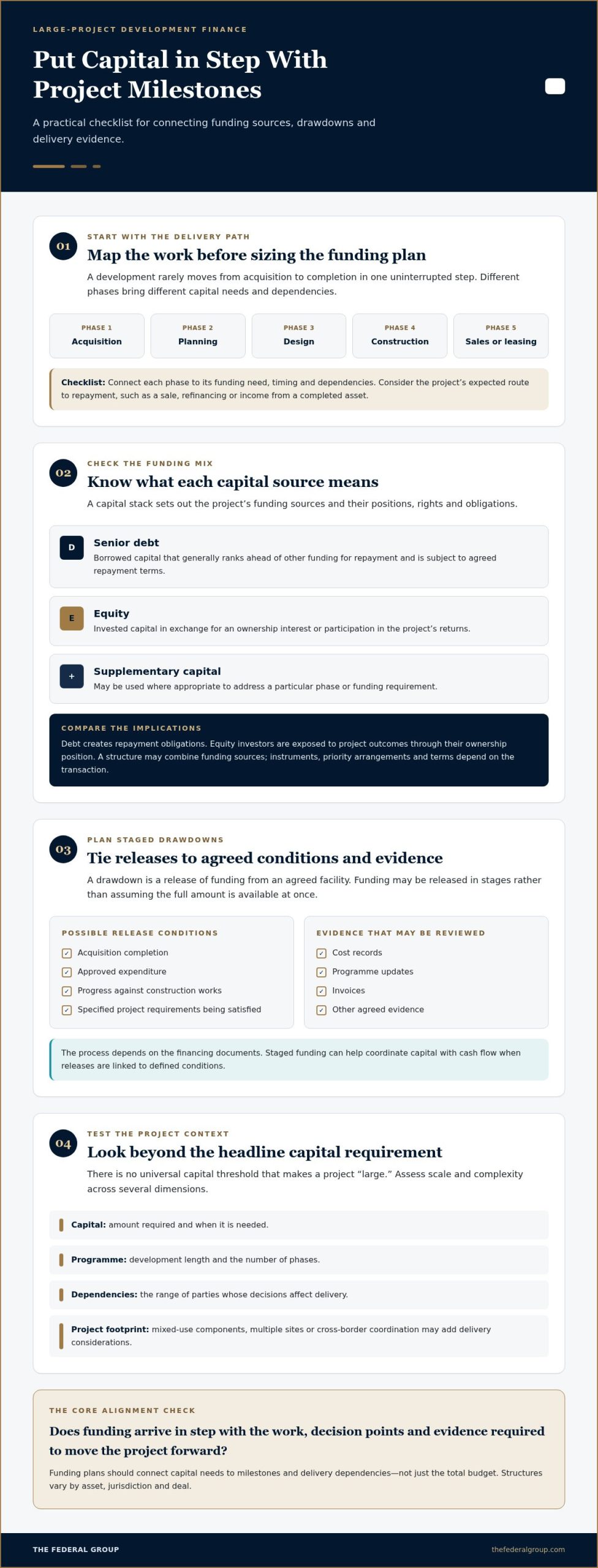
Large property developments rarely move from acquisition to completion in one uninterrupted step. Land, planning, design, construction and sales or leasing create different capital needs and dependencies. Development finance for large projects is best understood as funding structured around what the project must achieve at each stage, rather than as a single sum considered in isolation.
Project-level funding is assessed in the context of a defined asset or development, its delivery plan and its expected route to repayment. General corporate credit, by contrast, is considered primarily against a company’s broader financial position and obligations. The distinction matters, but it does not prescribe one structure for every deal. A sponsor’s balance sheet, the project’s maturity, available security and intended delivery model can all influence how capital is organised.
What makes a development project financially large or complex?
There is no universal capital threshold that makes a project “large.” Scale is better judged across several dimensions: the amount and timing of capital required, the length of the development programme, the number of phases and the range of parties whose decisions affect delivery. A project with a long pre-construction period may need a different funding plan from one ready to mobilise, even if their headline budgets are similar.
Complexity can also arise from a project’s footprint and purpose. A mixed-use scheme may need to coordinate residential, commercial and public-realm components, each with a distinct delivery sequence. Multiple sites can introduce separate acquisition and construction timetables. Cross-border operations may add coordination around local markets, currencies and stakeholders. The practical task is to identify these dependencies early and understand when each one affects capital requirements.
Why does project context matter more than a headline loan amount?
The same amount of capital can carry different risks depending on what it funds and when the money is needed. A project still progressing through planning has different timing and execution considerations from one with permissions in place and construction ready to begin. The delivery model matters too: responsibilities, procurement and construction sequencing shape when funds must be available. The repayment route, such as a sale, refinancing or income from a completed asset, informs the project’s financing horizon.
That is why a funding plan should connect capital needs to decision points, evidence and delivery dependencies, not just the total budget. The Project Finance Overview provides useful background on project finance structures, risks and applications. Each development still needs to be assessed on its own terms.
Finance should follow the project’s milestones, because capital is most useful when it arrives in step with the work and evidence required to move forward.
A project-led strategy starts by mapping the path from acquisition through completion, then testing whether funding timing and structure reflect that path. This creates a clearer basis for comparing options, identifying pressure points and coordinating capital with delivery. The sections that follow examine how funding can align with milestones and how different capital structures may fit a project’s requirements.
How Development Finance Aligns Capital With Project Milestones
A project’s capital plan needs to cover more than total anticipated spend. It must account for when funds are needed, what conditions apply to their release and how each phase connects to the next. In development finance for large projects, this means mapping capital to the transaction’s actual sequence while recognising that structures vary by asset, jurisdiction and deal.
What are the main components of a large-project capital stack?
A capital stack describes a project’s funding sources and their respective positions, rights and obligations. Senior debt is borrowed capital that generally ranks ahead of other funding for repayment and is subject to agreed repayment terms. Equity is invested capital in exchange for an ownership interest or participation in the project’s returns. Supplementary capital may also be used where appropriate to address a particular phase or funding requirement.
These components allocate risk differently. Debt creates repayment obligations, while equity investors are exposed to project outcomes through their ownership position. A structure may combine funding sources, but the instruments, priority arrangements and terms depend on the transaction. Institutional or public-sector mechanisms may also be relevant for some projects. The U.S. Department of Commerce outlines examples in its guide to Government-backed Project Financing.
How do staged drawdowns support development delivery?
A drawdown is a release of funding from an agreed facility. Rather than assuming the full amount is available at once, a project may release capital in stages under defined conditions. The process depends on the financing documents, but releases can be linked to evidence such as acquisition completion, approved expenditure, progress against construction works or satisfaction of specified project requirements.
Staged funding can help coordinate capital with cash flow. Before a planned release, the parties may review cost records, programme updates, invoices or other agreed evidence. Monitoring compares actual progress and expenditure with the project plan, while updated forecasts can show whether upcoming work, timing changes or cost movements affect the funding profile.
A practical milestone map can show:
- Acquisition and pre-construction requirements, including when land-related and early project expenditure is due.
- Construction phases, with expected costs, delivery evidence and anticipated funding requirements.
- Completion and the transition to the intended repayment or exit route.
These stages are not a universal sequence. A phased scheme, an acquisition-led transaction and a project in a different jurisdiction may need different release conditions or capital sources. Clear documentation and regular cash-flow forecasting help keep funding assumptions connected to delivery. For more context on international property development finance, consider how local market and transaction factors influence a structure. The Federal Group brings development finance, bridging loans and private equity together with development capabilities, offering a broader perspective on project funding. Explore its property finance and development capabilities.
Debt, Equity, or a Combined Structure: Comparing Large-Project Finance
Choosing capital for a major development is a question of fit, not a contest to find one universally superior source. Debt creates contractual repayment obligations; equity involves an ownership-based investment and participation in project outcomes. A combined structure may bring both into the same plan, but it also requires careful alignment of rights, decision-making and cash flow. For development finance for large projects, the appropriate balance depends on the project’s funding needs, risk profile and delivery plan.
| Consideration | Debt | Equity | Combined structure |
|---|---|---|---|
| Control | Ownership may remain with the sponsor, subject to lender rights and agreed conditions. | Investors receive an ownership interest or participation, which can affect governance and decisions. | Control and decision rights are shared or allocated through the transaction documents. |
| Repayment | Repayment is required under agreed terms, whether or not the project performs as planned. | Returns generally depend on the investment terms and project outcomes rather than scheduled debt repayment. | Debt obligations sit alongside the equity return structure. |
| Risk allocation | The borrower carries repayment obligations, with lender exposure shaped by the agreed security and terms. | Investors share in project performance and may bear loss if value or returns fall short. | Risk and potential returns are allocated across capital providers according to the structure. |
| Potential fit | A project with defined funding needs and a credible repayment route may warrant assessment for debt. | Equity may suit a project where investment capital and shared exposure align with sponsor objectives. | Different capital sources may address distinct needs or phases. |
When might debt suit a large development project?
Debt may be considered when the funding requirement, project milestones and repayment route can be clearly assessed. Repayment might depend on a planned sale, refinancing or income from a completed asset, but each assumption needs to be tested against realistic timing and cash flow. Delays or slower sales can affect repayment capacity. Suitability depends on underwriting, security, project evidence and agreed terms, not simply the size of the facility.
When might equity or blended finance be relevant?
Equity can contribute capital while sharing project risk, but it also affects ownership, returns and governance. A blended structure may be considered when different phases or requirements call for distinct forms of capital. The Federal Reserve Bank of St. Louis discusses the range of sources used in community development finance in its Community Development Finance Landscape. For property investment, the specific allocation of rights and risk remains transaction-dependent. Consider the role of a real estate private equity partner when assessing equity participation.
Neither debt nor equity is automatically cheaper, faster or safer. Debt can preserve ownership but adds repayment pressure; equity can share exposure but may dilute ownership and decision authority. A combined approach can match capital to different needs, but may introduce additional coordination and documentation. The Federal Group brings development finance and private equity together with property development capabilities. Learn how its property finance and development approach relates to project requirements by treating capital and delivery as connected parts of the same strategy.
How to Prepare a Large Project for Development Finance
A well-prepared project presents a coherent case for what will be built, how delivery will be managed and how capital requirements relate to the plan. For development finance for large projects, preparation also means making assumptions visible so the project’s opportunities and pressure points can be assessed together. Use this four-step sequence to organise the material.
- Define the scope. Summarise the asset, site or sites, proposed uses, development phases and delivery model. Distinguish confirmed decisions from working assumptions, and show how the project’s components fit together.
- Evidence feasibility. Assemble site information, a development schedule, cost assumptions and relevant market analysis. Set out the basis for anticipated sales, leasing income or refinancing, as applicable to the planned exit.
- Map risks. Identify uncertainties that could affect cost, timing, value or repayment. Explain their potential effect on the programme and the measures planned to manage them, including contingencies where appropriate.
- Document governance. Make the ownership structure, decision rights, reporting responsibilities and approval process clear. Show how changes to budget, programme or scope will be monitored and communicated.
What project evidence helps clarify funding requirements?
Bring the project brief, site details, development schedule and cost plan together in a consistent set of documents. Make key assumptions traceable: connect each phase to its expected expenditure, timing and delivery dependencies. Market analysis should explain the basis for demand and the proposed sales, leasing or refinancing route, rather than presenting an exit assumption without context.
Permissions and supporting records need project-level review, particularly when sites or activities span jurisdictions. Requirements and documentation can differ by location and project status, so identify what is in place, what remains outstanding and how each item relates to the programme.
How should developers make risk and governance visible?
Describe the risks that matter to the specific scheme, which may include construction sequencing, planning decisions, market conditions, key counterparties or cross-border coordination. Explain who is responsible for each area and how changes will be escalated. Show how ownership, decision authority, reporting and contingency planning connect, so reviewers can understand both the exposure and the response.
Transparent assumptions strengthen finance discussions by making a project’s needs, uncertainties and decisions easier to assess. Test the plan against sensitivities such as construction delays, cost movements or slower sales and leasing, without treating any single scenario as certain. Record what changes under each case and how that affects funding timing and the exit route.
Once the project materials and governance are organised, explore The Federal Group’s development finance capabilities as part of a broader project strategy.
How an Integrated Finance and Development Partner Supports Large Projects
Finance and delivery decisions are closely connected. A change in design can alter scope, cost assumptions and sequencing; a shift in construction timing can affect when capital is needed and how the project is expected to generate repayment or returns. Considering these elements together gives sponsors a clearer view of how funding choices relate to execution. It does not remove project risk, but it can make dependencies easier to identify and discuss.
What does an integrated development approach bring to finance?
Design choices influence the development brief, while construction strategy shapes procurement, programme and cash-flow assumptions. If these are considered separately from capital planning, a funding plan may rely on assumptions that no longer match the delivery approach. An integrated perspective connects the proposed scheme to its funding requirements and milestones. The Federal Group’s Federal Holdings division operates as an integrated design-and-build developer, bringing development capability into the wider group’s property finance context.
That connection matters throughout a project, from acquisition and early planning through construction and completion. Development finance, bridging loans and private equity can each play a role in property projects, depending on their requirements and structure. The appropriate combination is specific to the transaction. The aim is to consider capital alongside the development plan, not to imply that integration guarantees savings, removes uncertainty or ensures a particular delivery outcome.
For example, a project’s construction sequence may affect when expenditure falls due, while design decisions may change the scope assumed in its budget. If those assumptions shift, the funding plan and delivery programme may need to be reviewed together. Federal Holdings’ integrated model provides a development perspective within The Federal Group’s wider capabilities. Learn more about the role of an integrated design and build developer.
What should a strategic finance partnership address?
A strategic discussion should connect the project’s capital requirements to its milestones, risk allocation and long-term objectives. It should also clarify how decisions are coordinated among the sponsor, finance parties and development stakeholders. Responsibilities for reporting, approvals and responses to changes in scope or timing matter because they can influence project assumptions. Clear communication helps participants work from a shared understanding of the plan, without treating every risk as automatically resolved.
The Federal Group brings together development finance, bridging loans, private equity and Federal Holdings’ integrated design-and-build development capability. The group’s international property finance experience also provides context for projects with cross-border considerations, without presuming that one structure or approach suits every market. The focus remains on how funding and development fit the particular project.
A considered partnership should engage with both the financing strategy and the realities of delivery. If you are evaluating development finance for large projects, a discussion with The Federal Group can help frame the project’s capital needs alongside its development objectives and delivery plan.
Set the Next Phase in Motion
Turn your project’s priorities into a clear basis for strategic discussion. Consider what needs funding first, which decisions could change the delivery plan and how your long-term objectives shape the route forward. This gives conversations about development finance for large projects a practical focus: not just the capital required, but how financing and delivery can work together as the project advances.
The Federal Group brings a broader property-development perspective to finance, helping frame capital considerations alongside the realities of project delivery. The right approach depends on the project, its milestones and its objectives. A focused discussion can help you explore how those elements fit together and identify the questions that deserve attention as plans progress.
Discuss your large development project with The Federal Group and take a considered step toward the next phase. A clear view of your objectives and delivery priorities gives the conversation a practical starting point.
Frequently Asked Questions
How does development finance for large projects work?
It involves assessing a specific property project and shaping capital around its planned activities, timing and financial assumptions. Funding may be deployed for different needs as the project progresses, with release conditions set out in the agreed structure. Assessment also considers how the project is expected to repay debt or deliver investor returns, such as through a sale, refinancing or income from a completed asset. The appropriate approach depends on the transaction.
What types of projects can use development finance?
Development finance may be relevant to property projects with substantial acquisition, construction or redevelopment requirements. Examples include residential schemes, mixed-use developments, commercial property and projects delivered across multiple phases or sites. The financing approach depends on factors such as the asset, project plan, delivery stage and anticipated repayment route, rather than a universal definition of project size. Each proposed development should be considered on its individual characteristics and funding needs.
Can a large property project combine debt and equity?
Yes. Debt and equity can contribute different forms of capital within one project structure. Debt involves repayment obligations and may have priority over equity under the agreed terms, while equity involves an ownership interest and can affect control, governance and the distribution of returns. A combined structure needs to define how these rights and obligations interact, including what happens if plans change. Its suitability depends on the project’s requirements and negotiated transaction terms.
How are development finance funds released during construction?
Funds are often released through drawdowns, with timing and conditions defined in the financing agreement. A construction-phase release may depend on agreed evidence, such as records of eligible expenditure or documentation showing progress against a specified stage. Monitoring relates reported progress to the programme and budget, while updated forecasts can highlight emerging funding needs. Developers should understand the agreed evidence, notice periods and conditions before relying on a projected release date.
What information is needed to assess finance for a large development?
Prepare a clear project description, site information, development plan, budget and realistic programme. Include the basis for feasibility assumptions, the status of relevant permissions and key risks such as construction delays or changes in market demand. Explain the intended repayment or investor exit route, such as a sale, refinancing or operating income. A consistent set of documents makes it easier to understand how project scope, cost, timing and financial assumptions relate.
How does cross-border development finance affect a project?
Cross-border projects may need to account for differences in jurisdiction, local market conditions, currency exposure, documentation and stakeholder coordination. For example, project income and costs in different currencies can affect forecasts if exchange rates move, while local processes may influence the timing of development stages. These considerations should be reflected in project planning and finance discussions. This is general information, not legal or tax advice; project-specific matters require appropriate professional guidance.
Can a development finance partner also support project delivery?
Yes. Some groups combine capital provision with development capabilities, though financing and delivery remain distinct roles with different responsibilities. The Federal Group provides development finance, bridging loans and private equity, while Federal Holdings operates as its integrated design-and-build development division. Considering finance alongside design and construction planning can help stakeholders coordinate assumptions about scope, timing and capital needs. The practical arrangement depends on the project and the roles agreed among its participants.