Mezzanine Finance for Property Development Guide (2026)
25 July 2026Relying solely on senior debt in 2026 is no longer a growth strategy; it’s a bottleneck that locks your capital in place while global opportunities pass you by. You’re likely facing a market where traditional lenders have retreated to conservative 60% or 70% loan to cost caps, leaving you with a difficult choice between stalling your pipeline or surrendering significant equity to joint venture partners. It’s a frustrating position when you have the vision for high value projects but lack the flexible leverage to execute them simultaneously.
This guide will help you master mezzanine finance for property development to optimize your capital stack and reclaim control over your project’s destiny. You’ll learn how to increase your leverage to 85% or higher, allowing you to deploy capital across multiple international developments without diluting your ownership. We’ll break down the mechanics of current interest rates, the strategic importance of intercreditor deeds, and how to use private credit to bridge the gap between senior debt and your own equity efficiently.
Key Takeaways
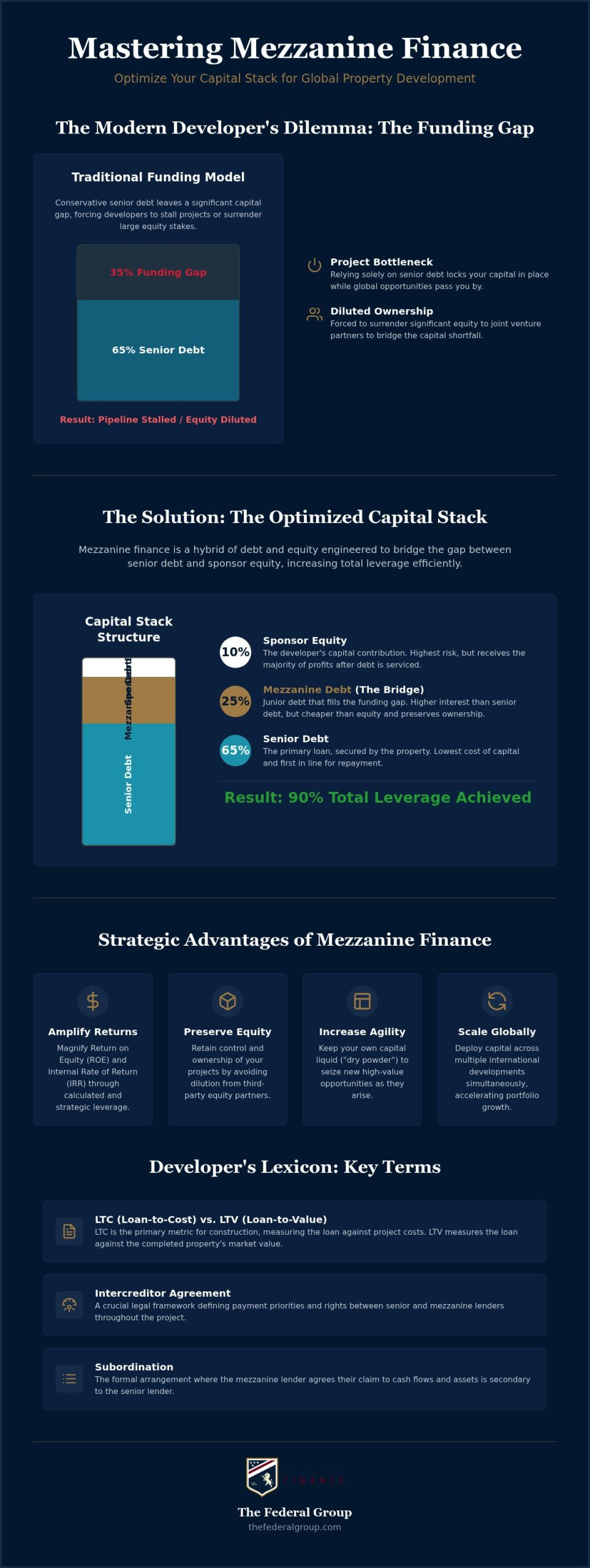
- Understand how mezzanine debt functions as a strategic gap-filler, enabling you to move from conservative 60% LTC ratios to 90% without deploying additional equity.
- Learn to optimize your capital stack by layering debt to reduce your weighted average cost of capital and preserve liquidity for high-value acquisitions.
- Master the mechanics of mezzanine finance for property development to amplify your return on equity and internal rate of return through calculated leverage.
- Identify critical requirements for cross-border projects, including jurisdictional legal nuances and currency risk management in US, UK, and EU markets.
- Discover the advantages of an integrated model where Federal Holdings’ design-build expertise de-risks capital positions and streamlines global project delivery.
What is Mezzanine Finance for Property Development?
Mezzanine finance represents a sophisticated hybrid of debt and equity, specifically engineered to bridge the capital gap between senior debt and sponsor equity. In the current 2026 market, where traditional institutional lenders frequently cap their participation at 60% or 65% of the total project cost, mezzanine finance for property development has transitioned from an optional luxury to a fundamental necessity for liquidity. It functions as the critical “gap-filler,” enabling developers to reach up to 90% Loan-to-Cost (LTC) without diluting their ownership through excessive third-party equity partners.
To understand its structural complexity, one must view it through the lens of What is Mezzanine Finance? and how it occupies the “middle floor” of the capital stack. At The Federal Group, we view this instrument not merely as a safety net for undercapitalized projects, but as a strategic growth accelerator. By reducing the amount of personal cash equity locked into a single scheme, you gain the agility to scale global portfolios and manage multiple high-value developments simultaneously. This flexibility is vital in a high-stakes environment where speed of execution determines market dominance.
Debt vs. Equity: The Hybrid Nature of Mezzanine
Mezzanine sits as junior debt in the hierarchy, but it inherits distinct characteristics of preferred equity. While it carries a higher interest rate than senior debt, it’s typically unsecured by the physical asset in the primary sense. Instead, security usually rests on a second-charge mortgage and a pledge of shares in the Special Purpose Vehicle (SPV) owning the property. For the developer, this means access to capital that doesn’t require giving up voting rights or management control. For the lender, the risk is mitigated by higher yields and specific rights to take over the project entity if a default occurs, creating a high-stakes risk-reward profile that demands technical precision from both parties.
Key Terminology for Developers
Mastering the lexicon of mezzanine finance for property development is essential for negotiating favorable terms with institutional partners. Clarity on these metrics ensures your capital stack remains resilient:
- LTC vs. LTV: While Loan-to-Value (LTV) measures the loan against the completed market value, Loan-to-Cost (LTC) is the primary metric for construction, measuring the facility against the actual hard and soft costs of the build.
- Intercreditor Agreements: These are the legal frameworks that define the relationship between your senior lender and your mezzanine provider, detailing payment priorities and “cure rights” during the project lifecycle.
- Subordination: Subordination is the formal arrangement where a junior lender agrees that their claim to project cash flows and assets is secondary to the rights of the senior lender.
The Strategic Role of Mezzanine Debt in the Capital Stack
The capital stack is a hierarchical structure of financial claims on a project’s cash flow and assets. At the base sits senior debt, followed by mezzanine capital, and finally, sponsor equity at the peak. While senior debt remains the most cost-effective component, its conservative limits in 2026 often leave a significant shortfall. Utilizing mezzanine finance for property development allows you to bridge this distance without sacrificing the equity needed for your next site assembly. This hierarchy ensures that every dollar is deployed with maximum efficiency, keeping your primary capital focused on growth rather than project survival.
By layering mezzanine debt, you effectively lower your Weighted Average Cost of Capital (WACC). While mezzanine carries a higher coupon rate than senior debt, it’s significantly less expensive than the cost of equity or the profits lost through joint venture dilution. This strategic layering ensures your project maintains momentum, particularly when integrated with professional development finance solutions that require consistent cash flow to meet aggressive delivery timelines. Preserving your equity allows for a “dry powder” approach, where you can move on new opportunities the moment they arise without waiting for a current project to reach completion.
Structuring the Capital Stack for Efficiency
In a “Thin Equity” model, the sponsor contributes minimal cash, relying on mezzanine to reach 85% to 90% LTC. This approach is essential for scaling international projects where capital must be spread across multiple jurisdictions simultaneously. Integrating bridging loans for initial land acquisition followed by a mezzanine-backed construction facility creates a seamless transition. This method de-risks the entry phase and ensures that the transition to the build phase is fully funded from the outset, providing a stable foundation for industrial-scale developments.
Risk Mitigation and Subordination
Mezzanine lenders are contractually “second in line” for repayment, a position formalized through a Deed of Priority or Intercreditor Agreement. In the current lending environment, senior lenders increasingly welcome reputable mezzanine partners. They recognize that a fully funded capital stack reduces the risk of project abandonment or construction delays due to liquidity crunches. These legal frameworks ensure a clear hierarchy of rights and standstill periods, providing the structural stability required for complex, multi-layered finance arrangements across global markets.
Calculating ROI: How Mezzanine Capital Enhances Returns
Efficiency in capital deployment is the hallmark of institutional grade development. While many developers focus on the headline interest rate of junior debt, the more sophisticated metric is the impact on Return on Equity (ROE). Utilizing mezzanine finance for property development creates a powerful “Leverage Effect.” By reducing the sponsor’s cash contribution from a standard 30% down to 10%, you significantly amplify the yield on every dollar of your own capital. This strategy doesn’t just fund a project; it optimizes the entire financial ecosystem of your firm.
Internal Rate of Return (IRR) optimization relies on precise debt layering. In a typical 2026 scenario, a developer might face senior lender caps at 65% Loan-to-Cost (LTC). Without mezzanine, that developer must provide 35% equity. By introducing a mezzanine layer to reach 85% LTC, the developer reduces their equity requirement by nearly two thirds. Even after accounting for mezzanine interest rates, which currently range between 13% and 16% for construction, the net profit attributed to the smaller equity base results in a vastly superior IRR. It’s the difference between a project that is merely profitable and one that is truly transformative for your balance sheet.
Comparing Mezzanine Costs to Equity Dilution
The choice between mezzanine debt and bringing on a joint venture partner is a choice between fixed costs and profit sharing. Equity is the most expensive capital in the stack. A JV partner typically demands 40% to 50% of the project’s total profit in exchange for providing the “gap” capital. In contrast, mezzanine finance for property development is a debt instrument with a defined maturity and a fixed or floating rate. You retain 100% of the upside after the debt is serviced. For a visionary developer, this means maintaining full control over the project’s exit strategy while keeping the lion’s share of the value created.
Mezzanine in Mixed-Use and Sports Infrastructure
Large scale developments, such as professional sports infrastructure and integrated mixed-use schemes, require long term design-build cycles that can strain liquidity. These projects often involve complex international funding requirements. For a deeper analysis of how these structures operate at scale, consult The Definitive Guide to International Property Development Finance (2026). Layering mezzanine into these high value projects ensures that momentum is never lost to capital lock up. It allows the developer to stay proactive, using the “recycled” equity to secure the next international site while the current build progresses toward completion.
Key Considerations for International Cross-Border Projects
Scaling property portfolios globally requires a sophisticated understanding of jurisdictional friction. While mezzanine finance for property development provides the necessary leverage for international expansion, it also introduces layers of complexity that regional lenders often overlook. In 2026, the acceleration of cross-border development means that your capital partner must possess a deep understanding of how debt interacts with international trade shifts and energy transition regulations. Efficiency in these high-stakes environments depends on anticipating regulatory hurdles before they impact your construction timeline.
Legal Jurisdictions and Enforcement
The mechanics of security enforcement vary significantly between the US, UK, and EU. In the United States, mezzanine security typically involves a pledge of equity interests in the property-owning LLC, governed by the Uniform Commercial Code (UCC). This allows for a relatively swift foreclosure process compared to the UK, where English law security documents and “step-in” rights are meticulously negotiated. In the EU, civil law systems may introduce additional layers of complexity regarding the registration of second-charge mortgages. Integrated developers who possess local market knowledge in valuation and regulatory compliance manage these risks more effectively. They de-risk the asset at the design and build stage, ensuring the mezzanine position is protected by a project that meets local institutional standards from day one.
Structuring for Global Portfolio Scaling
Scaling a global portfolio is most efficient when using a single, sophisticated mezzanine partner across multiple international assets. This “ecosystem” approach reduces administrative overhead and ensures a consistent intercreditor framework. There’s a growing synergy between high-value property development and sports multi-club ownership, where infrastructure investments require specialized capital solutions across various continents. Managing currency risk through sophisticated hedging and addressing tax implications, such as withholding taxes on cross-border interest payments, is a technical requirement for any international facility. The Federal Group serves as a strategic partner in this space, offering the scale of a global corporation with the focused insight of a niche consultancy.
If you’re looking to scale your operations across borders, contact The Federal Group today to discuss our integrated international real estate finance solutions.
Partnering with The Federal Group for Integrated Solutions
Traditional financiers often treat mezzanine debt as a siloed transaction, detached from the physical realities of the construction site. The Federal Group rejects this fragmented approach, positioning mezzanine finance for property development as one component of a comprehensive, integrated ecosystem. By aligning capital provision with execution expertise, we eliminate the friction that typically exists between a project’s capital stack and its build phase. This synergy ensures that high-value international projects remain liquid, agile, and structurally sound from inception through to exit.
Our Federal Holdings division serves as the cornerstone of this de-risking strategy. By integrating Design & Build Development capabilities directly with our financing arms, we provide a level of oversight that traditional lenders cannot match. We don’t just provide “gap capital”; we provide a technical partnership that understands the nuances of architectural design, procurement, and site management. This integrated model allows us to offer custom capital solutions that transition seamlessly from initial bridging loans for land acquisition to long-term mezzanine and private equity structures.
The Integrated Design & Build Developer Advantage
Being a developer-lender hybrid provides a superior structural advantage for our partners. We streamline the entire project lifecycle, reducing the time and cost overruns that often plague multi-layered developments. Our internal expertise allows us to:
- De-risk mezzanine positions by maintaining direct control over the construction timeline and budget.
- Accelerate the transition from architectural design to active construction finance.
- Provide flexible capital stacks that adapt to the shifting requirements of industrial-scale builds.
- Ensure that every international project meets the rigorous standards required for institutional exit or refinancing.
Strategic Private Equity and Sports Investment
The Federal Group’s expertise extends beyond residential and commercial assets into the specialized sector of professional sports infrastructure. We leverage our knowledge of mezzanine finance for property development to support Sports Multi-Club Ownership and high-potential stadium developments globally. This cross-sector proficiency allows us to identify unique value-add opportunities where traditional real estate lenders see only complexity. Our commitment to high-potential developments ensures that our partners have access to the scale of a global corporation paired with the precision of a niche consultancy.
Success in 2026 requires more than just a lender; it requires a strategic partner capable of managing every stage of a project’s lifecycle. Whether you’re assembling a multi-site international portfolio or executing a complex mixed-use scheme, our integrated solutions provide the stability and ambition your vision demands. Consult with The Federal Group on your next project financing to discover how our specialized capital solutions can scale your global development footprint.
Scaling Global Portfolios with Strategic Capital
The financial landscape of 2026 demands more than just traditional funding; it requires a sophisticated approach to capital liquidity. Mastering mezzanine finance for property development allows you to break free from conservative lending caps and recycle equity across a broader international pipeline. By optimizing your capital stack, you maintain the momentum necessary for high-value builds while preserving the total upside of your vision. Success in this high-stakes environment depends on a partner who understands the technical nuances of global jurisdictions and the physical requirements of the build site.
Since 2009, The Federal Group has served as a strategic connector of opportunities, deploying capital across property and professional sports markets with institutional precision. Our integrated model, bolstered by the Design & Build capabilities of Federal Holdings, de-risks complex projects and ensures seamless delivery across borders. We provide the stability of an established corporation with the focused insight of a niche consultancy, helping you navigate the complexities of international finance with quiet confidence.
It’s time to elevate your capital strategy and scale your development footprint with a partner who shares your ambition. Partner with The Federal Group for bespoke development finance solutions and secure the leverage your next project requires.
Frequently Asked Questions
How does mezzanine finance differ from a second mortgage?
Mezzanine finance is primarily secured by a pledge of equity interests in the project owning entity, rather than a direct charge over the physical real estate. While a second mortgage involves a second ranking lien on the property title, mezzanine lenders hold security over the shares of the Special Purpose Vehicle (SPV). This structure allows for a swifter enforcement process and is a standard requirement for institutional senior lenders who prefer to manage only one party with a direct property charge.
What is the typical interest rate for mezzanine property finance in 2026?
In July 2026, all in pricing for construction mezzanine finance for property development generally ranges from 13% to 16% per annum. This typically consists of a current pay rate between 10% and 12%, supplemented by a Paid in Kind (PIK) accrual of 2% to 3%. These rates reflect the hybrid nature of the capital, sitting between lower cost senior debt and higher cost third party equity.
Can I use mezzanine finance for land acquisition?
Yes, mezzanine capital is frequently used to bridge the gap during land acquisition, often in conjunction with a bridging loan. This combination allows developers to secure high value sites with minimal cash equity while they finalize planning permissions or architectural designs. Once the project moves into the construction phase, the acquisition debt is typically refinanced into a larger development facility that includes a construction mezzanine layer.
What is the maximum Loan-to-Cost (LTC) achievable with mezzanine debt?
Developers can achieve a total leverage of up to 90% LTC by layering mezzanine debt on top of a senior facility. While traditional banks in 2026 often cap their participation at 60% or 65% of costs, the mezzanine layer provides the additional 25% to 30% required to complete the capital stack. This high leverage model is a key driver for equity recycling across multiple international projects.
How long does it take to secure mezzanine financing for a development?
Securing mezzanine finance for property development typically requires a window of four to six weeks from the initial submission to the first drawdown. The process involves a rigorous review of the intercreditor deed and technical due diligence on the build costs. Integrated firms with internal design and build expertise can often compress this timeline by streamlining the verification of construction budgets and project timelines.
Do mezzanine lenders require a seat on the board or equity in the project?
Pure mezzanine lenders do not usually require board seats or management control, as the facility is structured as a debt instrument with a fixed return. This is a significant advantage over joint venture equity, which often demands a share of the project’s voting rights and a percentage of the final profits. Mezzanine allows the developer to retain full operational control while maintaining 100% of the project’s upside after the debt is serviced.
What happens to the mezzanine lender if the senior lender forecloses?
The rights of the mezzanine lender are defined by the Intercreditor Agreement, which establishes their subordination to the senior debt. In the event of a senior foreclosure, the mezzanine lender typically possesses “cure rights,” allowing them to step in and make payments on behalf of the developer to prevent the loss of the asset. They may also have the option to purchase the senior debt in its entirety to take control of the project’s completion.
Is mezzanine finance suitable for residential, commercial, or mixed-use projects?
Mezzanine capital is highly versatile and suitable for all high value asset classes, including residential, commercial, and complex mixed use schemes. It’s increasingly utilized in professional sports infrastructure investments where large scale capital deployment is required across multiple jurisdictions. The flexibility of the capital stack makes it an essential tool for any industrial scale developer looking to scale their global portfolio in 2026.