Institutional Property Finance: The 2026 Strategic Framework for Global Developers
20 September 2026With $875 billion in commercial real estate debt maturing in 2026, the global development landscape has reached a critical inflection point where traditional bank lending often fails to bridge the gap. You’re likely feeling the pressure of navigating $50M+ projects through a maze of multi-jurisdictional regulations while trying to secure a capital stack that doesn’t erode your ROI. It’s an environment where the “extend and pretend” era has officially ended, replaced by a demand for rigorous transparency and lifecycle efficiency.
This guide provides a definitive framework to master institutional property finance in this new era of private credit dominance. You’ll learn how to access sophisticated capital, optimize your debt structure against 5.0% 10-year Treasury yields, and integrate design and construction into a single, bankable lifecycle. We’ll examine the strategic shift toward multi-tiered private capital and how specialized partnerships help you secure long-term stability for your most ambitious international property and sports ventures.
Key Takeaways
- Understand the 2026 pivot toward alternative institutional lenders and how they provide the necessary liquidity for large-scale projects as traditional banks tighten balance sheets.
- Learn to structure a resilient capital stack that balances senior debt with mezzanine or preferred equity to satisfy modern un-levered debt-yield demands and institutional covenants.
- Navigate the complexities of institutional property finance across international borders by aligning cross-border capital with local regulatory and ESG mandates.
- Discover how an integrated design and build approach secures institutional-grade financing by mitigating construction risk and ensuring project lifecycle efficiency.
- Explore the strategic role of a global partner in managing complex asset classes, from high-value property developments to specialized sports ventures.
Defining the 2026 Institutional Property Finance Landscape
Institutional property finance represents the deployment of large-scale capital from sophisticated entities like pension funds, insurance companies, and real estate private equity (REPE) firms. Unlike retail lending, this sector operates on a global scale, prioritizing long-term yield and risk mitigation over simple interest margins. For projects exceeding $50 million, institutional backing isn’t just a preference; it’s a structural necessity. These high-value developments require the deep liquidity and technical underwriting that only institutional partners provide. While retail commercial property often relies on local bank branches and standard appraisals, institutional-grade finance demands rigorous lifecycle audits and global market analysis.
The Shift Toward Alternative Institutional Capital
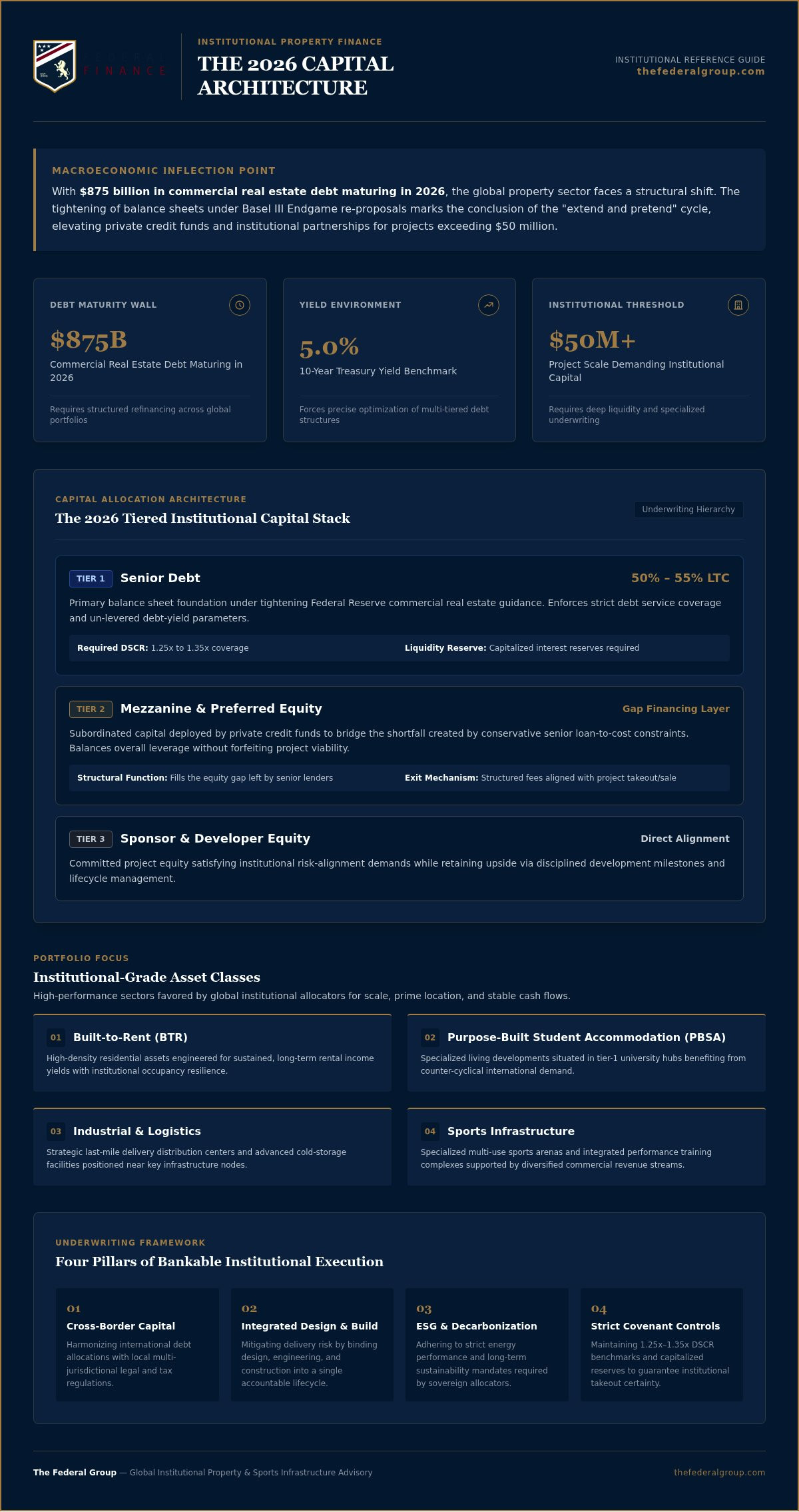
Traditional tier-1 banks have significantly tightened their balance sheets following the Basel III Endgame re-proposals of early 2026. This retreat has created a vacuum now filled by private credit funds and alternative institutional lenders. These entities offer greater flexibility, often integrating mezzanine financing structures to fill the equity gap left by senior lenders. Developers now prioritize speed and certainty in land acquisition, favoring partners who can move at the pace of the market. This shift is particularly evident as the $875 billion maturity wall of 2026 forces a massive refinancing wave across the sector. Institutional liquidity is the lifeblood of global infrastructure.
Identifying Institutional-Grade Real Estate Assets
An institutional-grade asset is defined by its ability to attract and retain high-caliber capital through superior scale, prime location, and stable tenant profiles. In 2026, the focus has shifted toward the “living” sectors and mixed-use developments that demonstrate high resilience. Primary institutional targets include:
- Built-to-Rent (BTR): High-density residential assets designed for long-term rental income.
- Purpose-Built Student Accommodation (PBSA): Specialized housing in tier-1 university cities.
- Industrial and Logistics: Last-mile delivery hubs and cold storage facilities.
- Sports Infrastructure: Multi-use arenas and training complexes with diversified revenue streams.
Successfully navigating this space requires a deep understanding of international property development finance to ensure projects meet the rigorous ESG and energy performance standards mandated by global regulators. Institutional investors prioritize assets that demonstrate long-term decarbonization pathways and clear exit strategies. By focusing on these high-performance asset classes, developers can align their projects with the specific risk-return mandates of the world’s largest capital allocators.
The Modern Capital Stack: Structuring Debt and Private Equity
Capital allocation for large-scale projects in 2026 isn’t a binary choice between debt and equity. It’s a structured hierarchy where each layer serves a specific risk profile and return expectation. Institutional property finance relies on this tiered approach to ensure stability while maximizing the developer’s return on investment. By understanding the interplay between senior debt, subordinated layers, and equity, developers can navigate the current high-yield environment without sacrificing project viability.
Senior debt remains the foundation of the stack, though its parameters have shifted. In 2026, institutional-grade projects typically see Loan-to-Cost (LTC) benchmarks between 50% and 55%. Lenders are increasingly focused on Federal Reserve commercial real estate guidance, which emphasizes tighter underwriting and risk-management for large-scale portfolios. Covenants are stricter; developers must maintain robust debt service coverage ratios (DSCR), often between 1.25x and 1.35x, to satisfy institutional underwriting standards.
Senior Debt and Mezzanine Structures for Developers
Managing cash flow during construction is paramount. Institutional lenders often require capitalized interest reserves to cover debt service until the asset generates income. Exit fees are structured to align with the project’s takeout or sale, ensuring the lender’s yield is protected without starving the project of liquidity during its critical build phase. Mezzanine debt and preferred equity bridge the gap between senior debt and the developer’s equity. This strategic use of mezzanine debt optimizes the Weighted Average Cost of Capital (WACC), allowing for higher leveraged returns on the remaining equity while filling the 15% to 20% gap left by senior lenders.
Private Equity and Joint Venture Partnerships
Private equity isn’t just a funding source; it’s a strategic alliance. Most institutional investors demand “skin in the game” from the developer, usually 5% to 10% of the equity, to ensure interests are aligned. Profits are then distributed through a waterfall model, where the developer earns an “outperformance” promote after the institutional partner hits a preferred return hurdle. This structure rewards the developer’s execution while providing the institutional partner with a predictable risk-adjusted return.
Partnering with a real estate private equity partner provides the scale needed to compete in global gateway markets. These partners bring more than capital; they bring technical expertise, global connections, and exit liquidity. If you’re looking to scale your international footprint, exploring bespoke development finance can help bridge the gap between vision and execution. Evaluating a partner’s track record in specific asset classes, such as the living sectors or sports infrastructure, is essential for long-term success.
Strategic Execution in Cross-Border Institutional Markets
Cross-border capital deployment reached a significant milestone in H1 2026, with global transactions totaling $71.8 billion. This volume underscores the shift toward globalized investment, yet it introduces friction points that traditional lenders aren’t equipped to handle. Institutional property finance provides the necessary scale and regulatory sophistication to overcome these barriers. While traditional funding is often restricted by domestic lending limits and regional exposure caps, institutional capital offers a broader reach. It demands a higher level of compliance, but the reward is a partner capable of funding $50M+ projects across multiple continents simultaneously.
Securing international backing requires projects to meet standardized global benchmarks that transcend local practices. Adhering to the RICS technical due diligence framework ensures that technical risk is assessed with a methodology recognized by global allocators. This standardization bridges the gap between local asset execution and international capital requirements, making a development “bankable” in any jurisdiction. Local market expertise remains vital, not just for site selection, but for interpreting how local zoning and environmental mandates impact the global capital stack.
Navigating International Regulatory and Tax Frameworks
The implementation of BEPS (Base Erosion and Profit Shifting) rules has fundamentally altered how international property deals are structured. Developers must ensure that Special Purpose Vehicles (SPVs) are optimized for tax efficiency without violating anti-avoidance regulations. Effective institutional property finance structures rely on navigating repatriation rules and leveraging international tax treaties to prevent profit leakage. For a deeper analysis of regional compliance, consult our international real estate finance partner 2026 guide.
Currency Risk and Capital Mobility
Currency volatility remains a primary concern for developers operating across USD, GBP, and EUR. Foreign allocators often face elevated hedging costs, which can compress returns if not managed proactively. Institutional partners offer the stability needed to weather these fluctuations, providing sophisticated hedging strategies that protect the capital stack from FX drag. Speed is equally critical in cross-border markets. Using bridging finance for land acquisition allows developers to secure international sites before permanent institutional debt is finalized, ensuring they don’t lose prime opportunities to local competitors who can move faster with domestic funds.
Risk Mitigation through Integrated Lifecycle Management
Institutional investors are moving away from fragmented project delivery. In 2026, the complexity of international projects makes the traditional siloed approach too risky for high-stakes capital. Institutional property finance providers now favor models that consolidate responsibility to protect their interest against the rising costs of materials and labor. This preference stems from a need to control the maturity wall risks discussed earlier; lenders want certainty that their capital is protected by a unified management structure rather than a disconnected chain of third-party consultants.
Consolidating the design, build, and finance phases eliminates the structural disconnect that often leads to project failure. When the financier also understands the construction site, the underwriting becomes more accurate. This alignment allows for more aggressive capital deployment because the lender has direct visibility into the project’s physical progress. Securing a partner who can bridge these disciplines is the most effective way to de-risk a $50M+ international development.
The Financial Efficiency of Design-Build Integration
The integrated design and build developer model significantly reduces friction costs. These costs usually arise from disputes between architects, contractors, and financiers. Federal Holdings mitigates these risks by providing a single point of accountability for the lender. This structure minimizes cost overruns and prevents the timeline slippage that often triggers debt covenant breaches. Integrated alpha is the measurable financial performance gained by eliminating the structural disconnect between capital allocation and physical construction.
Diversifying into Sports and Alternative Asset Classes
Institutional capital is increasingly targeting professional sports infrastructure as a resilient alternative asset class. Modern stadiums are no longer just venues; they’re the anchors of large-scale commercial and residential ecosystems. Professional football clubs have evolved into institutional-grade assets with diversified revenue streams that are less correlated with traditional property market cycles. This shift represents a significant opportunity for developers to diversify their portfolios while maintaining institutional backing.
Understanding the financial structuring for multi-club ownership is essential for developers looking to tap into this market. These projects create unique synergies between the sports facility and surrounding high-value commercial property. By integrating stadium development with broader urban regeneration, developers can access specialized institutional property finance pools dedicated to sports and entertainment. To secure your project’s future with a partner that understands both the site and the stack, explore our integrated design and build development solutions.
The Federal Group: A Global Partner for Institutional Scale
The Federal Group operates as a specialist partner at the intersection of high-value development and institutional property finance. Since 2009, we’ve refined a model that manages the high-stakes complexities of industrial-scale property and professional sports assets. Our role extends beyond simple capital provision; we act as a strategic partner that integrates the entire project lifecycle into a single, efficient ecosystem. This approach ensures that every stage, from initial land acquisition to final exit, is managed with the technical precision and financial security that global stakeholders demand. We don’t just fund projects; we provide the institutional weight and visionary energy required to see them through to completion.
Our global footprint across the US, UK, and other key international markets allows us to facilitate cross-border growth with localized expertise. We understand that a $50M+ project in London requires a different regulatory and tax strategy than a similar venture in New York. By acting as a connector of opportunities, we provide the scale of a large corporation paired with the focused, results-driven insight of a niche consultancy. This dual identity makes us a reliable heavyweight partner for developers who need to move quickly without sacrificing the stability of institutional property finance structures.
Bespoke Development Finance and Bridging Solutions
Project momentum is frequently lost during the transition between funding stages. Our development finance lender model addresses this by providing a seamless transition throughout the capital stack. We offer flexible funding structures that adapt to the specific regulatory and economic climates of international markets. For developers requiring immediate liquidity to secure prime sites, our bridging loans provide the speed to act before permanent debt is finalized. This capability allows our partners to maintain a competitive edge in high-velocity gateway markets where timing is often the difference between success and a lost opportunity.
Strategic Equity Deployment for Global Growth
Scale requires more than just debt; it requires a partner with the vision to deploy strategic private equity. Our private equity division focuses on delivering long-term value through joint venture partnerships and structured equity models. We connect sophisticated global opportunities with the capital needed to realize them, leveraging our specialized expertise in professional sports and high-value commercial property. This results-driven approach prioritizes completion and security, providing our partners with the confidence to pursue complex, multi-jurisdictional projects. Contact The Federal Group today to discuss your institutional-scale project and discover how our integrated ecosystem can optimize your capital stack.
Securing the Future of Global Development
The 2026 market demands a fundamental shift from fragmented project management to a unified, institutional ecosystem. Success in this high-stakes environment depends on your ability to align complex capital stacks with rigorous technical execution. By integrating design, construction, and institutional property finance into a single lifecycle, you eliminate the friction that threatens international ROI. Whether you’re navigating multi-jurisdictional regulations or diversifying into specialized sports infrastructure, the right partnership ensures your vision remains bankable and secure.
The Federal Group brings over 15 years of international property finance expertise to your most ambitious ventures. Our integrated design and build capability through Federal Holdings, combined with our strategic sports multi-club ownership division, provides the scale and specialized insight required for global success. We don’t just provide liquidity; we provide the stability needed to build the future. Partner with The Federal Group for your next institutional-scale project and transform your development potential into a lasting global legacy.
Frequently Asked Questions
What qualifies as institutional property finance?
Institutional property finance refers to the deployment of large-scale capital by sophisticated entities such as pension funds, insurance companies, and real estate private equity firms. Unlike retail lending, these structures are specifically designed for projects exceeding $50 million, prioritizing long-term yield and risk mitigation. This form of financing provides the deep liquidity necessary for complex, industrial-scale developments that local commercial banks typically lack the capacity to underwrite effectively.
How does institutional debt differ from traditional commercial bank loans?
Institutional debt offers greater flexibility and scale compared to traditional commercial bank loans. While banks are often constrained by domestic lending limits and rigid balance sheet requirements, institutional lenders utilize alternative capital pools to fund high-value, international projects. These structures often integrate mezzanine layers to optimize the capital stack. This approach provides developers with faster execution and more sophisticated risk-management frameworks than standard retail banking products.
What are the typical LTV requirements for institutional property development in 2026?
Typical Loan-to-Value (LTV) and Loan-to-Cost (LTC) benchmarks for institutional-grade projects in 2026 range between 50% and 55%. Lenders prioritize stability, requiring developers to cover the remaining capital through a combination of mezzanine debt and equity. These conservative ratios reflect a heightened focus on debt service coverage and un-levered debt yields, ensuring the project remains resilient against market volatility while maintaining strict institutional underwriting standards.
Can institutional finance be used for cross-border property projects?
Yes, institutional property finance is specifically designed to facilitate cross-border property projects across multiple legal jurisdictions. Sophisticated lenders provide the regulatory expertise and capital mobility needed to navigate international tax treaties and repatriation rules. This allows developers to scale their portfolios in gateway markets like the US and UK while leveraging a single, global capital partner to manage currency risk and multi-jurisdictional compliance seamlessly.
How does an integrated design and build model affect financing terms?
An integrated design and build model improves financing terms by reducing construction risk and eliminating friction between project phases. Lenders prefer this structure because it provides a single point of accountability, minimizing the likelihood of cost overruns or timeline slippage. This increased certainty leads to more favorable interest margins and higher leverage, as the financier has direct visibility into every stage of the development lifecycle from design through completion.
What role does private equity play in institutional property development?
Private equity serves as a strategic equity partner rather than just a funding source. In institutional development, private equity firms provide the necessary capital to fill the gap between senior debt and developer equity, often through joint venture structures. These partnerships align interests through specific “skin in the game” requirements and waterfall distribution models, rewarding developers for successful execution while providing the institutional scale needed for high-value growth.
How do institutional investors view sports assets like football clubs?
Institutional investors increasingly view professional sports assets, such as football clubs, as resilient, institutional-grade real estate and commercial opportunities. These assets offer diversified revenue streams that are less correlated with traditional property cycles. When integrated with surrounding commercial developments, sports infrastructure acts as a powerful anchor for urban regeneration. This makes institutional property finance a vital tool for developers targeting these specialized, high-growth alternative asset classes globally.